How Live Dealer Casino Games Work
See how live dealers, cameras and software settle wagers, and how Lightning Roulette combines a physical wheel with randomly selected multipliers.

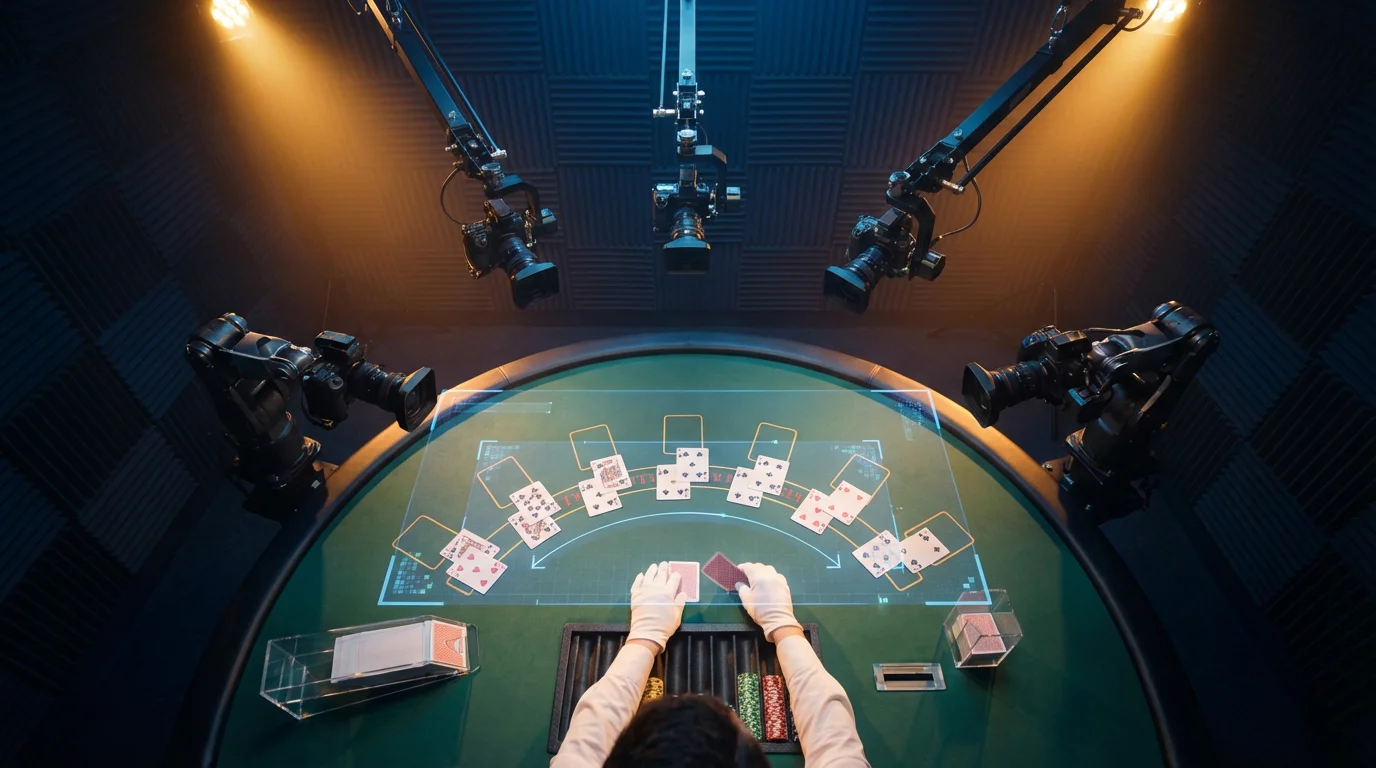
You see a dealer flip a card. What you don’t see is the OCR scanner that just read its value in under 200 milliseconds, the Game Control Unit encoding it for thousands of simultaneous players, and the CDN distributing that moment across 40+ countries before you even register the card’s suit. Live dealer casino games look simple from the player’s seat, but behind every hand of blackjack and every roulette spin sits a sophisticated production pipeline that rivals live television.
KEY FACTS AT A GLANCE
- Market Size: $7.8 billion globally in 2024, projected to reach $20.4 billion by 2033 (10.1% CAGR)
- Major Providers: Evolution (40+ studio locations, 21,000+ employees), Pragmatic Play Live (500+ casino partners), Playtech (world’s largest studio in Riga at 8,500 sqm)
- Core Technology: OCR card reading, Game Control Unit (GCU) at every table, H.264 streaming with adaptive bitrate
- Streaming delay: studio processing, delivery and buffering affect what appears on screen.
- Fairness: Regulated by UKGC and MGA; audited by eCOGRA, iTech Labs, and GLI to ISO/IEC 17025 standards
- Live blackjack: pay rules and player decisions determine the theoretical return.
- Bandwidth Needed: 10–25 Mbps desktop, 4–6 Mbps minimum on mobile with adaptive bitrate
Inside the Studio: Where Live Dealer Games Are Made
Live dealer games are not streamed from the back room of a regular casino. The vast majority originate from purpose-built studios designed with the precision of a television production set. Professional-grade lighting eliminates shadows on the table surface, boom microphones capture the dealer's voice without background noise, and multiple HD cameras — typically three or more per table — provide overhead, table-level, and close-up angles simultaneously.
The three dominant providers have each invested heavily in physical infrastructure. Evolution, headquartered in Stockholm, operates more than 40 studio locations worldwide with over 21,000 employees. Their facilities span Europe (Riga, Malta, Spain, Romania, Prague, Tbilisi), North America (Atlantic City, Philadelphia, Michigan, Connecticut, Toronto), Latin America (Buenos Aires, Colombia, São Paulo), and Asia-Pacific (Cebu). Each studio features Hollywood-style sets with green rooms, wardrobe departments, and dealer shifts running around the clock.
Pragmatic Play Live invested $15 million in its Colombia studio alone, housing over 100 tables and creating more than 1,500 jobs. The company powers over 500 online casinos globally and employs native-speaking dealers for regional markets. Playtech, meanwhile, operates the world's largest single live casino facility: an 8,500-square-meter complex in Riga, Latvia, built atop the city's 16th-century fortified walls. Playtech also runs studios in the Philippines, Spain, Belgium, Romania, and multiple US states.
| Provider | HQ | Studio Locations | Notable Facility | Scale |
|---|---|---|---|---|
| Evolution | Stockholm | 40+ worldwide | Multiple Hollywood-style studios | 21,000+ employees |
| Pragmatic Play Live | Malta | Colombia, Bucharest, Asia | $15M Colombia studio, 100+ tables | 500+ casino partners |
| Playtech | London | Riga, Philippines, Spain, Belgium, Romania, USA | 8,500 sqm Riga (world's largest) | Global coverage |
Some operators also stream from real casino floors through land-based partnerships, but dedicated studios are far more common because they allow total control over lighting, sound, camera angles, and regulatory compliance.
The Tech Stack: From Card Flip to Your Screen
The camera captures the table, game equipment records the outcome, and the streaming service delivers the video. The time between an event on the table and its appearance on a player’s screen varies with the delivery network, device and player buffer.
STEP 1: CARD FLIP
Dealer physically deals the card face-up on the table surface
STEP 2: OCR SCAN
Overhead camera reads the card's rank and suit via Optical Character Recognition
STEP 3: GCU ENCODING
Game Control Unit encodes video, tracks game state, and manages bet data
STEP 4: GAME SERVER
Central server reconciles card data with all active bets and calculates outcomes
STEP 5: CDN DELIVERY
Edge servers worldwide distribute the stream to the nearest player location
STEP 6: PLAYER SCREEN
The player interface receives the game event and updates the result; the video and balance display can arrive at different times.
OCR (Optical Character Recognition) is the eyes of the system. Cameras positioned above the table capture every card as it is dealt. The OCR software identifies the rank and suit from the printed symbols in near real-time, then transmits that data to the game server. This technology replaced older RFID-embedded cards, which required physical scanning before each deal. Modern OCR is faster, more accurate, and does not require specially manufactured cards.
Table equipment transmits detected game events to the game system, which associates them with accepted bets and settlement rules. Hardware and video encoding choices vary by studio.
An adaptive stream can lower resolution as bandwidth falls. Encoding, network routing and player buffering all add delay, so there is no single guaranteed end-to-end latency for a live table.
On the player's end, a software overlay handles all interaction. During a betting window — typically 10 to 15 seconds — you click or tap to place chips on the table layout. The interface communicates with the game server, which reconciles your bets with the physical game outcome from the GCU. The overlay also displays game history, round statistics, and a live chat where you can interact with the dealer and other players.
Which outcomes come from the table and which use an RNG?
In classic live roulette the physical ball and wheel determine the winning pocket. In Lightning Roulette the wheel still determines the pocket, while digital random draws select lucky numbers and their payouts. Evolution describes this combination in its original game announcement. Watching the physical result alone cannot establish how the multiplier was selected.
But visual transparency alone is not sufficient for regulatory purposes. Live dealer games are subject to the same oversight as their RNG counterparts. The UK Gambling Commission (UKGC) and Malta Gaming Authority (MGA) are the two primary regulatory bodies that license and monitor live dealer operations. Both require operators to meet strict standards around dealing procedures, shuffling methods, game integrity, and player protection.
Independent third-party auditors add another layer of accountability. eCOGRA, iTech Labs, and Gaming Laboratories International (GLI) test and certify live dealer games to ISO/IEC 17025 international standards. These audits verify that dealing procedures are fair, shuffling is genuinely random, and payout calculations are accurate. In 2026, the UKGC introduced real-time intervention monitoring, allowing regulators to observe live games as they happen and intervene if procedures are not followed. The MGA has also implemented a unified self-exclusion database that applies across all licensed live dealer platforms.
Players can take their own verification steps as well. Most live dealer platforms provide complete hand histories and round replays. You can review every card dealt, compare results against statistical expectations, and verify game results at any time through the platform's records.
CHECKING THE HOUSE EDGE
Always verify the RTP and house edge of live dealer games before playing. Unlike RNG games where RTP is fixed in the code, live dealer games can have slightly different house edges depending on rule variations — for example, whether the dealer stands on soft 17 in blackjack or whether the la partage rule applies in roulette.
Read the rules for both components. In classic roulette a winning straight-up bet normally pays the stated fixed odds. In Lightning Roulette a matching lucky number can change the straight-up payout. A base outcome and its payout can therefore have distinct sources.
Beyond Blackjack and Roulette: Live Dealer Game Variety
The classic trio — blackjack, roulette, and baccarat — remains the foundation of live dealer gaming, but the category has expanded far beyond traditional table games. Speed variants compress round times significantly. Speed Baccarat completes a round in roughly 27 seconds compared to the standard 48 seconds, and Speed Blackjack removes the wait for other players to make decisions. These formats are designed for players who want more hands per hour without sacrificing the live experience.
The real expansion, however, has come from game shows. These are live dealer games hosted by presenters in elaborate studio sets with large-scale props — spinning wheels, bonus boards, ball machines — where production values rival reality television. Crazy Time features four distinct bonus rounds and a massive wheel. Lightning Roulette (based on standard roulette rules) adds random multipliers of 50x to 500x on straight-up numbers each round. Monopoly Live integrates a full board game bonus round with multiplier mechanics. These games represent a fundamental shift — they are entertainment products first and gambling products second.
| Game | Provider | RTP | Key Feature | Max Multiplier |
|---|---|---|---|---|
| Crazy Time | Evolution | 95.41% | 4 bonus rounds, giant wheel | 20,000x |
| Lightning Roulette | Evolution | 97.30% | Random multiplied straight-ups | 500x |
| Monopoly Live | Evolution | 96.23% | Board game bonus round | 6,400x |
| Dream Catcher | Evolution | 96.58% | Money wheel with Top Slot multiplier | 40x |
| Mega Ball | Evolution | 95.40% | Bingo-lottery hybrid with multiplied lines | 1,000,000x |
First-person hybrid modes bridge the gap between RNG and live play. These are RNG-based 3D simulations of live dealer games — same rules, same interface style, but powered by an algorithm rather than a physical dealer. They offer faster play, lower minimum bets, and no wait for a seat. Most first-person games include a "Go Live" button that switches you directly to the real live dealer version of the same game with one click, making them a useful practice ground before joining a live table.
Practical Guide: Getting the Best Live Dealer Experience
A stable connection and supported browser matter more than an advertised speed target. If the stream freezes, check the bet history and the operator’s interruption rules before placing another bet.
DESKTOP VS. MOBILE EXPERIENCE
Desktop
- Full HD streaming at higher bitrates
- Multi-table play (2–3 live tables simultaneously)
- Larger interface with detailed statistics panels
- Wired connection option for lowest latency
- Chat and game history always visible
Mobile
- Adaptive quality adjusts to connection speed
- Redesigned UI with larger bet buttons for touch
- Single-table play only (no multi-tabling)
- Network and player buffering affect delay
- Chat minimized by default to maximize table view
Both platforms connect to the same game server and the same video stream — only the interface layer differs. Most providers report that over 60% of live dealer traffic now comes from mobile devices.
A live dealer is not itself an RTP advantage. Two blackjack tables with the same rules and strategy can have the same theoretical return even if one uses software to deal. For roulette, identify the wheel, bet type and any multiplier rules.
The practical counterbalance is pace. Live dealer games are slower than RNG games because you are watching real physical actions. Fewer rounds per hour means your hourly expected loss is often similar or even lower, despite the slightly higher per-hand edge. For bankroll management, this slower pace is generally an advantage.
KEY TAKEAWAYS
- The studio is real — live dealer games stream from purpose-built facilities with professional dealers, multiple HD cameras, and OCR technology that digitizes every card value in real time.
- Delivery varies. Studio encoding, network conditions and buffering affect the delay.
- Trust through transparency — you watch real shuffles and real deals, regulated by the UKGC and MGA and audited by eCOGRA, iTech Labs, and GLI to ISO/IEC 17025 standards.
- Beyond table games — game shows like Crazy Time and Lightning Roulette have transformed live dealer into an entertainment category, while first-person hybrid modes bridge RNG and live play.
- Live blackjack offers ~99.5% RTP — among the highest in any casino game with optimal strategy, though fewer hands per hour than RNG means your hourly cost may be similar.
- Bandwidth matters — 10–25 Mbps for desktop, 4–6 Mbps minimum on mobile. A stable connection matters more than raw speed.

Aevan Lark
Aevan Lark is a gambling industry veteran with over 7 years of experience working behind the scenes at leading crypto casinos — from VIP management to risk analysis and customer operations. His insider perspective spans online gambling, sports betting, provably fair gaming, and prediction markets. On Dyutam, Aevan creates in-depth guides, builds verification tools, and delivers honest, data-driven reviews to help players understand the odds, verify fairness, and gamble responsibly.
Related coverage
How to Play Crazy Time: Complete Guide to Rules, Bonuses & Strategy
Check all 54 Crazy Time wheel segments and compare the landing probability and published RTP for each wager under Loto-Québec’s rules.

How to Play Baccarat: Complete Beginner’s Guide to Rules, Strategy & Winning Tips (2026)
Learn baccarat drawing and payout rules. Compare commission baccarat, EZ Baccarat and the different tie-bet payouts.

How to Play Roulette and Read the Payout Table
Learn roulette bets and payouts, including the double-zero five-number wager. Compare wheel types and check the rules of the table you are…