Kelly Criterion Sports Betting Calculator
Analysis
Strategy Comparison
| Strategy | Bet % | Amount | Growth |
|---|
What is the Kelly Criterion?
The Kelly Criterion is a mathematical formula developed by John L. Kelly Jr. at Bell Labs in 1956. It determines the optimal size of a series of bets to maximize the expected logarithm of wealth while minimizing the risk of ruin.
Originally designed for signal noise issues in telecommunications, the Kelly Criterion quickly found applications in gambling and investment. Today, it's used by professional sports bettors, poker players, and hedge fund managers alike.
How Kelly Criterion Works
Estimate Win Probability
Determine your true probability of winning. This requires research, data analysis, and accurate handicapping skills.
Compare to Implied Odds
Calculate the bookmaker's implied probability from the odds. If your estimate exceeds theirs, you have an edge.
Calculate Optimal Size
Use the Kelly formula to determine what percentage of your bankroll to wager for maximum long-term growth.
Apply Fractional Kelly
Most professionals use Half or Quarter Kelly to reduce volatility while maintaining strong growth potential.
Fractional Kelly Strategies
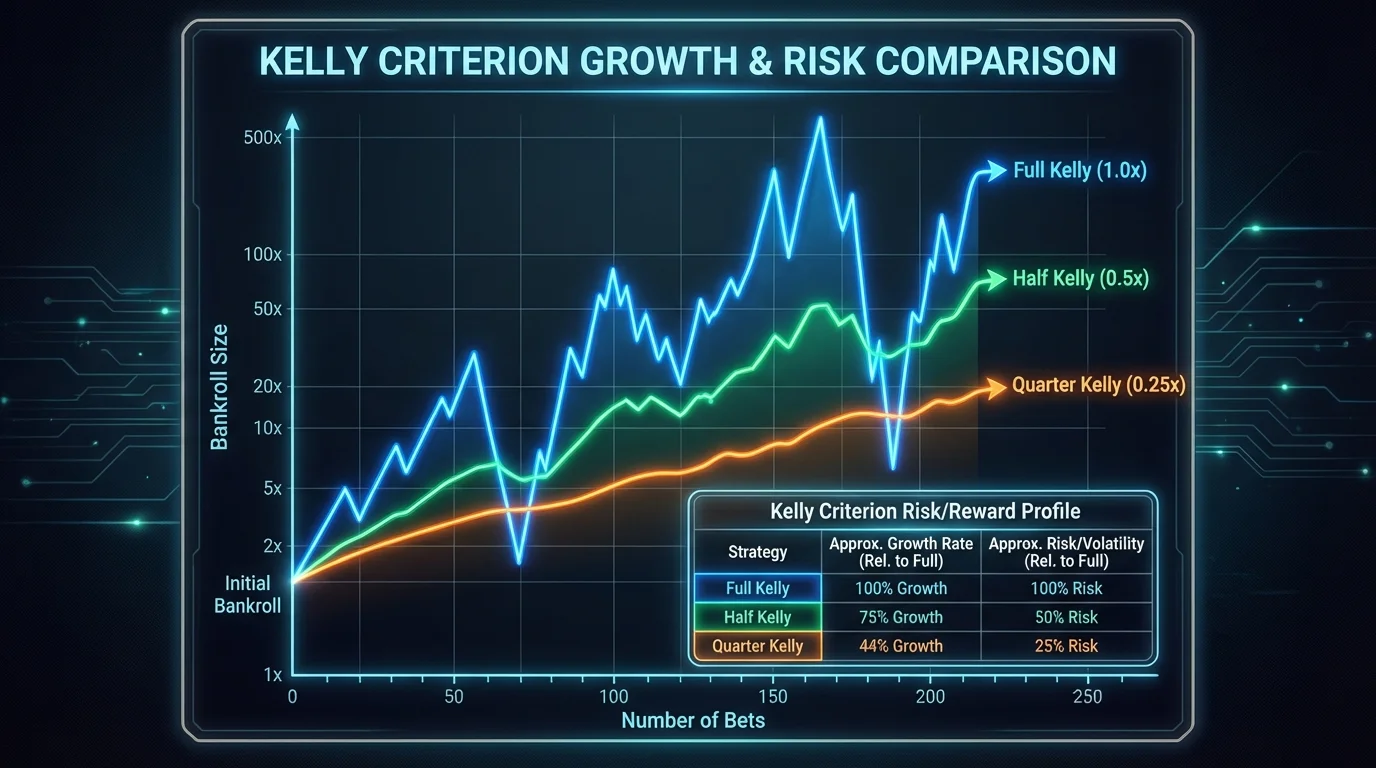
While full Kelly maximizes theoretical growth, it comes with extreme volatility. Professional bettors almost universally use fractional Kelly to balance growth with capital preservation.
Full Kelly
100%Maximum theoretical growth rate but extremely high volatility. Can experience 50%+ drawdowns. Only suitable for verified edges with high confidence.
Half Kelly
50%Industry standard among professionals. Captures 75% of maximum growth with 50% less variance. Best balance of growth and stability.
Quarter Kelly
25%Conservative approach ideal for beginners or uncertain probability estimates. Significantly smoother equity curve.
Eighth Kelly
12.5%Ultra-conservative for high uncertainty situations. Minimal drawdowns but slower growth. Good for learning phases.
Kelly Criterion Best Practices
Start Conservative
Begin with Quarter Kelly until you've verified your edge over 500+ bets. Overconfidence is the fastest path to ruin.
Track Your Results
Maintain detailed records of your predictions vs outcomes. This data calibrates your probability estimates over time.
Never Exceed Kelly
Betting more than full Kelly actually decreases expected growth. The Kelly percentage is a ceiling, not a target.
Recalculate Regularly
Update your bet sizes as your bankroll changes. Kelly naturally increases bets after wins and decreases after losses.
Account for Correlation
If betting multiple correlated events, reduce individual bet sizes. Treat correlated bets as a single larger position.
Focus Long-Term
Kelly optimizes for geometric growth over many bets. Short-term variance is expected; trust the math over months, not days.
Risk Management Considerations
Probability Estimation Errors
CriticalKelly is extremely sensitive to probability errors. A 5% overestimation can turn a winning strategy into bankruptcy. Always err on the side of lower estimates.
Negative Kelly Results
WarningIf the calculator shows a negative percentage, you have no edge on this bet. The mathematically correct action is to not bet at all.
Bankroll Volatility
CautionEven with accurate estimates, full Kelly can produce 50-70% drawdowns. Most humans cannot emotionally handle this volatility.
Simultaneous Bets
NoteWhen placing multiple bets simultaneously, reduce each bet's Kelly fraction to account for total exposure across your portfolio.
Frequently Asked Questions
What is a good Kelly percentage to bet? +
Most professional bettors aim for Kelly percentages between 1-5% of their bankroll per bet. If full Kelly suggests betting more than 10%, it's a sign of either a very strong edge or potentially overestimated win probability. Many pros use half Kelly (betting 50% of the suggested amount) to reduce variance while still capturing most of the growth potential.
Should I use full Kelly or fractional Kelly? +
Fractional Kelly is almost always the better choice. Half Kelly gives you 75% of the growth rate with significantly less volatility and is the industry standard among professional bettors. Quarter Kelly is ideal for beginners or when you're uncertain about your probability estimates. Full Kelly is only appropriate when you have extremely accurate probability estimates and can tolerate 50%+ drawdowns.
What does a negative Kelly percentage mean? +
A negative Kelly percentage means you have no edge on this bet - the bookmaker's implied probability is better than your estimated win probability. Kelly Criterion recommends not placing this bet at all. Never force a bet when Kelly is negative; wait for opportunities where you have a genuine edge.
How accurate does my win probability estimate need to be? +
The Kelly Criterion is highly sensitive to probability estimates. A small error can lead to significant overbetting or underbetting. This is why fractional Kelly is so popular - it provides a buffer against estimation errors. If your estimates are off by even 5%, full Kelly can lead to overbetting and potential ruin. Track your predictions over time to calibrate your accuracy before using higher Kelly fractions.
Can I use Kelly Criterion for parlays? +
Yes, but you need to calculate the combined probability of all legs winning together. Multiply the individual win probabilities for each leg, then use the parlay odds in the Kelly formula. Be extra conservative with parlays because small errors in individual leg probabilities compound significantly. Most Kelly practitioners avoid parlays altogether or use quarter Kelly at most.
How often should I recalculate my Kelly bet size? +
Recalculate your Kelly bet size whenever your bankroll changes significantly - typically after each betting session or at least daily. Since Kelly uses a percentage of your current bankroll, your absolute bet sizes should grow after winning streaks and shrink after losing streaks. This automatic adjustment is one of Kelly's key features for protecting against ruin while maximizing growth.
What's the difference between Kelly Criterion and flat betting? +
Flat betting uses the same fixed amount for every bet regardless of edge, while Kelly dynamically adjusts bet size based on your edge and bankroll. Kelly mathematically maximizes long-term growth when you have accurate probability estimates, but requires more discipline and calculation. Flat betting is simpler and less sensitive to estimation errors. Many recreational bettors prefer flat betting, while serious bettors with proven edges often use Kelly.
Does Kelly Criterion work for casino games? +
For most casino games, Kelly Criterion will recommend not betting at all because the house edge means you have negative expected value. The only casino scenarios where Kelly applies are advantage play situations like card counting in blackjack or exploiting promotional offers. If you're playing standard casino games, Kelly will always return a negative or zero percentage because the math is against you.