
How to Play Poker Through Your First Hand
Follow a first poker hand, read the board, choose the best five cards and see when two players split the pot.

Deal a practice hand of Texas Hold’em with chips that have no cash value. Each player receives two private cards, and up to five community cards go in the middle. At showdown, compare the best five cards each player can make.
Use this page to follow a first hand. The Texas Hold’em rules guide covers position, betting structures, heads-up play and pot odds.
The Basics: Objective of the Game
The goal in Texas Hold’em is simple: Make the best five-card hand using any combination of your two private cards (hole cards) and the five community cards on the table. Alternatively, you can win by bluffing—forcing all other players to fold before the showdown.
Poker Hand Rankings
Before you bet a single chip, you must memorize the hand rankings. Knowing what beats what is the foundation of poker strategy.
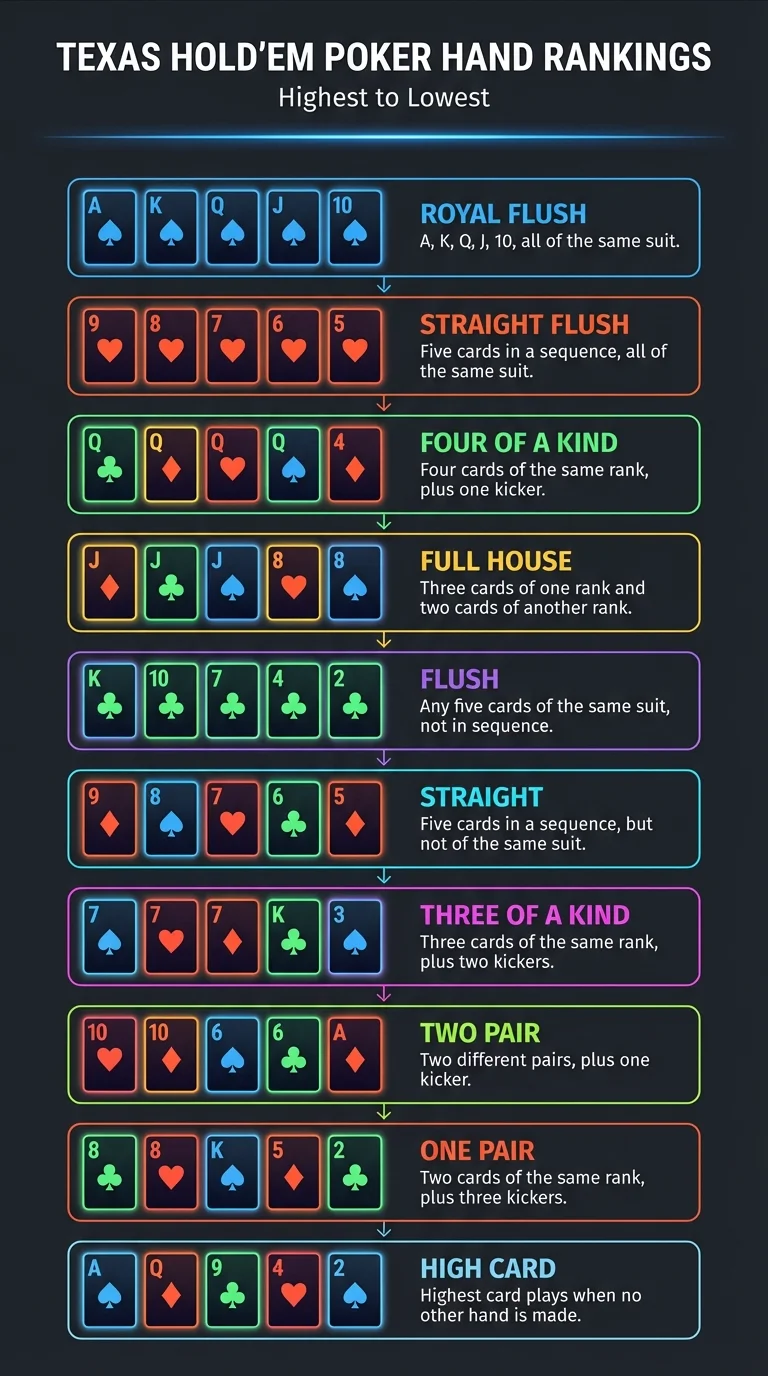
- Royal Flush: A, K, Q, J, 10, all of the same suit. The unbeatable hand.
- Straight Flush: Five cards in a sequence, all of the same suit (e.g., 9-8-7-6-5 of hearts).
- Four of a Kind: Four cards of the same rank (e.g., Q-Q-Q-Q).
- Full House: Three of a kind plus a pair (e.g., J-J-J-8-8).
- Flush: Any five cards of the same suit, not in sequence.
- Straight: Five cards in a sequence, but not of the same suit.
- Three of a Kind: Three cards of the same rank.
- Two Pair: Two different pairs (e.g., 10-10 and 6-6).
- One Pair: Two cards of the same rank.
- High Card: When you have none of the above, the highest card plays.
The Setup: Blinds and Buttons
Every hand starts with forced bets to create action. This is called “The Setup.”
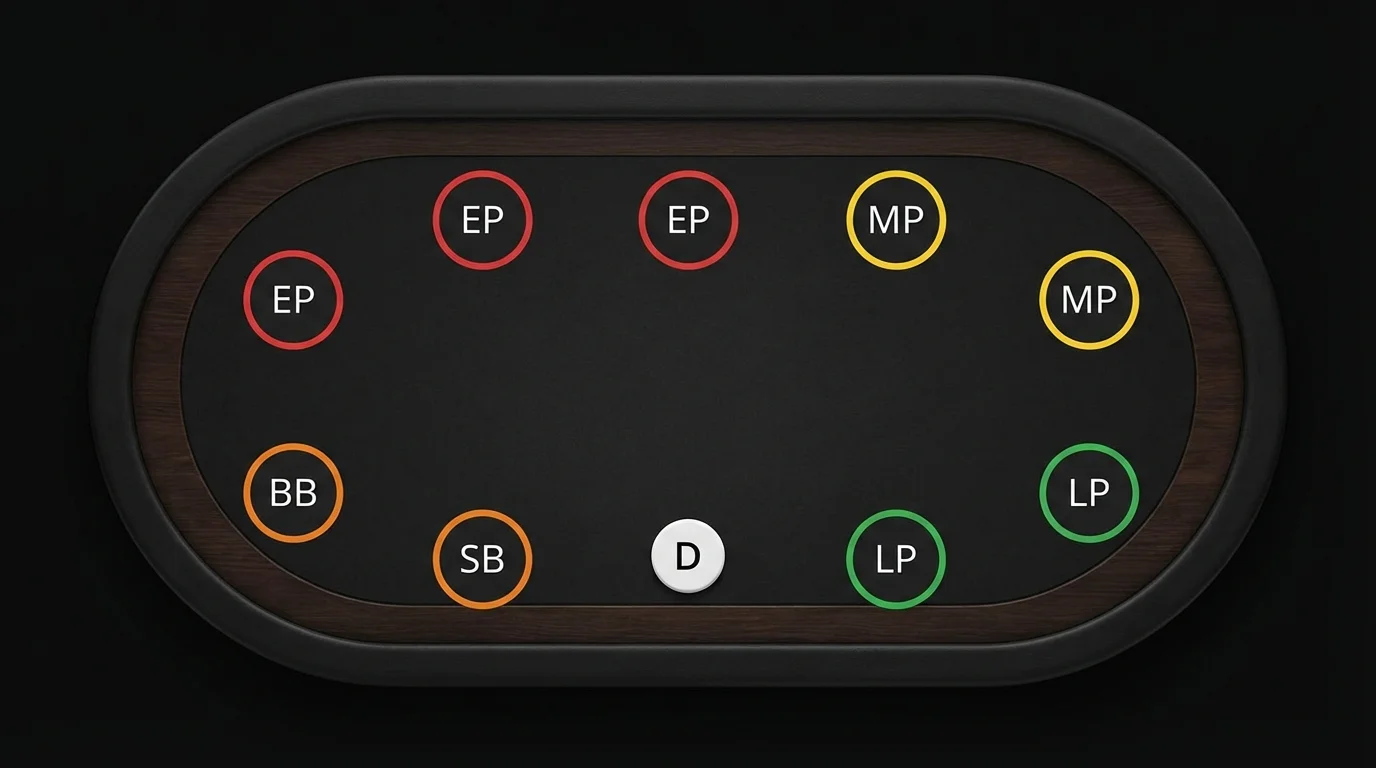
- The Dealer Button (D): Moves one spot to the left after every hand. It determines who acts last on post-flop betting rounds.
- Small Blind (SB): The player to the immediate left of the dealer. They must post a forced bet (usually half the minimum bet).
- Big Blind (BB): The player to the left of the SB. They must post the full minimum bet.
How a Hand Plays Out (Step-by-Step)
1. The Pre-Flop
The dealer deals two cards face down to every player. Action starts with the player to the left of the Big Blind (Under the Gun). You can Call (match the big blind), Raise (increase the bet), or Fold (discard your hand).
2. The Flop
The dealer burns a card and deals three community cards face up. This is the “Flop.” Another round of betting occurs, starting with the first active player to the left of the button.
3. The Turn
A fourth community card (the “Turn”) is dealt. Another round of betting follows.
4. The River
The fifth and final community card (the “River”) is dealt. This is the last chance to bet, raise, or bluff.
5. The Showdown
If two or more players remain, they reveal their cards. The player with the best five-card hand wins the pot.
Read the five cards that win
Maya holds A♣ Q♦ and Sam holds A♥ J♦. The flop is A♠ 8♣ 3♦, the turn is 2♥, and the river is 6♠. Each has a pair of aces. Maya plays A♣ A♠ Q♦ 8♣ 6♠; Sam plays A♥ A♠ J♦ 8♣ 6♠. Maya’s queen kicker wins.
Now deal a separate hand with 10♣ J♦ Q♠ K♥ A♣ on the board and the same hole cards. Both best hands are the board’s ace-high straight. Neither player can make a flush or a higher straight, so they split the pot.
The Core Actions
- Check: Pass the action to the next player without betting. Only possible if no one has bet before you in the current round.
- Bet: Place chips into the pot. Other players must call your bet to stay in.
- Call: Match the current bet to stay in the hand.
- Raise: Increase the current bet.
- Fold: Discard your hand and forfeit any chance of winning the pot.
Basic Strategy Tips for Beginners
- Play Fewer Hands: Don’t play every hand. Fold weak starting hands like 7-2 or J-4 offsuit.
- Position is Power: Acting last (being “in position”) is a huge advantage. You get to see what your opponents do before you act.
- Aggression Pays: It’s usually better to be the aggressor (betting and raising) than the caller.
- Manage Your Bankroll: Never bet money you can’t afford to lose.
Conclusion
Practice naming all five cards before comparing hands. In a tie, a sixth card cannot break it.

Aevan Lark
Aevan Lark is a gambling industry veteran with over 7 years of experience working behind the scenes at leading crypto casinos — from VIP management to risk analysis and customer operations. His insider perspective spans online gambling, sports betting, provably fair gaming, and prediction markets. On Dyutam, Aevan creates in-depth guides, builds verification tools, and delivers honest, data-driven reviews to help players understand the odds, verify fairness, and gamble responsibly.
Related coverage

Texas Hold’em Rules, Position and Pot Odds
Follow the betting order at a full or heads-up table and use a worked pot-odds example to study a Texas Hold’em decision.

Jacks or Better Strategy: Video Poker’s 99.54% Payback
Read a 9/6 Jacks or Better paytable and choose which cards to hold. Worked hands show how a made straight flush compares…
Wager 101: What a “Bet” Really Is—From Chips to Math and Back Again
Distinguish stake, gross return and net profit. Calculate the expected value of a wager from the estimated win probability and decimal odds.