Fielding Percentage Calculator
Measure Defensive Reliability (FPCT)
What is Fielding Percentage?
Fielding Percentage (FPCT) is the traditional metric used to evaluate a baseball player\'s defensive consistency. It represents the ratio of successful defensive plays (putouts and assists) to the total number of opportunities (chances) a player had. While it doesn\'t account for range, it is a vital indicator of how \"sure-handed\" a fielder is.
How to Calculate Fielding Percentage
The formula is based on three primary defensive stats:
FPCT = (Putouts + Assists) / (Putouts + Assists + Errors)
Example: A shortstop with 100 putouts, 250 assists, and 5 errors has a FPCT of (100+250) / (100+250+5) = 350 / 355 = .986.
Defensive Benchmarks
Standards for fielding percentage vary significantly by position. In the Major Leagues, these are the general benchmarks for excellence:
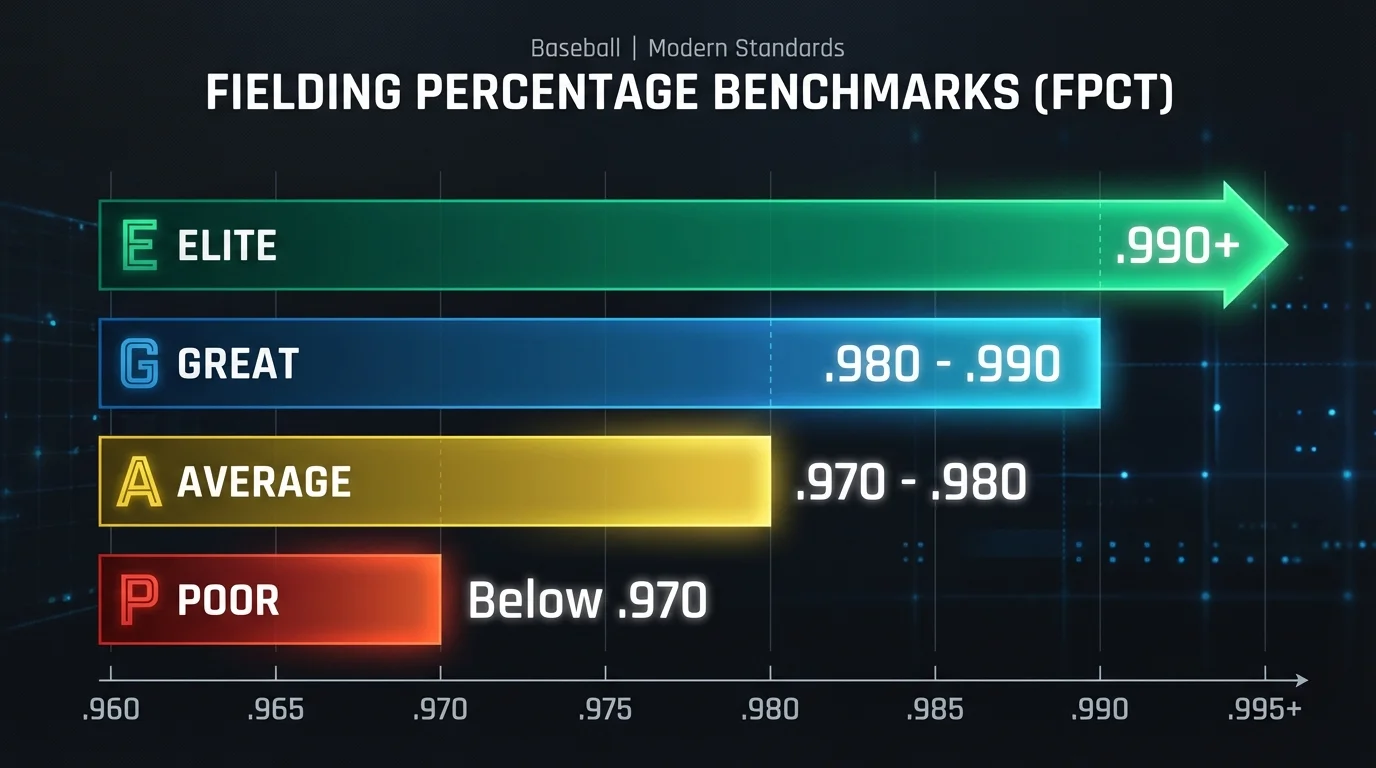
- .990+ (Elite): Platinum and Gold Glove territory. Common for first basemen and catchers.
- .980 - .990 (Great): A very reliable starter at premium positions like shortstop or center field.
- .970 - .980 (Average): A solid, big-league standard for defensive reliability.
- Under .970 (Below Average): May indicate a player struggling with consistency or \"the yips.\"
Range vs. Reliability
It is important to remember that Fielding Percentage has its flaws. A \"statue\" infielder who never reaches a ball in the gap will have a .000 error rate, but they aren\'t helping the team. Conversely, a high-range defender might reach more difficult balls and commit more errors, yet still be the superior player. To get a better picture, combine FPCT with advanced stats like Defensive Runs Saved (DRS).
Frequently Asked Questions
What is Fielding Percentage (FPCT)?
Fielding Percentage is a measure of a baseball player's defensive reliability. It calculates the percentage of total fielding chances (putouts, assists, and errors) that a player handles successfully without committing an error.
How is Fielding Percentage calculated?
The formula is: FPCT = (Putouts + Assists) / (Putouts + Assists + Errors). For example, if a player has 50 putouts, 20 assists, and 2 errors, their FPCT is (50+20) / (50+20+2) = 70/72 = .972.
What is considered a good fielding percentage?
A 'good' percentage depends on the position. Major League infielders and outfielders typically aim for .980 or higher. First basemen and catchers often have percentages above .995 because they handle many routine putouts.
What are the limitations of Fielding Percentage?
Fielding Percentage only measures how well a player handles the balls they actually reach. It does not account for range—a player with a high FPCT might actually be a poor defender if they are slow and don't reach many balls that a faster player would (and perhaps commit an error on).