Fish Weight Calculator
Updated:Estimate fish weight from length and girth measurements with species-specific formulas.
What is Fish Weight Estimation?
Fish weight estimation is a calculation method used by anglers to determine the approximate weight of a fish without using a scale. By measuring the length and girth (circumference) of a fish, you can calculate its weight using proven mathematical formulas developed specifically for different fish species.
This technique has become essential for modern conservation-focused fishing, particularly in catch-and-release scenarios where minimizing handling time is critical for fish survival. Tournament anglers, trophy hunters documenting personal bests, and conservation-minded fishermen all rely on these formulas to record catches without the stress of prolonged handling or the need for hanging scales that can damage fish.
Why Weight Estimation Matters
- Conservation: Quick measurements allow for faster release, improving fish survival rates in catch-and-release fishing.
- Tournament Compliance: Many fishing tournaments now require catch-and-release with photo documentation of measurements rather than live wells.
- Personal Records: Track your trophy catches and personal bests without needing scale access on the water.
- Fish Management: Biologists use these formulas to monitor fish populations and health without invasive procedures.
How to Calculate Fish Weight
The standard fish weight formula is: Weight (lbs) = (Length × Girth²) / Divisor
The divisor varies by species based on body shape and density. Fish with rounder, thicker bodies use lower divisors (meaning they're heavier), while lean, streamlined fish use higher divisors.
You catch a bass measuring 20 inches long with a 15-inch girth:
(20 × 15²) / 800 = (20 × 225) / 800 = 4,500 / 800 = 5.625 lbs
Your bass weighs approximately 5.6 pounds (2.5 kg).
Species-Specific Formulas
Different fish species require different divisors in the formula due to varying body shapes and densities:
- Bass (800): Largemouth, smallmouth, and spotted bass have moderately thick bodies. The 800 divisor accounts for their balanced build.
- Trout (900): Rainbow, brown, and brook trout are more streamlined and less dense, requiring a higher divisor.
- Pike/Musky (900): These predators have elongated, lean bodies with less mass relative to their length, using the same divisor as trout.
- Walleye (900): Similar body structure to pike, with a streamlined shape optimized for speed.
- Catfish (700): Channel cats, blue cats, and flatheads are notably rounder and heavier-bodied, requiring a lower divisor.
- Salmon (800): Chinook, coho, and Atlantic salmon share similar body density to bass species.
- Carp (750): Common carp and mirror carp are thick-bodied and dense, falling between catfish and bass.
How to Properly Measure a Fish
Accurate measurements are critical for reliable weight estimates. Follow these steps for best results:
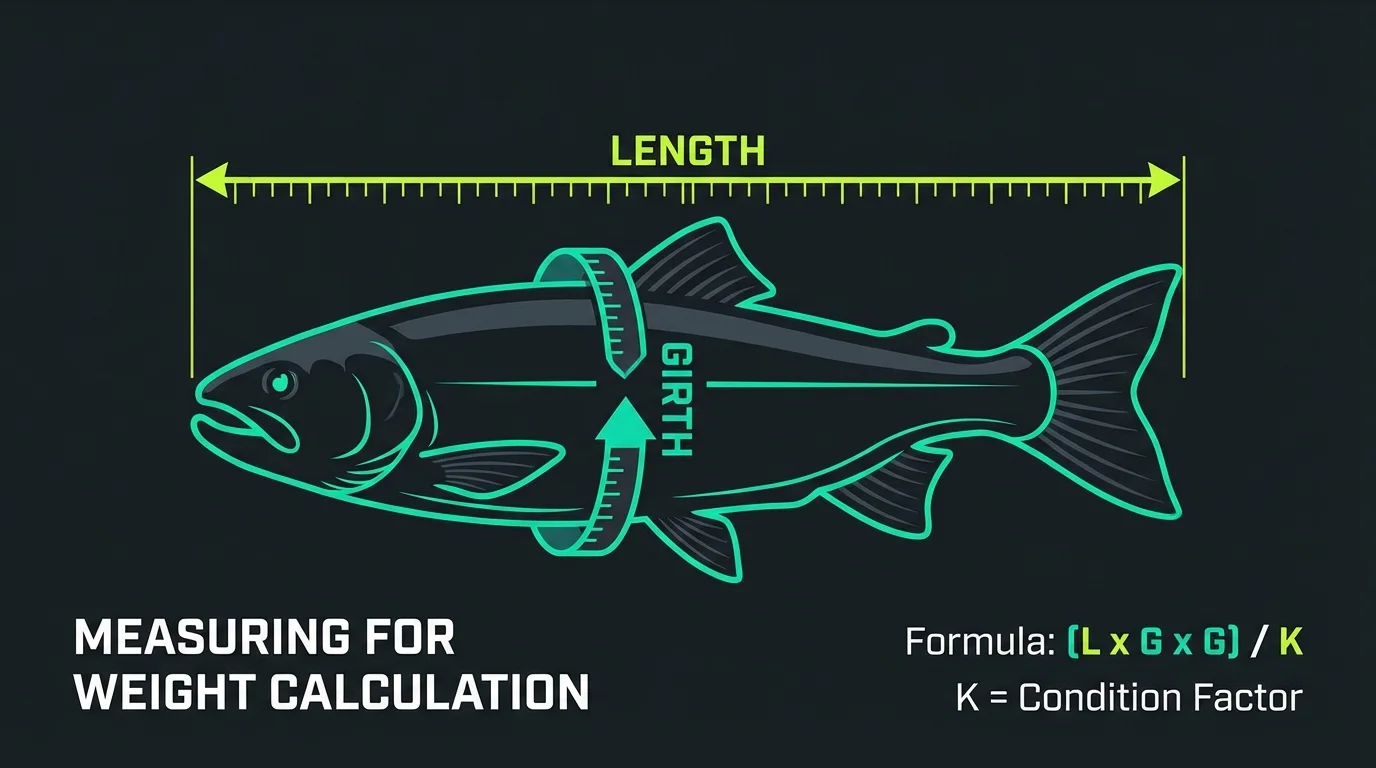
Measuring Length
- Starting Point: Place the measuring tape or ruler at the very tip of the fish's nose or jaw (with mouth closed).
- Ending Point: For forked tails (most game fish), measure to the fork or center point of the tail. For rounded tails, measure to the center of the tail fin.
- Fish Position: Keep the fish horizontal and flat. Don't let the body curve or bend, as this will shorten the measurement.
- Pinch the Tail: Gently pinch the tail fin closed to get a consistent measurement endpoint.
Measuring Girth
- Location: Measure around the thickest part of the body, typically just behind the pectoral (front side) fins.
- Tool: Use a flexible measuring tape or a piece of string that you measure afterward.
- Tension: Wrap snugly but don't compress the fish. The tape should follow the body contour naturally.
- Keep Fish Wet: Take girth measurements while the fish is still wet to avoid scale damage and ensure accuracy.
Understanding Formula Accuracy and Limitations
While these formulas are remarkably accurate for typical specimens, several factors can affect precision:
Factors That Affect Accuracy
- Body Condition: Well-fed, healthy fish will be heavier than thin, stressed fish of the same measurements. Spawning females carrying eggs can be 15-20% heavier than the formula suggests.
- Seasonal Variation: Fish typically weigh more in fall after feeding heavily, and less in late spring after spawning.
- Measurement Technique: Compressed girth measurements or stretched length can skew results significantly. Since girth is squared in the formula, even small errors are magnified.
- Species Variation: Subspecies and regional variants may have slightly different body shapes. For example, Florida-strain largemouth bass are often thicker-bodied than northern strains.
- Hybrid Species: Crossbred fish like tiger musky or hybrid striped bass may not match parent species formulas perfectly.
When to Use Alternative Methods
For competition weigh-ins, official records, or fish that look exceptionally thin or fat, use a scale for precise measurement. The formulas work best for:
- Quick field documentation during catch-and-release
- Personal record tracking when scales aren't available
- Photo tournament submissions requiring measurement proof
- Estimating fish populations in biological surveys
For more fishing tools and calculators, check out our related watersports calculators below to plan your fishing trips and track your catches.
Frequently Asked Questions
How accurate is the fish weight calculator?
The calculator provides estimates typically within 10-15% of actual weight for healthy fish. Accuracy depends on proper measurement technique, fish species, and body condition. Spawning females or exceptionally thin fish may vary from estimates.
How do I properly measure a fish for weight estimation?
Measure length from the tip of the nose to the fork of the tail (or center of tail if round). Measure girth at the widest part of the body, typically just behind the pectoral fins. Keep the fish horizontal and use a flexible measuring tape for girth.
Why do different fish species use different formulas?
Fish body shapes vary significantly by species. Catfish are rounder and heavier for their length, while pike are leaner. Each formula uses a species-specific divisor (700-900) that accounts for typical body density and shape.
Can I use this calculator for saltwater fish?
The standard formulas work for many saltwater species with similar body shapes. Use the Bass formula for grouper/snapper, Pike formula for barracuda, or Salmon formula for tuna. However, specialized saltwater species may require specific formulas not included here.
Should I measure in inches or centimeters?
Both units work equally well. The calculator automatically converts measurements and displays weight in both pounds and kilograms. Use whichever unit is most convenient for your measuring tools.
Why is the girth measurement so important?
Girth (squared in the formula) has exponentially more impact on weight than length. A fish that is 20% wider weighs roughly 44% more at the same length. This is why proper girth measurement is critical for accurate estimates.
When is catch-and-release weight estimation most useful?
Weight estimation is essential for tournament anglers following catch-and-release rules, conservation-minded anglers tracking personal records without stressing fish, and when documenting trophy catches for record submissions without scale access.