Triathlon Finishing Time Calculator
Updated:Estimate your Sprint, Olympic, 70.3, or Ironman race time based on swim, bike, and run paces
A triathlon finishing time is the total elapsed duration from race start to finish line, calculated as: Swim Time + T1 (transition) + Bike Time + T2 (transition) + Run Time. Standard distances range from Sprint (1:00-1:45) to full Ironman (10:00-17:00).
What is a Triathlon Finishing Time?
A triathlon finishing time is the total elapsed time from the start of the swim to crossing the finish line after the run. It includes all three disciplines (swim, bike, run) plus the two transition periods (T1 and T2). Understanding how each segment contributes to your overall time helps you identify strengths, weaknesses, and opportunities for improvement.
This triathlon race time predictor estimates your finishing time based on your pace for each discipline. Whether you're planning your first sprint triathlon or targeting a sub-10-hour Ironman, accurate Ironman finish time estimation helps you set realistic goals and develop appropriate race strategies.
How to Calculate Your Triathlon Time
Your total triathlon time is the sum of five components:
Total = Swim Time + T1 + Bike Time + T2 + Run Time
Each component is calculated separately:
Swim Time = Distance (m) x Pace (sec/100m) / 100
Bike Time = Distance (km) / Speed (km/h)
Run Time = Distance (km) x Pace (min/km)
Average Finishing Times by Distance
Triathlon finishing times vary widely based on experience, fitness, age, and course conditions. Here are typical ranges for each standard distance:
- Sprint Triathlon (750m/20km/5km): Average finishers complete in 1:15 to 1:30. Beginners may take 1:30 to 2:00, while competitive athletes finish under 1:00. The short distances make this ideal for first-time triathletes.
- Olympic Triathlon (1.5km/40km/10km): Average times range from 2:30 to 3:00. Recreational athletes typically finish in 2:45 to 3:30, while elite athletes complete in under 2:00. This is the standard distance for Olympic Games competition.
- Half-Ironman / 70.3 (1.9km/90km/21.1km): Most finishers complete in 5:30 to 6:30. Beginners often take 6:00 to 8:00, while competitive age-groupers target sub-5:00. Course cutoffs are typically 8:30.
- Full Ironman (3.8km/180km/42.2km): Average finish times are 12:00 to 14:00. First-timers often finish between 13:00 and 16:00, while elite age-groupers target sub-10:00. The official cutoff is 17 hours.
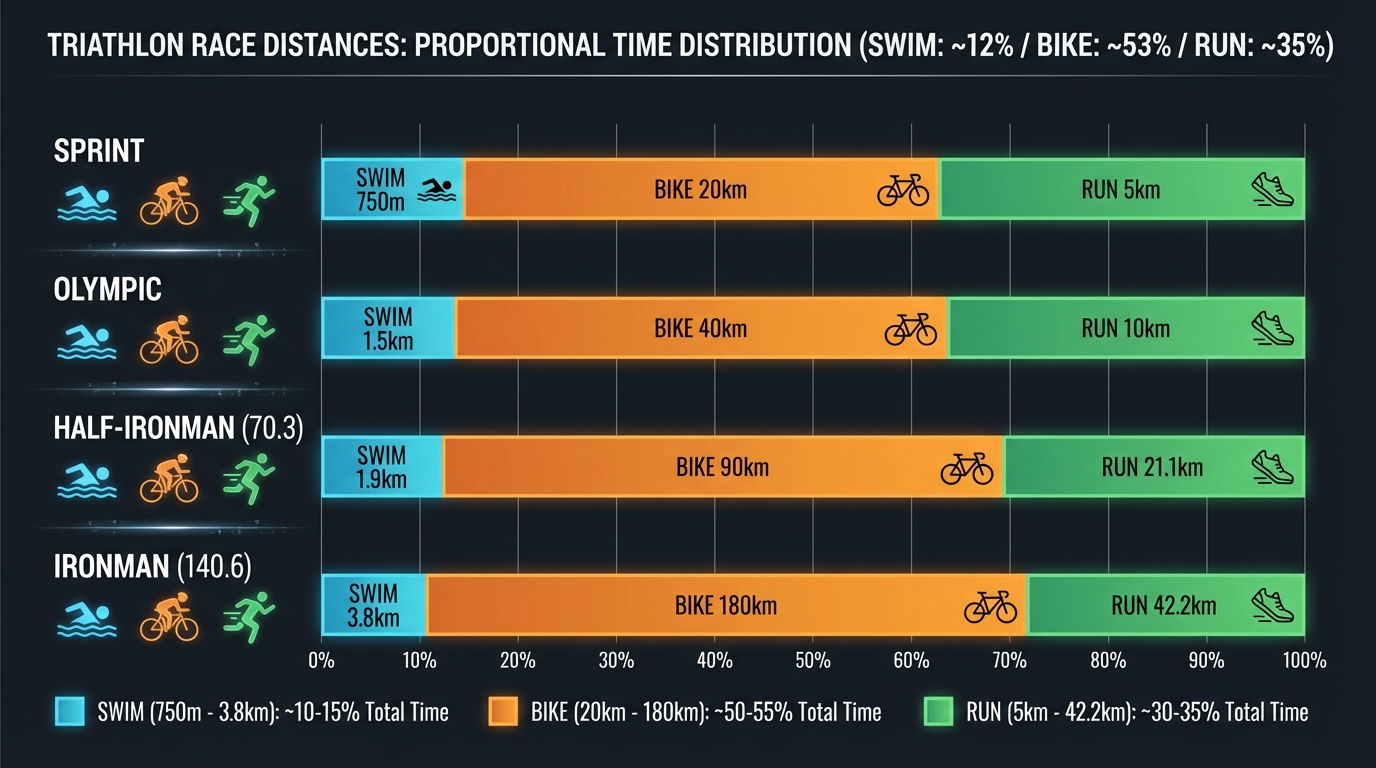
Triathlon Time Comparison: Sprint vs Olympic vs Ironman
Understanding how triathlon times scale across distances helps you set appropriate goals and predict your race performance. This triathlon race time predictor accounts for the non-linear relationship between distance and finishing time—as distances increase, average pace slows due to the need for sustainable effort.
| Distance | Beginner | Intermediate | Competitive | Elite |
|---|---|---|---|---|
| Sprint 750m / 20km / 5km |
1:45 - 2:00 | 1:15 - 1:30 | 1:00 - 1:10 | < 1:00 |
| Olympic 1.5km / 40km / 10km |
3:00 - 3:30 | 2:30 - 3:00 | 2:00 - 2:15 | < 1:50 |
| Half-Ironman 70.3 1.9km / 90km / 21.1km |
6:30 - 8:00 | 5:30 - 6:30 | 4:30 - 5:00 | < 4:00 |
| Full Ironman 3.8km / 180km / 42.2km |
14:00 - 16:30 | 12:00 - 14:00 | 10:00 - 11:00 | < 8:30 |
Using This Calculator as an Ironman Finish Time Estimator
For long-course events like Half-Ironman 70.3 and full Ironman races, this Ironman finish time estimator requires careful pace input. Your sustainable race pace for a 5+ hour event differs significantly from training paces. When predicting your Ironman race time, reduce your typical bike speed by 2-3 km/h and add 30-60 seconds per kilometer to your run pace compared to shorter races. The calculator provides a baseline estimate—experienced athletes often add 5-10% buffer for nutrition stops, mechanical issues, and the mental challenge of long-course racing.
Sprint Triathlon Time Calculator Guide
Sprint triathlons are ideal for beginners and athletes working on speed. When using this sprint triathlon time calculator, you can input paces closer to your maximum sustainable effort since the 60-90 minute duration allows for higher intensity. Focus on transitions—they represent a larger percentage of your total time in sprints. A 2-minute improvement in combined transition time that might seem minor in an Ironman becomes significant when your total race time is under 90 minutes.
Tips for Improving Your Triathlon Time
Each discipline offers opportunities for time savings. Here are key strategies for improving your overall triathlon finish time, whether you're targeting a faster sprint triathlon or aiming to predict your Ironman race time more accurately.
How to Improve Your Triathlon Swim Time
Focus on technique over raw speed—improved body position and stroke efficiency save energy for the bike and run while naturally increasing your pace. Key improvements include reducing drag through better head position, developing a high elbow catch, and building an efficient two-beat kick. Open water practice is essential for race preparation: practice sighting every 6-8 strokes, learn to draft behind or beside other swimmers, and get comfortable with mass starts. Consider joining a masters swim group for structured technique feedback. Even a 10-second improvement per 100m translates to 1-6 minutes saved depending on race distance.
How to Improve Your Triathlon Bike Split
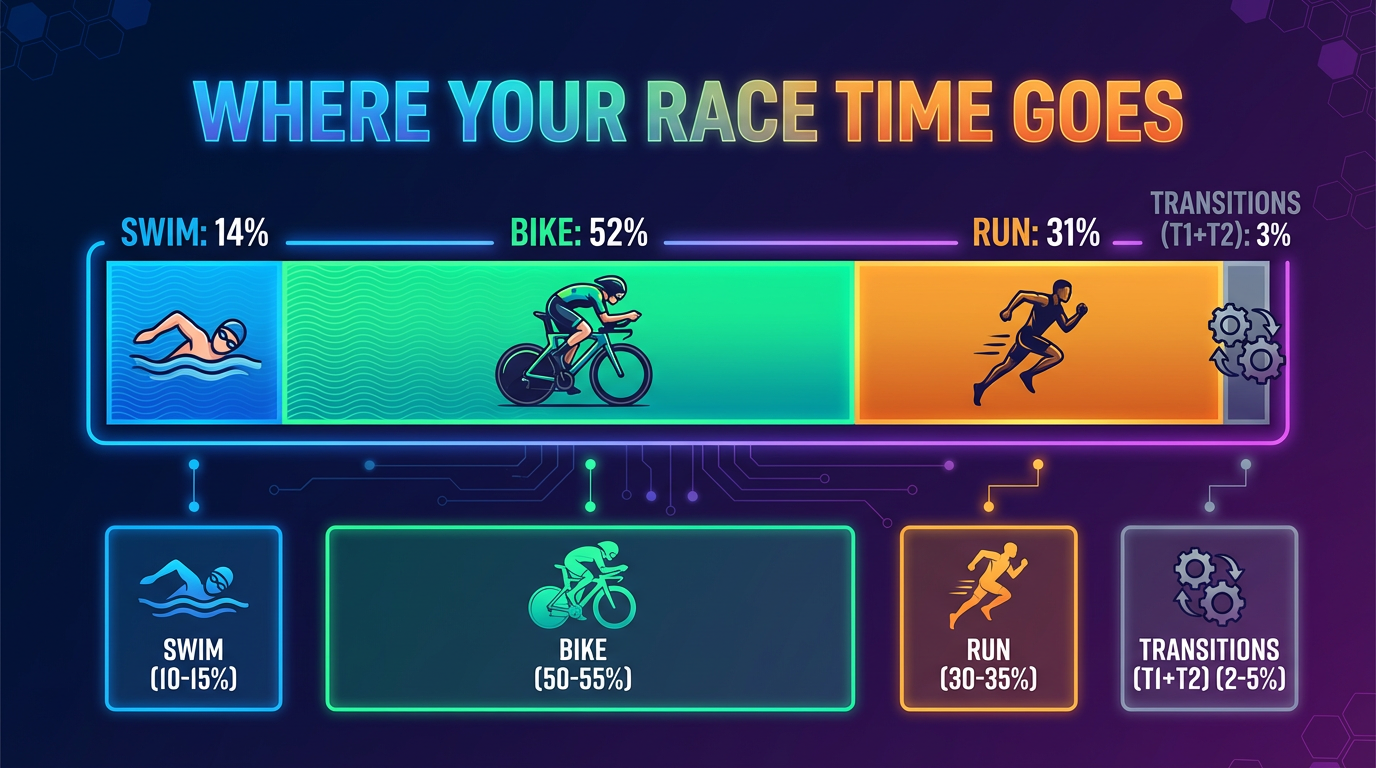
The bike leg consumes 50-55% of your total race time, making it the most impactful discipline for time savings. Maintain a sustainable power output (around 70-75% of FTP or RPE 6-7) to preserve energy for the run—going too hard on the bike is the most common pacing mistake. Aerodynamic positioning can save 30-60 seconds per 10km without any fitness improvement. For longer distances, dial in your nutrition strategy: consume 60-90g of carbohydrates per hour and stay hydrated. Consider investing in a bike fit, aero helmet, and wheel upgrades once you've maximized training gains.
How to Improve Your Triathlon Run Time
Running off the bike presents unique challenges due to accumulated fatigue and the "brick" sensation in your legs. Start the run conservatively—going out too fast in the first kilometer is a common mistake that leads to significant slowdowns later. Break the run into mental segments (each 2-3km) and focus on maintaining cadence and form rather than pace. Practice brick workouts (bike immediately followed by run) at least once weekly to adapt to this transition. Strengthen your running economy through hill repeats, tempo runs, and cadence drills. Even experienced runners typically run 15-30 seconds per kilometer slower off the bike compared to standalone running.
How to Speed Up Triathlon Transitions
Transitions are often called the "fourth discipline" and offer "free speed" since improvements require practice rather than fitness. Efficient transitions can save 2-5 minutes compared to recreational athletes. For T1 (swim-to-bike): practice wetsuit removal while moving, use body glide on ankles and wrists, have your helmet already clipped open on your aerobars, and consider cycling shoes that clip to your pedals for a flying mount. For T2 (bike-to-run): use elastic laces on your running shoes, have a race belt with your number already attached, and keep nutrition accessible. Rehearse your transition routine before race day until it becomes automatic.
Race Day Considerations
Your actual race time may differ from this triathlon time calculator's estimates due to several race-specific factors. Course elevation can add 10-20 minutes on hilly routes. Weather conditions—particularly headwinds and heat—significantly impact bike and run performance. Wetsuit legality affects swim times (wetsuits add buoyancy and typically improve pace by 5-10%). Nutrition and hydration execution becomes critical in races over 2 hours. Race-day adrenaline often leads to faster-than-planned early pacing, which can backfire later. Use this triathlon race time predictor as a planning tool and adjust your goal times based on specific course profiles and weather forecasts.
Frequently Asked Questions
How accurate is the triathlon finish time calculator?
This triathlon race time predictor provides estimates within 5-10% accuracy when you input realistic training paces. The calculator assumes consistent effort across all three disciplines, which rarely happens in actual races. Your real finish time will vary based on course-specific factors like elevation gain (hilly bike courses add 10-20 minutes), weather conditions (headwinds can slow cycling by 2-3 km/h), water temperature and conditions for the swim, and your nutrition and pacing strategy. For the most accurate prediction, use pace data from recent brick workouts rather than standalone discipline times. Consider this tool a race planning aid to set goal times and develop pacing strategies, not an exact finish time guarantee.
What transition times should I use?
Transition times vary significantly by experience level and should be practiced regularly. For T1 (swim-to-bike): beginners typically take 4-7 minutes (removing wetsuit, drying feet, putting on cycling shoes and helmet), intermediate athletes average 2-4 minutes, and elite competitors complete T1 in 45-90 seconds with flying mounts. For T2 (bike-to-run): beginners need 2-4 minutes (racking bike, changing shoes, grabbing nutrition), intermediate athletes average 1-2 minutes, and elites finish in 30-60 seconds. To improve your transitions, practice the sequence at home, use elastic laces on running shoes, consider cycling shoes that clip to pedals, lay out gear in a logical order, and do mental rehearsals before race day.
How do I convert my pool swim pace to open water pace?
Open water swimming is typically 5-15% slower than pool swimming, and this conversion is crucial for accurate triathlon time estimation. The slowdown occurs due to several factors: sighting every 6-8 strokes adds 1-2 seconds per 100m, lack of walls means no push-off advantage (adds 2-3 seconds per 100m), waves and currents can add 5-15 seconds per 100m depending on conditions, and wetsuit restrictions on shoulder mobility may affect stroke efficiency. As a practical guide: if your pool pace is 1:45/100m, expect 1:52-2:00/100m in calm open water, or 2:00-2:10/100m in choppy conditions. Practice open water swimming before race day to calibrate your personal conversion factor.
What is a good finishing time for each triathlon distance?
Good finishing times depend heavily on age, experience, and course difficulty, but here are general benchmarks. Sprint triathlon (750m/20km/5km): beginners finish in 1:30-2:00, recreational athletes in 1:15-1:30, competitive age-groupers under 1:10, and elites under 1:00. Olympic triathlon (1.5km/40km/10km): beginners finish in 3:00-3:30, recreational athletes in 2:30-3:00, competitive age-groupers under 2:15, and elites under 1:50. Half-Ironman 70.3 (1.9km/90km/21.1km): beginners finish in 6:30-8:00, recreational athletes in 5:30-6:30, competitive age-groupers under 5:00, and elites under 4:00. Full Ironman (3.8km/180km/42.2km): beginners finish in 14:00-16:30, recreational athletes in 12:00-14:00, competitive age-groupers under 11:00, and professionals under 8:00.
How long does a sprint triathlon take for a beginner?
A beginner completing their first sprint triathlon should expect a finish time between 1 hour 30 minutes and 2 hours. Breaking this down by segment: the 750m swim typically takes 15-25 minutes (2:00-3:20 pace per 100m), T1 transition takes 4-7 minutes, the 20km bike takes 40-50 minutes (24-30 km/h average), T2 transition takes 2-4 minutes, and the 5km run takes 25-35 minutes (5:00-7:00 min/km pace). First-time triathletes often spend extra time in transitions due to nerves and unfamiliarity with the process. Focus on finishing comfortably rather than racing hard—you can target faster times in subsequent races once you understand the unique demands of multi-sport competition.
What is a good Ironman time for a first-timer?
For a first-time Ironman finisher, any time under the 17-hour cutoff is an achievement worth celebrating. Realistic goal times for beginners range from 13 to 16 hours depending on athletic background. A typical first-timer breakdown: 3.8km swim in 1:20-1:45 (pace 2:05-2:45/100m), T1 in 10-15 minutes, 180km bike in 6:30-8:00 (22-28 km/h), T2 in 8-12 minutes, and marathon in 5:00-6:30 (7:00-9:15 min/km). The key to finishing your first Ironman is conservative pacing—aim to feel strong entering the run rather than having "left it all on the bike." Many first-timers hit the wall during the marathon because they cycled too hard. Target negative splits where possible and prioritize consistent nutrition every 20-30 minutes throughout the race.
How do I calculate my triathlon pace for race day?
To calculate your triathlon race pace, use recent training data with appropriate adjustments for race conditions. For the swim: use your average 100m pace from continuous swims of at least race distance, then add 5-10 seconds for open water. For the bike: take your average speed from rides of similar duration at sustainable effort (RPE 6-7 out of 10), reducing by 1-2 km/h if the race course is hillier than your training. For the run: use your pace from brick workouts (bike immediately followed by run) rather than standalone runs, as running off the bike is significantly harder. Enter these adjusted paces into the triathlon finish time calculator to get a realistic race day estimate. Always prepare pacing bands for the run to prevent going out too fast.
What percentage of triathlon time is spent in each discipline?
The time distribution across triathlon disciplines follows a consistent pattern regardless of race distance. The bike leg consumes the largest portion at approximately 50-55% of total race time, making it the most impactful discipline for time savings. The run accounts for 30-35% of finish time and is where races are often won or lost due to accumulated fatigue. The swim represents only 10-15% of total time despite feeling exhausting—even large improvements in swim fitness yield modest time gains. Transitions (T1 and T2 combined) account for 2-5% of finish time but offer "free speed" since improvements require practice rather than fitness gains. For optimal training allocation, most coaches recommend spending training time proportionally: 50% cycling, 30% running, 15% swimming, and dedicated transition practice sessions.