Windsurfing Calculator
Updated:Get personalized sail size and board volume recommendations based on your weight, wind conditions, and riding style.
What is a Windsurfing Equipment Calculator?
A windsurfing calculator is a specialized tool that helps riders select the optimal sail size and board volume for their specific conditions. Unlike other watersports, windsurfing equipment selection is highly technical—the right combination of sail size, board volume, and wind speed directly impacts your ability to plane, maneuver, and enjoy your session safely.
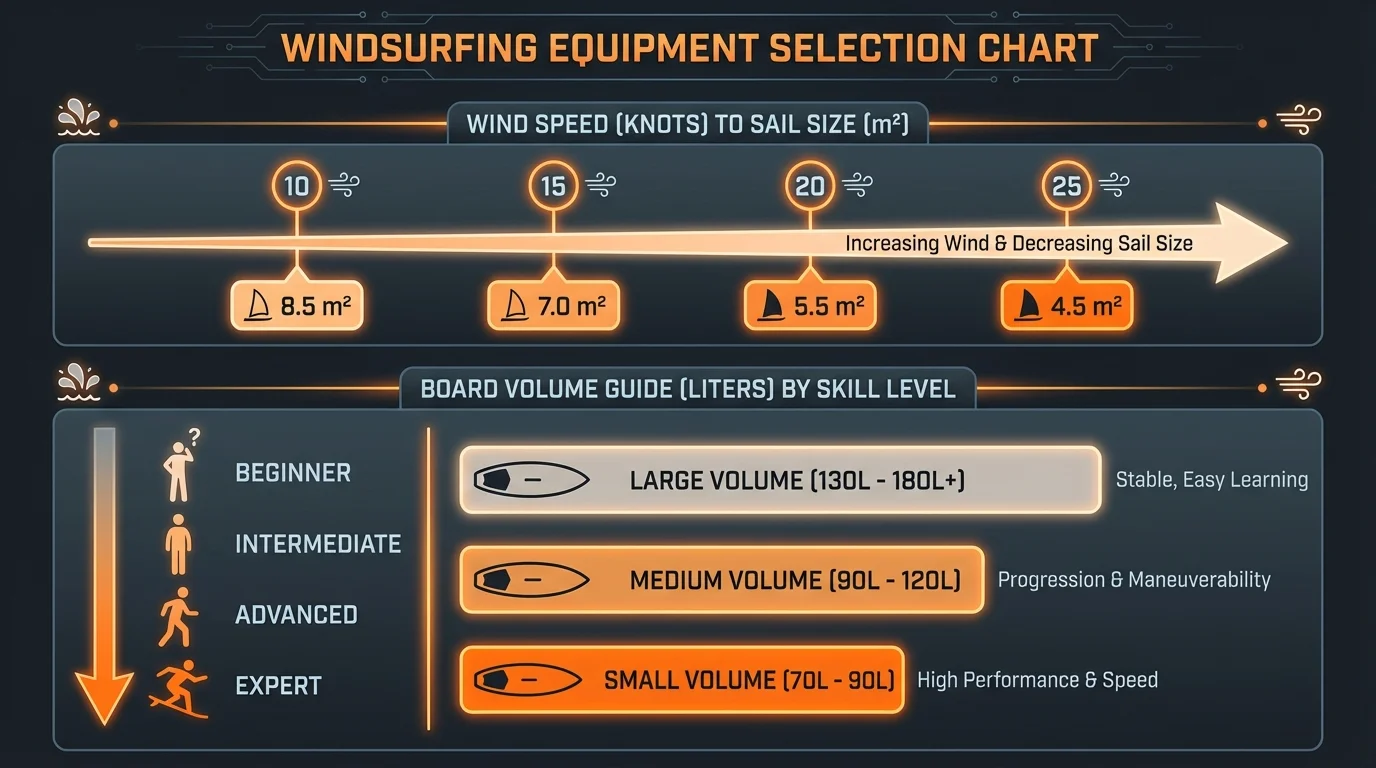
This calculator takes into account four critical variables:
- Rider Weight: Heavier riders require larger sails and more board volume to generate sufficient power and flotation.
- Wind Speed: The primary factor determining sail size—stronger winds require smaller sails for control, while light winds demand larger sails for power.
- Skill Level: Beginners need more forgiving, stable equipment, while experts can handle smaller, more responsive gear.
- Discipline: Wave sailing, freeride, freestyle, slalom, and formula racing each have unique equipment requirements.
How to Choose Windsurfing Sail Size
Sail size is measured in square meters (m²) and is the most critical decision for any windsurfing session. The fundamental principle is simple: more wind = smaller sail, less wind = larger sail. However, the exact size depends on your weight and ability.
How to Calculate Windsurfing Equipment Needs
Calculating windsurfing gear requires balancing your weight against the wind force and your technical ability. We use established ratios to determine the ideal sail area and board buoyancy.
Sail Size Formula by Wind Conditions
Sail Size (m²) = Rider Weight (kg) ÷ 6-7
Example: 70kg rider → 70 ÷ 6.5 ≈ 10.8m² sail (use 9-11m²)
Sail Size (m²) = Rider Weight (kg) ÷ 8-10
Example: 70kg rider → 70 ÷ 9 ≈ 7.8m² sail (use 7-8m²)
Sail Size (m²) = Rider Weight (kg) ÷ 12-15
Example: 70kg rider → 70 ÷ 13 ≈ 5.4m² sail (use 4.5-5.5m²)
Understanding Board Volume for Windsurfing
Board volume, measured in liters (L), determines flotation and stability. The right volume allows you to uphaul the sail easily, maintain balance in light winds, and transition smoothly to planing in stronger conditions. Volume requirements decrease significantly as skill level increases.
Board Volume Formula by Skill Level
- Beginner: Body Weight (kg) + 80-100L
Example: 70kg beginner → 150-170L board - Intermediate: Body Weight (kg) + 30-50L
Example: 70kg intermediate → 100-120L board - Advanced: Body Weight (kg) + 0-20L
Example: 70kg advanced → 70-90L board - Expert/Wave: Body Weight (kg) - 10-20L
Example: 70kg expert → 50-60L board
Beginner vs Advanced Gear Selection
The gap between beginner and expert equipment is substantial in windsurfing. Understanding these differences helps you choose gear appropriate for your current ability while planning your progression.
Beginner Equipment (First 6-12 months)
- Board: Wide, stable freeride boards (140-170L) with a centerboard/daggerboard for upwind ability in light winds
- Sail: Larger, more forgiving sails (5.5-7.5m²) made from durable monofilm with simple cam-free designs
- Focus: Stability over performance—learning to uphaul, tack, jibe, and build water time
- Typical Setup: 160L board with 6.5m² sail in 12-18 knots
Advanced/Expert Equipment
- Board: Smaller, performance-oriented boards (60-100L) designed for planing, carving, and wave riding
- Sail: High-performance sails with cambered profiles for racing or lightweight wave sails for maneuverability
- Focus: Speed, maneuverability, and discipline-specific performance
- Typical Setup: 85L board with 5.0m² sail in 20 knots for wave sailing, or 120L board with 8.5m² race sail for slalom
Building a Windsurfing Quiver
As you advance, you'll develop a "quiver" of equipment to handle varying conditions. Most intermediate to advanced windsurfers own 2-4 sails and 1-2 boards to cover the full wind range they encounter. Here's a typical progression:
Essential Quiver for Most Locations
- Light Wind Sail (7.0-8.5m²): For 10-15 knot conditions, gets you on the water when others are struggling
- All-Around Sail (5.5-6.5m²): Your most-used sail for typical 15-20 knot conditions, versatile and confidence-inspiring
- Strong Wind Sail (4.5-5.0m²): For 20-25+ knot conditions, provides control and prevents over-powering
- Board (100-120L): A freeride or freestyle board that works with your entire sail range and accommodates most conditions
Advanced sailors may add specialized equipment: a dedicated wave board (70-85L), a formula or slalom board (130-160L) for racing, or a freestyle board (95-105L) for tricks. The key is matching your investment to your local conditions and riding goals.
Discipline-Specific Equipment Guide
Freeride Windsurfing
The most popular discipline, freeride prioritizes versatility, comfort, and progression. Boards range from 100-130L with moderate width for stability and planing performance. Sails are typically 5.0-7.5m² with easy, forgiving handling. This is the best starting point for most windsurfers.
Wave Sailing
Wave sailing demands smaller, highly maneuverable equipment. Boards (65-90L) are compact with thruster or quad fin setups for tight turns. Sails (3.7-5.5m²) are lightweight and durable to handle onshore winds and challenging conditions. This discipline requires strong fundamental skills.
Freestyle Windsurfing
Freestyle focuses on tricks and aerial maneuvers. Boards (90-110L) have wide tails for stability during spins and jumps. Sails (4.5-6.0m²) balance power with lightness. Freestyle is popular in flat water conditions with moderate winds (15-20 knots).
Slalom Racing
Slalom prioritizes pure speed. Boards (90-130L) are narrow and fast with single fin setups. Sails (6.0-9.5m²) use cambered designs for maximum power and efficiency. This discipline demands excellent technique and is pursued by experienced riders seeking competitive racing.
Formula Windsurfing
Formula is the ultimate light-wind racing discipline. Boards (130-160L) are extremely wide (up to 1 meter) for early planing in 8-12 knots. Sails (8.0-12.5m²) are massive and require significant strength to manage. Formula is for dedicated racers with strong fitness.
Fin Size Recommendations
Fin size directly impacts control, upwind performance, and top speed. Larger fins provide better upwind ability and stability but reduce maneuverability. Smaller fins feel more responsive but can spin out in choppy conditions. The calculator recommends fin sizes based on your sail size:
- Small Sails (3.5-5.0m²): 20-28cm fins for wave and freestyle sailing
- Medium Sails (5.5-6.5m²): 28-38cm fins for all-around freeride
- Large Sails (7.0-8.5m²): 38-48cm fins for light wind and cruising
- Extra Large Sails (9.0m²+): 50-70cm fins for formula and race boards
Frequently Asked Questions
How do I choose the right sail size for windsurfing?
Sail size depends on your weight, wind conditions, and skill level. In lighter winds (10-15 knots), heavier sailors need larger sails (7-9m²). In strong winds (20+ knots), smaller sails (4-6m²) provide better control. Our calculator factors all these variables to recommend optimal sail sizes.
What board volume do I need as a beginner windsurfer?
Beginners should choose a board with volume equal to their body weight in kg plus 80-100 liters for maximum stability. For example, a 70kg beginner should use a 150-170L board. As you progress to intermediate level, you can reduce volume to body weight plus 30-50L.
Can I use one sail size for all wind conditions?
No, experienced windsurfers build a "quiver" of 3-4 sails ranging from 4.5m² to 7.5m² to cover different wind ranges. A 5.5m² sail might work in 15-20 knots, but you will need a larger sail for lighter winds and a smaller sail for stronger conditions.
How does windsurfing discipline affect equipment choice?
Different disciplines require different setups. Wave sailing uses smaller, more maneuverable boards (70-90L) with smaller sails. Freeride prioritizes versatility with medium boards (100-130L). Slalom and formula racing use larger boards (100-160L) for maximum speed. Our calculator adjusts recommendations based on your chosen discipline.
What fin size should I use with my windsurfing board?
Fin size correlates with sail size and board volume. Smaller sails (4-5m²) typically use 20-28cm fins, medium sails (5-6.5m²) use 28-38cm fins, and larger sails (7m²+) require 38-50cm+ fins. The calculator provides specific recommendations based on your sail size.
How accurate is this windsurfing calculator?
This calculator provides industry-standard recommendations based on established formulas used by windsurfing coaches and manufacturers. However, personal preference, local wind conditions, and specific board designs can affect your ideal setup. Use these recommendations as a starting point and adjust based on your experience on the water.