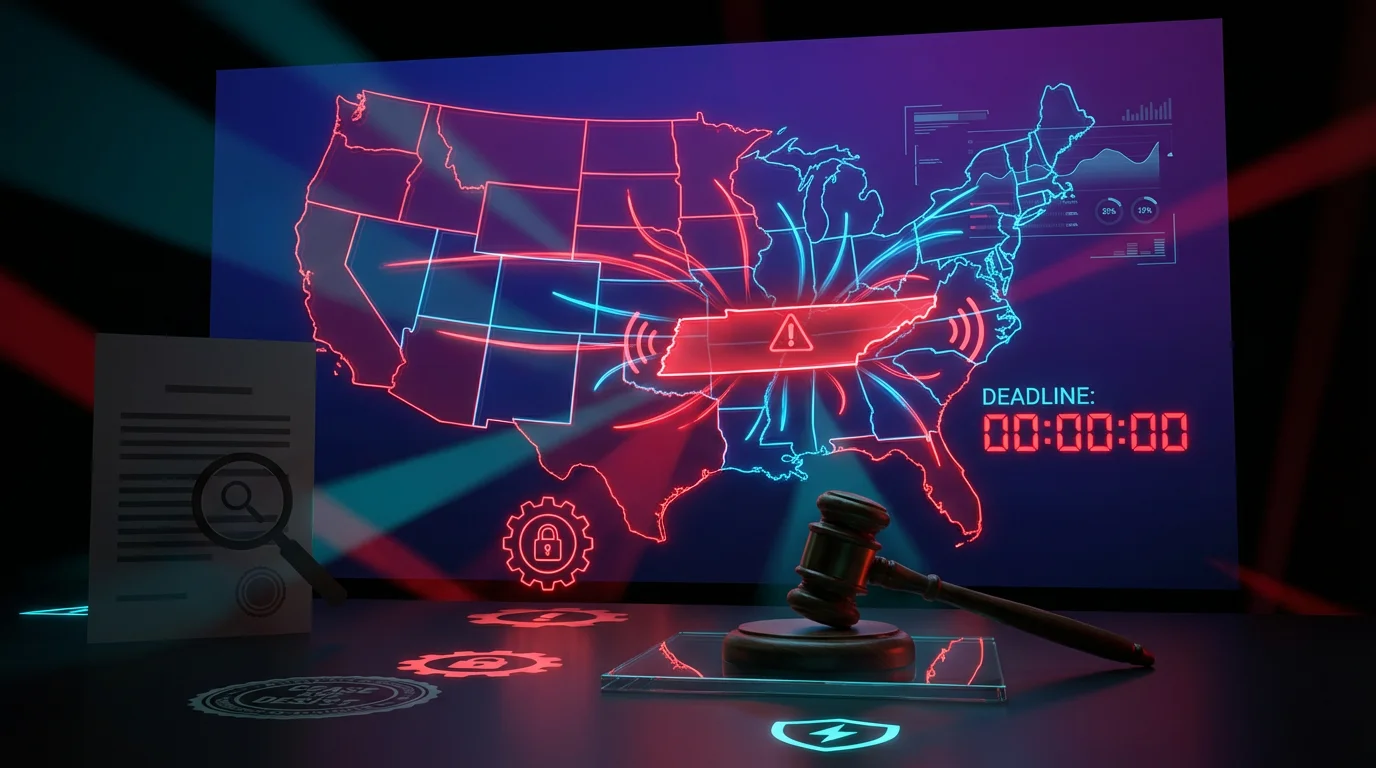
Tennessee Gives Polymarket, Kalshi Until January 31: Criminal Prosecution Looms
Tennessee becomes ninth state to target prediction markets with January 31 deadline threatening criminal prosecution
Tennessee has given Polymarket, Kalshi, and Crypto.com until January 31 to void all sports contracts held by state residents, refund customer funds, and cease operations—or face escalating fines and criminal prosecution referrals. The cease-and-desist orders, dated January 9, mark Polymarket’s first state-level enforcement action since its November 2025 US relaunch, and position Tennessee as at least the ninth state to formally challenge prediction market platforms over sports-related offerings.
KEY FACTS AT A GLANCE
- Orders Dated: January 9, 2026
- Compliance Deadline: January 31, 2026
- Platforms Targeted: Polymarket, Kalshi, Crypto.com
- Requirements: Void all TN sports contracts, refund all customer funds, cease operations
- Penalties: $10,000 first offense, $15,000 second, $25,000+ subsequent violations
- Escalation: Criminal prosecution referrals for non-compliance
- Significance: Polymarket’s first state-level enforcement since US relaunch
What Tennessee Is Demanding
The Tennessee Sports Wagering Council (SWC) issued cease-and-desist letters to all three platforms on January 9, 2026, alleging violations of the Tennessee Sports Gaming Act. The regulator’s position is unambiguous: “Sports events contracts offered…are Wagers under the Act and are being offered illegally in violation of Tennessee law.”
The orders require platforms to:
- Immediately cease offering sports event contracts to Tennessee customers
- Void all existing contracts entered into by Tennessee residents
- Refund all customer funds by January 31, 2026
- Confirm compliance in writing to the SWC
Attorney General Jonathan Skrmetti was copied on all three letters—a signal of serious intent. Skrmetti previously joined 37 other attorneys general in an amicus brief supporting Maryland’s lawsuit against Kalshi, and signed onto a June 2025 amicus brief with 33 other AGs challenging federal court rulings favorable to prediction markets.
The Criminal Prosecution Threat
Most coverage will bury the most significant detail: Tennessee isn’t just threatening fines. The letters explicitly warn that continued violations could trigger criminal referrals for aggravated gambling promotion—a felony under Tennessee law.
PENALTY STRUCTURE
- First offense: $10,000 fine
- Second offense: $15,000 fine
- Subsequent violations: $25,000+ per violation
- Non-compliance: Referral to law enforcement for criminal prosecution
For Polymarket, which already settled with the CFTC for $1.4 million in 2022 over operating without proper registration, adding state-level criminal exposure represents a serious escalation. The platform’s recent insider trading controversies and Venezuela payout disputes compound the reputational risk.
Polymarket vs. Kalshi: Divergent Legal Positions
Both platforms received identical cease-and-desist orders, but their ability to fight back differs significantly.
REGULATORY POSITION COMPARISON
Kalshi
- CFTC-designated contract market since 2020
- Won federal preemption arguments in NJ, CT
- Lost preemption argument in MD, NV (recent)
- Already filed federal lawsuit against Tennessee
- $11 billion valuation, resources to litigate
- Track record of aggressive legal pushback
Polymarket
- CFTC approval received November 2025
- Previously banned from US (2022-2025)
- Settled with CFTC for $1.4M in 2022
- First state enforcement since relaunch
- Currently offers only sports contracts to US
- No history of fighting state actions
Kalshi has already responded. A company spokesperson told The Block that Kalshi “filed a suit in federal court in order to block Tennessee’s unlawful attempt to stop prediction markets in the state.” The company’s argument: “Kalshi is a regulated, nationwide exchange for real-world events, and it’s subject to exclusive federal jurisdiction. It is very different from what state-regulated sportsbooks and casinos offer their customers.”
Polymarket has not publicly responded to the Tennessee order. The platform’s weaker legal standing—shorter regulatory track record, recent settlement history, and less litigation experience—suggests it may be less equipped to mount an aggressive legal defense.
The Federal Preemption Battle
At the core of every state enforcement action is a single legal question: Does CFTC oversight of prediction markets preempt state gambling laws?
Federal courts have issued contradictory rulings:
| State | Court Ruling | Outcome for Platforms |
|---|---|---|
| New Jersey | CEA preempts state law | WIN – Kalshi can operate |
| Connecticut | Temporary injunction granted | WIN – Pending Feb 12 hearing |
| Nevada | Sports products subject to state law | LOSS – Injunction dissolved |
| Maryland | CEA doesn’t preempt gambling laws | LOSS – No preliminary injunction |
| California | UIGEA applies, not gambling | WIN – Tribal case dismissed |
The split among federal courts makes the outcome in any new state unpredictable. Nevada’s recent reversal—dissolving an injunction that had protected Kalshi—demonstrates that even initially favorable rulings can flip. Judge Andrew Gordon ruled that Kalshi’s expanded sports products, including prebuilt parlays and player-prop-style markets, “are not swaps under the Commodity Exchange Act.”
The State Enforcement Map
Tennessee joins a growing list of states taking formal action against prediction market platforms:
| State | Action Type | Platforms Targeted | Current Status |
|---|---|---|---|
| Nevada | Cease-and-desist | Kalshi | Kalshi lost; injunction dissolved |
| New Jersey | Cease-and-desist | Kalshi | State appealed to Third Circuit |
| Maryland | Lawsuit | Kalshi | Kalshi denied injunction |
| Massachusetts | State court lawsuit | Kalshi | Ongoing |
| New York | Cease-and-desist + legislation | Kalshi, Polymarket | ORACLE Act reintroduced |
| Arizona | License revocation | Underdog | License pulled |
| Ohio | Enforcement action | Kalshi | Kalshi sued state |
| Connecticut | Cease-and-desist | Kalshi, Robinhood, Crypto.com | Kalshi won temp injunction; Feb 12 hearing |
| Tennessee | Cease-and-desist | Kalshi, Polymarket, Crypto.com | Jan 31 deadline pending |
The pattern is clear: states are acting, and they’re sharing enforcement templates. Tennessee’s letters will be studied by AG offices nationwide. States that were on the fence now have a playbook.
The Cascade Question: Who’s Next?
Tennessee’s action doesn’t exist in isolation. Thirty-eight states joined an amicus brief supporting Maryland’s lawsuit against Kalshi. That coalition represents potential future enforcement—each of those AGs now has legal precedent and enforcement templates to draw from.
Watch for action from:
- Kentucky — Shares border with Tennessee, historically gambling-hostile
- Alabama — Conservative state with strong anti-gambling lobby
- Georgia — No legal sports betting, protective of lottery monopoly
- Texas — No legal sports betting, large population, high-value target
- Florida — Tribal compact complications, active enforcement posture
The question isn’t whether more states will follow Tennessee’s template—it’s how many and how fast. Each successful enforcement action emboldens the next.
Polymarket’s Brutal January
For Polymarket specifically, Tennessee’s enforcement action caps a disastrous week. Within 72 hours, the platform faced:
JAN 9: TENNESSEE ORDERS
First state-level cease-and-desist since US relaunch. Criminal prosecution threat for non-compliance.
JAN 11-12: GOLDEN GLOBES
Mainstream TV integration mocked as “dystopian” and “cringe.” Backlash was immediate and brutal.
ONGOING: INSIDER TRADING
Maduro trade scrutiny. Iran bet patterns exposed. Torres bill introduced.
This isn’t coincidence—it’s a platform under pressure from every direction simultaneously. Regulatory heat from states, mainstream backlash from entertainment audiences, congressional attention from the Torres insider trading bill, and trust erosion from payout disputes.
The Crypto.com Wildcard
Crypto.com’s inclusion in the Tennessee orders deserves attention. Unlike Kalshi and Polymarket, Crypto.com is primarily a cryptocurrency exchange that added prediction markets as a feature—not a prediction market native.
This signals Tennessee is casting a wide net. Any platform offering event contracts to Tennessee residents is a target, regardless of whether prediction markets are their core business. For crypto exchanges considering adding prediction market features, Tennessee’s action is a warning.
Why Sports Contracts Specifically
Tennessee’s orders target sports event contracts specifically—not political or entertainment markets. This is strategic.
Sports betting is where states have the clearest regulatory authority. Every state with legal sports betting has established licensing frameworks and enforcement mechanisms. Political prediction markets occupy murkier legal territory—Kalshi won a federal appeals court case specifically about election contracts.
By targeting sports first, Tennessee is picking a battle it’s more likely to win. If successful, the template could expand to political and entertainment contracts later.
What Happens on January 31
The deadline creates several possible scenarios:
POSSIBLE OUTCOMES
Compliance
Platforms exit Tennessee voluntarily. Refund TN users. Avoid fines and prosecution. Sets precedent for other states to demand same.
Litigation
Kalshi has already filed federal lawsuit. Could seek injunction before deadline. Polymarket’s response unclear. Extended legal battle likely.
The Connecticut case provides a preview. Kalshi won a temporary injunction there, with oral arguments scheduled for February 12. If Tennessee follows a similar pattern, the January 31 deadline may get extended pending litigation—but only if platforms actively fight back in federal court.
What This Means for Bettors
IF YOU’RE IN TENNESSEE
- Your open sports contracts may be voided
- Platforms are required to refund your funds by January 31
- Monitor platform communications for withdrawal instructions
- Consider withdrawing funds proactively before the deadline
IF YOU’RE IN OTHER STATES
- Check if your state has joined amicus briefs against prediction markets
- 38 states supported Maryland’s lawsuit—your state may be next
- Platform access could change with minimal notice
- Diversifying across platforms may not help if states target all operators
The Road to the Supreme Court
The contradictory federal court rulings—platforms winning in New Jersey and Connecticut, losing in Nevada and Maryland—create conditions for a circuit split. If the Third Circuit (hearing New Jersey’s appeal) and other circuits reach different conclusions, the prediction market question could ultimately reach the Supreme Court.
The clearest indicator of how this saga plays out will be the Third Circuit’s written opinion. A victory for Kalshi there increases odds of a circuit split, which increases odds of Supreme Court review.
Until then, the industry faces a patchwork of conflicting state actions and uncertain federal precedent. Platforms, regulators, and users are all operating in legal limbo—with Tennessee’s January 31 deadline the next concrete milestone in this ongoing battle.
KEY TAKEAWAYS
- Criminal Escalation — Tennessee isn’t just threatening fines. Non-compliance risks felony prosecution referrals for aggravated gambling promotion.
- Divergent Positions — Kalshi has filed a federal lawsuit; Polymarket hasn’t responded publicly. Their different regulatory histories may produce different outcomes.
- Cascade Effect — Tennessee is state #9. With 38 states supporting Maryland’s lawsuit, the enforcement playbook is spreading.
- Sports First — Tennessee specifically targets sports contracts where state authority is clearest. Political markets may be next.
- Polymarket’s Crisis — State enforcement + Golden Globes backlash + insider trading scrutiny + payout disputes = credibility crisis from every direction.
RELATED COVERAGE
- Polymarket’s Golden Globes Disaster: When Prediction Markets Met Mainstream TV
- Polymarket Insider Trading: $630K Profit on Maduro Capture Raises Alarm
- Polymarket Refuses to Pay $10.5 Million in Venezuela Invasion Bets
- Torres Introduces Bill to Ban Insider Trading on Prediction Markets
- Polymarket Israel-Iran Conflict: 100% Win Rate Bettors Exposed
- Prediction Market Wars: Kalshi, Polymarket, and the $40B Industry Battle
Sources
- Tennessee Sports Wagering Council — Official Regulatory Body
- CFTC Press Releases — Federal Regulatory Updates

Aevan Lark
Aevan Lark is a gambling industry veteran with over 7 years of experience working behind the scenes at leading crypto casinos — from VIP management to risk analysis and customer operations. His insider perspective spans online gambling, sports betting, provably fair gaming, and prediction markets. On Dyutam, Aevan creates in-depth guides, builds verification tools, and delivers honest, data-driven reviews to help players understand the odds, verify fairness, and gamble responsibly.
Related coverage
A $10 Parlay Skips FanDuel’s Illinois Fee. A $10 Straight Bet Doesn’t.
FanDuel’s 50¢ Illinois fee favors qualifying parlays over equal-sized singles, with a steep cost for small stakes.

What Does a DraftKings Gambling Warning Actually Change?
Safety Prompt, Then Promotion: Inside ProPublica’s DraftKings Test

Yasin Kol Arrested: Match-Fixing Allegations and a Disputed Money Trail
The Süper Lig referee denies wrongdoing as reported bank totals raise questions about the evidence behind the match-fixing allegations.