Prop Bets Explained: How to Bet on Player Props
Master player props, game props, and Same Game Parlays. Learn line shopping strategy and find edges in NFL, NBA, and MLB prop markets.
Prop bets are where sports betting gets personal. Instead of picking winners or predicting totals, you’re betting on specific events within the game—will Patrick Mahomes throw over 275.5 passing yards? Will LeBron James grab more than 7.5 rebounds? This granular approach lets you profit from knowledge that traditional betting ignores, and it’s why prop markets have become the fastest-growing segment of legal sports betting.
KEY FACTS AT A GLANCE
- Prop Bet Types: Player props, game props, team props, and novelty props
- Typical Vig: -115 to -120 (higher than standard -110 on spreads/totals)
- Edge Opportunity: Softer lines due to less sharp action and volume-based limits
- Same Game Parlays: Combine correlated props in one bet (higher risk, higher reward)
- Key Strategy: Line shopping across 3-5 books can swing 1-2 points on player totals
- Research Focus: Matchups, pace, weather, and recent form matter more than traditional stats
- Best Value: NFL player props and NBA scoring markets offer most inefficiencies
What Are Prop Bets?
A proposition bet (prop bet) is any wager that doesn’t directly tie to the final outcome of a game. While traditional bets ask “Who wins?” or “What’s the total score?”, props zoom in on specific events, performances, or occurrences within the contest. Think of them as betting on the plot points rather than just the ending.
Props became mainstream during Super Bowl broadcasts—will the coin flip land heads? What color will the Gatorade shower be? But serious bettors discovered that player performance props offer genuine analytical edges. When you know a cornerback struggles against slot receivers and the opposing team’s slot guy averages 7 targets per game, you’re not gambling—you’re applying information the market hasn’t fully priced.
How to Read Prop Bet Lines
Before diving into strategy, you need to understand how prop bet lines are displayed. If you’re familiar with over/under betting, prop lines work the same way—a number is set, and you bet whether the actual result goes over or under.
| Component | Example | Meaning |
|---|---|---|
| The Line | Mahomes Passing Yards: 275.5 | The projected stat; bet over or under this number |
| The Odds | Over -115 / Under -105 | -115 means bet $115 to win $100; -105 means bet $105 to win $100 |
| Half Points | 275.5 (not 275) | Eliminates pushes—the result must go over or under |
| Alt Lines | Over 250.5 (-200) / Over 300.5 (+150) | Lower threshold = more likely = worse odds; higher = less likely = better payout |
| Yes/No Props | Anytime TD: Yes (-120) / No (+100) | Binary outcome—player either scores or doesn’t |
The odds on each side tell you how the sportsbook views the probability. When you see -115/-115 instead of the standard spread betting rate of -110/-110, that extra juice is the sportsbook charging more for the pricing uncertainty in prop markets. Understanding how odds work is essential before placing any prop.
Types of Prop Bets
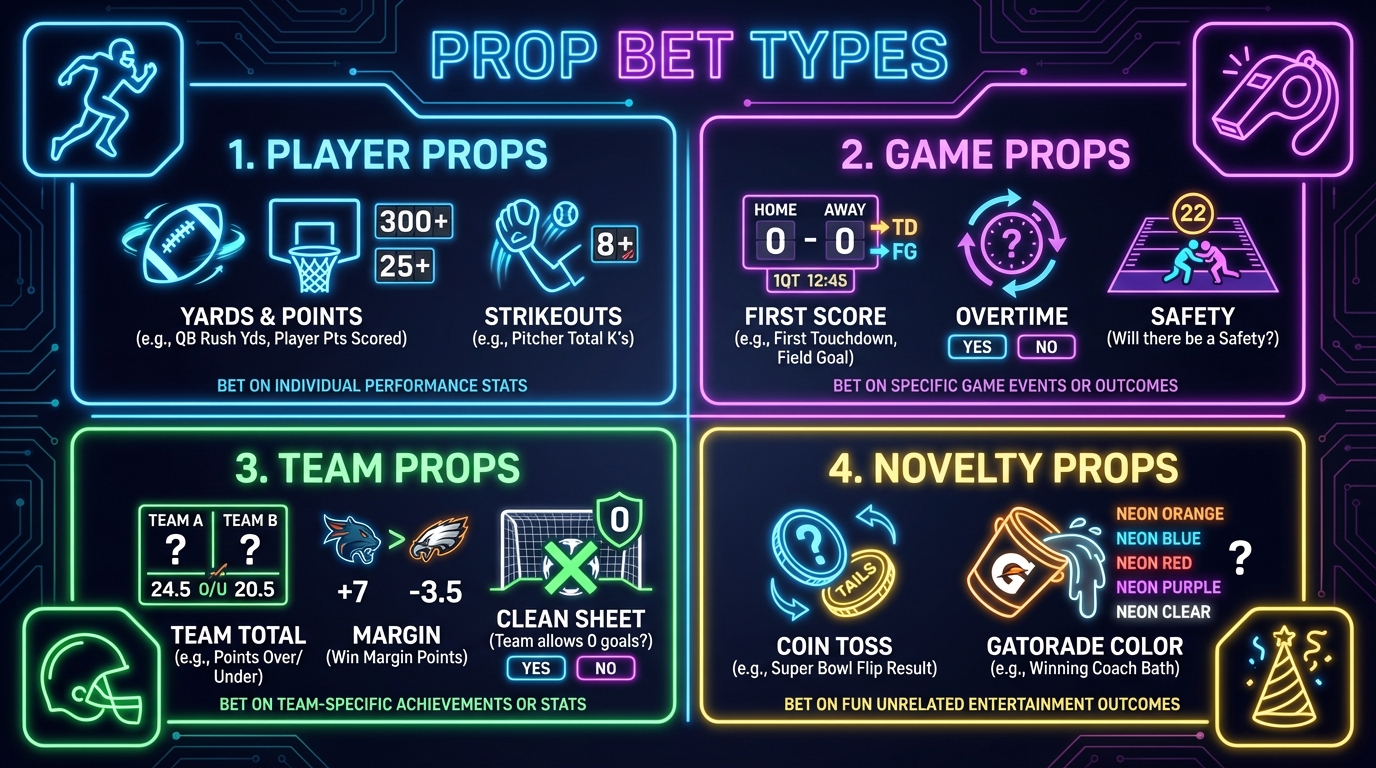
Player Props
Player props are individual performance bets—the bread and butter of prop betting. Sportsbooks set a projected stat line, and you bet whether the player goes over or under that number.
| Sport | Common Player Props | What to Watch |
|---|---|---|
| NFL | Passing yards, TDs, rushing yards, receptions, receiving yards | Weather, pace, defensive matchups, game script |
| NBA | Points, rebounds, assists, 3-pointers, steals, blocks, PRA combos | Pace, rest days, back-to-backs, rotation changes |
| MLB | Strikeouts, hits, home runs, RBIs, total bases, pitcher outs | Ballpark, platoon splits, umpire tendencies |
| NHL | Goals, assists, shots, shots on goal, saves, points | Power play time, line combinations, goalie matchups |
| Soccer | Goals, assists, shots, shots on target, cards | Tactical setup, rest, opponent defensive style |
Game Props
Game props focus on events within the contest without tying to final scores. These range from straightforward questions to creative scenarios:
- First to Score: Which team scores first? Which player scores first?
- Scoring Method: Will there be a safety? A pick-six? An own goal?
- Time-Based: Will there be a score in the first 5 minutes?
- Yes/No Props: Will there be overtime? Will both teams score in every quarter?
- Race to X: Which team reaches 20 points first?
Some game props overlap with correct score betting, particularly margin-of-victory and exact-score propositions. The difference is that game props typically offer more granular outcomes and higher odds.
Team Props
Team props isolate one side’s performance regardless of the opponent’s output. This is useful when you have a strong read on one team but uncertainty about the other.
- Team Totals: Chiefs over/under 27.5 points (independent of opponent’s score)
- Half/Quarter Totals: Lakers first half over/under 56.5
- Margin Props: Will the favorite win by 10+? By exactly 7?
- Clean Sheet: Will a soccer team keep a shutout?
Novelty Props
Novelty props cover non-game events—most popular during the Super Bowl. National anthem length, Gatorade color, halftime show song selections. These are entertainment bets with limited analytical edge (though some sharp bettors do time anthem rehearsals).
Player Props by Sport: Deep Dive
NFL Player Props
NFL props offer the most inefficiency because games happen once a week and sample sizes are tiny. Sportsbooks can’t react to information as quickly as in daily sports.
Quarterback Props: Passing yards (most liquid), passing TDs, interceptions, rushing yards. Look for weather impacts—wind over 15 mph consistently suppresses passing volume. Dome QBs on the road in cold weather often underperform their lines.
Receiving Props: Receptions, receiving yards, and anytime TD scorer. Target share percentage is your best friend here. A receiver with 25%+ target share in a positive game script is gold. Watch for shadow coverage situations—elite corners traveling with a team’s WR1 pushes targets to the slot and TE.
Rushing Props: Rushing yards and attempts correlate heavily with game script. A team favored by 7+ points in a projected high-scoring game likely runs less than their season average. Look for revenge narratives—running backs against former teams historically outperform.
NBA Player Props
NBA props move fast because of daily games and real-time injury news. The edge here is reaction speed and understanding usage redistribution.
Points + Rebounds + Assists (PRA): Combo props that smooth out variance. A player might score 18 or 28 depending on shot-making, but their overall involvement (PRA) stays more consistent. Great for high-usage players.
Pace Matters: A game with 210+ Vegas total plays faster, meaning more possessions, more stats across the board. Conversely, grinding defensive matchups suppress everyone’s numbers. The difference between a 208 and 228 game total can swing a point prop by 3-5 points.
Rest and Back-to-Backs: Players on the second night of back-to-backs average 2-4% fewer minutes. Veterans especially see load management. Check recent rest patterns before betting overs.
MLB Player Props
Baseball props are all about platoon splits and matchups. A hitter’s season average means little compared to how they perform against the specific pitcher type they’re facing.
Pitcher Strikeouts: The most popular MLB prop. Look at opponent strikeout rate (K%), ballpark factors, and whether the pitcher is on normal rest. Aces facing high-K% lineups in pitcher-friendly parks consistently exceed their strikeout totals.
Total Bases: More stable than home run props because it captures all extra-base hits. A 1.5 total bases line means the batter needs either two singles or one extra-base hit. Check recent batted ball data—a hitter with elevated hard-hit rate but bad luck is due for regression.
NHL Player Props
Hockey props are thinly traded, which creates opportunity but also limits bet sizes. Shots on goal is the primary market.
Shots on Goal: Top-line players average 3-4 SOG per game. Power play time is crucial—PP1 units get the most shooting opportunities. Look for favorable matchups against passive defensive teams that allow high shot volumes.
Anytime Goal Scorer: High variance but fun. Target players with high shooting percentage and favorable goalie matchups. Backup goalies facing top lines offer inflated goal-scoring probability.
Live and In-Game Props
Live prop betting is the fastest-growing segment of the prop market. Once a game kicks off, sportsbooks continuously update player lines based on real-time performance, game flow, and remaining time.
Where Live Props Shine: A quarterback has 180 passing yards at halftime, and the book posts a second-half line of 125.5. If the game is tied and you expect a pass-heavy shootout, the over becomes valuable because the game script supports continued aerial attack. Conversely, if his team leads by 21, expect run-heavy clock management and take the under.
The Speed Advantage: Live props reward bettors who watch games closely. Injuries, momentum shifts, and tactical adjustments all create windows where the book’s algorithm lags behind reality. A basketball player whose defender just picked up his fourth foul in the third quarter is about to see more aggressive play—the live points prop hasn’t adjusted yet.
Caution: Live props carry wider juice (often -120 to -130) and lower limits than pregame markets. The cash out feature becomes relevant here—if your live prop is winning but game circumstances shift, locking in partial profit can be the disciplined move.
Same Game Parlays and Correlated Props
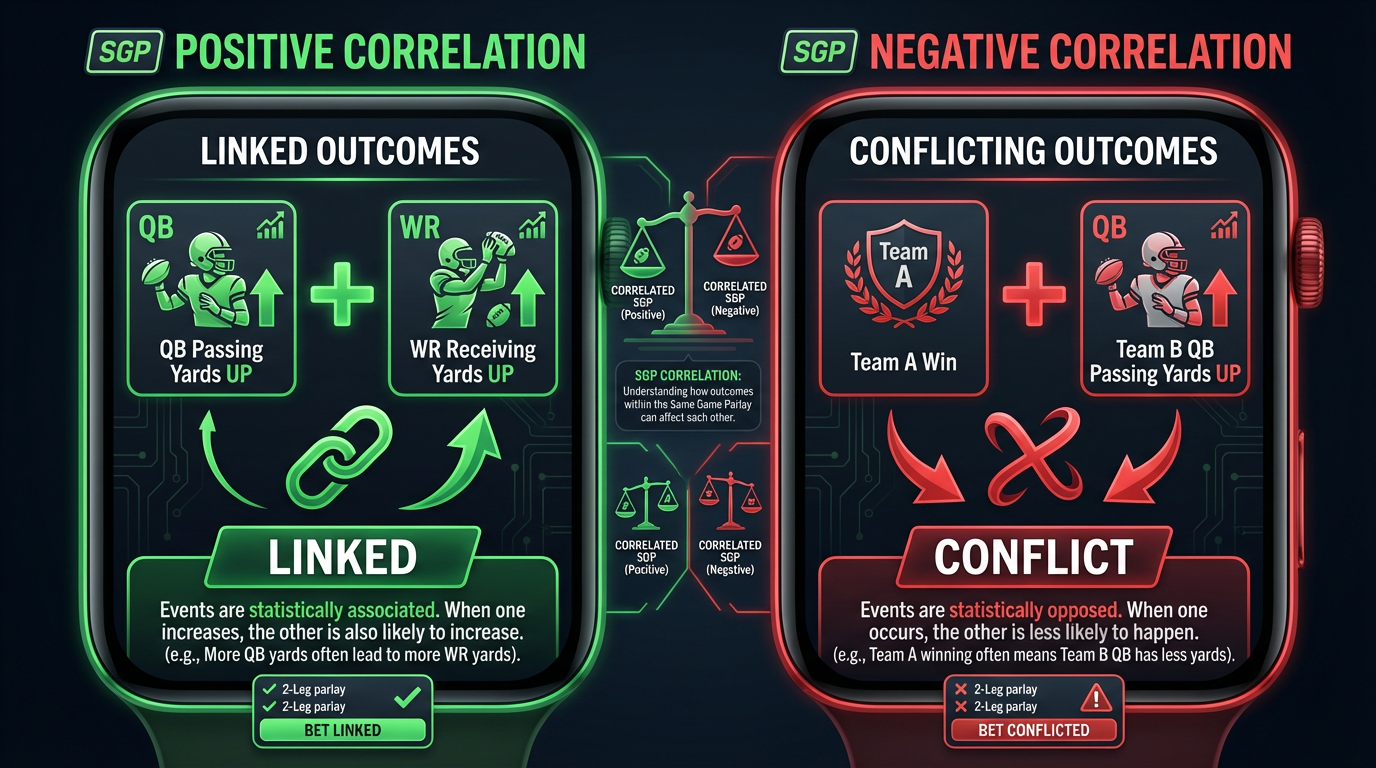
Same Game Parlays (SGPs) let you combine multiple props from a single game into one bet. The catch: sportsbooks adjust the odds to account for correlation, but they don’t always price it perfectly. If you understand how parlays work, SGPs are the next logical step—applying correlation logic instead of stacking independent outcomes.
POSITIVE VS NEGATIVE CORRELATION
Positive Correlation (Good)
- QB passing yards + WR receiving yards
- High game total + player overs
- Team win + star player performance
- Running back carries + team rushing yards
Negative Correlation (Risky)
- Both starting QBs over passing yards
- Underdog win + star player over
- Low game total + player overs
- Opposing RBs both hitting overs
The SGP Sweet Spot: Two to three correlated legs where the outcomes support each other. A high-scoring game projection plus the lead back on the underdog going under (because they’ll be passing to catch up) is logical correlation. Stacking five random props because the parlay odds look juicy is how sportsbooks profit.
Pro Tip: Build SGPs around game script. If you expect a blowout, bet the favorite’s RB over rushing + underdog’s QB over passing (garbage time). If you expect a close defensive battle, bet unders across the board. The logic should flow from game state, not stat-hunting.
Prop Betting Strategy
Line Shopping Is Non-Negotiable
Prop lines vary more across sportsbooks than spreads or totals. One book might have Patrick Mahomes at 285.5 passing yards while another has 278.5. That 7-yard swing is the difference between a 52% win rate and a 48% win rate—which is the difference between profitable and losing.
Keep accounts at 3-5 sportsbooks minimum. Before placing any prop bet, check all available lines. Odds comparison tools exist specifically for this purpose. The 30 seconds of comparison frequently adds 2-3% to your expected return.
Understand the Juice
Standard spreads and totals typically carry -110/-110 juice (4.55% vig). Prop markets often run -115/-115 (6.5% vig) or worse. Some alternate lines push to -120 or beyond. This means you need to hit approximately 53.5% instead of 52.4% to break even. Understanding how the house edge works helps you calculate whether a perceived edge actually overcomes the vig.
The higher vig isn’t necessarily bad—it reflects the market inefficiency that creates opportunity. But it does mean you need a stronger edge on props than on main lines to profit.
Focus on Information Edges
Props reward deep knowledge more than any other bet type. Sharp bettors on main lines have billions of dollars and sophisticated models. Prop markets have lower limits, less sharp action, and more pricing errors.
Where to find edges:
- Injury impact: How does a missing player redistribute usage? If a team’s WR2 is out, does the WR3 absorb targets or does the TE?
- Matchup specifics: Not just “good defense vs bad offense” but specific positional battles
- Situational factors: Revenge games, contract years, milestone chasing
- Weather: Particularly impactful for NFL passing props
- Pace and style: Team tempo affects everyone’s stat potential
Bankroll Management for Props
Props carry higher variance than sides and totals because individual performances fluctuate more than team outcomes. A quarterback might average 280 yards per game but swing between 180 and 380 depending on game flow.
Recommended approach: Keep prop bets to 1-2% of your bankroll per play. If you’re betting $100 units on spreads, bet $20-50 units on props. The smaller sizing accounts for the higher variance while still capitalizing on your edges. Also keep in mind the federal gambling loss deduction rules—tracking your prop bet wins and losses separately helps at tax time.
IMPORTANT: SPORTSBOOK LIMITS
Props typically have much lower limits than main markets—often $200-500 for NFL player props versus $10,000+ on spreads. If you’re consistently winning, books will limit your prop access quickly. Diversify across multiple books and avoid obvious tells like always betting the same sport/market.
Prop Bet Integrity: What Can Go Wrong
Player props have a unique vulnerability: the person being bet on can directly influence the outcome. Unlike point spreads where an entire team must underperform, a single player can manipulate their own stat line. This makes prop markets a target for manipulation schemes.
Recent cases illustrate the risk. An NBA prop bet scheme saw a gambler coordinate with players to control stat outcomes, turning small prop bets into guaranteed payouts via parlays. The scheme exploited exactly the kind of correlated-prop logic discussed above—but with inside information rather than analytical edge.
What this means for bettors: Suspicious line movements on obscure player props (especially unders on less-monitored stats like rebounds or assists) can indicate integrity issues. If a line moves sharply against the public without injury news, proceed with caution. Sportsbooks increasingly void bets on games with confirmed integrity violations, so even “winning” a compromised prop may not pay out.
Common Prop Betting Mistakes
1. Ignoring Matchups for Season Averages: A receiver averaging 75 yards per game matters less than whether he’s facing a bottom-5 secondary or a shutdown corner. Context always beats aggregate data.
2. Overloading SGPs: Four-leg SGPs hit roughly 6-7% of the time even with favorable individual legs. The parlay multiplier feels exciting but the math crushes long-term returns. Stick to 2-3 correlated legs maximum.
3. Not Checking Alternate Lines: Sometimes the -0.5 alternate at -150 offers better expected value than the main line at -110. Run the numbers before assuming the standard line is best.
4. Fading Public Favorites: Just because everyone bets Mahomes’ over doesn’t mean the under is value. Public money on props is smaller than on main lines—sportsbooks don’t always shade popular players as heavily as you’d expect.
5. Ignoring Game Script: A 14-point favorite’s running back might see 25 carries or 12 carries depending on how the game unfolds. Project the likely game state, not just the matchup.
Conclusion
Prop betting rewards homework. Unlike spreads and totals where massive betting pools create efficient markets, player and game props maintain soft spots that educated bettors can exploit. The higher vig means you need stronger conviction, but the flip side is less competition from sharp syndicates who can’t bet meaningful volume in these markets anyway.
Start with one sport you know deeply. Master the prop markets there—understand what moves lines, which books offer the best numbers, what factors the market underweights. Then expand. The prop betting edge doesn’t come from picking winners; it comes from knowing more about specific situations than the lines reflect. When you can identify a 55% opportunity priced at -115, you’ve found sustainable profit.
KEY TAKEAWAYS
- What They Are: Props bet on specific events/performances within a game, not final outcomes
- Best Markets: NFL player props and NBA scoring props offer the most inefficiency
- Critical Strategy: Line shop across 3-5 books—prop lines vary more than main markets
- Vig Reality: Props run -115 to -120 juice; you need a stronger edge than on spreads
- SGP Approach: Stick to 2-3 positively correlated legs; avoid random prop stacking
- Live Props: Growing market with wider juice but real-time information advantages
- Watch Out: Lower limits mean books restrict winning prop bettors quickly
- Bottom Line: Props reward deep knowledge over broad action—specialize to profit
FAQs
What is a prop bet in sports betting?
A prop bet (proposition bet) is a wager on a specific event or player performance within a game rather than the final outcome. Examples include betting on a quarterback’s passing yards, whether there will be a safety, or which team scores first. Props let you profit from detailed knowledge about matchups and situations.
What is the difference between player props and game props?
Player props focus on individual performance statistics like passing yards, rebounds, or strikeouts. Game props focus on events within the contest regardless of individual players—like which team scores first, whether there will be overtime, or total touchdowns in the game. Both offer edges through matchup analysis but require different research approaches.
Why is the juice higher on prop bets than on spreads?
Sportsbooks charge higher juice on props (-115 to -120 vs standard -110) because these markets see less volume and less sharp action, making them harder to price efficiently. The higher vig compensates for their pricing uncertainty. However, this same inefficiency creates opportunities for educated bettors who can find edges the market missed.
How do Same Game Parlays work?
Same Game Parlays (SGPs) combine multiple props from a single game into one bet. All legs must hit for the parlay to pay. Sportsbooks adjust odds to account for correlation between outcomes—QB passing yards and WR receiving yards move together, so you won’t get full parlay odds. Stick to 2-3 logically correlated legs for best results.
What are correlated props and why do they matter?
Correlated props are bets where the outcomes influence each other. If a game goes high-scoring, most player overs become more likely. If a team dominates, their running back gets more carries while the opponent’s QB throws more in catch-up mode. Building SGPs around logical correlation (not random props) improves your hit rate and expected value.
Which sport has the best prop betting opportunities?
NFL player props offer the most inefficiency because games happen weekly, sample sizes are small, and sportsbooks can’t react quickly to information. NBA props are also profitable due to daily games creating pricing gaps when news breaks. MLB pitcher strikeouts and NHL shots on goal have value but face lower limits and thinner markets.
Why is line shopping important for prop bets?
Prop lines vary more across sportsbooks than spreads or totals. One book might have a receiver at 62.5 receiving yards while another has 58.5—a 4-yard swing that dramatically affects win probability. Shopping 3-5 books before placing props regularly adds 2-3% to expected returns, which compounds significantly over hundreds of bets.
How much should I bet on props compared to spreads?
Props carry higher variance than sides and totals because individual performances fluctuate more than team outcomes. Recommended sizing is 1-2% of bankroll per prop bet compared to 2-3% on main lines. This accounts for variance while still capitalizing on edges. Also note that sportsbooks have lower limits on props, often $200-500 versus $10,000+ on spreads.
What are live prop bets and are they worth betting?
Live prop bets are player and game props offered after a game has started, with lines updating in real-time based on game flow. They reward bettors who watch games closely and can spot advantages before the algorithm adjusts. However, they carry wider juice (-120 to -130) and lower limits than pregame props, so you need a stronger edge to profit.

Aevan Lark
Aevan Lark is a gambling industry veteran with over 7 years of experience working behind the scenes at leading crypto casinos — from VIP management to risk analysis and customer operations. His insider perspective spans online gambling, sports betting, provably fair gaming, and prediction markets. On Dyutam, Aevan creates in-depth guides, builds verification tools, and delivers honest, data-driven reviews to help players understand the odds, verify fairness, and gamble responsibly.
Related coverage

Fresno State Betting Scandal: First Nevada Felony Arrest
Nevada made its first arrest in the Fresno State betting scandal, filing fraud and money-laundering charges with more suspects to come.

CFTC Sports Prediction Market Rules: 38 States vs Kalshi
The CFTC's proposed sports prediction market rules would let Kalshi keep most bets — but 38 states are fighting back.

World Cup 2026: The Biggest Betting Event in History, by the Numbers
Analysts project $60 billion in global wagers on the 2026 World Cup — the biggest betting event ever staged.