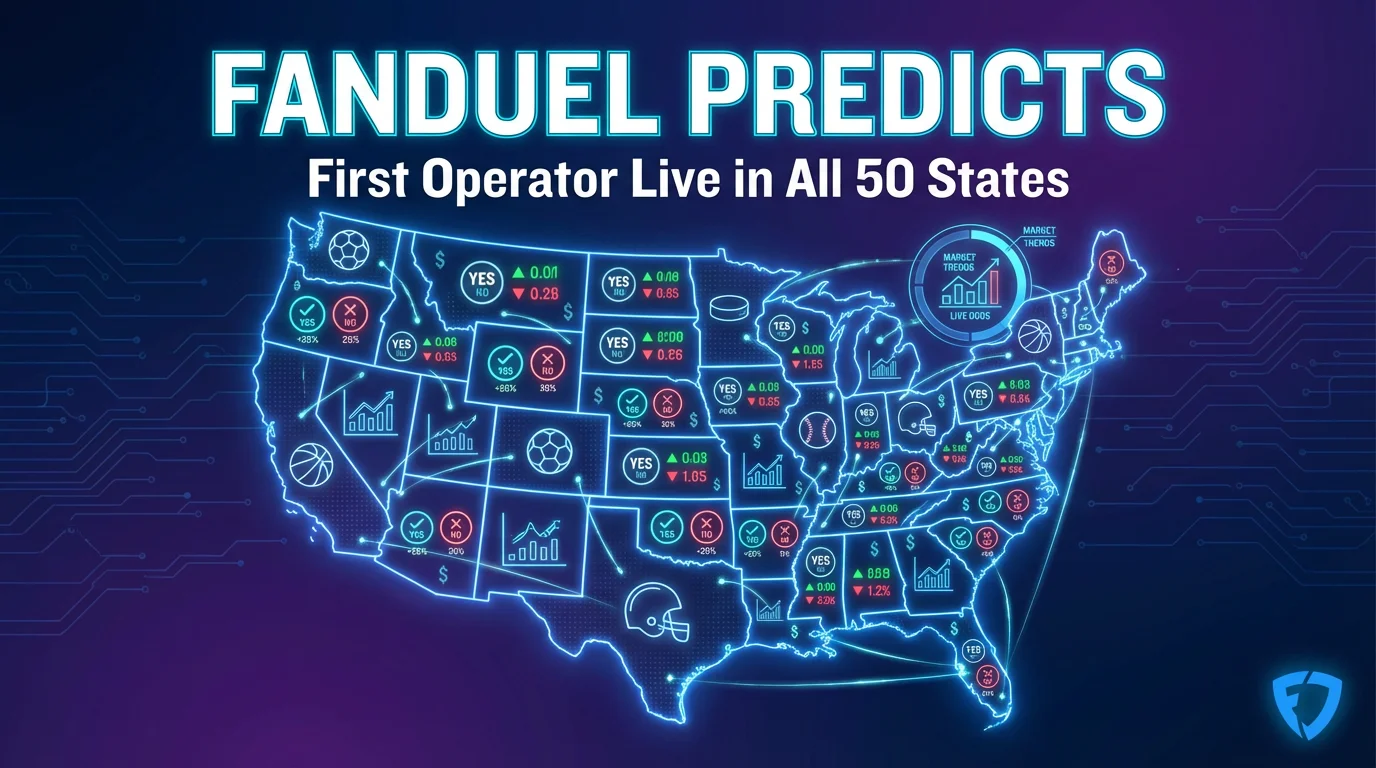
FanDuel Predicts Launches in All 50 States – Here’s What’s Available Where
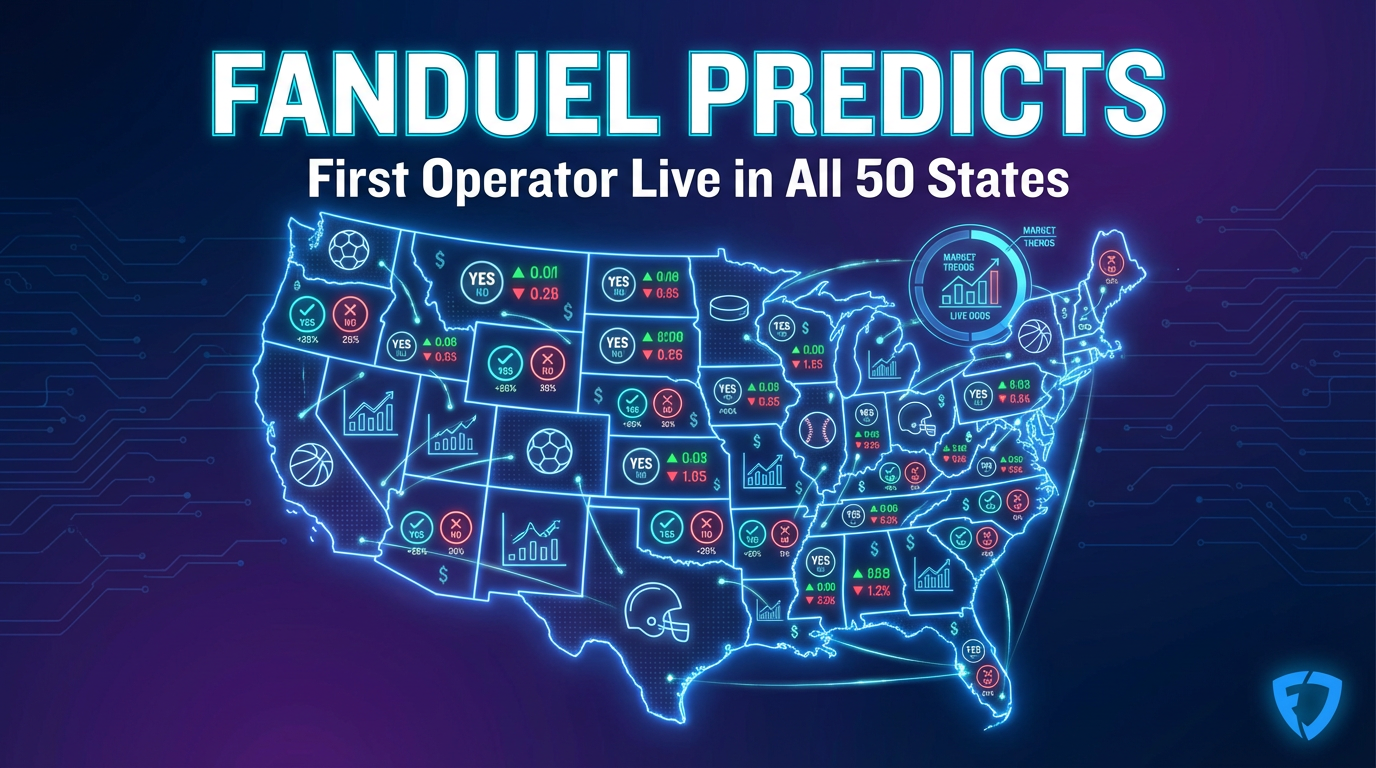
FanDuel becomes first operator live in all 50 states. Sports contracts in 18 states; finance-only where sportsbook operates.
FanDuel has become the first online gaming operator to offer prediction markets in all 50 U.S. states—completing a nationwide rollout in under four weeks. But here’s the strategic twist: sports contracts are deliberately withheld in states where FanDuel already runs a sportsbook. The goal isn’t market dominance—it’s market preparation.
KEY FACTS AT A GLANCE
- Industry Volume (2025): $63.5 billion — up 302% year-over-year
- 2026 Projection: $100 billion+ annual volume
- FanDuel User Base: 17 million registered users; 4.3 million monthly active
- CME Revenue Potential: $300 million+ from FanDuel partnership alone
- Sports Contract States: 18 (where FanDuel Sportsbook can’t operate)
The Hidden Infrastructure Play
Here’s what most coverage misses: FanDuel Predicts and DraftKings Predictions run on the same exchange. Both platforms use CME Group’s infrastructure, meaning a FanDuel user’s order can be filled by a DraftKings user—and vice versa. The apps are just different front-ends to identical order books.
This matters because it means the prediction market wars aren’t about exchange technology. They’re about user acquisition. FanDuel’s 17 million registered users versus DraftKings’ base will determine who captures the larger share of CME’s projected $300 million+ annual revenue from these partnerships.
State-by-State Breakdown
| Sports Contracts (18 States) | Finance Only (32 States) |
|---|---|
| No Legal Sports Betting: Alabama, Alaska, California, Georgia, Hawaii, Idaho, Minnesota, Nebraska, New Mexico, North Dakota, Oklahoma, South Carolina, South Dakota, Texas, Utah Monopoly Markets: Delaware (BetRivers), Florida (Hard Rock), Rhode Island (IGT) |
All 23 states where FanDuel Sportsbook operates, plus DC, Connecticut, Mississippi, Montana, Nevada, Washington, Wisconsin, Wyoming, and others without FanDuel presence |
The 18 sports states aren’t random. They’re the gaps in FanDuel’s sportsbook map—including California (39.5M population), Texas (30.5M), and Florida (22.6M). Combined, that’s 92 million people FanDuel can now reach with sports products for the first time.
The Nevada Sacrifice
Both FanDuel and DraftKings made a calculated trade-off to enter prediction markets. Flutter (FanDuel’s parent) withdrew its Nevada gaming license application; DraftKings pulled its Nevada license entirely. Nevada regulators view prediction markets as unlicensed sports betting—operators had to choose one or the other.
They chose prediction markets. The math explains why: Kalshi alone processed $23.8 billion in volume in 2025—a 1,100% increase from 2024. During the NFL playoffs, sports contracts accounted for 94% of Kalshi’s volume, with $455 million traded on a single Saturday.
KEY TAKEAWAYS
- Same exchange, different apps — FanDuel and DraftKings orders fill against each other on CME
- 92 million new users accessible — California, Texas, and Florida alone represent massive untapped markets
- Nevada license sacrificed — Both operators chose prediction markets over Nevada sports betting
- $100B industry by end of 2026 — Analysts project continued explosive growth
- Built-in exit clause — Sports contracts automatically drop when states legalize betting

Aevan Lark
Aevan Lark is a gambling industry veteran with over 7 years of experience working behind the scenes at leading crypto casinos — from VIP management to risk analysis and customer operations. His insider perspective spans online gambling, sports betting, provably fair gaming, and prediction markets. On Dyutam, Aevan creates in-depth guides, builds verification tools, and delivers honest, data-driven reviews to help players understand the odds, verify fairness, and gamble responsibly.
Related coverage
Two Bookmakers, One Tally: Unpacking SteveWillDoIt’s Gamdom Bets
A compiler’s tally separates Gamdom and Red Rock. Its conflicting figures show the limits of SteveWillDoIt’s public betting record.

Offset’s Paris Casino Clip: The Skit Claim and the $100K MotorCity Lawsuit
Offset’s reported skit explanation, conflicting Paris money claims and the dated court order in MotorCity’s separate $100,000 lawsuit.

Who Answers for a Gambling Ad? Greece’s Case Against 18 Influencers
Greek complaints against 18 influencers over alleged unlicensed gambling promotion: the case status, the fine framework and how Dutch rules compare.