The $80,000 Parlay That Almost Paid $1.1M: Inside the NBA Prop Bet Scheme That Sent a Gambler to Prison
First prison sentence in NBA prop bet scandal as Timothy McCormack gets 2 years for insider betting scheme.
Timothy McCormack, a 38-year-old self-described gambling addict, became the first person sentenced to federal prison in the sprawling NBA prop bet manipulation scandal on January 22, 2026—a case that transformed legal sportsbooks into the very integrity watchdogs that caught the scheme and is now accelerating calls to restrict or eliminate player prop markets entirely.
KEY FACTS AT A GLANCE
- Defendant: Timothy McCormack, 38, sentenced January 22, 2026
- Sentence: 24 months federal prison (prosecutors sought 41–51 months)
- Judge: LaShann DeArcy Hall, Eastern District of New York
- Scheme: Placed bets using insider info from NBA players who agreed to exit games early
- Largest single bet: $80,000 same-game parlay with $1.1M potential payout (frozen by DraftKings)
- Significance: First prison sentence in “Operation Nothing But Bet” — 34 defendants across 11 states
The $80,000 Parlay That Exposed Everything
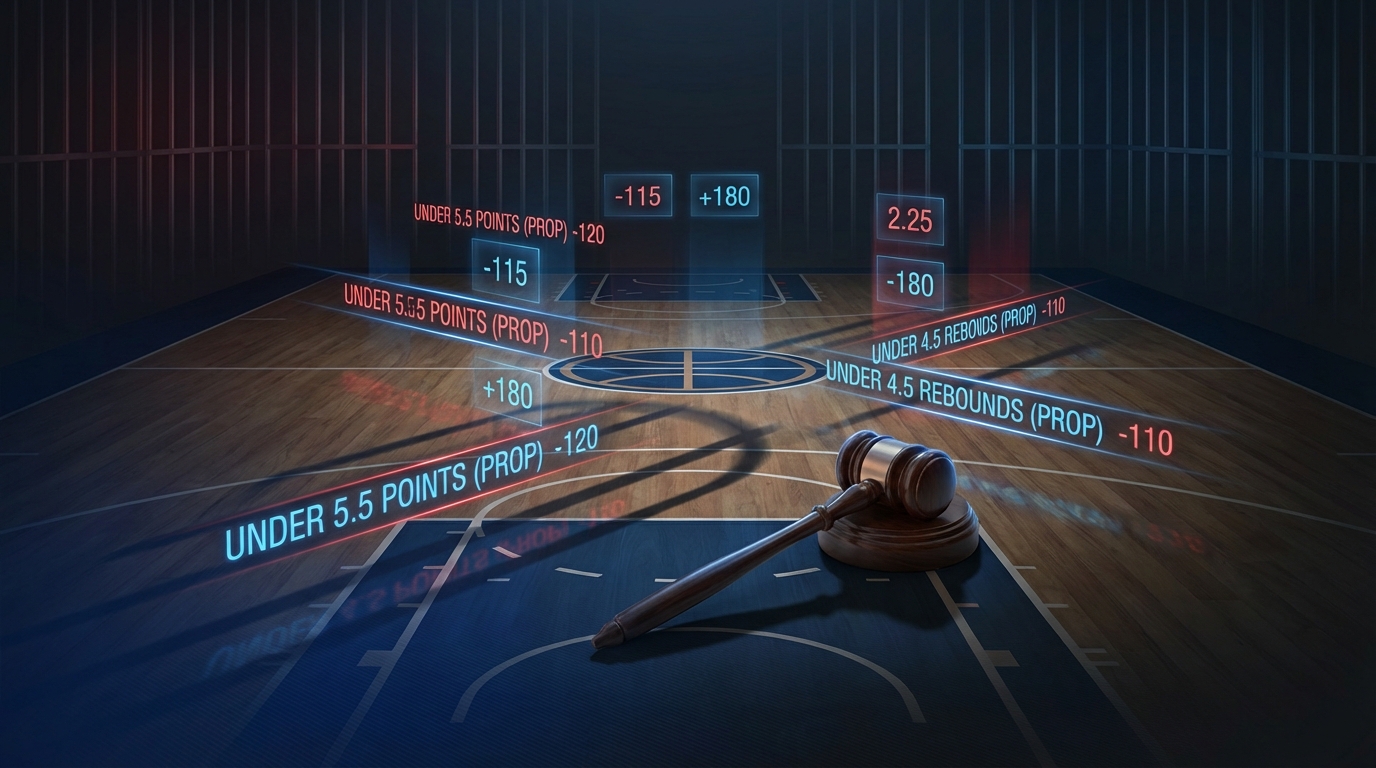
Before the Toronto Raptors tipped off against the Sacramento Kings on March 20, 2024, co-conspirator Mahmud Mollah walked into a DraftKings retail sportsbook in Atlantic City and placed an $80,000 six-leg same-game parlay. Every leg was an under on Jontay Porter’s stats: points, rebounds, assists, three-pointers, steals, and blocks. The potential payout exceeded $1.1 million.
Porter played two minutes and 43 seconds that night. He cited illness, walked off the court with zero points and two rebounds, and every single under hit automatically. But the $1.1 million never paid out. DraftKings’ algorithms had already flagged the game—Porter’s prop unders were the biggest moneymaker among all NBA player props that evening, and multiple accounts had attempted bets of $10,000 to $20,000 on a player whose standard prop limits topped out around $2,000.
McCormack was there that night too. He placed an $8,000 under bet on Porter’s rebounds, pocketing $36,000 in profit. Together with three co-conspirators, they collectively wagered more than $12,600 and won nearly $57,000 on that single game. It was, as prosecutors later described it, “cold, hard fraud.”
How the Scheme Worked
The mechanics were devastatingly simple. Porter, a two-way contract player earning roughly $415,000 per season with the Raptors, agreed to exit games within the first few minutes. Co-conspirators would flood sportsbooks with under bets on his stats before tipoff—points under 5.5, rebounds under 4.5, assists under 1.5, three-pointers under 0.5. Once Porter left the game, every under cashed automatically regardless of the line.
The pattern repeated across multiple games. On January 26, 2024 against the Clippers, Porter played four minutes and 24 seconds before citing a re-aggravated eye injury. He finished with zero points, three rebounds, and one assist. McCormack had placed a $7,000 four-leg under parlay on Porter’s stats, profiting $33,250. DraftKings reported the next day that Porter’s three-point under was the single biggest moneymaker for bettors of any NBA player prop that evening.
The scheme extended beyond Porter. On March 23, 2023, Charlotte Hornets guard Terry Rozier allegedly tipped off childhood friend Deniro Laster that he planned to exit early against the Pelicans. Rozier played nine minutes and 34 seconds before leaving with reported foot discomfort—despite not appearing on any injury report before the game. Over $200,000 in under prop bets had been placed on his stats. McCormack’s cut: six wagers totaling $23,726, yielding $53,887 in winnings.
McCormack’s role was specific. He was a “straw bettor”—someone who received insider information through intermediary Ammar Awawdeh and placed bets accordingly. He never communicated directly with Porter or Rozier. Under the profit-sharing arrangement for the March 20 game, Porter, Awawdeh, and middleman Long Phi “Bruce” Pham each received approximately 25% of winnings. McCormack received 4%.
How Sportsbooks Caught It
The scheme’s unraveling contradicts the popular narrative that legal betting corrupts sports. DraftKings’ internal algorithms identified the anomaly not through any single bet—Mollah’s $80,000 parlay was within normal VIP limits—but through the aggregate spike in betting interest on Porter unders. When a bench player on a two-way contract suddenly becomes the biggest moneymaker in your prop market two games in a row, something is wrong.
DraftKings suspended Mollah’s account before he could withdraw the majority of his winnings and reported the suspicious activity to the International Betting Integrity Association and the NBA. FanDuel independently flagged irregularities on the same games. One bettor had placed 30 separate wagers on Rozier prop unders within a 46-minute window before tipoff. These are patterns that regulated sportsbooks are designed to detect—and that the illegal market never would.
As DraftKings stated after the arrests: legal betting systems “identify and report suspicious activity, and the integrity of sport is therefore protected in a manner that does not exist in the illegal market.” The scheme was caught because of legal, regulated sportsbooks—not despite them.
The Coercion Factor
Court documents reveal a darker layer most coverage glosses over. Porter didn’t start as a willing schemer—he was coerced. By early 2024, he had accumulated significant gambling debts to Awawdeh and other co-conspirators. In an encrypted message to Awawdeh, Porter wrote: “If I don’t do a special with your terms. Then it’s up. And u hate me and if I don’t get u 8k by Friday you’re coming to Toronto to beat me up.” Awawdeh confirmed on encrypted chat that he was “forcing” Porter to participate.
They called the fixed games “specials”—code for Porter intentionally exiting early so under bets would cash. This mirrors patterns seen in overseas soccer match-fixing, where organized crime grooms vulnerable athletes through debt, then weaponizes them. The two defendants who allegedly threatened Porter—Awawdeh and Shane Hennen—remain under indictment. Pham attempted to flee the country and was arrested at JFK Airport boarding a one-way flight to Australia.
“Think about it, if you could get all your homies rich by telling them, ‘Yo, bet $10,000 on my under this one game. I’m going to act like I’ve got an injury, and I’m going sit out. I’m going to come out after three minutes.’ And they all get a little bag because you did it one game.”
— Michael Porter Jr., Jontay’s brother and NBA forward, on the “One Night with Steiny” podcast (August 2025)
Games Implicated in the Scheme
| Date | Matchup | Insider | What Happened | Bet Outcome |
|---|---|---|---|---|
| Feb 9, 2023 | Lakers vs. Bucks | Damon Jones | Leaked that LeBron James would sit | Bucks covered |
| Mar 23, 2023 | Hornets vs. Pelicans | Terry Rozier | Rozier exited after 9 min 34 sec | All unders hit |
| Mar 24, 2023 | Blazers vs. Bulls | Eric Earnest (Billups connection) | Key players rested; Blazers lost by 28 | Blazers lost |
| Apr 6, 2023 | Magic vs. Cavaliers | Unnamed Magic player | Lineup info leaked | Unknown |
| Jan 15, 2024 | Lakers vs. Thunder | Damon Jones | Player availability leaked | Unknown |
| Jan 26, 2024 | Raptors vs. Clippers | Jontay Porter | Porter exited after 4 min (eye injury) | All unders hit |
| Mar 20, 2024 | Raptors vs. Kings | Jontay Porter | Porter exited after 3 min (illness) | Unders hit; $80K parlay frozen |
The Regulatory Fallout
McCormack’s sentencing arrives at the exact moment American regulators are debating whether player prop markets should exist at all. The timeline of restrictions has accelerated dramatically since Porter’s lifetime NBA ban in April 2024. Ohio removed college player props in February 2024. By summer 2024, the NBA had asked sportsbook partners to stop offering props on two-way and 10-day contract players—the informal “Jontay Porter Rule.” In August 2025, Ohio Governor Mike DeWine called for a full nationwide ban on prop bets after two Cleveland Guardians pitchers were suspended for suspicious betting activity on individual pitches.
NBA Commissioner Adam Silver acknowledged in October 2025 that certain betting markets are “too easy” to manipulate, specifically calling out prop bets on two-way players who “don’t have the same stake in the competition.” The NBA now requires injury reports between 11 a.m. and 1 p.m. on game days, with public updates every 15 minutes. MLB has gone further, reaching agreements with major sportsbooks including DraftKings and FanDuel to cap micro prop bets at $200—the only professional sports league to implement such restrictions.
The industry’s counter-argument comes from the American Gaming Association: prohibition pushes betting underground, where no one monitors it and no algorithms flag suspicious activity. The detection of this very scheme—by DraftKings and FanDuel’s internal systems—is their strongest evidence. States with college prop restrictions now include Ohio, Louisiana, Maryland, and Vermont, with over 20 states imposing some form of limits. But professional prop bets remain largely unrestricted, and McCormack’s sentencing is unlikely to settle the debate. If anything, it gives both sides ammunition.
What’s Next
McCormack must report to prison by April 20, 2026, followed by one year of supervised release during which he cannot gamble. But his sentencing is just the first domino. Jontay Porter pleaded guilty in July 2024 and still awaits sentencing after multiple delays. Terry Rozier pleaded not guilty on December 8, 2025 and remains on a $3 million bond, with his attorneys arguing the charges violate a recent Supreme Court ruling narrowing federal wire fraud—his next court date is March 3, 2026. Chauncey Billups, charged in the related “Operation Royal Flush” rigged poker scheme involving Bonanno, Genovese, and Gambino crime families, is out on $5 million bail with travel restrictions and a gambling ban. Damon Jones pleaded not guilty in November 2025, released on $200,000 bond.
The scope of “Operation Nothing But Bet” now encompasses 34 defendants across 11 states, with tens of millions of dollars in fraudulent wagers. In January 2026, 26 additional people were charged in a related college basketball point-shaving scheme. FBI Director Kash Patel called it “the insider trading saga for the NBA.” Whether the judicial system treats it with corresponding severity remains to be seen—McCormack’s two years, after all, was half what prosecutors requested.
KEY TAKEAWAYS
- First judicial precedent — McCormack’s 2-year sentence establishes the benchmark for prop bet manipulation in the post-legalization era
- Regulated markets work — DraftKings and FanDuel caught the scheme through algorithmic detection, not law enforcement tips
- Coercion, not just greed — Porter was threatened into participation through gambling debts, mirroring overseas match-fixing patterns
- Prop market vulnerability — Two-way players earning $415K are structurally easier to corrupt than max-contract stars
- Regulatory momentum building — From Ohio’s college ban to MLB’s $200 cap, restrictions are tightening but professional props remain largely untouched
Related tools: Parlay Calculator · Expected Value Calculator · Odds Converter
Sources
- Operation Nothing But Bet Indictment — U.S. Attorney’s Office, Eastern District of New York
- NBA Bans Jontay Porter for Gambling Violations — NBA Official
- Sports Wagering Market Integrity Act — U.S. Congress

Aevan Lark
Aevan Lark is a gambling industry veteran with over 7 years of experience working behind the scenes at leading crypto casinos — from VIP management to risk analysis and customer operations. His insider perspective spans online gambling, sports betting, provably fair gaming, and prediction markets. On Dyutam, Aevan creates in-depth guides, builds verification tools, and delivers honest, data-driven reviews to help players understand the odds, verify fairness, and gamble responsibly.
Related coverage
Two Bookmakers, One Tally: Unpacking SteveWillDoIt’s Gamdom Bets
A compiler’s tally separates Gamdom and Red Rock. Its conflicting figures show the limits of SteveWillDoIt’s public betting record.
Offset’s Paris Casino Clip: The Skit Claim and the $100K MotorCity Lawsuit
Offset’s reported skit explanation, conflicting Paris money claims and the dated court order in MotorCity’s separate $100,000 lawsuit.
Who Answers for a Gambling Ad? Greece’s Case Against 18 Influencers
Greek complaints against 18 influencers over alleged unlicensed gambling promotion: the case status, the fine framework and how Dutch rules compare.