New Zealand Declares Prediction Markets Illegal Gambling — But Polymarket Hasn’t Blocked Access Yet
New Zealand's gambling regulator classifies Kalshi and Polymarket as illegal, but enforcement gaps leave platforms accessible.
New Zealand’s gambling regulator has declared Kalshi and Polymarket illegal under the country’s Gambling Act 2003 — but while Kalshi moved quickly to geoblock Kiwi users, Polymarket still hasn’t restricted access, exposing a widening gap between regulatory classification and actual enforcement in the prediction markets space.

KEY FACTS AT A GLANCE
- Regulator: NZ Department of Internal Affairs (DIA)
- Classification: Kalshi & Polymarket = illegal gambling
- Legal basis: Gambling Act 2003
- Kalshi response: Added NZ to blocked countries list
- Polymarket response: NZ still not on restricted list
- NZ users affected: Unknown (NZ$127K+ wagered on OCR decision alone)
- Global context: 33+ countries have restricted Polymarket
What Did New Zealand’s Regulator Actually Say?
The Department of Internal Affairs’ Gambling Director Vicki Scott left no room for ambiguity. In a statement to Newsroom NZ, she confirmed that her department views prediction market platforms as gambling operators — and unauthorized ones at that.
“We consider platforms such as Kalshi and Polymarket to be gambling under New Zealand law. Since they aren’t authorised operators, they are prohibited from offering their gambling products to people in this country.”
— Vicki Scott, DIA Gambling Director
The classification falls under New Zealand’s Gambling Act 2003, which broadly defines gambling as paying consideration for a chance to win a prize. Scott made clear that prediction markets — regardless of how they brand themselves — meet that definition in the eyes of NZ regulators.
What makes the DIA’s approach notable is its measured tone. Scott acknowledged that neither Kalshi nor Polymarket actively markets to New Zealanders, which affects enforcement priority. But she was clear on the legal reality.
“We prioritise contacting websites that actively market themselves to New Zealanders… Neither Kalshi or Polymarket do that. However, we intend to send them a notification for the sake of clarity.”
— Vicki Scott, DIA Gambling Director
Scott also delivered a direct warning: “To the extent these platforms are taking bets from New Zealand customers, they are breaching the law here and can expect to hear from us.” At the time of the initial Newsroom report, the DIA had not yet formally notified either platform.
The Compliance Split — Kalshi vs Polymarket
The two platforms’ responses to the NZ classification couldn’t be more different — and the contrast reveals a lot about how each company approaches regulatory risk.
PLATFORM COMPLIANCE COMPARISON
KALSHI — COMPLIED
- Added NZ to blocked countries list quickly after ruling
- Declined to comment publicly
- Positions itself as a CFTC-regulated financial derivatives exchange
- Currently CNN’s official prediction market partner
- Pattern of proactive compliance with international regulators
POLYMARKET — HAS NOT COMPLIED
- NZ still NOT on restricted countries list
- NZ users have unrestricted access
- No public response to the classification
- Already restricted in 33+ countries globally
- Valued at NZ$12B+ in recent capital raise
- Partnered with Golden Globes
Kalshi’s quick compliance is consistent with its broader strategy of positioning itself as a legitimate, regulated financial exchange. As a CFTC-regulated entity in the United States, Kalshi has more to lose from appearing to flout international regulators — even those whose classification it likely disagrees with.
Polymarket’s non-response follows a different pattern. The platform is accessible in roughly 180 countries but restricted in 33+, suggesting it takes a selective approach to compliance. New Zealand, with its relatively small user base and no ISP-level blocking mechanism, may not register as a priority.
Why Prediction Markets Keep Getting Called Gambling
At the heart of every prediction market regulatory battle is a classification problem: these platforms simultaneously resemble financial derivatives and gambling products. The outcome depends entirely on which lens a regulator chooses to apply.
New Zealand is now the latest jurisdiction to look at prediction markets and see gambling. Australia’s ACMA reached the same conclusion when it banned Polymarket in August 2025, explicitly stating that users were “not engaging with or purchasing financial products under Australian law.” The Netherlands’ KSA reached a similar conclusion, threatening Polymarket with an €840,000 fine.
The pattern is clear: when regulators examine the actual mechanics — users deposit money, pick an outcome, and either win or lose based on a future event — they see gambling. The fact that Kalshi holds CFTC approval in the US doesn’t change how other jurisdictions classify the same activity under their own laws.
This classification divide isn’t just academic. It determines whether platforms need gambling licenses (expensive, heavily regulated) or financial services licenses (different regime, different requirements), and whether users have access to consumer protections designed for bettors or investors.
New Zealand’s Gambling Landscape Is Changing Fast
The prediction markets classification arrives at a pivotal moment for New Zealand’s gambling regulation. The country is in the midst of overhauling its online gambling framework through the Online Casino Gambling Bill, which would create a licensed online casino market for the first time.
Currently, online wagering in New Zealand is a monopoly held by TAB (operated by Entain). The new bill would auction 15 online casino licenses, with no single entity allowed to hold more than three — a deliberate attempt to create a competitive but controlled market.
| Milestone | Timeline | Details |
|---|---|---|
| First Reading | July 2025 | Bill introduced to Parliament |
| License Auction | Sept 2026 | 15 licenses, max 3 per entity |
| Licenses Issued | Dec 2026 | Operators begin onboarding |
| Market Launch | Q1 2027 | Licensed online casinos go live |
Prediction markets don’t fit neatly into either the existing TAB monopoly framework or the proposed online casino licensing structure. The DIA’s classification as “gambling” means these platforms would theoretically need authorization under NZ law — but no clear licensing pathway exists for prediction market operators specifically.
The Global Regulatory Domino Effect
New Zealand joins a growing list of jurisdictions that have taken action against prediction markets. The pattern is striking: countries are not waiting for the US to establish a global regulatory framework. They’re making their own calls — and overwhelmingly choosing the “gambling” label.
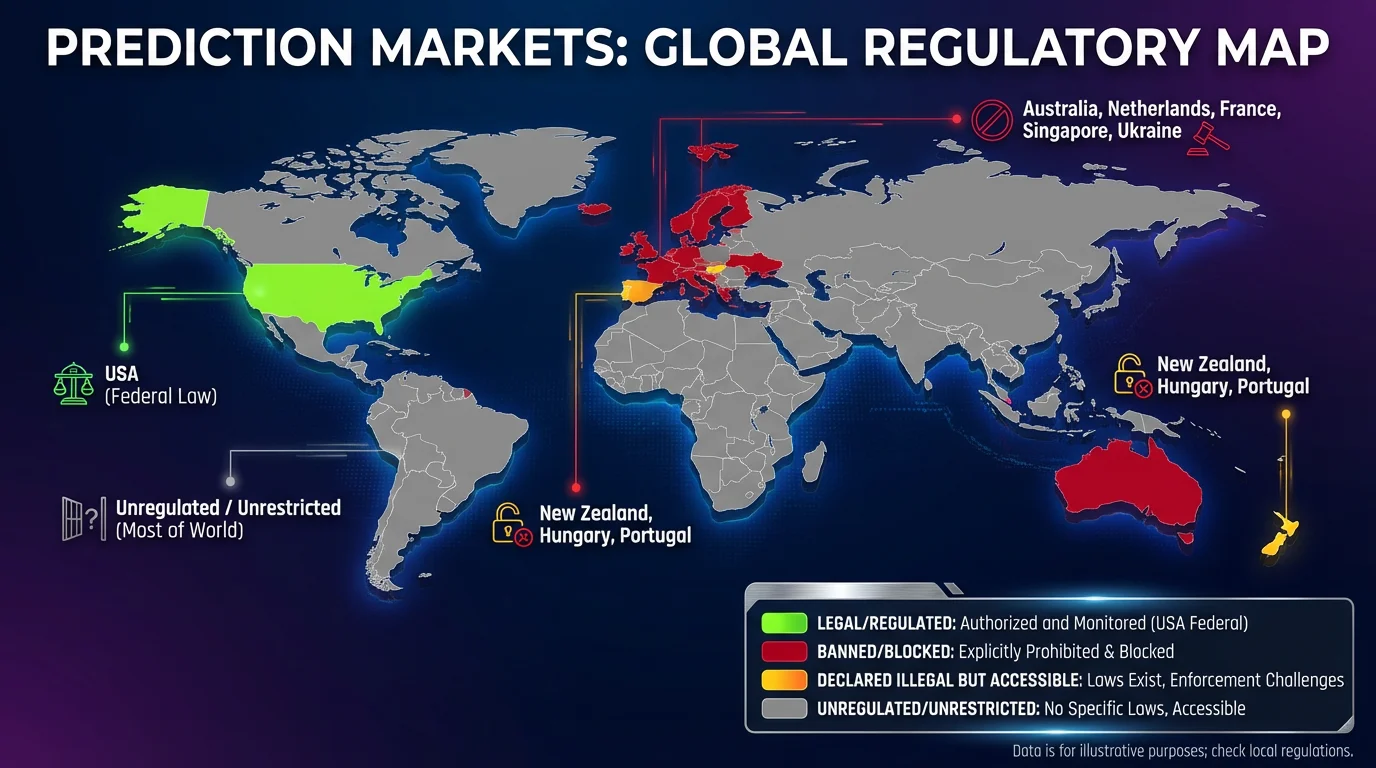
| Country | Action Taken | Date |
|---|---|---|
| Australia | ISP-level blocking via ACMA | Aug 2025 |
| Netherlands | KSA penalty order, €840K fine threat | 2025 |
| France | Restricted to view-only mode | 2025 |
| Ukraine | Ban (war betting controversy) | 2025 |
| Romania | Blacklisted (election wagering) | Oct 2025 |
| Singapore | Restricted | Pre-2025 |
| Hungary | Temporary ban | Jan 2026 |
| Portugal | Ban (no authorization + political betting prohibited) | Jan 2026 |
| New Zealand | Classified as illegal gambling | Feb 2026 |
| US (Tennessee, Nevada) | Cease-and-desist / enforcement actions | Jan–Feb 2026 |
Australia went the furthest with ISP-level blocking after ACMA found 1.9 million visits from Australian users between November 2024 and May 2025. The EU remains fragmented with no unified framework — individual member states are taking their own approaches while MiCA regulation remains pending. Meanwhile in the US, the contrast is stark: federal CFTC approval coexists with state-level pushback from Tennessee and Nevada.
The Ukraine ban stands out for a different reason — it was driven by ethical concerns over markets allowing bets on war casualties and territorial outcomes, a controversy that highlighted the moral limits of the “predict anything” model.
The Enforcement Gap — Legal Ban, Open Access
Here’s the uncomfortable reality: New Zealand has declared prediction markets illegal, but NZ users can still access Polymarket right now with no technical barrier whatsoever. The country does not currently geoblock gambling websites, and Polymarket hasn’t self-imposed restrictions.
This creates a significant enforcement gap. Compare New Zealand’s approach to Australia’s, where ACMA directed ISPs to block Polymarket at the network level — making access impossible without a VPN. New Zealand has done the legal classification but none of the technical enforcement.
STEP 1: NOTIFICATION
DIA formally notifies platforms they’re operating illegally in NZ. Kalshi already complied at this stage.
STEP 2: PAYMENT BLOCKING
Regulators could target payment processors and banks to prevent NZ users from depositing funds on platforms.
STEP 3: ISP BLOCKING
The nuclear option — directing ISPs to block platform domains entirely, as Australia did with ACMA’s intervention.
The open question is whether the DIA will escalate beyond notification. The fact that NZ$127,000+ was wagered on the Reserve Bank’s Official Cash Rate decision alone on Polymarket suggests there’s meaningful NZ user activity — even if the platforms aren’t actively marketing to Kiwi users.
For NZ users currently on prediction platforms, the situation is legally precarious but practically unchanged. The platforms remain accessible. But the legal classification means users are technically participating in unauthorized gambling — which could have implications if enforcement escalates. Tools like an odds converter can help users understand the probability formats these platforms use, but they can’t change the legal reality.
The Torres insider trading bill in the US adds another layer — if prediction markets gain clearer federal regulation stateside, it could either provide a framework that other countries adopt or further entrench the divergence between jurisdictions that treat these platforms as financial instruments versus gambling products.
KEY TAKEAWAYS
- NZ classified prediction markets as illegal gambling — The Department of Internal Affairs declared Kalshi and Polymarket in breach of the Gambling Act 2003
- Kalshi complied quickly; Polymarket hasn’t — Kalshi added NZ to its blocked list, while Polymarket still allows unrestricted access from New Zealand
- Growing global pattern — NZ follows Australia, Netherlands, Ukraine, and others in rejecting the “financial instrument” framing
- No technical enforcement yet — NZ has made the legal classification but hasn’t implemented geoblocking or ISP-level restrictions
- NZ gambling framework in flux — The Online Casino Gambling Bill could reshape the landscape with 15 new licenses by Q1 2027
- Regulators choosing “gambling” over “finance” — Internationally, the trend is clear: product function matters more than how platforms brand themselves
Sources
- Polymarket and Kalshi are illegal, regulator says — Newsroom NZ
- Online Casino Gambling Bill — New Zealand Legislation
- Gambling Legislation — NZ Department of Internal Affairs

Aevan Lark
Aevan Lark is a gambling industry veteran with over 7 years of experience working behind the scenes at leading crypto casinos — from VIP management to risk analysis and customer operations. His insider perspective spans online gambling, sports betting, provably fair gaming, and prediction markets. On Dyutam, Aevan creates in-depth guides, builds verification tools, and delivers honest, data-driven reviews to help players understand the odds, verify fairness, and gamble responsibly.
Related coverage

A $10 Parlay Skips FanDuel’s Illinois Fee. A $10 Straight Bet Doesn’t.
FanDuel’s 50¢ Illinois fee favors qualifying parlays over equal-sized singles, with a steep cost for small stakes.

What Does a DraftKings Gambling Warning Actually Change?
Safety Prompt, Then Promotion: Inside ProPublica’s DraftKings Test

Yasin Kol Arrested: Match-Fixing Allegations and a Disputed Money Trail
The Süper Lig referee denies wrongdoing as reported bank totals raise questions about the evidence behind the match-fixing allegations.