Downtown Grand Enters Receivership After $90M Default — What It Signals for Vegas’s Mid-Tier Casino Debt
CIM Group invested $290M. Offers are around $100M. A receiver is now selling downtown Las Vegas's biggest cautionary tale.
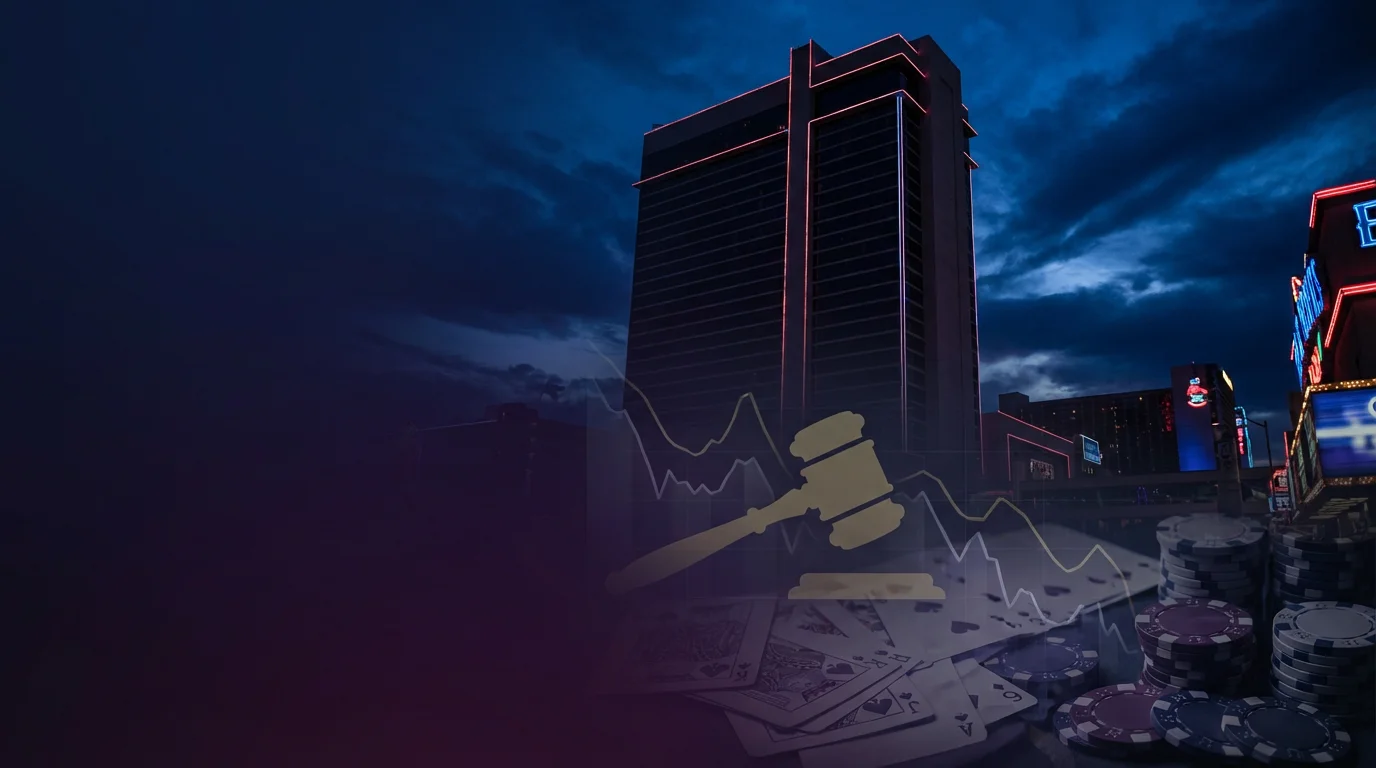
A 1,124-room casino-hotel in downtown Las Vegas is now being run by a court-appointed receiver who is actively shopping it to buyers. The Downtown Grand — once the Lady Luck, reborn in 2013 after a $100 million renovation, expanded in 2020 with a $90 million tower — defaulted on its construction loan after its owners stopped making interest payments. The Downtown Grand receivership marks the end of an 18-year, nearly $290 million bet by CIM Group, the Los Angeles-based real estate firm now facing a sale that could recover barely a third of that investment.
This is not just a story about one casino. It is the first visible crack in a casino debt refinancing cliff that has been building since the low-rate era of 2020–2022, when operators borrowed heavily against future revenue that never fully materialized. Downtown Las Vegas gaming floors generate roughly $312 in revenue per square foot — compared to $890 on the Strip. For properties carrying expansion-era leverage at those revenue levels, the math has stopped working.
If you gamble downtown, you are gambling in a corridor where the structural gap between revenue and debt has turned several mid-tier properties into ticking clocks. The Downtown Grand was the first to go off.
KEY FACTS AT A GLANCE
- Property: Downtown Grand Hotel & Casino, 1,124 rooms — corner of North 3rd Street & Ogden Avenue, downtown Las Vegas
- Owner: CIM Group (Los Angeles-based real estate and infrastructure firm)
- Total Investment: ~$290M ($100M acquisition in 2007, ~$100M renovation in 2013, $90M Gallery Tower loan in 2019–2020)
- Lender: Banc of California (formerly Pacific Western Bank)
- Default: Interest payments stopped March 21, 2025. Loan matured unpaid August 19, 2025.
- Lawsuit Filed: December 23, 2025
- Receiver Appointed: January 5, 2026 — Paul Huygens, Province LLC (Henderson, NV)
- Buyer Interest: 162 prospective buyers contacted, 25 NDAs signed, 17 meetings held. Offers reportedly around $100M — against CIM’s $180M asking price.
How the Downtown Grand Went From $290M Investment to Default
The Downtown Grand’s collapse is a story told in three phases: a long, expensive bet on downtown revitalization, a leveraged expansion at the worst possible moment, and an accelerating slide into distress that outpaced every exit strategy CIM Group attempted.
CIM Group, a private real estate and infrastructure firm headquartered in Los Angeles, acquired the shuttered Lady Luck casino in July 2007 for approximately $100 million. After gutting the property, CIM spent another $100 million on renovation and reopened it as the Downtown Grand Hotel & Casino in November 2013. For a decade, the property operated as a mid-tier downtown competitor — functional, with a standard casino floor and hotel offering, but never quite establishing the identity or pricing power of properties like Circa or the Golden Nugget.
The critical decision came in 2019. CIM secured an $82.5 million construction loan from Pacific Western Bank (now Banc of California) to fund the Gallery Tower — an eight-story, 495-room expansion that would be downtown Las Vegas’s first ground-up hotel tower in over a decade. The loan was later increased to $90 million in August 2020. The Gallery Tower opened in September 2020, directly into the COVID-19 shutdown. Downtown Las Vegas was among the slowest corridors to recover.
By 2024, CIM needed an exit. The firm listed the Downtown Grand for sale at $180 million. Four offers came in around $100 million — roughly a third of CIM’s total investment. Corvus Collective, a group led by former Cosmopolitan CEO John Unwin, got the closest but could not assemble the required cash. In early 2025, Penske Media Corp. entered advanced due diligence with plans to rebrand the property as a Rolling Stone Hotel & Casino. That deal collapsed during financial review, reportedly due to what was found in the books.
With no buyer and no path to refinancing, CIM stopped making interest payments on March 21, 2025. By July, vendor payments had also ceased and approximately 20% of the workforce was laid off. The $90 million loan matured unpaid on August 19, 2025. Banc of California filed suit on December 23, 2025, and on January 5, 2026, Clark County District Court appointed Paul Huygens of Henderson-based Province LLC as receiver.
What the Downtown Grand Default Signals for Las Vegas Casino Debt
There is a tempting counter-read to this story: CIM Group simply bungled it. An LA real estate firm that never understood gaming operations, failed to create a coherent identity for the property, and made a leveraged bet on a third tower at the worst possible moment. Under that reading, the Downtown Grand receivership is an execution failure, not a market signal. Downtown operators like Circa, Plaza, and El Cortez are publicly insisting business is “steady and resilient.”
That counter-read deserves honest consideration — but the macro data stress-tests it hard.
CIM Group’s $190 Million Loss on the Downtown Grand
CIM Group’s all-in investment was approximately $290 million: roughly $100 million to acquire the Lady Luck in 2007, another $100 million to renovate and reopen as the Downtown Grand in 2013, and $90 million for the Gallery Tower construction loan. Before the default, the property attracted offers of approximately $100 million — roughly 34 cents on the dollar of CIM’s total outlay. Under receivership conditions, the eventual sale price could be even lower. This is a capital destruction event of approximately $190 million, unfolding across a nearly two-decade hold period.
The Gallery Tower was supposed to be a catalyst. When it opened in September 2020 as downtown’s first ground-up hotel tower in over a decade, it was celebrated as a sign of corridor revitalization. Instead, it became the albatross that sank the property. The $90 million in debt was serviceable at 2019–2020 interest rates. When rates rose and occupancy failed to recover to pre-pandemic levels, the math became unworkable. This is the same dynamic playing out across the broader gambling industry’s financial correction.
The Casino Debt Refinancing Cliff Hits Downtown Las Vegas
The Downtown Grand is not an outlier — it is a canary. Properties that originated or refinanced debt in 2020–2022 at historically low rates now face maturities at far higher borrowing costs. The broader commercial real estate market faces an estimated $875 billion in loan maturities in 2026 alone. For casino and hospitality assets specifically, the exposure is concentrated in mid-tier operators who borrowed against revenue projections that assumed a full post-COVID recovery.
The structural vulnerability of downtown Las Vegas is laid bare in the numbers. Downtown gaming floors generate approximately $312 per square foot in revenue, compared to $890 on the Strip — a gap of nearly 65%. Hotel occupancy in downtown Las Vegas fell to 66.4% in November 2025, while the Strip maintained 82.0%. Downtown revenue per available room (RevPAR) dropped 14.8% year-over-year, more than triple the Strip’s 4.6% decline. January 2026 downtown gaming revenue came in at approximately $79 million, down 5% from a year ago. These are not blip numbers. They describe a corridor where properties carrying expansion-era leverage are structurally exposed.
What Happens When a Las Vegas Casino Enters Receivership
When a casino enters receivership, a court appoints a neutral third party to take control of the property, stabilize operations, and manage a sale process — all while the casino continues operating normally. Unlike bankruptcy, receivership is faster and does not require federal court involvement. In Nevada, the Uniform Commercial Real Estate Receivership Act (NRS 32.100–32.370) allows a judge to approve a sale "free and clear" of existing liens and debts, giving the buyer a clean balance sheet from day one. For bettors and downtown visitors, understanding the distinction matters: this process is designed to transition the property to a new operator quickly, without the multi-year drag of bankruptcy proceedings.
The receiver, Paul Huygens of Province LLC, has already moved aggressively. Within weeks of his January 5 appointment, he stabilized operations with additional lender funding, prepared a 53-page confidential information memorandum, uploaded more than 500 documents to a data room, and circulated sale materials to 162 prospective buyers. By mid-February, 25 parties had signed NDAs and 17 had taken meetings. A March 5 court stipulation confirmed the sale process is well underway.
IMPORTANT FOR BETTORS
Receivership does not mean closure. The Downtown Grand is operating normally — gaming floor, sportsbook (currently William Hill), hotel rooms, and dining are all open. Staff and vendors continue under the receiver's management. However, the property will change hands, and the new owner's plans for the sportsbook operation, loyalty program, room pricing, and gaming floor could shift significantly. If you hold outstanding comps, loyalty points, or prepaid reservations, monitor the situation — historically, unsecured creditors in gaming receiverships recover below 30 cents on the dollar. Understanding your risk exposure matters here.
Any ownership transfer also requires Nevada Gaming Control Board approval — a process that typically takes 6 to 18 months. The NGCB has confirmed it is monitoring the Downtown Grand situation. This adds a significant timeline overlay to any sale: even after a buyer is selected and the court approves the transaction, the new owner cannot operate the gaming license until NGCB signs off.
Downtown Grand Sale Process: What to Watch Next
The sale process is the immediate story, but the downstream signals matter more. Here is what to track.
The sale price sets a new benchmark. Whatever the Downtown Grand sells for becomes the reference point for every other downtown Las Vegas hotel-casino valuation. If the property clears at $80–100 million — roughly $71,000–$89,000 per room — it reprices the entire corridor. Operators like Circa and El Cortez have been publicly defending downtown's health, but a receivership sale at deep discount will be harder to talk around. Valuation disconnects across the gambling sector are not unique to the Downtown Grand, but this one is about to get a public price tag.
The buyer pool matters. The receiver's 162-party outreach and "free and clear" sale structure are designed to attract casino operators, private equity firms, and hospitality groups. The Penske/Rolling Stone deal showed there is brand interest in the location. The question is whether anyone will pay enough to make creditors whole — or whether the eventual buyer gets the property at a fire-sale price that validates the market's loss of confidence in downtown.
Watch unsecured creditor recovery. Vendors, contractors, and service providers who are owed money by the Downtown Grand will likely recover significantly less than what they are owed. Historically, unsecured creditors in gaming receiverships recover below 30 cents on the dollar. If you are a bettor with outstanding comps, loyalty points, or prepaid reservations, this is the part that may affect you directly. Understanding how to manage your bankroll exposure across properties is practical, not paranoid.
Other mid-tier properties are on notice. Any Las Vegas casino-hotel with debt maturities in 2025–2026 is now under closer scrutiny from lenders who watched how fast the Downtown Grand timeline accelerated — from missed payment in March 2025 to receivership in January 2026, just 10 months. The speed of the deterioration, and the collapse of two separate sale attempts before the default, signals a market that is pricing downtown risk much more aggressively than the operators themselves believe is warranted.
Las Vegas drew 38.5 million visitors in 2025, down 7.5% from 2024 — the first post-COVID decline. The Strip absorbed the hit with pricing power. Downtown, without that cushion, is where the stress is showing first. The Downtown Grand receivership is a data point, not an endpoint — and a warning shot for Las Vegas casino debt more broadly. The question is which other data points follow.
KEY TAKEAWAYS
- $290M to ~$100M in under 20 years — CIM Group's investment may realize a 65%+ loss when the property sells under receivership conditions.
- Receivership is not closure — The Downtown Grand is operating normally under receiver Paul Huygens of Province LLC. Gaming, hotel, and sportsbook operations continue.
- The Gallery Tower bet failed — A $90M expansion that opened into COVID-19 and never recovered. The debt was serviceable at 2019 rates. It was not serviceable at 2024 rates.
- Downtown's structural gap is widening — 66.4% occupancy vs. the Strip's 82.0%. RevPAR down 14.8% vs. 4.6%. Gaming revenue per square foot less than half the Strip's. Properties carrying expansion debt at those revenue levels are mathematically exposed.
- 162 buyers contacted, offers at ~$100M — Serious interest exists, but two prior deals (Corvus, Penske/Rolling Stone) already collapsed. The market sees distress and is pricing accordingly.
- Watch the sale price — Whatever the Downtown Grand sells for becomes the benchmark for every downtown Las Vegas property valuation. If it clears below $100M, the repricing effect ripples outward.
- This is a canary, not an outlier — Mid-tier casino operators who borrowed in the low-rate era face maturities at far higher costs. The Downtown Grand is the first visible crack in that wall.
Sources
- Downtown Las Vegas Casino Owners Default on $82.5M Loan, Property in Receivership — Las Vegas Review-Journal (original reporting, March 28, 2026)
- Downtown Las Vegas Casino Enters Receivership After $90M Default — Casino.org
- Gaming Revenue Information — Nevada Gaming Control Board
- Las Vegas Visitor Statistics — Las Vegas Convention and Visitors Authority

Aevan Lark
Aevan Lark is a gambling industry veteran with over 7 years of experience working behind the scenes at leading crypto casinos — from VIP management to risk analysis and customer operations. His insider perspective spans online gambling, sports betting, provably fair gaming, and prediction markets. On Dyutam, Aevan creates in-depth guides, builds verification tools, and delivers honest, data-driven reviews to help players understand the odds, verify fairness, and gamble responsibly.
Related coverage
Two Bookmakers, One Tally: Unpacking SteveWillDoIt’s Gamdom Bets
A compiler’s tally separates Gamdom and Red Rock. Its conflicting figures show the limits of SteveWillDoIt’s public betting record.

Offset’s Paris Casino Clip: The Skit Claim and the $100K MotorCity Lawsuit
Offset’s reported skit explanation, conflicting Paris money claims and the dated court order in MotorCity’s separate $100,000 lawsuit.

Who Answers for a Gambling Ad? Greece’s Case Against 18 Influencers
Greek complaints against 18 influencers over alleged unlicensed gambling promotion: the case status, the fine framework and how Dutch rules compare.