Fresno State Betting Scandal: First Nevada Felony Arrest
Nevada made its first arrest in the Fresno State betting scandal, filing fraud and money-laundering charges with more suspects to come.
When the NCAA permanently banned three college basketball players last September, it looked like the final word on the Fresno State betting scandal. It wasn’t even close. On June 11, 2026, the Nevada Gaming Control Board announced the first arrest in a criminal conspiracy case — charging fraud, cheating at gambling, and money laundering — and warned that “several additional suspects remain outstanding.”
The arrest marks a sharp escalation. What began as an NCAA eligibility matter — a governing body stripping players of their careers — has become a felony prosecution out of Las Vegas, with prison time on the table and more arrests promised. Here is everything that has happened, how the scheme actually worked, and why the case is far from over.
KEY FACTS AT A GLANCE
- Who: One unnamed suspect arrested; the Nevada Gaming Control Board says more arrests are coming
- What: Three Nevada felonies — fraudulent acts, conspiracy cheating at gambling, and conspiracy to launder money
- When: Booked May 5, 2026; publicly announced June 11, 2026
- Where: Clark County Detention Center, Las Vegas
- Root cause: Prop bets tied to a player’s intentional underperformance during the 2024–25 season
- Prior action: The NCAA permanently banned three players on September 10, 2025
What the Nevada Gaming Control Board Announced
The Nevada Gaming Control Board (NGCB) said it had concluded “a comprehensive investigation into suspicious sports wagering activity involving Fresno State men’s basketball games during the 2024-2025 season.” That investigation, the board said, “revealed an alleged conspiracy involving former and current associates connected to collegiate basketball programs, who coordinated and illegally profited from proposition wagers that they made based on their inside knowledge of a player’s intentional underperformance.”
One suspect was arrested and booked into the Clark County Detention Center on May 5, 2026. Notably, regulators have not released the person’s name, and the board’s wording — “former and current associates connected to collegiate basketball programs” — stops short of identifying the arrestee as one of the players. The NGCB said it is withholding details “to protect the integrity of the ongoing investigation.”
The suspect was booked on three felony counts. Unlike the NCAA’s earlier action, these are criminal charges under Nevada law, each tied to a specific statute:
| Charge | Nevada statute |
|---|---|
| Fraudulent acts | NRS 465.070 |
| Conspiracy cheating at gambling | NRS 199.480(3) |
| Conspiracy to launder money | NRS 207.195(1) |
According to casino.org’s reading of the case, conviction on all three counts could carry roughly 20 to 30 years in Nevada state prison, plus fines and restitution — though that exposure has not been confirmed against a formal charging document. The board said its case was built on “subpoenas, financial records, cellphone data, licensed sportsbook operators, and coordination with the” NCAA, and that the evidence established probable cause around a single Fresno State game played on January 7, 2025.
“The Nevada Gaming Control Board remains committed to protecting the integrity of Nevada’s gaming industry and will continue to aggressively investigate any activity that threatens the fairness and public confidence of regulated sports wagering.”
— Mike Dreitzer, Chairman, Nevada Gaming Control Board
Crucially, the board added that “several additional suspects remain outstanding and criminal charges are being actively pursued” — a clear signal that this first arrest is the beginning of the criminal case, not the end of it.
How We Got Here: The Full Timeline
The Fresno State basketball betting story has unfolded in slow motion over nearly 18 months — from a lopsided January 2025 loss, to an integrity alert, to permanent NCAA bans, and finally to a Las Vegas jail cell. Here is how the scandal progressed:
Two Cases, One Scheme: NCAA vs. Criminal
It is easy to blur the two proceedings together, but they are very different things. The September 2025 action was the NCAA’s — a governing body enforcing its own rulebook, with the harshest penalty it can impose being a loss of eligibility. The 2026 case is the state of Nevada’s, run through the Gaming Control Board and Clark County’s criminal system, where the penalties are fines and prison rather than a lifetime ban from college sports.
The distinction matters because the criminal case can reach people the NCAA never could. The NCAA can only punish student-athletes and member schools; it has no power over the outside “associates” who placed the large wagers and moved the money. Nevada’s fraud and money-laundering statutes do reach them — which is exactly why the first person arrested appears to be an associate rather than one of the banned players.
Anatomy of the Rigged Game
At the center of both cases is one game: Fresno State’s January 7, 2025 road trip to Colorado State, a 91–64 blowout loss. According to the NCAA’s infractions decision, forward Mykell Robinson “altered his performance, with three points scored, two rebounds, one three-pointer and no assists, to ensure the under-line bets won.” A proposition (or “prop”) bet is a wager on a single player’s statistics — points, rebounds, assists — rather than the final score, so a player who quietly underperforms can make those “under” bets cash without obviously throwing the game. If you are new to how these markets are priced, our guide to how NCAA betting odds and lines work breaks down the basics.
The math is what makes the scheme so stark. Robinson, fellow player Steven Vasquez, and a third party placed three “under” prop bets on Robinson’s stat lines that night, staking a combined $2,200. When Robinson scored just three points, those bets paid out $15,950 — a return of more than seven times the stake on a single rigged performance.
Those three wagers were not the whole of it. In its September 2025 ruling, the NCAA found that the players “bet on their own games, one another’s games and/or provided information that enabled others to do so during the 2024-25 regular season.” Robinson separately placed 13 daily-fantasy prop bets on his own performances, staking $454 and winning $618. Jalen Weaver, another Fresno State player, put $50 on a parlay and collected $260.
“The student-athletes bet on their own games, one another’s games and/or provided information that enabled others to do so during the 2024-25 regular season.”
— NCAA Committee on Infractions
The NCAA permanently revoked the eligibility of all three players: Mykell Robinson and Jalen Weaver of Fresno State, and Steven Vasquez, who had transferred to San Jose State after starting his career at Fresno State. Weaver cooperated with the investigation; Robinson and Vasquez did not. Neither university was penalized — both were credited with self-reporting and cooperating.
“Fresno State holds itself to the highest standards of integrity… The University proactively shared reported information concerning sports wagering activity with the NCAA and worked collaboratively with the NCAA staff throughout the investigation.”
— Fresno State University
The Bigger Picture: College Betting’s Integrity Wave
The Fresno State basketball betting scandal did not happen in a vacuum. Since the Supreme Court cleared the way for legal sports betting in 2018, a steady wave of integrity cases has hit American sports — and prosecutors have shown that similar prop-bet rigging has already led to prison sentences. The blueprint at Fresno State — an insider quietly underperforming so “under” props cash — is the same one the NBA cited when it banned Jontay Porter for life in 2024.
It is also part of the broader NCAA point-shaving scandal that swept college basketball, and it sits against a backdrop of the surge in student sports betting that has regulators on edge. Here is how recent cases stack up:
What Happens Next
With “several additional suspects” still outstanding, the most likely next development is more arrests. The board’s emphasis on financial records and money-laundering charges suggests investigators are following the money trail outward — toward whoever placed the largest wagers and collected the payouts, not just the athletes who tipped them off.
The case also lands in the middle of a heated policy fight. NCAA President Charlie Baker has spent two years pressing states to ban individual prop bets on college athletes, arguing they invite exactly this kind of manipulation. “States and gaming operators that continue to offer these bets are putting student-athletes and competition integrity at risk,” Baker has said. Some states have complied; others have refused, and legislators are increasingly targeting college betting markets from several directions at once. The Fresno State arrest will be cited by both sides — as proof the prop markets are dangerous, and as proof that regulated sportsbooks and integrity monitors are the very thing that caught the fraud.
However it plays out in court, the message from Nevada is blunt: betting on rigged college games is no longer just an eligibility problem — it is a felony. If gambling is a problem for you or someone you know, find support through our responsible gambling resources.
FAQs
Who was arrested in the Fresno State betting scandal?
The Nevada Gaming Control Board has not released the suspect’s name. One person was booked into the Clark County Detention Center on May 5, 2026, and the board describes the arrestee as one of the “associates connected to collegiate basketball programs” rather than a player. Officials say more arrests are coming.
What are the charges in the Fresno State betting case?
The suspect was booked on three Nevada felonies: fraudulent acts (NRS 465.070), conspiracy cheating at gambling (NRS 199.480(3)), and conspiracy to launder money (NRS 207.195(1)).
How much prison time does the suspect face?
According to casino.org’s reading of the case, conviction on all three felony counts could carry roughly 20 to 30 years in Nevada state prison, plus fines and restitution. That figure has not been confirmed against a formal charging document.
Which Fresno State players were banned and why?
In September 2025 the NCAA permanently revoked the eligibility of Mykell Robinson and Jalen Weaver of Fresno State, and Steven Vasquez of San Jose State (a former Fresno State player). They bet on their own and one another’s games and, in two cases, manipulated their performances. Neither school was penalized.
How did the Fresno State betting scheme work?
Bettors placed “under” prop wagers on Mykell Robinson’s statistics for the January 7, 2025 game at Colorado State while he intentionally underperformed, finishing with just three points. The combined $2,200 in under bets paid out $15,950 once those lines cashed.
How was the Fresno State betting scandal discovered?
A sports-integrity monitoring service flagged suspicious prop bets on Robinson in January 2025 after a Nevada sportsbook operator detected irregular wagering, then alerted Fresno State and NCAA enforcement. No specific sportsbook has been publicly named.
Is the Nevada Gaming Control Board investigation still open?
Yes. The board said several additional suspects remain outstanding and that criminal charges are being actively pursued, and it is withholding further details to protect the ongoing investigation.
What is the difference between the NCAA case and the criminal case?
The NCAA case, announced in September 2025, was an eligibility matter that permanently banned three players. The criminal case, brought in 2026 by the Nevada Gaming Control Board, is a state prosecution targeting the wider conspiracy, including fraud and money-laundering charges against people connected to the programs.
KEY TAKEAWAYS
- First criminal arrest — Nevada has made its first arrest in the Fresno State betting scandal, escalating it from an NCAA matter to a felony case.
- Three felony charges — fraudulent acts, conspiracy cheating at gambling, and conspiracy to launder money, all under specific Nevada statutes.
- An associate, not a player — the suspect’s name is withheld and the board’s wording points to an outside associate; more arrests are promised.
- $2,200 became $15,950 — three “under” prop bets cashed after Mykell Robinson scored just three points in the January 7, 2025 game.
- Part of a wave — the case mirrors recent integrity scandals from Jontay Porter to a 26-defendant federal point-shaving indictment.
Sources
- NGCB Arrests Suspect Involved in NCAA Illegal Sports Wagering Activity (press release, June 11, 2026) — Nevada Gaming Control Board
- NCAA uncovers sports betting-related game manipulation; eligibility revoked permanently (Sept 10, 2025) — NCAA
- Fresno State infractions decision, Case No. 020420 — NCAA Committee on Infractions
- 26 People Charged in Alleged Bribery and Point-Shaving Scheme — U.S. Department of Justice (EDPA)
- Nevada gaming regulators announce arrest in Fresno State basketball sports betting scandal — CDC Gaming
- Nevada Arrests Suspect Tied to Fresno State Basketball Betting Scandal — Casino.org
- Nevada Arrests Suspect in Fresno State Betting Scandal — GamblingNews

Aevan Lark
Aevan Lark is a gambling industry veteran with over 7 years of experience working behind the scenes at leading crypto casinos — from VIP management to risk analysis and customer operations. His insider perspective spans online gambling, sports betting, provably fair gaming, and prediction markets. On Dyutam, Aevan creates in-depth guides, builds verification tools, and delivers honest, data-driven reviews to help players understand the odds, verify fairness, and gamble responsibly.
Related coverage
Your Betting History Shows What You Did. Can You See What Your Sportsbook Predicts You’ll Do Next?
Sportsbook profiles can predict future behavior. We examine the records, the rights and the case for clearer disclosure.
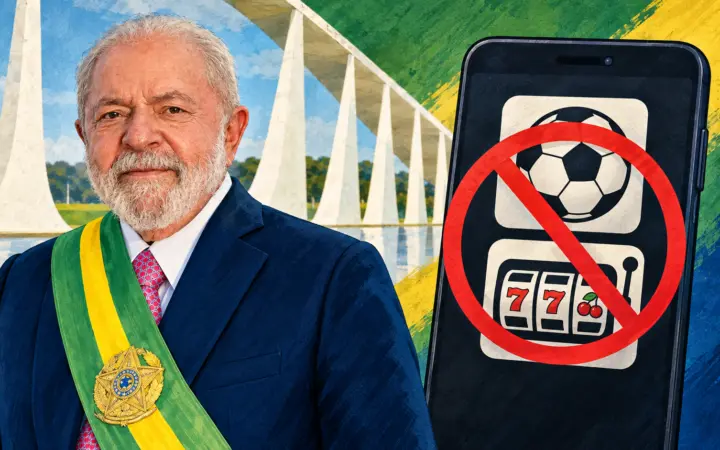
Brazil Betting Ban Orders Legal Sites Shut by October 6
Brazil orders licensed sportsbooks and online casinos to close, with withdrawal protections and an October 6 site shutdown.

New York Sues Polymarket; Company Files Federal Challenge
New York seeks gambling penalties against Polymarket US as the company brings the dispute into federal court.