Kalshi Self-Exclusion Loophole: Why State Bans May Not Carry Over
State exclusions, provider controls and shared registries have different limits. Their published terms show where protection may stop.
The Kalshi self-exclusion loophole concerns a gap in coverage: a state gambling ban may not extend to a prediction-market account. Understanding that gap requires separating state programs, provider-specific restrictions and shared registries.
KEY FACTS AT A GLANCE
- State scope: Pennsylvania’s exclusions apply to its licensed gaming providers.
- Kalshi’s policy: Direct exclusion includes a stated exception for broker access.
- Shared coverage: SelfExclude.io’s FAQ identifies Kalshi and Novig as fully integrated.
- Evidence: Policies checked October 6, 2026; their enforcement has not been independently tested for this article.
Three systems with different boundaries
Self-exclusion is a request to restrict someone’s own access to gambling or trading. Its practical reach depends on the program receiving that request. A state-administered list can cover licensed operators within its remit. A provider can restrict its own accounts. A shared registry can notify participating businesses across platforms.
Those arrangements should not be treated as interchangeable. A restriction can work within its stated boundary while leaving another account or service outside it. “Loophole” here describes that gap in coverage, rather than a finding that an operator broke the law or ignored an exclusion it had accepted.
The distinction also applies within prediction markets. Kalshi’s direct controls and a broker’s controls belong in the provider-specific category, but they are separate policies. A reader needs to know which account a request reaches, not simply whether a business advertises self-exclusion.
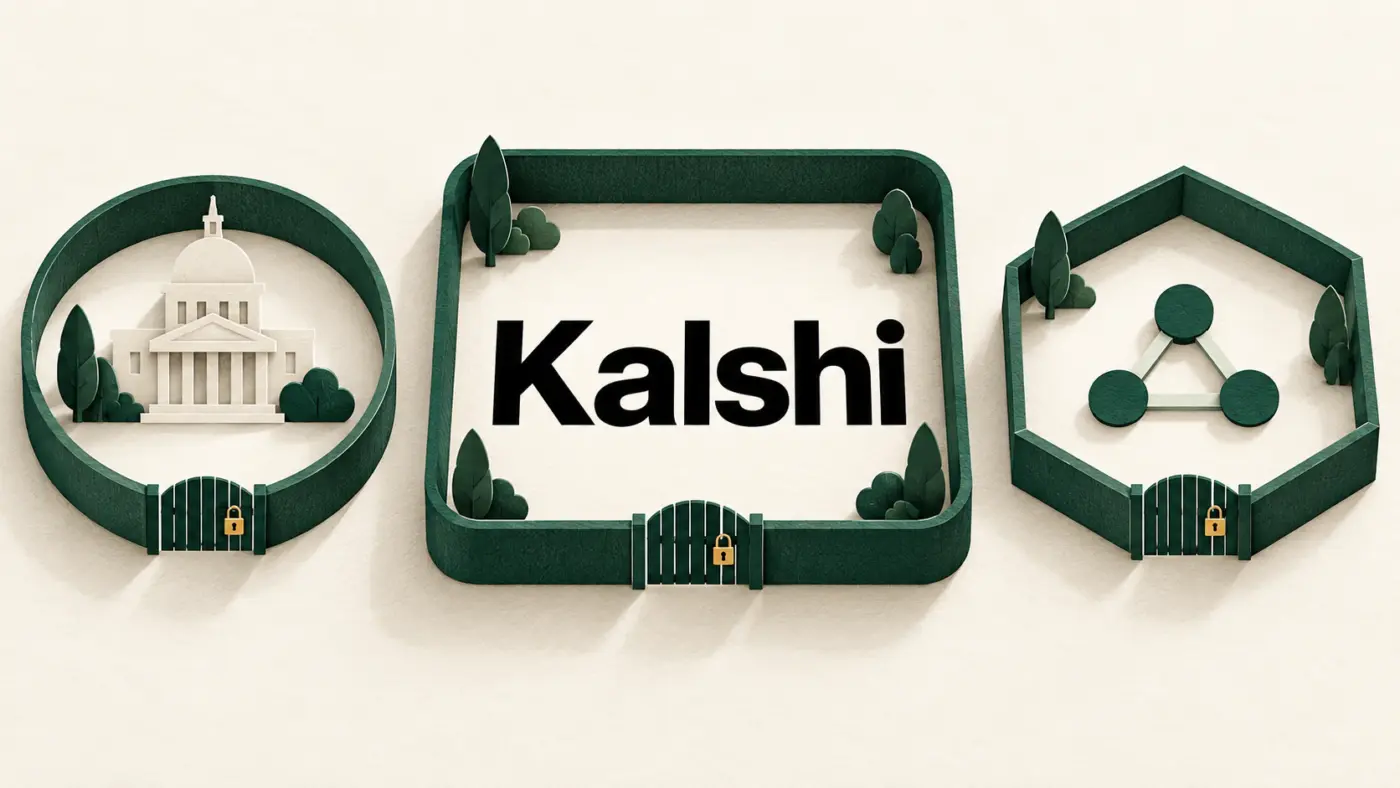
State-administered schemes
Applies to providers licensed by the Pennsylvania Gaming Control Board.
Casino and retail sportsbooks; iGaming, including online sportsbooks; video gaming terminals; fantasy contests.
Enrollment does not establish that Kalshi is covered.
Provider-specific controls
Covers its website, app and API.
Kalshi says this exclusion does not limit access through a futures commission merchant (FCM).
Robinhood offers full event-contract exclusion through its support process.
Broker restrictions have their own terms.
Shared voluntary registry
Kalshi and Novig, according to its detailed FAQ.
Polymarket, Robinhood, ProphetX, Matchbook and Juice Exchange.
Pending integration does not mean a platform lacks its own controls.
Policies checked October 6, 2026. This diagram describes published scope, not an operational audit. It does not imply automatic enrollment or synchronization between programs.
The reported relapse behind the debate
NPR reported on October 2 that Thomas, a Pennsylvania man identified by his middle name, joined Pennsylvania’s self-exclusion list after filing for bankruptcy in late 2023. He encountered a Kalshi advertisement about two years later. Thomas told NPR he lost more than $25,000 in total on Kalshi. The report described 15-minute bitcoin-price contracts as his favored markets.
NPR said it reviewed records and correspondence. It described a closure request, an automated response offering protective tools, further emails two days later and an eventual ban. NPR did not date the eventual ban or report whether Thomas enrolled in the shared registry.
Kalshi spokesperson Dani Lever called it “a cherry-picked case” and told NPR the company’s profits are not tied to customers’ losses.
Why a Pennsylvania exclusion may stop at licensed operators
The Pennsylvania Gaming Control Board says its exclusion programs apply to gaming providers it licenses. Casino exclusion covers retail sportsbooks, while internet-gambling exclusion includes online sportsbooks. The state also runs separate programs for video gaming terminals and fantasy contests.
Kalshi operates a derivatives exchange designated by the federal Commodity Futures Trading Commission, or CFTC. It is not on Pennsylvania’s list of licensed online sportsbooks, so joining the state’s exclusion program does not automatically create a Kalshi exclusion.
A casino exclusion and an internet-gambling exclusion are not automatically the same administrative process. Pennsylvania’s guidance also distinguishes their endings: a fixed internet-gambling exclusion expires automatically, while removal from a fixed casino exclusion requires a request. An operator may impose broader restrictions of its own.
For a person relying on a state list, the practical question is which licensed businesses and activities that list reaches. It is not evidence of a nationwide exclusion from every service offering a wager or an event contract. Nor does the scope of a state list settle the separate legal dispute over regulatory authority.
That legal dispute continues alongside the consumer-protection debate, as reflected in New York’s lawsuit against Kalshi. A challenge to an operator’s legal status and a functioning exclusion connection are different things. Filing a lawsuit does not itself create a shared list.
What Kalshi self-exclusion covers
Kalshi’s published voluntary-exclusion policy covers direct use of its website, app and application programming interface, or API. It also contains an explicit limitation:
“Voluntary Self-Exclusion does not limit a trader’s ability to access Kalshi products via a Futures Commission Merchant.”
— Kalshi Help Center, voluntary self-exclusion policy
A futures commission merchant is a broker providing exchange access. Kalshi’s direct restriction does not extend to broker access under that policy. Brokers can impose separate restrictions.
There is another practical detail: Kalshi warns that open positions cannot be sold during exclusion. Its responsible-trading hub says a chosen restriction cannot be lifted before its term ends. Readers should understand both the restriction and its treatment of existing positions before relying on it.
Kalshi also offers a personalized monthly funding cap. The cap applies immediately to future deposits; an increase takes effect in the next calendar month. Wire transfers are unavailable while the cap is enabled. A deposit cap limits additional funding, so it should not be confused with an exclusion or a ceiling on trading losses.
On May 4, 2026, Kalshi announced expanded safeguards, including identity measures, activity-based deposit recommendations and an optional Inner Circle feature, which lets users share trading activity with chosen friends or family.
Broker controls require a separate check
Robinhood Derivatives offers event contracts through KalshiEX and other exchanges, under a separate exclusion process. Its help page describes full self-exclusion from all event-contract trading through support. Open positions must be closed before the account is fully disabled. Robinhood describes a review and a short period before the restriction takes effect but does not specify its length. Re-enabling trading requires another support review.
Robinhood’s sports-market visibility setting serves a different purpose: hiding sports markets does not prevent trading them. That distinction matters when someone wants access removed rather than a less prominent display. The reviewed documents do not explain coordination between a direct Kalshi exclusion and separate broker restrictions, or the effect of a registry exclusion on broker access.
SelfExclude.io’s coverage claim meets its FAQ
SelfExclude.io’s claim to cover “all major regulated prediction markets” is broader than its detailed integration list, shown above. The FAQ should guide coverage expectations.
An unfinished registry integration also does not mean a platform lacks its own controls; Dyutam’s reporting on Polymarket’s player-protection tools addresses that separate question.
The registry’s terms identify its operator as Integrity Compliance 360 Inc., or IC360. Its role is to maintain the registry and notify partners; participating platforms implement the blocks. Those are separate responsibilities, and the terms do not guarantee immediate or error-free enforcement by every partner.
There is also a timing qualification. The FAQ gives a within-24-hours expectation after verified enrollment, while the terms allow implementation to take 24 hours or longer depending on the operator’s update schedule. The terms therefore do not support treating the FAQ’s timing as an unconditional deadline.
These are published limitations, not findings that a particular block failed. They show why enrollment, notification and actual account restriction should not be collapsed into a single promise. This review did not test the systems or establish automatic enrollment in the registry after a direct Kalshi exclusion.
When an exclusion ends matters too
In its April CFTC submission, the National Council on Problem Gambling recommended exclusions from six months through lifetime, no early cancellation and an affirmative customer decision before access is restored. It also recommended consent-based sharing of exclusions. These are proposed safeguards, not a statement of current legal requirements.
| Dimension | SelfExclude.io | NCPG proposal |
|---|---|---|
| Available periods | 1, 3, 6 or 12 months. | Options ranging from 6 months to lifetime. |
| Ending early | The selected exclusion cannot be shortened. | Exclusion should remain irrevocable for the selected term. |
| At expiry | The registry exclusion expires automatically and platforms are notified. Extensions and re-enrollment are available. | Restoration should require an affirmative choice by the customer. |
Checked October 6, 2026. NCPG’s recommendations are proposals, not law. These registry terms are not Kalshi’s direct-exclusion duration menu. Other account restrictions may remain after registry expiry.
NCPG separately recognizes shorter time-outs, so the existence of a short option alone does not establish inadequate protection. Pennsylvania’s fixed-term internet-gambling exclusions also expire automatically. The meaningful comparison is how a program combines duration, renewal and restoration, rather than whether it matches a single preferred number.
The accountability question is coordination
Kalshi has argued for a national regulatory framework rather than a patchwork of state rules. That position speaks to who should set standards. The consumer question is what happens when someone has already asked one part of the system to block access.
The practical questions are which accounts a program covers, when it takes effect and what is needed to restore access.
The reviewed policies establish distinct coverage boundaries. They do not establish how often people relapse, how consistently identities match across providers, or whether every promised restriction is enforced. Those questions require evidence beyond the presence of a help page or an individual reported case.
As the CFTC’s prediction-market rulemaking debate develops, the test is whether protections follow the person across the services the program claims to cover. Readers seeking practical support can also consult Dyutam’s responsible-gambling resources.
CONFIDENTIAL SUPPORT
In the United States, call or text 1-800-MY-RESET (1-800-697-3738) for the National Problem Gambling Helpline, available 24 hours a day. Support is available whether the concern involves sportsbooks, prediction markets or another form of gambling.
FAQs
Does a state gambling self-exclusion automatically cover Kalshi?
It should not be assumed to. Pennsylvania’s programs apply to its licensed gaming providers. Kalshi’s direct controls and shared prediction-market exclusions have their own scope.
Does Kalshi offer self-exclusion?
Yes. Kalshi offers direct self-exclusion. Its policy includes a broker exception and warns that excluded traders cannot sell open positions.
Does a Kalshi exclusion also block a broker account?
Kalshi’s policy contains a broker exception. Robinhood separately offers full event-contract self-exclusion through support. The reviewed documents do not establish whether or how these separate restrictions are coordinated.
Is SelfExclude.io the same as a state exclusion list?
No. It is a voluntary shared registry operated by IC360. Its FAQ lists Kalshi and Novig as fully integrated; other named integrations remain in progress.
Can a self-exclusion be permanent?
Some programs offer lifetime exclusion, including Pennsylvania’s casino and iGaming programs. SelfExclude.io lists terms up to 12 months, with extension and re-enrollment available. Kalshi’s direct help page does not specify its available durations.
Where is confidential help available?
In the United States, call or text 1-800-MY-RESET (1-800-697-3738). The National Problem Gambling Helpline provides confidential support 24 hours a day.
KEY TAKEAWAYS
- Check the boundary — a state, provider or registry exclusion has its own coverage.
- Separate access from visibility — hiding a market is not necessarily a trading restriction.
- Read the detailed terms — participation, processing time and restoration rules determine what an exclusion promises.
- Get a clear confirmation — ask each provider which accounts its restriction covers and when it starts.
Sources
- Self-exclusion program scope — Pennsylvania Gaming Control Board
- Pennsylvania self-exclusion programs — Office of Compulsive and Problem Gambling
- Sports-wagering self-exclusion requirements — Pennsylvania Code, Chapter 1411a
- Casino self-exclusion terms — Pennsylvania Gaming Control Board
- Internet-gambling self-exclusion terms — Pennsylvania Gaming Control Board
- Licensed online sports-wagering operators — Pennsylvania Gaming Control Board
- KalshiEX designated contract market record — Commodity Futures Trading Commission
- Voluntary self-exclusion policy — Kalshi
- Responsible Trading Hub — Kalshi
- Personalized funding cap — Kalshi
- Opting out of event contracts — Robinhood
- Program FAQ and integration status — SelfExclude.io
- Website terms of use — Integrity Compliance 360 Inc.
- April 24, 2026 prediction-market comment to the CFTC — National Council on Problem Gambling
- Expanded customer-protection measures — Kalshi
- Response on state lawsuits and prediction markets — Kalshi
- He was banned by betting sites. Then he relapsed on Kalshi. — NPR, republished by OPB, October 2, 2026
- About the National Problem Gambling Helpline — National Council on Problem Gambling

Aevan Lark
Aevan Lark is a gambling industry veteran with over 7 years of experience working behind the scenes at leading crypto casinos — from VIP management to risk analysis and customer operations. His insider perspective spans online gambling, sports betting, provably fair gaming, and prediction markets. On Dyutam, Aevan creates in-depth guides, builds verification tools, and delivers honest, data-driven reviews to help players understand the odds, verify fairness, and gamble responsibly.
Related coverage

Who Answers for a Gambling Ad? Greece’s Case Against 18 Influencers
Greek complaints against 18 influencers over alleged unlicensed gambling promotion: the case status, the fine framework and how Dutch rules compare.

Ohio Sends Cease-and-Desist Letters to 10 Prediction Market Firms
Ohio demands an immediate stop to sports contracts from ten prediction market firms, with written compliance confirmation due October 16.
UK Remote Gaming Duty Receipts Rise 108% in July
HMRC collected £589.7 million in July. Payment timing and the original forecasts explain what the increase proves.