CS2 Singapore Major Team Rebrands: BC.Game, 1win, BetBoom
PGL confirms four Singapore Major team names as gambling advertising rules and Valve’s separate sponsorship conditions reshape event branding.

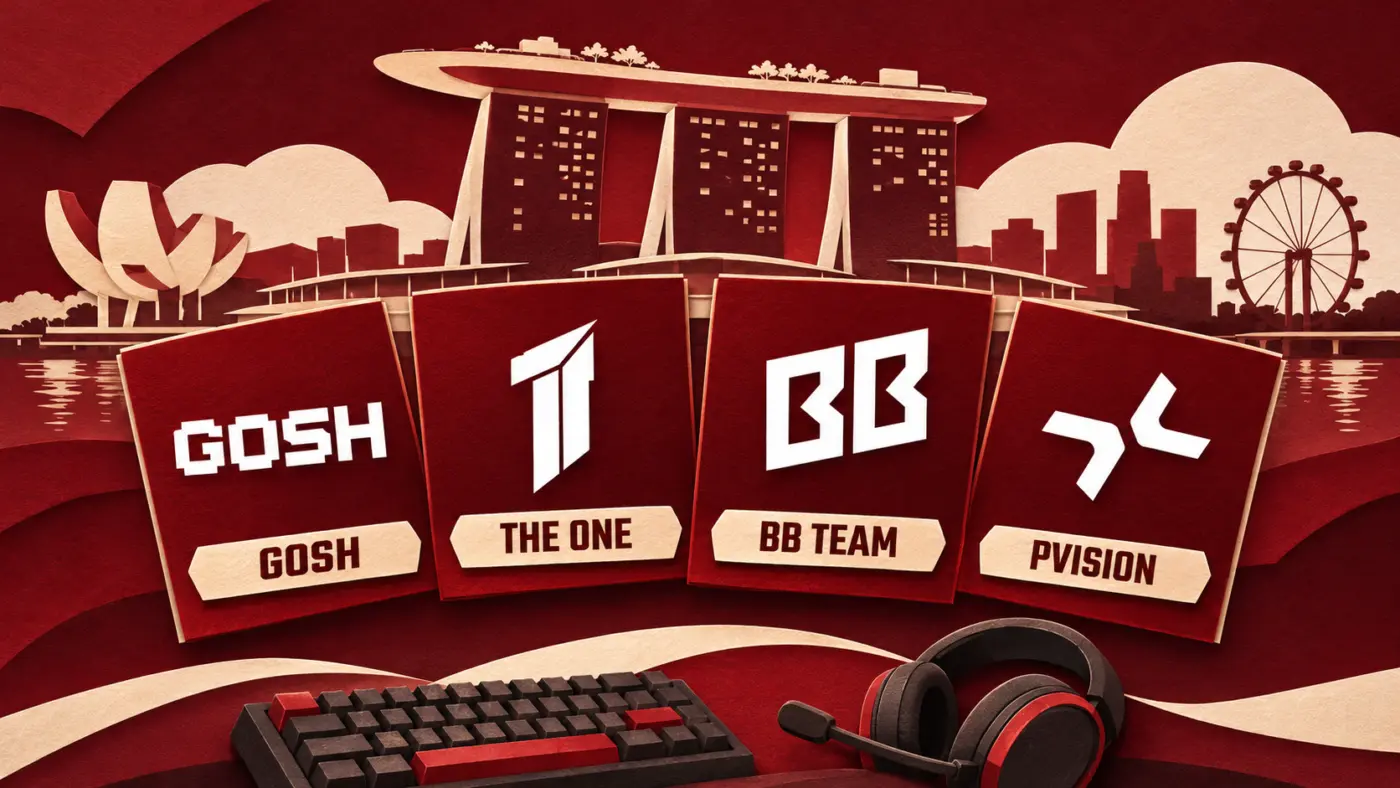
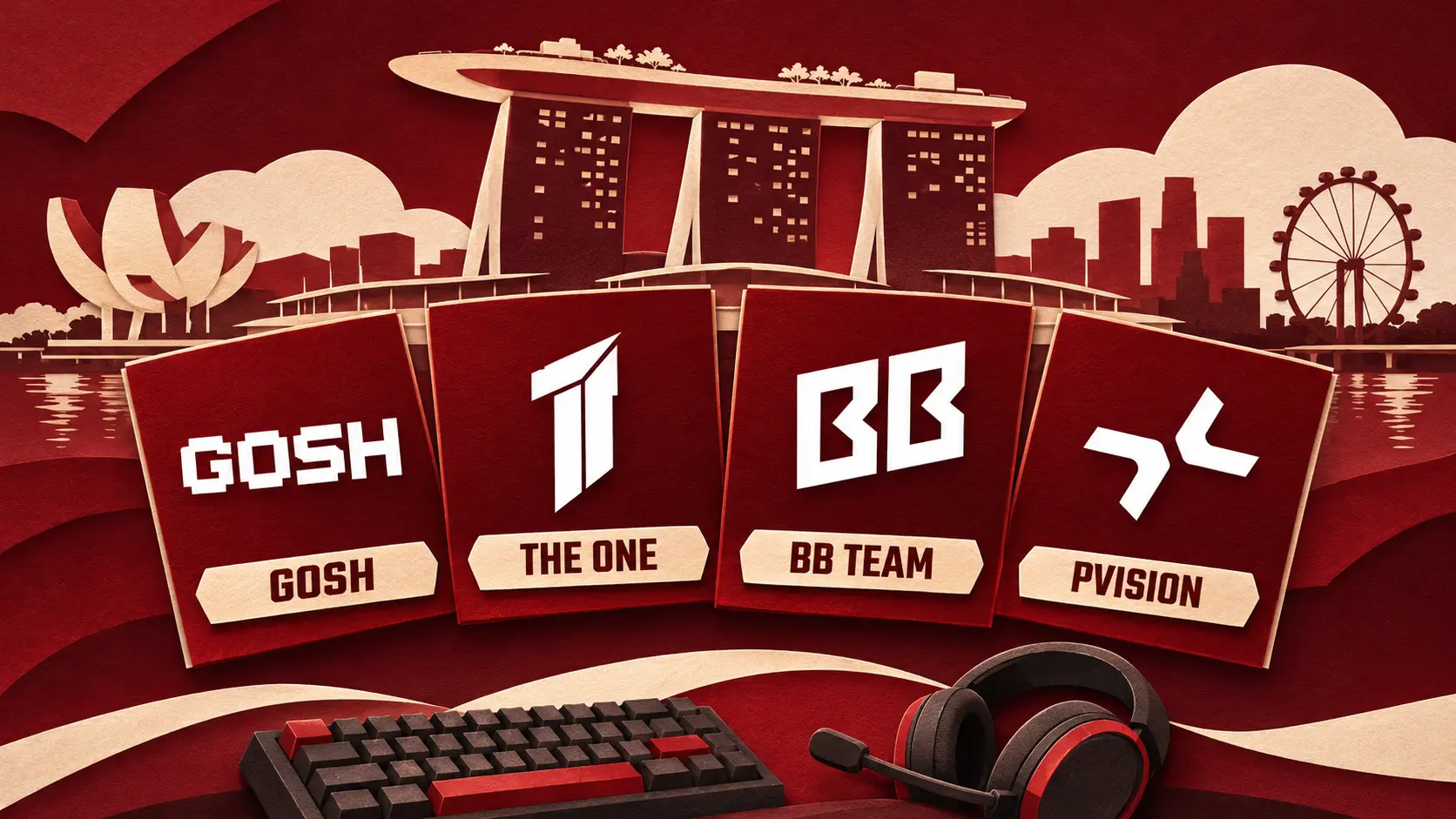
PGL has confirmed the Singapore Major team rebrands: BC.Game appears as GOSH, 1win as THE ONE, and BetBoom Team as BB TEAM. PARIVISION also becomes PVISION in the organizer’s November 9 team graphics for the Counter-Strike 2 (CS2) tournament.
KEY FACTS AT A GLANCE
- Confirmed names: PGL’s November 9 graphics show GOSH, THE ONE, BB TEAM, and PVISION. These are the teams’ Singapore Major identities.
- Event and rules: The Major runs November 24–December 13, 2026. BC.Game’s CEO attributes its branding change to Singapore regulations; Valve also has separate sponsorship conditions.
Which names will the four teams use?
The replacement names are now public. Earlier reports described proposed changes awaiting approval, but PGL’s stage graphics resolve that uncertainty. GOSH and PVISION appear in Stage 1, THE ONE in Stage 2, and BB TEAM in Stage 3.
The announcement establishes how PGL identifies these teams at this event. It does not establish permanent organization-wide rebrands or confirm the designs of in-game team stickers. Fans checking the event lineup should therefore use the new names while keeping those separate questions open.
Why Singapore’s gambling rules affect team branding
BC.Game CEO Ali “Ako” Muhanned attributed the restriction on the team’s name and logo to Singapore regulations. Before PGL published the replacement names, he told iGaming Business:
“We’ve submitted an alternative team name and are now waiting to hear back from Valve and PGL.”
— Ali “Ako” Muhanned, BC.Game CEO, quoted by iGaming Business on November 6
Singapore’s Gambling Control Act 2022 explains why a team name can raise an advertising issue. Section 85 prohibits advertising unlawful gambling. The Act’s section 16 defines gambling advertising broadly, including publicity involving trademarks, domain names, and words closely associated with gambling.
Section 85(5) also addresses sponsorship and brand-sharing arrangements. It covers displaying a name connected with an event, product, or service when gambling is the sole or main activity under that name. It also covers displays whose manner or context draws attention to gambling facilities.
As a result, removing a betting link or promotional offer may not resolve the issue. The brand itself can carry the advertisement. That matters more when an operator’s name is the team’s identity, rather than a logo beside an unrelated team name. Our coverage of the G2 Esports–Betpanda partnership provides another example of gambling brands buying esports exposure.
This is the relevant legal framework, supported by BC.Game’s explanation of its own change. PGL’s team graphics confirm the event names; they do not provide a legal ruling on each organization. No event-specific determination from Singapore’s Gambling Regulatory Authority (GRA) was identified in the research.
Is Singapore Pools the only legal gambling operator?
That description needs a qualifier. Singapore’s Ministry of Home Affairs identifies Singapore Pools as the country’s only licensed remote gambling provider. It also identifies Singapore Pools as the only licensed sports-betting provider. This does not mean Singapore has no other lawful gambling businesses: its casinos operate under a separate licensing regime.
Licensing and advertising approval are also separate matters. The GRA says licensed gambling operators need its approval for gambling advertisements and promotions. A license from another country therefore does not, by itself, establish permission to advertise gambling in Singapore. Our guide to checking an online casino’s license explains why the issuing authority and permitted market matter.
How this differs from Valve’s skin-gambling restrictions
Singapore’s advertising law and Valve’s tournament license address different issues. However, Valve’s rules also require organizers to consider local gambling permissions. Treating this as a choice between “Singapore rules” and “Valve rules” misses that overlap.
Valve also tests territorial permission
Under clause 2.4(d), betting sponsors need a license in the targeted territory or explicit legal permission to use a foreign license. Targeting includes official-language video feeds without geographic blocking.
By contrast, clause 2.4(e) restricts sponsorship involving Valve’s intellectual property, Steam agreements, local law, or game economies. Its examples include case-opening and skin-trading sites, which involve virtual game items.
Valve’s Tournament Operation Requirements also direct ranked and unranked events to comply with clause 2.4(e). The policy is therefore broader than a jersey-logo rule. At the same time, it does not establish a blanket ban on every conventional betting or casino sponsor.
For sponsors, the practical consequence is that passing one requirement does not settle the others. A business outside the skin-gambling category still faces territorial licensing conditions and local advertising law. A replacement event name is not proof that the underlying gambling service has Singapore authorization.
What GOSH confirms—and what remains unconfirmed
GOSH is the name PGL now displays for BC.Game’s entry. That makes it the relevant name for following this Major. It does not, on its own, establish a change in corporate ownership or a permanent replacement for the BC.Game organization.
The distinction matters because the brand has invested in a recognizable CS2 presence, including the roster expansion covered earlier this year. Tournament branding determines which name receives that event exposure. The November 9 graphics settle the names on PGL’s lineup; further announcements would be needed to establish permanent branding changes or sticker designs.
FAQs
What are BC.Game, 1win, and BetBoom called at the Singapore Major?
PGL’s November 9 graphics list BC.Game as GOSH, 1win as THE ONE, and BetBoom Team as BB TEAM. PARIVISION also appears as PVISION. These are confirmed event identities; the announcement does not establish permanent organization-wide rebrands.
Did Valve ban all gambling sponsors in CS2?
No. Valve’s license restricts certain sponsorships involving its intellectual property, Steam agreements, and game economies. It separately requires betting operators to meet licensing or legal-permission conditions in targeted territories. Local advertising laws can impose further restrictions.
When is the PGL Major Singapore 2026?
PGL lists the event for November 24–December 13, 2026. The tournament has 32 teams, and its final four days take place at Singapore Indoor Stadium.
Are the replacement names confirmed for CS2 stickers?
PGL’s team graphics confirm the names used in its event lineup. They do not, by themselves, confirm the final in-game sticker names or artwork. Those details require a separate official release or announcement.
KEY TAKEAWAYS
- Four event names are confirmed — PGL lists GOSH, THE ONE, BB TEAM, and PVISION for the Singapore Major.
- Separate rules can apply together — Singapore regulates gambling advertising, while Valve imposes territorial licensing and intellectual-property conditions.
Sources
- PGL Major Singapore 2026 event details — PGL
- Official Stage 1 team graphic, November 9 — PGL
- Official Stage 2 team graphic, November 9 — PGL
- Official Stage 3 team graphic, November 9 — PGL
- Gambling Control Act 2022, sections 16 and 85 — Singapore Statutes Online
- Efforts to tackle illegal e-sports betting, April 8, 2025 — Ministry of Home Affairs
- Offshore betting and gambling advertising controls, May 6, 2026 — Ministry of Home Affairs
- Harm minimisation and gambling advertising controls — Gambling Regulatory Authority
- Limited Game Tournament License, clauses 2.4(d) and 2.4(e) — Valve
- Counter-Strike Tournament Operation Requirements — Valve
- Gambling-backed esports teams forced to rebrand for Singapore tournament, November 6 — iGaming Business

Aevan Lark
Aevan Lark is a gambling industry veteran with over 7 years of experience working behind the scenes at leading crypto casinos — from VIP management to risk analysis and customer operations. His insider perspective spans online gambling, sports betting, provably fair gaming, and prediction markets. On Dyutam, Aevan creates in-depth guides, builds verification tools, and delivers honest, data-driven reviews to help players understand the odds, verify fairness, and gamble responsibly.
Related coverage
Israel election bets on Polymarket: what it takes to prove insider trading
Israel election bets illustrate how investigators test wallet clues, identify traders and distinguish suspicious activity from evidence of insider trading.
Duel.com Sweden Ban: What the Order Does and Doesn’t Do
Sweden's order prohibits unlicensed gambling. Payment measures, access restrictions and player balances involve separate questions.
NZ online casino cutoff: who can operate from 1 December?
Who can operate from 1 December 2026, what the application list proves, and how departing casinos should handle customer funds.