Baccarat is the casino game of choice for high rollers and James Bond alike—yet it’s surprisingly one of the simplest games to play. With a house edge as low as 1.06% on the best bet, baccarat offers some of the most favorable odds in any casino. Whether you’re intimidated by the velvet ropes or curious about this elegant card game, this complete guide will teach you everything you need to know to play baccarat with confidence.
KEY FACTS AT A GLANCE
- Best Bet: Banker (1.06% house edge)
- Worst Bet: Tie (14.36% house edge — avoid)
- Winning Hand: Closest to 9 wins
- Natural: 8 or 9 on first two cards ends round immediately
- Player Decisions: Zero — dealer handles everything
What Is Baccarat?
Baccarat (pronounced BAH-kah-rah) is a comparing card game played between two hands: the “Player” and the “Banker.” Despite the names, you’re not actually playing against the house—you’re simply betting on which hand will win or if they’ll tie.
YOU ARE NOT “THE PLAYER”
A common beginner confusion: “Player” and “Banker” are simply labels for the two hands being dealt—they do not refer to you or the casino. Think of yourself as an observer betting on a match between two sides. You can bet on either hand winning, or on a tie.
Here’s what makes baccarat unique: you make no decisions after placing your bet. The dealer handles everything according to fixed rules. This makes baccarat the ultimate game for those who want casino excitement without complex strategy. You bet, you watch, you collect (or don’t). If you’re playing at an online casino like BC.Game or Stake, you can even use our Baccarat Verifier to ensure game fairness.
Baccarat originated in Italy during the Middle Ages, migrated to France where it became a favorite of nobility, and eventually spread to casinos worldwide. Today, it generates more revenue than any other table game in many casinos—particularly in Asia, where it dominates gaming floors.
Why Play Baccarat? The Odds Advantage
Before diving into the rules, understand why baccarat is worth learning: it offers some of the best odds in any casino. Here’s how baccarat compares to other popular games:
| Game | House Edge | Your $100 Expected Loss |
|---|---|---|
| Baccarat (Banker) | 1.06% | $1.06 |
| Baccarat (Player) | 1.24% | $1.24 |
| Blackjack (Basic Strategy) | 0.5% | $0.50 |
| Craps (Pass Line) | 1.41% | $1.41 |
| American Roulette | 5.26% | $5.26 |
| Slot Machines | 5-10% | $5-10 |
| Baccarat (Tie) | 14.36% | $14.36 |
The Banker bet in baccarat gives you nearly the same expected value as blackjack—without requiring any skill or strategy decisions. This makes baccarat ideal for casual players who want good odds without memorizing charts. For more on how house edge affects your bankroll, see our RTP and house edge guide.
Baccarat Card Values: The Foundation
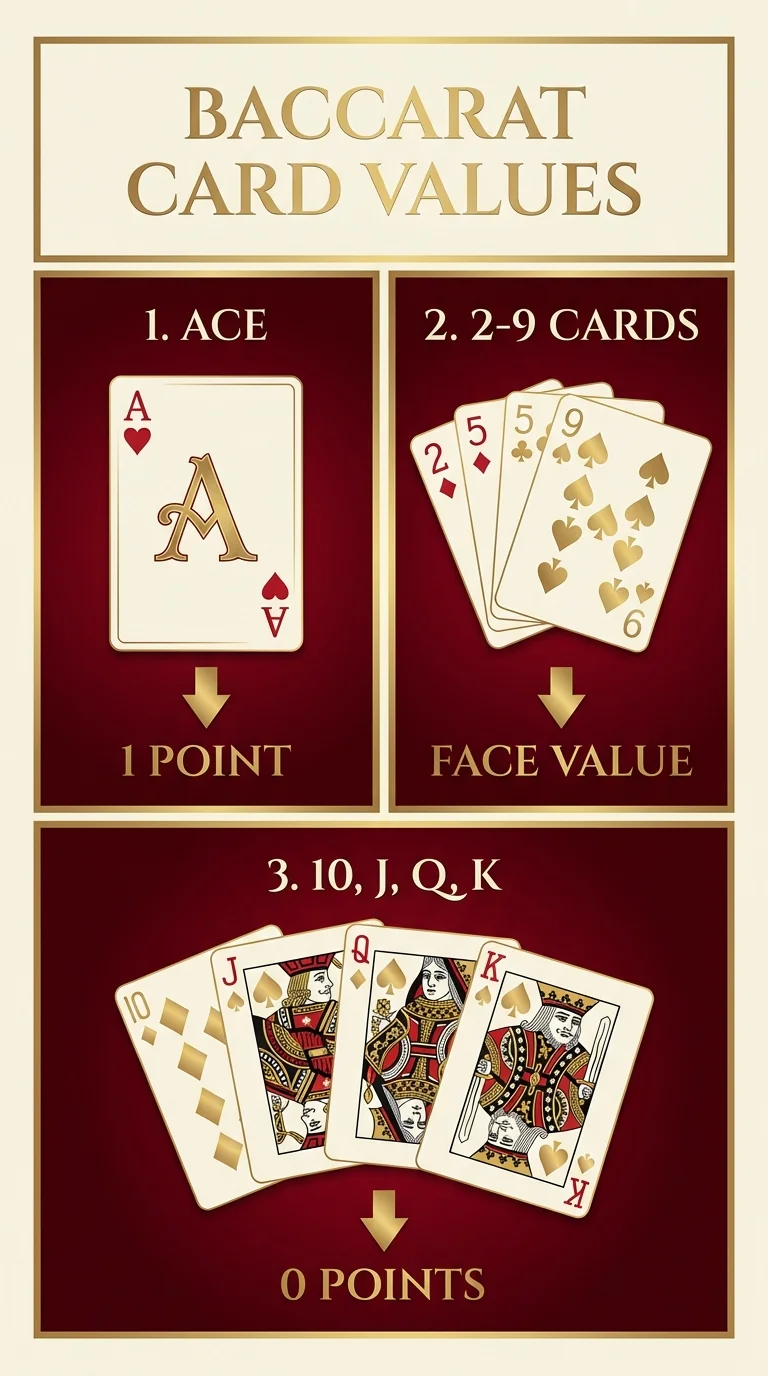
Card values in baccarat are different from most other card games:
| Card | Value | Example |
|---|---|---|
| Ace | 1 point | A + 8 = 9 (Natural!) |
| 2-9 | Face value | 7 + 2 = 9 |
| 10, J, Q, K | 0 points | K + 5 = 5 |
The “Drop the Digit” Rule
The key rule: Only the last digit of the total counts. If cards total more than 9, drop the first digit. This is the most important concept in baccarat scoring.
SCORING EXAMPLES
9 + 6 = 15
Drop the “1” → Hand = 5
King + 7 = 7
0 + 7 → Hand = 7
8 + 8 = 16
Drop the “1” → Hand = 6
Queen + Jack = 0
0 + 0 → Hand = 0 (worst)
Ace + 8 = 9
1 + 8 → Natural 9! (best)
Who Wins? Practice Scenarios
| Round | Player Hand | Banker Hand | Winner |
|---|---|---|---|
| 1 | K + 5 = 5 | 7 + 2 = 9 | Banker |
| 2 | 3 + 4 = 7 | Q + 6 = 6 | Player |
| 3 | 8 + A = 9 | 6 + 3 = 9 | Tie |
| 4 | 7 + 9 = 16 → 6 | 5 + 3 = 8 | Banker |
Step-by-Step: How to Play Baccarat
THE “NATURAL” RULE — CHECK THIS FIRST!
If either the Player or Banker hand totals 8 or 9 with their first two cards, the game is immediately over. This is called a “Natural.” No third cards are drawn—period.
- Natural 9 beats everything except another Natural 9 (tie)
- Natural 8 beats everything except Natural 9 or another Natural 8
- Many beginners get confused by third card rules before understanding that Naturals bypass them entirely
Gameplay Flow
STEP 1: PLACE YOUR BET
Choose between Player, Banker, or Tie. We recommend Banker for the best odds (1.06% house edge).
STEP 2: INITIAL DEAL
Dealer gives two cards to both Player and Banker hands. Cards are revealed immediately.
STEP 3: CHECK FOR NATURALS
If either hand has 8 or 9, round ends immediately. Higher hand wins (or it’s a tie).
STEP 4: PLAYER THIRD CARD
If Player totals 0-5, draws third card. If 6-7, stands. This is automatic—no decision needed.
STEP 5: BANKER THIRD CARD
Banker’s decision depends on Player’s action and third card. Dealer handles this automatically.
STEP 6: COMPARE & PAY
Closest to 9 wins. Banker pays 0.95:1 (5% commission), Player pays 1:1, Tie pays 8:1.
Third Card Rules
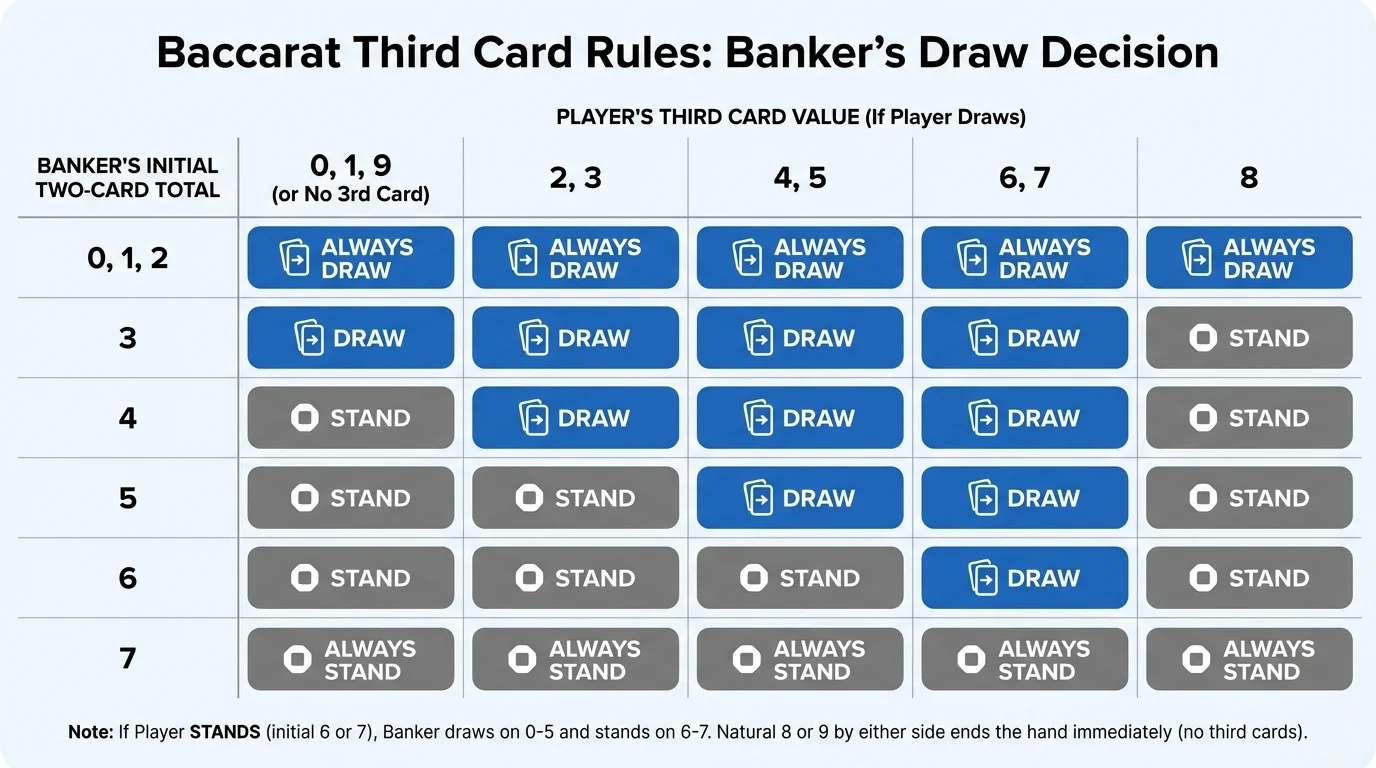
Don’t worry about memorizing these—the dealer handles everything automatically. But here’s the logic:
| Banker Total | Draws When Player’s 3rd Card Is | Stands When Player’s 3rd Card Is |
|---|---|---|
| 0-2 | Always draws | Never stands |
| 3 | 0-7, 9 | 8 |
| 4 | 2-7 | 0, 1, 8, 9 |
| 5 | 4-7 | 0-3, 8, 9 |
| 6 | 6, 7 | 0-5, 8, 9 |
| 7 | Never draws | Always stands |
The Three Main Bets Explained
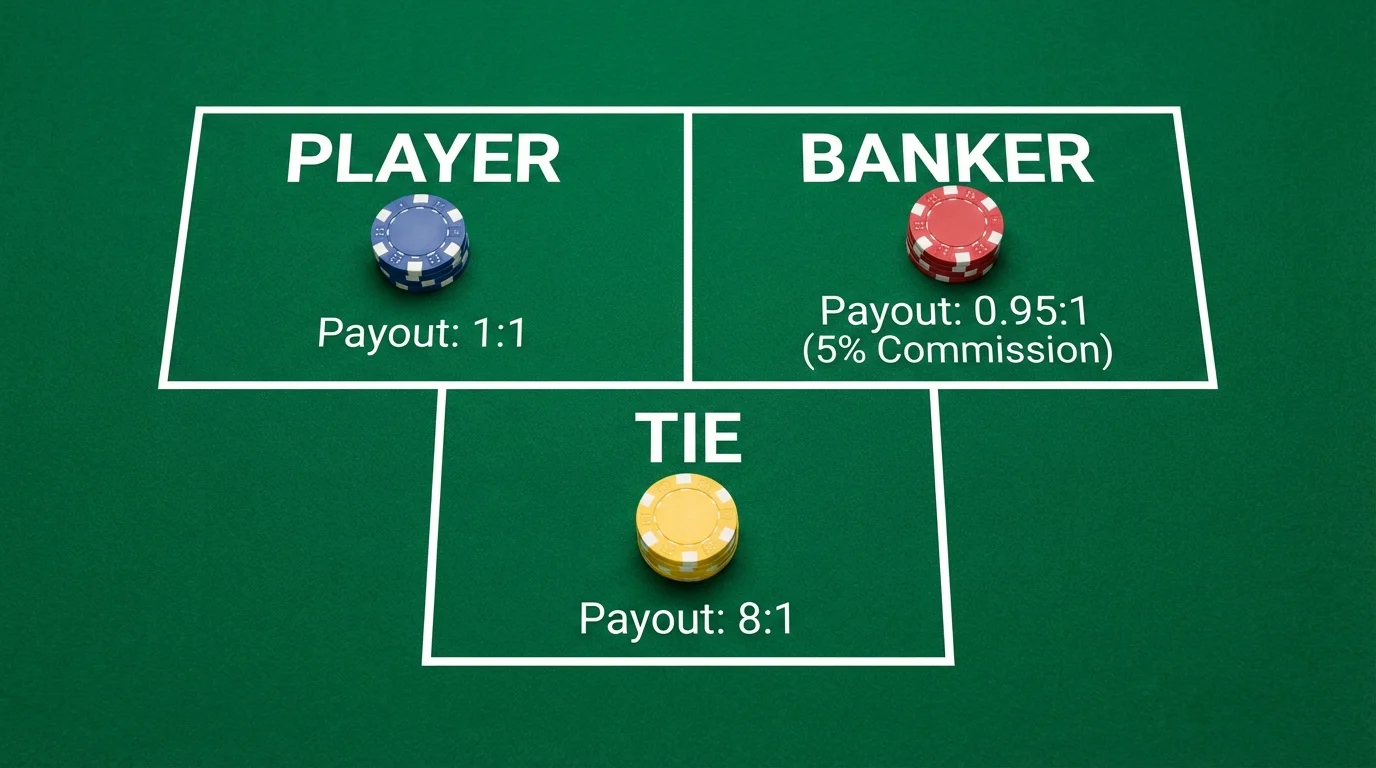
COMPARING THE THREE BETS
Banker Bet (Best)
- House edge: 1.06%
- Payout: 0.95:1
- Win rate: 45.86%
- 5% commission on wins
Player Bet (Good)
- House edge: 1.24%
- Payout: 1:1
- Win rate: 44.62%
- No commission
Tie Bet (Avoid)
- House edge: 14.36%
- Payout: 8:1 or 9:1
- Win rate: 9.52%
- Sucker bet
Understanding the 5% Commission
The commission on Banker bets confuses many beginners. Here’s exactly what it means for your money:
| Your Bet | Bet Type | If You Win | Total Returned |
|---|---|---|---|
| $10 | Player | $10.00 profit | $20.00 |
| $10 | Banker | $9.50 profit (after 5%) | $19.50 |
| $100 | Banker | $95.00 profit | $195.00 |
| $10 | Tie (8:1) | $80.00 profit | $90.00 |
Even with $0.50 less profit per $10 bet, the Banker bet is still mathematically superior because it wins more often (45.86% vs 44.62% for Player). If you want to dive deeper into the math, our Variance Survival Calculator can help you understand long-term betting outcomes.
Side Bets: What You’ll See at the Table
When you sit at a baccarat table, you’ll notice additional betting options beyond Player, Banker, and Tie. These are side bets, and while they add excitement, they typically carry much higher house edges.
| Side Bet | What It Means | Payout | House Edge |
|---|---|---|---|
| Player Pair | Player’s first two cards are a pair | 11:1 | ~10.4% |
| Banker Pair | Banker’s first two cards are a pair | 11:1 | ~10.4% |
| Either Pair | Either hand has a pair | 5:1 | ~14% |
| Dragon 7 | Banker wins with 7 using three cards | 40:1 | ~7.6% |
| Panda 8 | Player wins with 8 using three cards | 25:1 | ~10.2% |
SKIP THE SIDE BETS
While side bets are tempting with high payouts, the house edge is 5-10x higher than the main bets. Master the core game first, and only explore side bets with money you’re prepared to lose quickly.
Baccarat Variations You’ll Encounter
| Variation | Key Differences | Best For |
|---|---|---|
| Mini-Baccarat | Lower minimums ($5-25), faster play, dealer handles all cards | Beginners |
| No-Commission (EZ) | No 5% commission, but Banker wins with 6 pay only 50% | Convenience seekers |
| Punto Banco | Standard version—dealer controls everything (this guide) | Most players |
| Chemin de Fer | French version—players take turns as Banker, make decisions | European casinos |
Note on No-Commission Baccarat: The effective house edge is actually slightly higher (1.46% vs 1.06%) because Banker wins with 6 pay only half. It’s more convenient (no tracking commission owed), but mathematically slightly worse.
Baccarat Strategy: What Actually Works
Baccarat is a game of pure chance. No decision you make affects the outcome of the cards. However, you can make smart choices about how you bet.
THE ONLY REAL STRATEGY
- Bet on Banker — It is mathematically the best choice, period.
- Avoid the Tie Bet — The house edge is too high (14.36%).
- Skip side bets — Fun occasionally, but terrible long-term value.
- Ignore “patterns” — Past results do not predict future outcomes.
Unit-Based Bankroll Management
Instead of vague advice to “manage your money,” use a unit-based approach:
- 1 unit = 1-2% of your total session budget
- If you have $500 for the session, 1 unit = $5-10
- Never bet more than 1-2 units per hand
- Set a stop-loss: quit if you lose 20-30 units
- Set a win goal: consider leaving if you’re up 15-20 units
For serious bankroll planning, we recommend our Bankroll Calculator and Risk of Ruin Calculator.
WARNING: BETTING SYSTEMS DON’T WORK
The Martingale system (doubling after losses) and similar strategies are mathematically proven not to overcome the house edge:
- Table limits: After 7-8 losses, you hit the maximum bet
- Bankroll exhaustion: Losing streaks of 10+ happen more often than you’d think
- Risk vs reward: You risk $1,270 to win $10 after 7 doublings
Common Beginner Mistakes to Avoid
MISTAKES THAT COST YOU MONEY
Chasing the Tie Bet
- Ties occur ~9.5% of the time
- 8:1 payout needs 11.1% to break even
- Gap = 14.36% house edge
- Lose $14.36 per $100 wagered
Believing in Patterns
- Scorecards are entertainment only
- Cards have no memory
- Gambler’s Fallacy in action
- 8 Banker wins doesn’t change next odds
Thinking You’re “The Player”
- You’re an observer, not participant
- Bet on better odds (Banker)
- Names are just traditional labels
- Don’t feel obligated to bet Player
The Baccarat Table Layout
Knowing where to place your chips removes anxiety at the table:
┌─────────────────────────────────────────────────────┐
│                     DEALER AREA                     │
│            [Banker Cards]  [Player Cards]           │
├─────────────────────────────────────────────────────┤
│                                                     │
│   ╔═══════════════════════════════════════════╗     │
│   ║              T I E  (8:1)                 ║     │
│   ╚═══════════════════════════════════════════╝     │
│                                                     │
│   ╔═══════════════════╗   ╔═══════════════════╗     │
│   ║                   ║   ║                   ║     │
│   ║  B A N K E R      ║   ║   P L A Y E R     ║     │
│   ║    (0.95:1)       ║   ║     (1:1)         ║     │
│   ║                   ║   ║                   ║     │
│   ╚═══════════════════╝   ╚═══════════════════╝     │
│                                                     │
│           [Your Seat / Betting Position]            │
└─────────────────────────────────────────────────────┘
- BANKER box: Bet that the Banker hand wins (best odds)
- PLAYER box: Bet that the Player hand wins
- TIE box: Bet that both hands tie (avoid this)
- Pair circles: Side bet areas (if available)
FAQs
Baccarat is a game of pure luck. Unlike blackjack or poker, you make no decisions that affect the outcome. The only choice you make is where to place your bet.
The Banker bet is mathematically the best, with a house edge of only 1.06%. Even with the 5% commission on wins, it outperforms the Player bet (1.24% edge) and Tie bet (14.36% edge).
Since the Banker hand acts second and has a statistical advantage (wins 45.86% vs Player’s 44.62%), the 5% commission balances this advantage. Without it, the Banker bet would have a negative house edge.
You can use systems like Martingale or D’Alembert for entertainment, but they do not change the underlying house edge. Table limits and bankroll exhaustion prevent any system from guaranteeing profits.
If both hands have the same total, it is a standoff. All Player and Banker bets are returned (pushed), and only the Tie bet pays out (typically 8:1 or 9:1).
A Natural is when either hand totals 8 or 9 with the first two cards. When this happens, the round ends immediately—no third cards are drawn. Natural 9 beats Natural 8.
Mini-Baccarat has lower table minimums, faster gameplay, and the dealer handles all cards. The rules and odds are identical—it’s simply a more accessible format for beginners.
No. Scorecards display historical results but have zero predictive value. Each hand is independent—the cards don’t remember previous outcomes. Pattern-tracking is entertainment, not strategy.
Final Thoughts
Baccarat’s appeal lies in its beautiful simplicity combined with excellent odds. No complex strategy to memorize, no decisions to agonize over—just pure, elegant gambling where the Banker bet gives you better expected value than almost any other casino game except expert-level blackjack.
KEY TAKEAWAYS
- Bet on Banker — 1.06% house edge is the best in baccarat
- Avoid the Tie — 14.36% house edge is a sucker bet
- Naturals end the round — 8 or 9 on first two cards = instant result
- You make no decisions — Dealer handles everything automatically
- Ignore patterns — Scorecards are entertainment, not strategy
- Skip side bets — 5-10x higher house edge than main bets
- Use unit-based betting — 1-2% of session bankroll per hand
For more casino guides, check out our 21/Blackjack guide, roulette guide, or craps guide.
