You press spin. Symbols blur across the screen. Three seconds later, you’ve either won or lost — but what actually just happened in those three seconds? The answer involves pseudorandom number generators cycling through millions of values per second, mathematical models that guarantee the casino profits over time, and volatility curves that determine whether you’ll bleed out slowly or swing between euphoria and despair. This guide breaks down every layer of online slot mechanics — no myths, no marketing fluff, just the math and engineering behind every spin.

KEY FACTS AT A GLANCE
- How outcomes are determined: A Random Number Generator (RNG) produces millions of numbers per second — the result is decided before the reels even animate
- Online slot RTP: 94–98% returned to players over billions of spins (theoretical, not per-session)
- Land-based slot RTP: 85–92% — significantly lower due to higher operating costs
- Volatility types: Low (frequent small wins), Medium (balanced), High (rare but large wins)
- Hit frequency: 20–35% of spins produce any win — but “winning” $0.40 on a $1 bet still counts
- Common formats: 5×3 video slots, 243 ways to win, Megaways (up to 117,649 ways), cluster pays
- Regulation: Certified by independent labs — eCOGRA, iTech Labs, GLI, and BMM Testlabs
- The bottom line: RNG ensures fairness, not better odds — the house edge is mathematically guaranteed
What Is an Online Slot?
An online slot is a software-based gambling game that simulates the mechanical slot machines found in physical casinos. The visual interface consists of vertical columns called reels (typically 5), horizontal lines called rows (typically 3), and icons called symbols that land on the grid after each spin. When matching symbols align in specific patterns — called paylines or ways to win — the game awards a payout based on the symbol’s value and your wager size.
The standard configuration is a 5×3 grid (5 reels, 3 rows visible), but formats vary widely. Some games use 6 or even 7 reels. Others change the number of visible symbols per reel on every spin. What matters is this: the “spinning” animation is purely cosmetic. The outcome of every spin is determined instantly by a Random Number Generator the moment you press the button. The reels are just a visual representation of a result that already exists.
The RNG Engine — How Randomness Actually Works
Every online slot runs on a Pseudo-Random Number Generator (PRNG) — a mathematical algorithm that produces a continuous stream of numbers at a rate of millions per second. The PRNG uses a seed value (derived from system data like timestamps and entropy pools) as its starting point, then applies complex mathematical transformations to generate each subsequent number. These numbers are mapped to specific reel positions and symbol combinations.
When you hit “spin,” the game captures the RNG’s current value at that exact microsecond and translates it into a grid result. The RNG never pauses — it cycles continuously whether the game is being played or not. This means the outcome you get is determined by the precise moment you press the button, nothing else. A millisecond earlier or later would produce a completely different result.
Each spin is statistically independent. The RNG has no memory of previous results. It doesn’t know whether you just won $10,000 or lost 500 spins in a row. The probability of hitting any given outcome is identical on every single spin, which is why “hot streaks” and “cold machines” are illusions created by our pattern-seeking brains, not properties of the software.
DEEP DIVE: RNG TECHNOLOGY
For a comprehensive breakdown of how RNG algorithms work — seed generation, PRNG vs TRNG, testing standards, and certification processes — read our dedicated guide:
What Does RNG Mean in Gambling? How Random Number Generators Work →
See it yourself: Use our Gambler’s Fallacy Demonstrator to watch in real time why past outcomes don’t influence future results.
RTP & House Edge — The Casino’s Built-In Advantage
Return to Player (RTP) is a theoretical percentage indicating how much a slot pays back to players over an enormous sample size — typically calculated across billions of simulated spins. A slot with 96% RTP means that, collectively, $96 is returned for every $100 wagered. The remaining $4 is the house edge — the casino’s guaranteed mathematical profit margin. The formula is simple: House Edge = 100% − RTP.
“Theoretical” is the operative word. RTP doesn’t apply to your individual session. You might play 200 spins and walk away up 300%, or lose your entire bankroll. RTP only materializes over millions of spins across all players. Think of it as the game’s long-term gravity — individual sessions can fly in any direction, but over time, the numbers converge toward the programmed percentage.
RTP COMPARISON BY PLATFORM
Online Slots
- RTP: 94–98%
- House Edge: 2–6%
- Why higher: Lower operating costs (no building, fewer staff)
- Example: Blood Suckers — 98%
Land-Based Slots
- RTP: 85–92%
- House Edge: 8–15%
- Why lower: Rent, utilities, staff, physical machines
- Example: Vegas Strip avg — 88%
Progressive Jackpot Slots
- RTP: 88–94%
- House Edge: 6–12%
- Why lower: Portion of each bet feeds the jackpot pool
- Example: Mega Moolah — 88.12%
One critical detail casinos don’t advertise: many slots are available in multiple RTP configurations. The same game — identical name, identical visuals — might run at 96.5% RTP on one casino and 94.0% on another. Providers like Pragmatic Play and Play’n GO offer operators a choice of RTP settings. Always check the game’s info/help screen for the actual RTP at the casino you’re playing.
THE MATHEMATICAL REALITY
No strategy, betting system, or timing trick can overcome house edge. It’s mathematically impossible to beat slots in the long run. The RNG ensures randomness, but randomness doesn’t mean even odds — the game’s math model is designed so the casino always profits over sufficient volume.
UNDERSTANDING RTP & HOUSE EDGE
For a deep dive into how RTP is calculated, why house edge is mathematically guaranteed, and how to verify a game’s actual payout percentage:
The Math Behind the Magic: RTP, House Edge & Why Casinos Don’t Need Luck →
Calculate your session expectations: Use our RTP Reality Check Calculator to see what a specific RTP actually means for your bankroll over 100, 500, or 1,000 spins.
Volatility & Variance — Why Winning Feels So Random
Volatility (or variance) describes how a slot distributes its payouts over time. Two slots can have identical 96% RTP but feel completely different to play. A low-volatility slot pays out frequently in small amounts — your balance gently erodes. A high-volatility slot pays rarely but in larger bursts — you’ll experience long dry stretches interrupted by explosive wins. Neither changes how much you lose long-term; volatility only affects how the journey feels.
| Volatility | Win Frequency | Typical Win Size | Bankroll Risk | Example Games |
|---|---|---|---|---|
| Low | High (35–45%) | Small (1–50x) | Low — slow grind | Starburst, Blood Suckers |
| Medium | Moderate (25–35%) | Medium (20–500x) | Moderate | Book of Dead, Gonzo’s Quest |
| High | Low (15–25%) | Large (500–50,000x) | High — bust or boom | San Quentin xWays, Dead or Alive 2 |
Hit Frequency — How Often You Actually Win
Hit frequency is the percentage of spins that produce any payout — but “any payout” includes wins smaller than your bet. A $1 spin that returns $0.30 is technically a “hit.” Most online slots have a hit frequency between 20% and 35%, meaning roughly one in three to one in five spins returns something. The relationship between hit frequency and volatility is inversely correlated: low-volatility slots hit more often with smaller amounts; high-volatility slots hit less often but with larger payouts when they do.
HIT FREQUENCY BY VOLATILITY
Bankroll planning: Use our Variance Survival Calculator to estimate how long your bankroll will last based on a slot’s volatility and your bet size.
Paylines & Ways to Win — How Combinations Pay
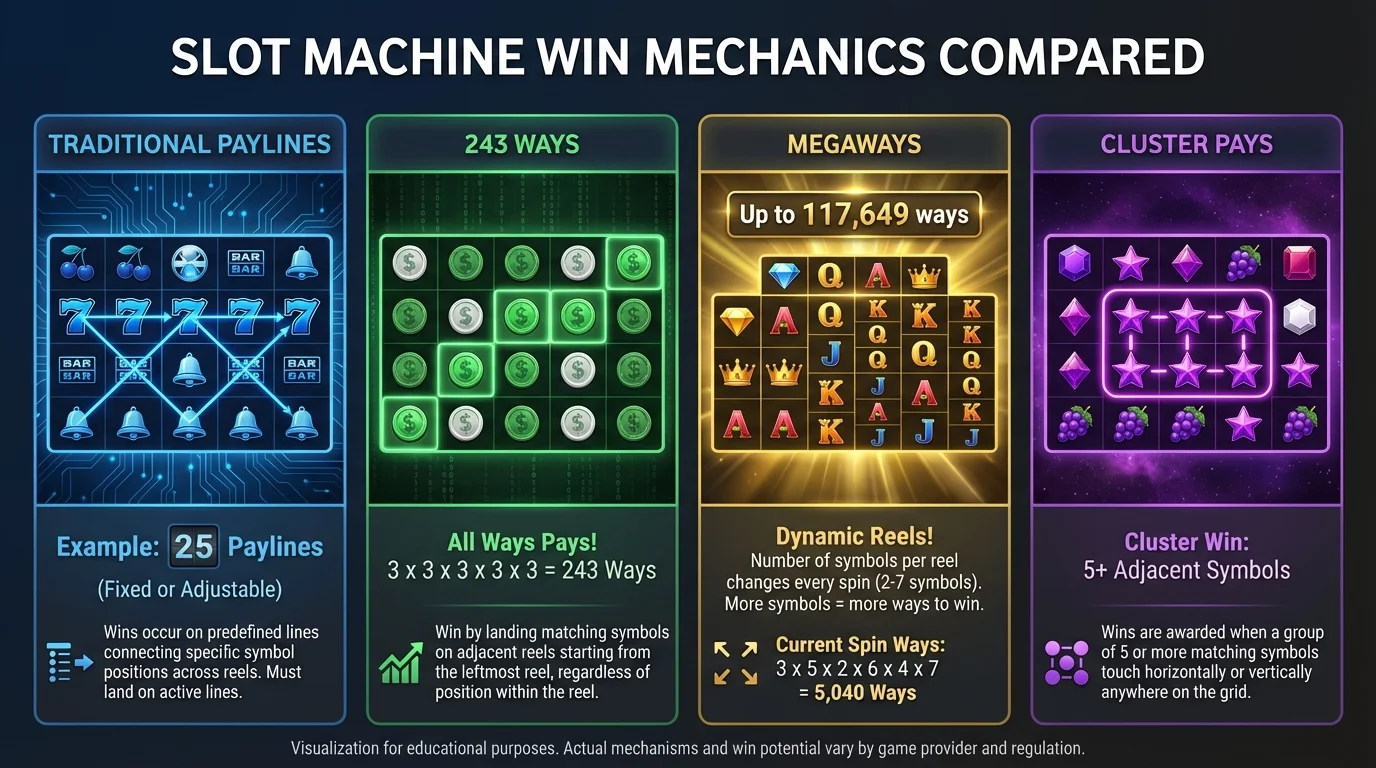
The original slot machines had a single payline — one horizontal line across three reels. Match three symbols on that line, you win. Modern online slots have evolved far beyond that, offering dozens of fixed paylines, hundreds of “ways to win,” dynamic Megaways mechanics, and grid-based cluster pay systems. Understanding the differences matters because each format changes how often you win, how much you risk per spin, and how the game feels.
WIN MECHANICS COMPARED
Traditional Paylines
- How it works: Fixed patterns across reels (diagonal, zigzag, horizontal)
- Typical count: 1, 10, 20, 25, or 50 lines
- Bet structure: Bet per line × number of lines
- Pros: Simple, predictable, easy to follow
- Example: Mega Joker (5 paylines)
Ways to Win (243 / 1,024)
- How it works: Matching symbols anywhere on consecutive reels count
- Formula: rowsreels (35 = 243 ways)
- Bet structure: Fixed total bet covers all ways
- Pros: More flexible, higher hit frequency
- Example: Immortal Romance (243 ways)
Megaways — invented by Big Time Gaming and licensed to 30+ other studios — takes the “ways” concept further. Each reel displays a variable number of symbols per spin (between 2 and 7), meaning the number of ways to win changes dynamically. When all six reels show their maximum 7 symbols, you get 76 = 117,649 ways to win on a single spin. Most Megaways slots combine this with cascading reels: winning symbols are removed, new symbols drop in, and the multiplier increases with each consecutive cascade. Games like Bonanza and Extra Chilli popularized this format.
Cluster pays eliminate paylines and ways entirely. Instead, wins occur when 5 or more matching symbols land adjacent to each other (touching horizontally or vertically) anywhere on the grid. Winning clusters are removed, new symbols fall in, and chain reactions can build. Games like Reactoonz and Sugar Rush use this format, which tends to produce higher hit frequencies but with more moderate individual win sizes compared to Megaways.
Slot Features & Mechanics — What Makes Spins Interesting
Modern slots differentiate themselves through bonus features — special mechanics that add variety and concentrate larger payouts into specific moments. It’s important to understand that features don’t improve RTP. They don’t give you a mathematical advantage. What they do is redistribute when wins happen: base game wins become smaller so that bonus rounds can deliver bigger payouts. The overall return stays the same.
Wild symbols substitute for regular symbols to complete winning combinations, similar to a joker in card games. Variants include expanding wilds (cover an entire reel), sticky wilds (remain in place for multiple spins), walking wilds (move one position per spin), and stacked wilds (appear in vertical groups). Scatter symbols are special icons that pay anywhere on the reels regardless of paylines, and typically trigger bonus features when 3 or more land.
Free spins are the most common bonus feature. Triggered by scatter symbols, they give you a set number of spins at no cost while keeping all winnings. Free spin rounds often include enhancements — extra wilds, increasing multipliers, or sticky symbols — that make big wins more likely during the bonus. Multipliers multiply your win amount (2x, 3x, up to 50,000x in extreme cases), and cascading reels remove winning symbols after a payout so new ones drop in, allowing multiple wins from a single spin.
| Feature | How Common | Changes RTP? | What It Does for You |
|---|---|---|---|
| Wild Symbols | ~95% of slots | No | Completes more winning combos |
| Free Spins | ~85% of slots | No | Risk-free spins with enhanced payouts |
| Multipliers | ~70% of slots | No | Amplifies individual win amounts |
| Cascading Reels | ~40% of slots | No | Multiple wins from one paid spin |
| Bonus Games | ~50% of slots | No | Interactive mini-games with instant prizes |
| Scatter Symbols | ~80% of slots | No | Triggers bonuses, pays anywhere on reels |
Types of Online Slots
Online slots come in several distinct categories, each with different mechanics, risk profiles, and win potential. Knowing the type helps you choose games that match your preferences and bankroll tolerance.
CLASSIC 3-REEL SLOTS
- Format: 3 reels, 1–5 paylines
- RTP: 93–97%
- Volatility: Low–Medium
- Max Win: 500–2,500x
- Symbols: Fruits, BARs, 7s, bells
- Best for: Simple, fast gameplay
VIDEO SLOTS (5-REEL)
- Format: 5 reels, 10–50 paylines or 243+ ways
- RTP: 94–98%
- Volatility: Low–High (varies widely)
- Max Win: 1,000–10,000x
- Features: Wilds, free spins, multipliers, bonus games
- Best for: Variety and entertainment
MEGAWAYS SLOTS
- Format: 6 reels, variable rows, up to 117,649 ways
- RTP: 95–97%
- Volatility: Medium–High
- Max Win: 10,000–50,000x
- Features: Cascading reels, increasing multipliers
- Best for: Action-packed, big-win potential
PROGRESSIVE JACKPOT SLOTS
- Format: Varies — networked prize pools
- RTP: 88–94% (lower base game)
- Volatility: High
- Max Win: Unlimited (jackpots reach $20M+)
- Features: Jackpot wheel, multi-tier prizes
- Best for: Life-changing win potential
BRANDED SLOTS
- Format: Licensed themes (movies, TV, music)
- RTP: 92–97%
- Volatility: Medium–High
- Max Win: 1,000–20,000x
- Features: Cinematic cutscenes, themed bonus rounds
- Best for: Fans of the franchise
PROGRESSIVE JACKPOTS EXPLAINED
Progressive jackpot slots have lower base-game RTP because a portion of every bet feeds the prize pool. Learn how networked jackpots work, the three types of progressives, and the actual odds of winning one:
Online vs Land-Based Slots — Key Differences
Both online and land-based slots use the same core technology — RNG-driven random outcomes — but the similarities largely end there. Online slots offer significantly better odds, vastly more variety, and features that physical machines simply can’t replicate. The reason is economics: running a website costs a fraction of operating a casino floor.
| Feature | Online Slots | Land-Based Slots |
|---|---|---|
| RTP Range | 94–98% | 85–92% |
| House Edge | 2–6% | 8–15% |
| Game Variety | 5,000+ titles | 50–200 machines |
| Bet Range | $0.01–$500 | $0.25–$100 |
| Bonus Features | Highly complex (Megaways, clusters, cascades) | Limited (basic free spins, wheel bonuses) |
| Spin Speed | 600+ spins/hour possible | 300–500 spins/hour |
| Demo/Free Play | Available for most games | Not available |
| RNG Technology | PRNG (software-based) | PRNG (chip-based) |
| Accessibility | Anywhere, anytime, any device | Physical casino visit required |
Try before you bet: Play free slot demos from top providers like Hacksaw Gaming, Pragmatic Play, and Nolimit City — no registration or deposit required.
Regulation & Fairness — How Slots Are Tested
Regulated online slots undergo rigorous third-party testing before they can be offered to players. Independent testing laboratories audit the RNG for true randomness, verify that the actual RTP matches the game’s claims, and ensure the rules displayed to players accurately reflect the game’s math model. These certifications are not one-time events — labs conduct periodic re-audits to confirm ongoing compliance.
eCOGRA
Founded: 2003 (UK)
Focus: RNG testing, RTP verification, player protection standards
Recognition: Globally recognized “Safe and Fair” seal
iTech Labs
Founded: 2004 (Australia)
Focus: RNG certification, game mathematics testing
Recognition: ISO/IEC 17025 accredited, 350+ jurisdictions
GLI (Gaming Labs International)
Founded: 1989 (USA)
Focus: Land-based and online testing, compliance
Recognition: 475+ jurisdictions worldwide
BMM Testlabs
Founded: 1981 (Australia)
Focus: Compliance testing, RNG certification
Recognition: Oldest independent gaming test lab
Beyond testing labs, online casinos must hold a valid license from a regulatory authority. The UK Gambling Commission (UKGC) and Malta Gaming Authority (MGA) enforce the strictest standards — requiring transparent RTP disclosure, responsible gambling tools, and regular operational audits. Curacao offers a more streamlined licensing process that covers all game types under a single license, though with less stringent oversight. Playing at a licensed, regulated casino ensures the games you play have been independently verified for fairness.
AVOID UNLICENSED CASINOS
Only play at licensed, regulated online casinos. Unlicensed sites may use rigged RNG software, refuse withdrawals, or disappear entirely with player funds. At minimum, verify the casino holds a valid UKGC, MGA, or Curacao license before depositing.
BLOCKCHAIN-BASED FAIRNESS
Some crypto casinos use provably fair systems where you can independently verify each game outcome using cryptographic hashes — no trust in a third party required:
Myths vs Facts — Debunking Slot Misconceptions
Slot machines are surrounded by more myths than almost any other form of gambling. Most of these misconceptions stem from the gambler’s fallacy and our natural tendency to see patterns in random data. Here are the most common myths — and what the math actually says.
MYTH: “This slot is due for a big win”
After a long losing streak, the machine must be ready to pay out. It’s been “building up.”
FACT: Each spin is independent
RNG has no memory. The probability of any outcome is identical on every spin regardless of what happened before. Slots don’t “build up” anything.
MYTH: “Casinos can tighten slots remotely”
The casino is secretly lowering your odds during peak hours or after a big win.
FACT: RTP is set by the game provider
RTP is programmed into the game software by the developer. Changing it requires regulatory approval, recertification, and a game update — casinos can’t flip a switch.
MYTH: “Slots pay more at night or on weekends”
More people play during peak times, so slots need to pay out more to keep them happy.
FACT: RNG operates identically 24/7
The RNG algorithm doesn’t know what time it is. Win probability is mathematically identical at 3 AM on a Tuesday and 9 PM on a Saturday.
MYTH: “New accounts win more to hook you”
Casinos rig slots to pay out more for new players, then tighten once you’re addicted.
FACT: RNG doesn’t know who you are
The game server processes spin requests identically regardless of account age, deposit history, or player profile. Every player faces the same math model.
MYTH: “Max bet gives you better odds”
Betting the maximum amount per spin improves your chances of winning.
FACT: Bet size doesn’t change probability
RTP percentage stays the same regardless of bet size. Max bet may be required for progressive jackpot eligibility, but it doesn’t improve base-game odds.
PARTIAL TRUTH: “Some slots are ‘hot’ or ‘cold'”
You notice a slot paying out a lot and conclude it’s “hot” — or losing a lot and call it “cold.”
REALITY: Short-term variance, not patterns
Short sessions can produce streaks that look like patterns, but they’re normal variance — the same way a fair coin can land heads 8 times in a row. Over millions of spins, results converge to the programmed RTP.
See it in action: Our Gambler’s Fallacy Demonstrator simulates thousands of outcomes in real time to prove why “due to hit” thinking is mathematically wrong.
Major Slot Game Providers
Online slots are developed by specialized game studios (providers), not by the casinos themselves. Casinos license games from these providers to offer on their platforms. Each studio has a distinctive style — understanding who made a game tells you a lot about what to expect in terms of volatility, features, and production quality.
Explore by provider: Play free demos from all major providers or check our Top 100 Slots of the Month rankings.
KEY TAKEAWAYS
- RNG determines everything — every spin outcome is decided by a pseudorandom number generator in microseconds. The reel animation is purely visual.
- RTP is long-term only — 96% RTP means $96 returned per $100 wagered over billions of spins. Your individual session can go anywhere.
- House edge is guaranteed — the casino’s mathematical advantage (2–6% online, 8–15% land-based) is built into the game code and cannot be overcome.
- Volatility affects experience, not odds — low volatility means frequent small wins, high volatility means rare big wins. Neither changes your long-term RTP.
- No patterns exist — each spin is independent. “Hot” machines, “due” payouts, and time-based patterns are myths created by our pattern-seeking brains.
- Online slots pay better — online RTP averages 96% vs 88% for land-based slots, because running a website costs far less than a casino floor.
- Features redistribute wins, not improve them — wilds, free spins, and multipliers don’t increase RTP. They concentrate wins in bonus rounds while reducing base-game payouts.
- Play at regulated casinos only — verify UKGC, MGA, or Curacao licensing. Look for eCOGRA or iTech Labs certification seals on the casino site.
