Here’s a question that’s sparked countless bar debates and fueled Hollywood plots: can you go to jail for counting cards? The short answer is no.

The longer answer involves private property rights, a landmark New Jersey court case, and the difference between using your brain and using a hidden computer. Card counting occupies a fascinating legal gray zone—perfectly legal, yet actively discouraged by every casino on the planet.
Key Highlights
- Card counting is 100% legal in the United States, UK, Canada, Australia, and most countries worldwide
- No federal or state laws prohibit using mental arithmetic to track cards during casino play
- Using devices is illegal—electronic aids, apps, or computers can result in felony charges in Nevada (up to 7 years)
- Casinos can legally ban you as private businesses, even though you’ve broken no laws (except in New Jersey)
- New Jersey is unique—the 1982 Uston v. Resorts International ruling prevents Atlantic City casinos from banning skilled players
- Getting caught typically means being asked to leave, not arrested—you’ll keep your winnings
The Legal Reality: Why Card Counting Isn’t a Crime
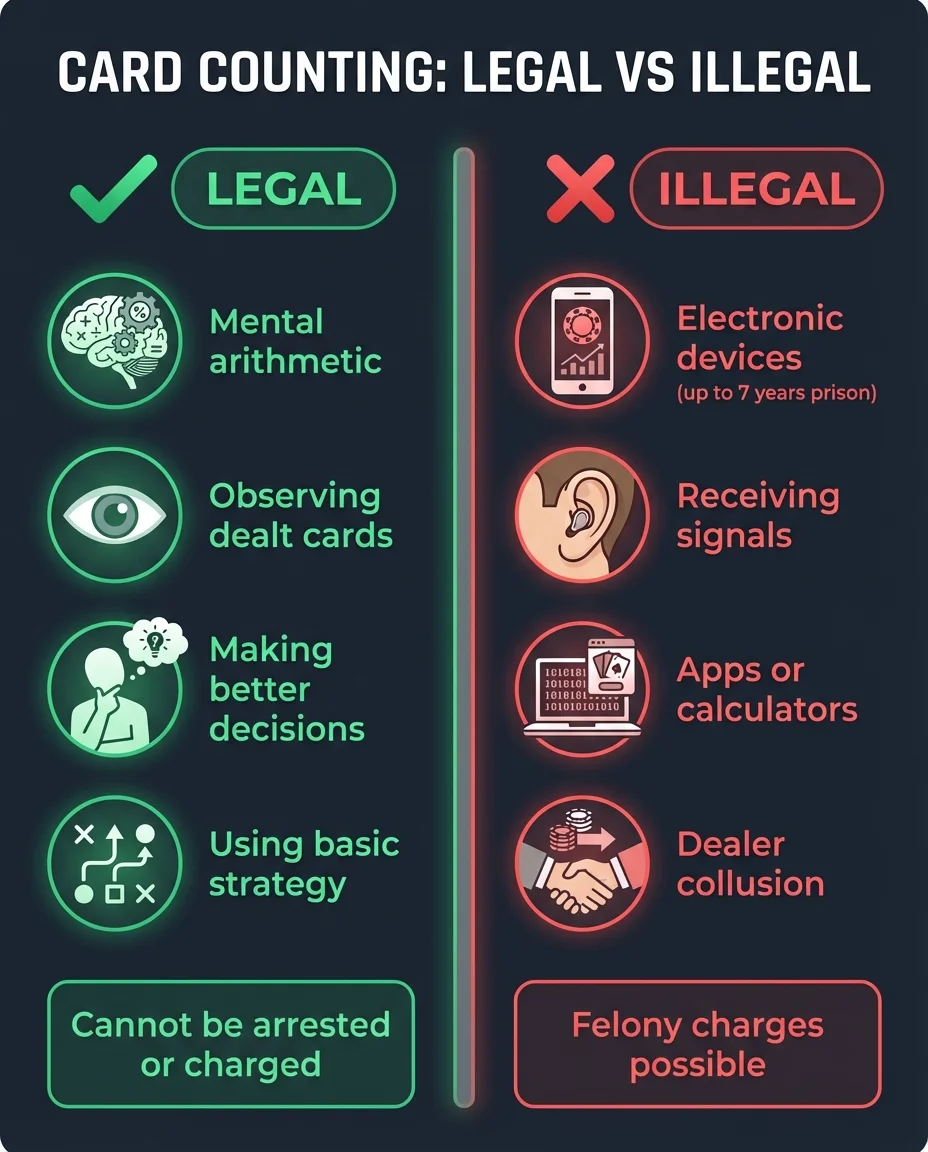
Card counting uses nothing but your brain. You’re observing publicly available information—the cards dealt face-up on the table—and doing math in your head. There’s no manipulation of equipment, no collusion with dealers, no deception. You’re simply making better decisions based on available data.
Courts have consistently ruled that this constitutes skill-based advantage play, not cheating or fraud. No federal, state, or local law in the United States criminalizes mental arithmetic at a blackjack table. The same applies in the UK (under Gambling Commission rules), Canada (confirmed by Ontario Court of Justice), and Australia.
The Legal Principle: You cannot be arrested, prosecuted, or criminally charged for counting cards using only your mind. Card counting is a strategy, not a crime. This has been upheld repeatedly in court decisions across multiple jurisdictions.
Think of it this way: when you play blackjack, you’re already making strategic decisions—when to hit, stand, or hit, stand, or double down. Card counting simply adds another layer of strategic thinking based on information the casino voluntarily displays.
What IS Illegal: The Line You Can’t Cross
While mental card counting is legal, the law draws sharp lines around certain activities. Cross these, and you’re no longer an advantage player—you’re a criminal.
Electronic Devices
Nevada Revised Statute 465.075 makes it unlawful to “use or possess with the intent to use any device to assist” in projecting outcomes or keeping track of cards. This includes:
- Hidden computers or calculators
- Smartphone apps used at the table
- Earpieces receiving information from accomplices
- Any electronic aid that assists with counting
Getting caught with a device in Nevada can result in felony charges carrying up to 7 years in prison. Other gambling jurisdictions have similar prohibitions.
Team Play with Signaling
While simply counting with friends at the same table isn’t inherently illegal, using coordinated signals to communicate count information can cross into fraud territory. The famous MIT Blackjack Team operated in a legal gray area, but their hand signals and coded communications pushed boundaries that modern casinos and prosecutors scrutinize carefully.
Dealer Collusion
Working with a dealer who intentionally exposes cards or manipulates the game is unambiguously illegal. This constitutes fraud and theft, and both the player and dealer face criminal prosecution.
Card Marking or Switching
Physically altering or marking cards, or introducing foreign cards into play, is cheating. This has nothing to do with counting and is prosecuted as fraud.
| Activity | Legal Status | Potential Consequences |
|---|---|---|
| Mental card counting | Legal | Casino ban (except NJ) |
| Using electronic devices | Illegal | Felony charges, up to 7 years (NV) |
| Smartphone apps at table | Illegal | Criminal charges, prosecution |
| Dealer collusion | Illegal | Fraud charges, imprisonment |
| Card marking/switching | Illegal | Cheating charges, prosecution |
| Team signaling (coordinated) | Gray Area | Potential fraud charges depending on methods |
The New Jersey Exception: Uston v. Resorts International
Atlantic City operates under different rules than anywhere else in America, thanks to Ken Uston and a 1982 New Jersey Supreme Court decision.
Ken Uston, a legendary card counter and eventual Blackjack Hall of Fame inductee, was barred from Resorts International in January 1979 for counting cards. He sued, arguing that casinos operating under state license shouldn’t have the right to exclude skilled players.
The case climbed to the New Jersey Supreme Court, which ruled in Uston’s favor. The court held that the Casino Control Act gives the New Jersey Casino Control Commission—not individual casinos—exclusive authority to set the rules of licensed casino games. Since the Commission hadn’t banned card counting, casinos couldn’t do so unilaterally.
From the Court’s Ruling:
“In sum, absent a valid Commission regulation excluding card counters, respondent Uston will be free to employ his card-counting strategy at Resorts’ blackjack tables.”
— New Jersey Supreme Court, Uston v. Resorts International Hotel, Inc., 1982
The Commission never created such a regulation. To this day, Atlantic City casinos cannot ban players for card counting—not for an afternoon, not for life.
How Atlantic City Casinos Respond Instead
Unable to ban counters, New Jersey casinos adapted with aggressive countermeasures:
- Eight-deck shoes — More cards make counting less effective
- Frequent shuffling — Cutting the shoe early (sometimes at 50%) destroys penetration
- Continuous shuffling machines — Eliminate counting entirely
- Flat betting requirements — Limiting bet spreads kills counter profitability
- Preferential shuffling — Dealers shuffle when the count favors players
These measures are perfectly legal and often make Atlantic City blackjack less profitable for counters than Las Vegas, despite the ban protection.
What Happens When You Get Caught
Despite Hollywood depictions of back-room beatings and broken fingers, modern casino responses to card counting are relatively mundane. Here’s what actually happens:
The Backoff
The most common response is a “backoff”—a polite conversation with a pit boss or floor manager who asks you to stop playing blackjack. They might say something like: “We appreciate your business, but we’re going to ask you to play other games.” You’re not being arrested. You’re not losing your chips. You’re simply being told blackjack is no longer available to you.
The Ban (86ing)
If you’ve been backed off multiple times or the casino considers you a serious threat, they may formally ban you from the property. Security will photograph you, and you’ll be asked to leave. Your name and image go into their database.
Database Sharing
Casinos share information about advantage players. If you’re banned from one MGM property, expect to be unwelcome at others. Third-party services and facial recognition technology make it harder than ever for known counters to play anonymously.
Trespassing Charges
Here’s where legal consequences become real: if you return to a casino after being banned and are caught, you can be arrested for criminal trespassing. The casino is private property, and once you’ve been formally excluded, entering constitutes a crime.
Important: You will virtually always be paid out your winnings before being asked to leave. Casinos know that refusing to pay lawfully won money creates legal liability. They want you gone, not in court.
Card Counting Around the World
The legal status of card counting is remarkably consistent globally—legal almost everywhere, but casinos retain the right to refuse service.
| Jurisdiction | Card Counting Legal? | Casino Can Ban? |
|---|---|---|
| United States (most states) | Yes | Yes |
| New Jersey (Atlantic City) | Yes | No (Uston ruling) |
| United Kingdom | Yes | Yes |
| Canada | Yes | Yes |
| Australia | Yes | Yes |
| Macau | Yes | Yes |
The UK Gambling Commission explicitly permits players to use mental strategies and mathematical skills. Canadian courts have ruled that card counting isn’t cheating. Australian law similarly treats it as legitimate skill-based play.
Advantage Play vs. Cheating: Understanding the Difference
The distinction is simple but critical: cheating manipulates the game; advantage play exploits it.
Advantage play techniques work within the rules of the game as designed. Card counting uses information the casino voluntarily provides (visible cards) and decisions the casino allows (variable bet sizing). The casino created these conditions; advantage players simply use them effectively.
Cheating, by contrast, involves activities the game’s rules and laws explicitly prohibit—marking cards, using devices, colluding with employees, or manipulating equipment. These actions carry criminal penalties because they constitute fraud.
Other forms of legal advantage play include:
- Shuffle tracking — Following card clumps through shuffles
- Ace sequencing — Tracking the location of Aces
- Hole carding — Spotting accidentally exposed dealer cards
- Wheel bias — Identifying imperfect roulette wheels
- Bonus hunting — Exploiting promotional offers mathematically
All of these are legal—and all will get you banned if detected.
Why Casinos Hate Legal Advantage Players
If card counting is legal, why do casinos fight it so aggressively?
Simple: mathematics. A skilled counter can gain a 0.5-1.5% edge over the casino—flipping the house edge from their favor to yours. Over thousands of hands with significant bets, that edge translates into substantial profits extracted from casino revenue.
Casinos are businesses designed around having a mathematical advantage on every game. Blackjack already has one of the lowest house edges (around 0.5% with perfect basic strategy). Add card counting, and the casino can actually be the underdog—an unacceptable situation for a business model predicated on statistical certainty.
The legal right to ban players exists precisely because casinos are private businesses. They can refuse service to anyone for non-discriminatory reasons. Being “too skilled at their game” qualifies.
Common Myths About Card Counting Legality
Myth: You can be arrested for counting cards
Reality: No law criminalizes mental card counting. You cannot be arrested, charged, or prosecuted for counting cards using only your brain. The only arrest scenarios involve trespassing (returning after a ban) or using illegal devices.
Myth: Casinos can confiscate your winnings if they catch you
Reality: Casinos must pay legitimate winnings. Refusing to pay lawfully won money creates legal liability. They’ll pay you and then ask you to leave.
Myth: Counting cards is only possible for mathematical geniuses
Reality: Basic counting systems like Hi-Lo require only adding and subtracting 1. The challenge isn’t intelligence—it’s practice, discipline, and avoiding detection.
Myth: Online casinos can’t detect card counting
Reality: Most online blackjack uses continuous shuffling or shuffles after every hand, making counting impossible. Live dealer games with real shoes are the exception, but sophisticated tracking software monitors betting patterns.
The Bottom Line
Card counting is legal. Full stop. Using your brain to track publicly visible information and adjust your bets accordingly breaks no laws in the United States, United Kingdom, Canada, Australia, or virtually any other jurisdiction. Courts have consistently ruled that mental advantage play constitutes skill, not cheating.
But legal doesn’t mean welcome. Casinos are private businesses with the right to refuse service, and they exercise that right aggressively against anyone they suspect of counting. The exception is New Jersey, where the Uston ruling prevents Atlantic City casinos from banning skilled players—though they’ve compensated with game conditions that make counting barely profitable anyway. If you choose to count cards, understand the landscape: you’re doing nothing wrong, but you’re playing a game within a game—trying to extract profit before detection ends your session.
FAQs
No. Card counting is legal in Las Vegas and all of Nevada. However, Nevada casinos have broad rights to refuse service. If they detect you counting, they can ban you from the property—and if you return after a ban, you can be arrested for trespassing.
Not for counting cards using only your mind. However, you can face criminal charges for: using electronic counting devices (felony in Nevada), returning to a casino after being banned (trespassing), or colluding with casino employees (fraud).
No. Casinos must pay legitimately won money. They cannot legally confiscate your chips or refuse to cash you out for card counting. They will typically pay your winnings in full, then ask you to leave and ban you from returning.
No, and uniquely, Atlantic City casinos cannot ban you for it either. The 1982 Uston v. Resorts International ruling established that only the New Jersey Casino Control Commission can set blackjack rules. However, casinos use countermeasures like frequent shuffling and bet restrictions.
Yes. Using any electronic device to assist with card counting is illegal in Nevada and most gambling jurisdictions. Nevada law (NRS 465.075) makes this a felony carrying up to 7 years in prison. Leave your phone in your pocket at the blackjack table.
No. The UK Gambling Commission permits players to use mental strategies and mathematical skills in casino games. However, UK casinos can still ban players they suspect of advantage play, and many share information about known counters across their properties.
Card counting uses publicly visible information and allowed betting options—it exploits the game as designed. Cheating involves prohibited activities: using devices, marking cards, colluding with dealers, or manipulating equipment. Counting is legal; cheating is criminal.
Casinos watch for betting patterns (big bets when the count is high, small bets when low), playing deviations from basic strategy that only make sense with count information, and prolonged focus on the cards. Surveillance, pit bosses, and facial recognition technology all contribute to detection.
