Every online gambler has wondered it at some point: “Is this game actually fair, or is it rigged against me?” The answer lies in three letters that power every digital spin, deal, and dice roll in the gambling world — RNG. Understanding how Random Number Generators work is the single most important thing you can learn as a casino player, because it separates informed gambling from blind faith. Whether you’re playing online slots or sitting at a land-based machine, RNG is the invisible engine determining your outcome — and if you’re new to gambling terminology, our guide on what a wager means is a great place to start.

KEY FACTS AT A GLANCE
- RNG stands for: Random Number Generator — the algorithm that determines every outcome in online casino games
- Two main types: PRNG (software-based, most common) and TRNG (hardware-based, uses physical phenomena)
- Used in: Online slots, video poker, digital table games, crash games, land-based slot machines, and virtual roulette
- NOT used in: Live dealer games (these use physical cards, wheels, and dice)
- Certified by: eCOGRA, iTech Labs, GLI, and BMM Testlabs
- Key misconception: RNG ensures fair randomness — it does NOT improve your odds or change the house edge
What Is RNG? The Basics
RNG stands for Random Number Generator. It is a sophisticated mathematical algorithm designed to produce sequences of numbers that are completely unpredictable. Think of it as rolling a billion-sided die millions of times per second — except no physical die exists. The entire process happens inside a computer chip using complex mathematical formulas.
In the context of gambling, the RNG is the invisible engine behind every game outcome. When you hit “spin” on a slot machine, click “deal” in blackjack, or watch a virtual roulette wheel turn, the RNG has already determined the result in a fraction of a millisecond. The animations you see are purely visual — the outcome was decided the instant you clicked.
Why can’t casinos just use a simple random function? Because gambling demands a level of randomness that’s cryptographically secure. The algorithm must produce results that cannot be predicted, reverse-engineered, or manipulated — by the casino, the player, or anyone else. This is why regulated online casinos use specially certified RNG systems that undergo rigorous independent testing.
Types of RNG Used in Gambling
Not all random number generators are created equal. The gambling industry primarily uses two types of RNG, each with distinct advantages and trade-offs.
PRNG vs TRNG COMPARISON
PRNG (Pseudo-Random Number Generator)
- How it works: Uses mathematical algorithms and a seed value to generate number sequences
- Speed: Extremely fast — generates millions of numbers per second
- Cost: Low — runs entirely in software
- Randomness: Deterministic but statistically indistinguishable from true randomness
- Usage: The standard for online casinos, accounting for nearly all online gambling RNG
TRNG (True Random Number Generator)
- How it works: Measures physical phenomena like atmospheric noise, radioactive decay, or thermal fluctuations
- Speed: Slower — limited by physical measurement processes
- Cost: High — requires specialized hardware
- Randomness: Genuinely random and cannot be reproduced or predicted
- Usage: Rare in mainstream online gambling; used primarily for seeding PRNGs or in high-security contexts
In practice, most online casinos use PRNG because it’s fast enough to handle millions of simultaneous game rounds across thousands of players. The “pseudo” part doesn’t mean it’s fake randomness — a properly implemented PRNG produces results that are statistically identical to true randomness. The key difference is that PRNG starts from a seed value (often derived from high-entropy sources like system clock microseconds combined with other unpredictable data), while TRNG derives randomness directly from nature.
Some advanced systems use a hybrid approach: a TRNG provides the seed values, and a PRNG generates the actual game outcomes at high speed. This combines the genuine randomness of hardware with the speed of software.
How RNG Works in Casino Games
RNG doesn’t work the same way in every casino game. Here’s how it operates across the most popular game types.
Online Slots
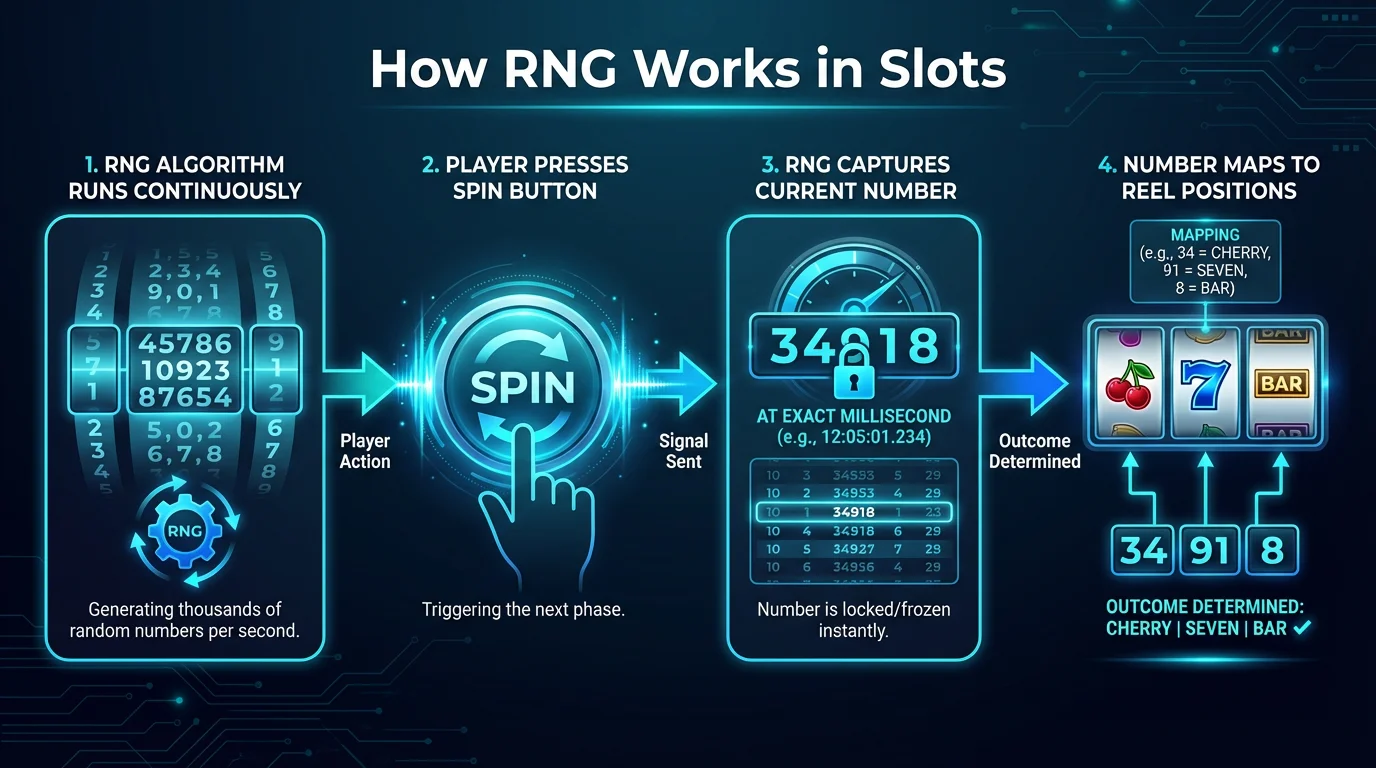
Slots are the most RNG-dependent game in any casino. The RNG runs continuously in the background, generating millions of random numbers every second — even when nobody is playing. The moment you press “spin,” the system captures the current number at that precise millisecond. This number is then mathematically mapped to specific reel positions, determining which symbols appear on each reel.
The spinning animation is purely cosmetic. Your result was determined the instant you clicked — the reels just provide visual entertainment while the predetermined outcome is displayed. This is why “stopping the reels early” or “timing your spins” has zero effect on the result.
Digital Table Games
In virtual blackjack, the RNG shuffles the deck digitally before each hand, ensuring cards are dealt in a completely random order. For virtual roulette, the RNG selects a number between 0 and 36 for European roulette (or from the 38 pockets — 0, 00, and 1–36 — in American roulette) the moment you click “spin.” The wheel animation simply reflects this predetermined result. If you’re learning the fundamentals, our blackjack beginner’s guide, roulette guide, and baccarat guide cover the rules and strategies in depth.
Video Poker
Video poker combines elements of both slots and table games. The RNG shuffles a virtual 52-card deck and deals your initial five cards. When you choose which cards to hold and which to discard, the RNG then deals replacement cards from the remaining virtual deck. Each draw is an independent random event.
Live Dealer Games
Here’s an important distinction: live dealer games do NOT use RNG for their core outcomes. Real human dealers use physical cards, dice, and roulette wheels in a studio broadcast via video stream. The randomness comes from the physical world — the way cards are shuffled, the force of the ball spin, and the natural physics of dice tumbling. However, some live dealer games use RNG for side bets or bonus features that run alongside the main game.
Crash Games and Provably Fair Systems
Crash games (like Aviator), Plinko, and other provably fair casino games represent a newer approach to randomness. Instead of relying solely on traditional RNG with third-party audits, these games use cryptographic hash functions that allow players to independently verify every single outcome. The system uses three components: a server seed (from the casino), a client seed (from the player), and a nonce (bet counter). After each round, players can mathematically prove whether the result was fair. You can learn exactly how this works in our guides to verifying provably fair results on BC.Game, Stake, and Shuffle.
RNG in Land-Based Slot Machines
While this article focuses heavily on online gambling, it’s important to understand that land-based slot machines have used RNG microchips since the mid-1980s. Before that, slot machines were purely mechanical — physical reels spun and stopped based on springs, gears, and lever mechanisms. A skilled player could sometimes predict or influence outcomes based on the machine’s physical behavior.
The introduction of RNG chips changed everything. Modern land-based slot machines contain a small computer running the same type of PRNG algorithm used in online casinos. The physical reels you see are motor-driven, but their stopping positions are determined entirely by the RNG chip — not by any mechanical process. When you pull the lever or press the spin button, the RNG captures its current number and maps it to reel positions, just like an online slot.
The key difference between land-based and online slots isn’t the RNG technology — it’s the RTP. Land-based casinos typically set their slot machines to return 85–92% of wagers over time, compared to 94–97% for online slots. The higher overhead costs of physical casinos (rent, staff, electricity) mean they need a larger house edge to remain profitable.
RNG Testing and Certification
A casino claiming their games are “fair” means nothing without independent verification. This is where third-party testing laboratories come in. These organizations rigorously audit RNG systems using advanced statistical tests to ensure true randomness and compliance with regulatory standards.
| Testing Lab | Founded | Key Markets | What They Test |
|---|---|---|---|
| eCOGRA | 2003 | UK, EU, Global | RNG certification, RTP verification, player protection audits |
| iTech Labs | 2004 | Global | RNG evaluation, game compliance, security assessments |
| GLI | 1989 | US, Asia, Global | RNG testing, regulatory compliance, hardware/software certification |
| BMM Testlabs | 1981 | Global | RNG testing, functionality validation, fairness audits |
These labs use sophisticated statistical tests to evaluate RNG quality. Common methodologies include Chi-Squared tests (analyzing distribution patterns), Marsaglia’s Diehard tests (a battery of 15+ statistical tests developed specifically for randomness evaluation), and Kolmogorov-Smirnov tests (verifying that outputs match expected distributions). The RNG must pass all tests across millions or billions of generated numbers before receiving certification.
HOW TO SPOT A RED FLAG
If an online casino does not display certification seals from recognized testing labs (eCOGRA, iTech Labs, GLI, or BMM Testlabs) in its footer, or if it lacks a valid gambling license from a recognized regulator, treat it as a major red flag. Unlicensed casinos may use uncertified or manipulated RNG systems with no independent oversight.
When RNG Goes Wrong: Historical Failures
While modern certified RNG systems are extremely secure, history shows what happens when RNG is poorly implemented or deliberately compromised — and why independent testing exists.
In the mid-1990s, Ronald Dale Harris, a computer technician employed by the Nevada Gaming Control Board, exploited his inside knowledge of slot machine RNG code to predict outcomes. Harris had access to the source code of slot machines he was supposed to be auditing and figured out how to predict the RNG sequences on certain older machines. He recruited accomplices to place winning bets and collected over $100,000 before being caught in 1995 when an associate triggered suspicion by winning a $100,000 keno jackpot at Bally’s Atlantic City.
In 2008, the Absolute Poker and UltimateBet scandal revealed that insiders at these online poker platforms had access to a “superuser” account that could see other players’ hole cards in real-time. While not strictly an RNG failure, it demonstrated how software vulnerabilities can undermine fairness even when the RNG itself is functioning correctly.
These cases actually demonstrate why the current system works: perpetrators were caught, prosecuted, and the incidents led to significantly tighter regulations and testing requirements. Modern RNG certification involves code-level audits, continuous monitoring, and separation of duties that make these exploits virtually impossible at licensed, regulated casinos.
Common RNG Myths Debunked
Misunderstanding RNG leads to costly gambling mistakes. Here are five of the most persistent myths — and the reality behind each one.
MYTH 1: “HOT/COLD” MACHINES AND “DUE” PAYOUTS
Many players believe that a slot machine that hasn’t paid out in a while is “due” for a win, or that a machine on a winning streak is “hot.” This is the textbook gambler’s fallacy. RNG ensures that every single spin is completely independent — the machine has no memory of previous results. A slot that just paid a jackpot has the exact same odds on the next spin as one that hasn’t paid in hours. There is no internal counter that says “after 500 losses, trigger a win.” Long losing streaks and winning streaks are a natural, mathematically expected part of random sequences — not evidence of cycles. Try our Gambler’s Fallacy Demonstrator to see this principle in action, and use the Variance Survival Calculator to understand how variance affects your session results.
MYTH 2: AUTOPLAY HAS DIFFERENT ODDS THAN MANUAL SPINS
Some players avoid autoplay because they believe it has worse odds, or conversely, use it because they think it wins more. Neither is true. Autoplay uses the exact same RNG function as a manual spin. The game software doesn’t know or care whether you physically clicked the spin button or whether autoplay triggered it — both actions make the same call to the RNG at that moment. The only difference is convenience, not probability.
MYTH 3: TIME OF DAY AFFECTS YOUR ODDS
Some players believe casinos adjust payouts based on traffic — tighter odds during peak hours, looser during off-hours. This is false. RNG operates identically 24/7 regardless of how many players are online, what day of the week it is, or what time zone you’re in. The algorithm doesn’t know or care about these factors.
MYTH 4: BETTING PATTERNS CAN BEAT THE RNG
Strategies like the Martingale system (doubling your bet after every loss) or Fibonacci betting cannot overcome RNG-determined odds. These systems change your bet sizing, but they cannot change the underlying probability of each outcome. The RNG doesn’t know or respond to your betting pattern — every result is independently random regardless of your wager amount.
MYTH 5: YOU CAN SPOT PATTERNS IN RNG RESULTS
Humans are hardwired to find patterns — even in completely random data. This is called apophenia (or confirmation bias when it reinforces existing beliefs). If you spin a slot 100 times, you will naturally notice clusters and streaks. But these patterns are a normal, expected feature of randomness, not evidence of a hidden system. Truly random sequences are actually full of apparent patterns — it’s their absence that would be suspicious.
How to Verify a Casino’s RNG Certification
Knowing that RNG exists is one thing — knowing how to verify it is what separates smart players from the rest. Here are five practical steps to confirm a casino’s RNG is legitimate.
STEP 1: CHECK THE FOOTER
Scroll to the bottom of the casino’s homepage. Look for certification seals from eCOGRA, iTech Labs, GLI, or BMM Testlabs. Legitimate casinos display these prominently.
STEP 2: VERIFY THE SEAL
Click on the certification seal. It should link directly to the testing lab’s website, showing the casino’s verification page. A seal that doesn’t link anywhere may be fake.
STEP 3: CHECK FOR PROVABLY FAIR
Crypto casinos often offer provably fair games. Look for a “Provably Fair” badge or section where you can verify individual game results using cryptographic hashes.
STEP 4: REVIEW AUDIT REPORTS
Check the casino’s “About,” “Fair Play,” or “Security” section for published RNG audit reports. These should show recent dates and results from recognized labs.
STEP 5: CHECK THE REGULATOR
Cross-reference the casino’s license number with the regulator’s database (UKGC, MGA, etc.). Licensed casinos are required to use certified RNG — losing their license would destroy their business.
RNG vs Provably Fair Systems
Traditional RNG and provably fair systems both aim to ensure fair gambling outcomes, but they take fundamentally different approaches to trust and transparency.
TRADITIONAL RNG vs PROVABLY FAIR
Traditional RNG
- Trust model: Trust the casino + third-party auditor
- Verification: Periodic audits (quarterly or annually)
- Player verification: Cannot independently verify individual bets
- Transparency: Aggregate audit reports published
- Standard for: Most licensed online casinos worldwide
Provably Fair (Blockchain)
- Trust model: Trustless — math provides proof, not authority
- Verification: Real-time, after every single bet
- Player verification: Players can independently verify each outcome
- Transparency: Complete — every bet has a cryptographic receipt
- Standard for: Crypto casinos (BC.Game, Stake, etc.)
Provably fair works by combining a server seed (the casino’s secret input), a client seed (your input), and a nonce (bet counter) through a cryptographic hash function. Before each round, the casino commits to its server seed by publishing a hash of it. After the round, you can verify that the seed matches the hash, confirming the casino didn’t change it after seeing your bet. For a deep dive into the mathematics, read our guide on the math behind provably fair systems.
Understanding RTP and Its Connection to RNG
RNG and RTP (Return to Player) are closely related but fundamentally different concepts that players often confuse. RNG determines which specific outcome occurs on any given spin or hand. RTP determines how much money the game returns to players over the long term as a percentage of total wagers.
Here’s the key insight: a perfectly fair RNG doesn’t mean you’ll win more. A slot with 96% RTP and certified RNG will still take 4% of all money wagered over time — it just does so fairly and unpredictably. The RNG ensures the casino can’t target specific players or manipulate individual sessions, but the mathematical house edge is built into the game design itself, not the RNG. For a complete breakdown of how these numbers work, read our guide on RTP, house edge, and why casinos don’t need luck, or use our RTP Reality Check tool to see exactly how RTP plays out over different numbers of spins.
| Game Type | Typical RTP Range | House Edge | RNG Role |
|---|---|---|---|
| Online Slots | 94% – 97% | 3% – 6% | Determines reel positions on every spin |
| Blackjack (Online) | 99.0% – 99.5% | 0.5% – 1% | Shuffles virtual deck for each hand |
| Roulette (European) | 97.3% | 2.7% | Selects winning number each round |
| Video Poker | 95% – 99.5% | 0.5% – 5% | Shuffles deck and deals replacement cards |
| Land-Based Slots | 85% – 92% | 8% – 15% | Same as online — RNG chip in the machine |
Regulatory Requirements by Jurisdiction
Different gambling regulators enforce different standards for RNG testing and certification. Here’s how the major jurisdictions compare.
| Regulator | RNG Requirements | Testing Frequency | Public Reports |
|---|---|---|---|
| UKGC (UK) | Mandatory certified RNG from approved lab | Monthly audits + annual review | Yes — full transparency |
| MGA (Malta) | Certified RNG + independent testing required | Monthly audits + quarterly tests | Yes |
| Curaçao | RNG certificate from independent lab required | Annual (improving in 2026) | Limited |
| Nevada (US) | Hardware + software RNG testing mandatory | Continuous monitoring | Yes |
The UKGC (UK Gambling Commission) maintains the most rigorous oversight globally, requiring monthly financial audits and RNG checks alongside strict responsible gambling enforcement. The MGA (Malta Gaming Authority) follows closely with comparable standards. Curaçao has historically been less stringent but is modernizing its regulations in 2026 to align with international standards. For US-based gambling, the Nevada Gaming Control Board requires continuous RNG monitoring for all casino operations.
Frequently Asked Questions
Licensed casinos cannot manipulate certified RNG systems. Third-party labs like eCOGRA and iTech Labs audit the RNG software regularly, and any tampering would result in license revocation and criminal prosecution. However, unlicensed casinos operating without regulatory oversight may use uncertified or manipulated systems — which is why you should always verify a casino’s license and certification before playing.
Not at licensed, regulated casinos. Online casinos licensed by reputable authorities (UKGC, MGA, Nevada Gaming Control Board) are required to use independently certified RNG and undergo regular audits. The house edge is built into the game mathematics, not through rigging. The casino profits from the mathematical edge over time, not by manipulating individual results.
Modern certified RNG systems use cryptographically secure algorithms (CSPRNGs) that are extremely resistant to hacking. The RNG code is audited at the source level by independent labs, seeds are derived from high-entropy sources, and the systems are continuously monitored. While historical cases like the Ronald Dale Harris incident show that weak or insider-compromised systems can be exploited, current certification standards make this virtually impossible at regulated casinos.
Check the casino’s footer for certification seals from recognized labs (eCOGRA, iTech Labs, GLI, BMM Testlabs). Click on the seal to verify it links to the lab’s official verification page. Also check the casino’s gambling license number against the regulator’s public database. Most casinos publish their RNG audit results in a “Fair Play” or “Security” section.
No — live dealer games use physical cards, dice, and roulette wheels operated by real human dealers in a studio broadcast via video stream. The randomness comes from the physical world, not from algorithms. However, some live dealer games use RNG for side bets or bonus features that run alongside the main game.
No. Autoplay uses the exact same RNG function as a manual spin. The game software doesn’t distinguish between a player clicking the spin button and autoplay triggering it — both make the same call to the RNG. The only difference is convenience, not probability or odds.
Traditional RNG requires you to trust the casino and third-party auditors — you can’t verify individual bets yourself. Provably fair systems (common in crypto casinos) use cryptographic hash functions that let players independently verify every single outcome. Both ensure fair results, but provably fair offers real-time transparency rather than periodic audit reports.
Yes. Land-based slot machines have used RNG microchips since the mid-1980s. The physical reels you see are motor-driven, but their stopping positions are determined entirely by the RNG chip inside the machine — not by any mechanical process. The technology is fundamentally the same as online slots, though land-based machines typically have lower RTP (85–92%) compared to online slots (94–97%).
KEY TAKEAWAYS
- RNG is the backbone of fair gambling — it generates mathematically unpredictable outcomes for every spin, deal, and roll in both online and land-based casinos
- PRNG (software) is the industry standard — it’s fast, certified, and statistically indistinguishable from true randomness
- Certification matters — always check for seals from eCOGRA, iTech Labs, GLI, or BMM Testlabs before playing
- RNG doesn’t change the house edge — fair randomness means unbiased results, not better odds for players
- Every spin is independent — there are no “hot” or “cold” machines, no due payouts, and no timing tricks
- Autoplay odds are identical — the RNG doesn’t know or care whether you clicked spin or used autoplay
- Provably fair is the transparency upgrade — blockchain-based systems let you verify every single bet yourself
- Check the regulator — UKGC and MGA-licensed casinos have the strictest RNG requirements
