Splitting pairs is one of blackjack’s most misunderstood decisions. Get it right, and you turn losing hands into winners while maximizing profit on favorable situations. Get it wrong, and you’ll double your losses on hands you should have left alone. The difference between a skilled player and a hopeful gambler often comes down to knowing exactly which pairs to split—and just as importantly, which ones to keep together.
Key Highlights
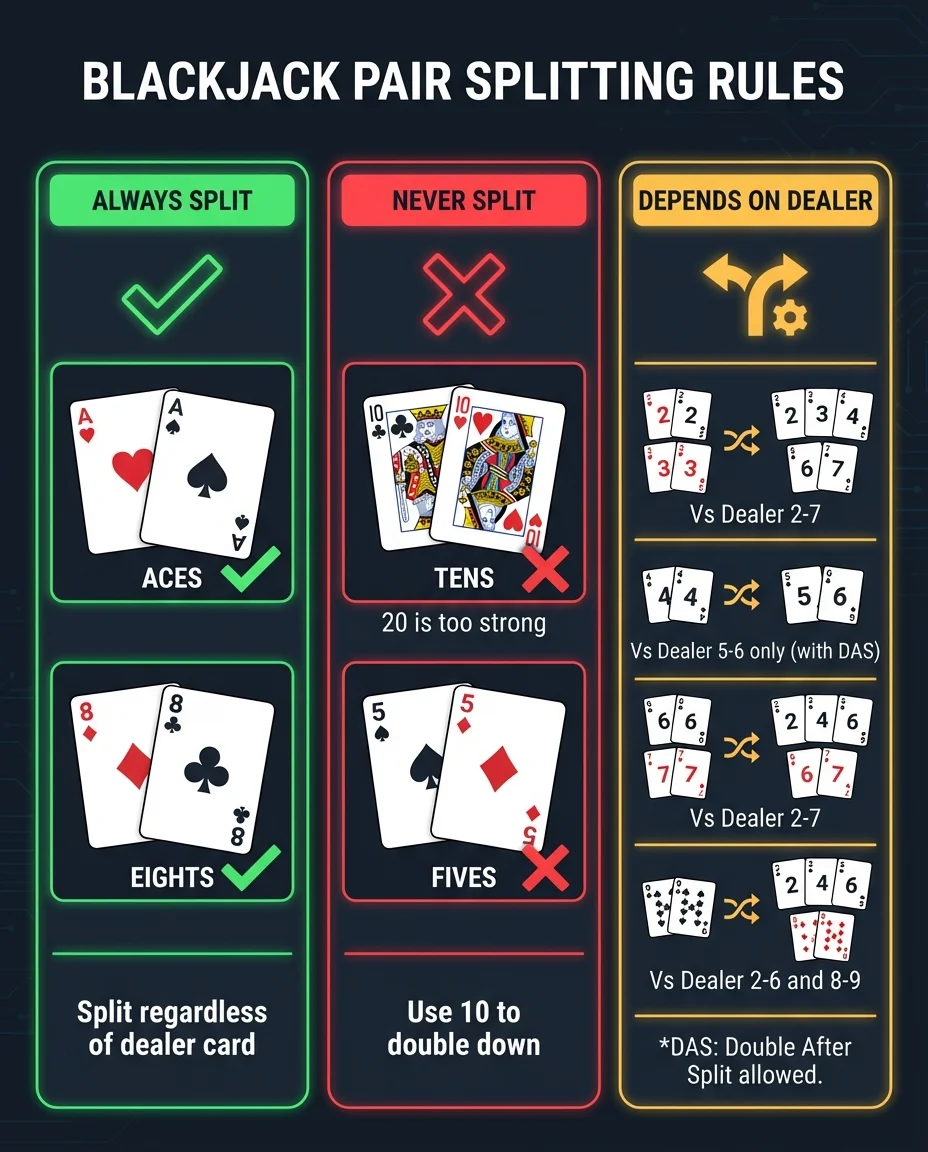
- Always split Aces and 8s—no exceptions in standard games. These are the two non-negotiable splitting rules.
- Never split 10s or 5s—20 is too strong to break up, and 10 is better for doubling down
- Split 2s, 3s, 6s, 7s against dealer 2-7 (with some DAS variations)
- Split 9s against 2-6 and 8-9, but stand against 7, 10, or Ace
- Split 4s only against 5-6 when Double After Split (DAS) is allowed
- DAS changes several decisions—know your table rules before sitting down
How Splitting Works
When you’re dealt a pair (two cards of equal value), you have the option to split them into two separate hands. You place a second bet equal to your original wager, and each card becomes the first card of a new hand. You then play each hand independently—hitting, standing, or even doubling down on each one.
The strategic value of splitting comes from two scenarios:
- Escaping a bad hand—turning one terrible total (like 16) into two reasonable starting points (like two 8s)
- Capitalizing on dealer weakness—doubling your money at risk when the dealer shows bust cards
The key insight: splitting isn’t about getting two hands instead of one. It’s about mathematical expected value. Sometimes splitting turns a losing expectation into a winning one. Sometimes it turns a moderate loss into a smaller loss. And sometimes—as with 10s and 5s—it turns a winner into two losers.
The Master Splitting Chart
Before diving into each pair, here’s the complete reference chart for standard multi-deck blackjack with Double After Split allowed:
| Your Pair | 2 | 3 | 4 | 5 | 6 | 7 | 8 | 9 | 10 | A |
|---|---|---|---|---|---|---|---|---|---|---|
| A-A | Y | Y | Y | Y | Y | Y | Y | Y | Y | Y |
| 10-10 | N | N | N | N | N | N | N | N | N | N |
| 9-9 | Y | Y | Y | Y | Y | N | Y | Y | N | N |
| 8-8 | Y | Y | Y | Y | Y | Y | Y | Y | Y | Y |
| 7-7 | Y | Y | Y | Y | Y | Y | N | N | N | N |
| 6-6 | Y | Y | Y | Y | Y | N | N | N | N | N |
| 5-5 | N | N | N | N | N | N | N | N | N | N |
| 4-4 | N | N | N | Y* | Y* | N | N | N | N | N |
| 3-3 | Y | Y | Y | Y | Y | Y | N | N | N | N |
| 2-2 | Y | Y | Y | Y | Y | Y | N | N | N | N |
Y = Split | N = Don’t Split | Y* = Split only if DAS allowed
The Two Golden Rules
Before we analyze each pair, memorize these two rules. They apply in every standard blackjack game, against every dealer upcard, with no exceptions.
Always Split Aces
A pair of Aces is worth either 2 or 12—both terrible totals. Split them, and you start two hands each worth 11, with a roughly 31% chance of drawing a 10-value card for 21 on each. Even if you don’t hit 21, an Ace is the best starting card in blackjack.
The value is so significant that casinos often restrict what you can do after splitting Aces—typically allowing only one card per Ace, with no option to hit further or double down. Even with these restrictions, splitting remains overwhelmingly correct.
Always Split 8s
A pair of 8s totals 16—statistically the worst hand in blackjack. You’ll bust if you hit and draw anything 6 or higher, but standing on 16 usually loses to the dealer’s made hand. It’s a losing proposition either way.
Splitting transforms this disaster into two hands starting at 8—a reasonable starting point that can develop into 18 with a 10-value card, or become a doubling opportunity with a 2 or 3.
The Math: Against a dealer 9, hitting a pair of 8s (hard 16) produces an expected loss of $52 per $100 bet. Splitting the 8s reduces that expected loss to $43 per $100 bet. You’re still losing, but you’re losing less—and in blackjack, minimizing losses is often the best you can do.
The Two Pairs You Never Split
Never Split 10s (10-10, J-J, Q-Q, K-K)
A pair of 10-value cards gives you 20—the second-strongest possible hand, beaten only by 21. Standing on 20 wins approximately 70% of the time against a dealer’s 6 (the weakest upcard).
If you split, each 10 has only a 38% chance of drawing another 10-value card for 20, and you’re far more likely to end up with worse hands. The math is unambiguous: standing on 20 yields an expected win of about 70 cents per dollar bet against a dealer 6. Splitting yields only about 58 cents. You’re giving up 12 cents of value per dollar wagered.
The only exception is for card counters in very specific high-count situations—and if you’re counting cards, you already know the nuances. For basic strategy players: never split 10s.
Never Split 5s
A pair of 5s totals 10—one of the best doubling opportunities in the game. Splitting would give you two hands starting at 5, which is a weak position that often leads to stiff totals like 15.
Instead of splitting, treat 5-5 as a hard 10 and follow doubling strategy: double against dealer 2-9, hit against 10 or Ace. You’re converting a strong position into maximum profit rather than breaking it into two weak positions.
Pair-by-Pair Breakdown
Now let’s examine each remaining pair in detail, explaining the reasoning behind each decision.
Pair of 9s: The Strategic Exception
Strategy: Split against dealer 2-6 and 8-9. Stand against 7, 10, and Ace.
The 9-9 split decision is the most nuanced in basic strategy. Your pair totals 18—a strong hand but not unbeatable.
Why split against 2-6? The dealer’s bust probability is high enough that getting two hands in play maximizes your expected profit. Against weak dealer cards, you want more money at risk.
Why split against 8 and 9? Your 18 is vulnerable to these dealer upcards, and splitting gives you two chances to outdraw the dealer’s likely final total.
Why stand against 7? This is the key exception. When the dealer shows 7, they’ll likely make 17 (assuming a 10 in the hole). Your 18 beats 17 approximately 63% of the time. Splitting would break up a winning hand into two hands that each need to beat 17 independently—a worse mathematical proposition.
Why stand against 10 and Ace? These are defensive stands. Against strong dealer upcards, your 18 has the best chance of survival as a single hand. Splitting doubles your exposure to hands that may well beat 18 anyway.
Pair of 7s: The Dealer Range Split
Strategy: Split against dealer 2-7. Hit against 8-Ace.
A pair of 7s totals 14—a stiff hand that’s difficult to improve without busting. Against weak dealer cards (2-7), splitting gives you two starting hands of 7, which can become 17 with a 10-value card or present doubling opportunities.
Against dealer 8 or higher, the dealer’s likely final total exceeds what two 7-based hands can reliably beat. Hitting the 14 and hoping for improvement becomes the lesser evil.
Pair of 6s: Avoid the 12
Strategy: Split against dealer 2-6. Hit against 7-Ace.
A pair of 6s totals 12—the beginning of the stiff zone where any 10-value card busts you. Against dealer bust cards (2-6), splitting lets you escape this trap and start two hands at 6.
The split against dealer 2 requires DAS to be available in some strategy variations. Without DAS, some charts recommend hitting against dealer 2 instead.
Pair of 4s: The DAS-Dependent Split
Strategy: Split against dealer 5-6 only if DAS is allowed. Otherwise, hit.
A pair of 4s totals 8—not a terrible starting hand. The only reason to split is if you can double down afterward, which means DAS must be available.
When you split 4s against a dealer 5 or 6 (the weakest upcards), you might draw a 6 or 7 to get 10 or 11—prime doubling hands against a dealer likely to bust. Without DAS, you lose this secondary opportunity, making the split unprofitable.
Pair of 3s: Capitalize on Dealer Weakness
Strategy: Split against dealer 2-7. Hit against 8-Ace.
A pair of 3s totals 6—which you’d normally hit anyway. Splitting against weak dealers gives you two chances to build competitive hands, and if DAS is available, you might catch doubling opportunities on cards like 7 or 8.
The decision to split against dealer 2 and 3 specifically depends on DAS in some strategy variations.
Pair of 2s: Similar Logic to 3s
Strategy: Split against dealer 2-7. Hit against 8-Ace.
The reasoning mirrors 3-3. A total of 4 isn’t going anywhere useful, so against weak dealers, you split to create two separate opportunities. Against strong dealers, you hit and hope for the best with your single hand.
Understanding Double After Split (DAS)
DAS is a rule that significantly affects splitting strategy. When DAS is allowed, you can double down on hands created after splitting—which creates additional value in split decisions.
For example, if you split 6-6 and draw a 5, you now have 11 and can double against a dealer’s weak upcard. This secondary opportunity makes splitting more valuable.
| Your Pair | With DAS | Without DAS |
|---|---|---|
| 4-4 | Split vs 5-6 | Never split (hit instead) |
| 6-6 | Split vs 2-6 | Split vs 3-6 only |
| 2-2 and 3-3 | Split vs 2-7 | Split vs 4-7 only |
Always check whether DAS is allowed before sitting at a table. It’s typically indicated on the felt or a placard. DAS availability makes blackjack more favorable for players overall, reducing the house edge by approximately 0.14%.
Resplitting and Other Rules
Resplitting Pairs
Most casinos allow you to split again if you receive another matching card after an initial split. For example, you split 8-8, receive an 8 on the first hand, and can split again to create three hands.
The strategy for resplitting follows the same logic as the initial split—if splitting was correct the first time, it’s correct again.
Resplitting Aces
Many casinos restrict resplitting Aces. You’ll typically only receive one card per Ace after splitting, with no option to split again if you receive another Ace. Check the house rules.
Splitting 10-Value Cards
While you should never split 10s strategically, know that you can typically split any two 10-value cards together—not just identical ones. A Jack and Queen both count as 10 and can be split. (Again: don’t do this.)
Common Splitting Mistakes
- Splitting 10s because “you might get two 21s” — You’re turning a near-guaranteed winner into two uncertain hands. The math doesn’t support it.
- Not splitting 8s against a dealer 10 or Ace — Yes, you’ll probably lose both hands. But you’ll lose less than playing 16 as a single hand.
- Splitting 4s without checking for DAS — Without the doubling option afterward, splitting 4s isn’t profitable.
- Splitting 5s ever — Treat 5-5 as a hard 10. Double against 2-9, hit against 10 and Ace.
- Standing on 9-9 against all strong cards — Remember to split against dealer 8 and 9, even though you stand against 10 and Ace.
Memory Tricks for Splitting
Here’s a quick way to remember the essentials:
- “Aces and 8s, Aces and 8s” — Always split these, no exceptions
- “Never split the money makers” — 10s give you 20, 5s give you 10. Keep them together.
- “Weak pairs against weak dealers” — 2s, 3s, 6s, 7s split when the dealer shows 2-7
- “9s avoid the 7” — Split 9s against everything except 7, 10, and Ace
- “4s need DAS” — Only split 4s if you can double afterward, and only against 5-6
The Bottom Line
Splitting pairs correctly separates informed players from hopeful gamblers. The strategy isn’t about getting more hands in play—it’s about maximizing expected value in every situation. Sometimes that means aggressively splitting weak pairs against bust-prone dealers. Sometimes it means keeping strong totals together despite the temptation of “two chances.”
Master the two absolutes (always split Aces and 8s, never split 10s and 5s), learn the conditional splits, and check for DAS before sitting down. Combined with solid hit-stand decisions and proper doubling, correct splitting completes the basic strategy puzzle and gives you the lowest possible house edge.
FAQs
Yes. Splitting Aces is always correct in standard blackjack. A pair of Aces totals 2 or 12, both terrible hands. Splitting gives you two hands starting at 11 with a roughly 31% chance of drawing to 21 on each. This is one of the most profitable plays in the game.
Because losing less is better than losing more. Hard 16 against a dealer 10 has an expected loss of about $52 per $100 bet. Splitting 8s reduces that to approximately $43. You’ll still likely lose, but splitting minimizes the damage. The Four Horsemen of blackjack mathematics proved this decades ago.
For basic strategy players, no. A total of 20 wins approximately 70% of hands and should never be broken up. The only exception is for card counters in specific high-count situations (true count of +4 or higher against a dealer 6), but this is advanced play beyond basic strategy.
Because 5-5 equals 10, which is one of the best doubling hands in blackjack. You have excellent chances of drawing to 20 or 21. Splitting would give you two weak hands starting at 5, which often become stiff totals like 15. Always treat 5-5 as a hard 10 and double against dealer 2-9.
Split 9s against dealer 2-6 and 8-9. Stand against 7, 10, and Ace. The exception against 7 exists because your 18 beats the dealer’s likely 17 about 63% of the time. Splitting would break up a winning hand into two hands that each need to beat 17 independently.
DAS allows you to double down on hands created after splitting. For example, split 6-6, draw a 5 for 11, then double. DAS makes splitting more valuable because you gain secondary profit opportunities. It affects strategy for 2s, 3s, 4s, and 6s—check table rules before playing.
Only if DAS is allowed and the dealer shows 5 or 6. Without DAS, never split 4s—your total of 8 is better played as a single hand. With DAS, splitting against the weakest dealer cards creates opportunities to double if you draw to 10 or 11.
Most casinos allow resplitting to 3 or 4 total hands. The strategy for resplitting follows the same logic as the initial split. The main exception is Aces—many casinos prohibit resplitting Aces and only allow one card per Ace after the initial split.
