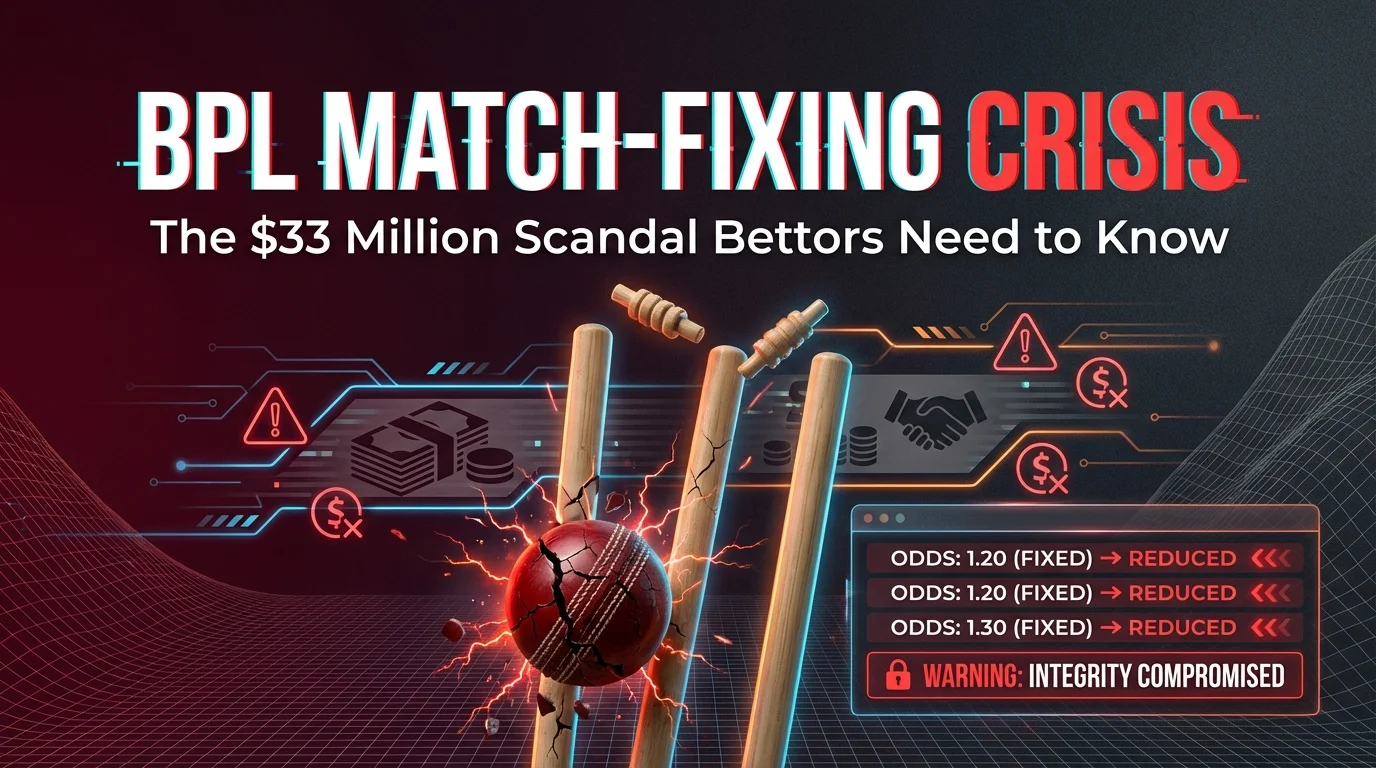
The 2025-26 Bangladesh Premier League is experiencing the most aggressive anti-corruption crackdown in its history—including phone seizures from franchise officials, foreign player interrogations, and documented evidence of a Tk 4 billion ($33 million) bribe offer to fix a single match. For bettors, the league’s erratic markets and systemic integrity problems make it one to avoid entirely.
KEY FACTS AT A GLANCE
- Suspicious incidents (2024-25 season): 36 flagged matches across the tournament
- Players barred from 2025-26 auction: 9 cricketers banned based on investigation
- Largest documented bribe offer: Tk 4 billion (~$33M USD) to fix a single match
- Teams implicated (previous season): 3 — Durbar Rajshahi, Sylhet Strikers, Dhaka Capitals
- Investigation report length: 900+ pages with 3,000+ pages of audio transcripts
- Suspicious incidents (last 5 BPL seasons): 140+ flagged events
- Players flagged across 5 seasons: 60+ individuals
The 2026 Investigation: Phone Seizures and Player Interrogations
The Bangladesh Cricket Board’s (BCB) integrity unit has identified what they call “credible suspicion” of corrupt practices during the ongoing 2025-26 tournament. The crackdown has been aggressive: foreign players including high-profile Afghan star Rahmanullah Gurbaz have been questioned, mobile phones have been seized from franchise officials, and the Noakhali Express franchise has formally protested the conduct of integrity officers.
For the first time in BPL history, the BCB has deployed Criminal Investigation Department (CID) officers to each franchise. This embedding of government law enforcement within the tournament represents a significant escalation in anti-corruption efforts—and signals just how severe the integrity problems have become.
“Gurbaz couldn’t sleep all night. He slept around 7-8 AM. Suddenly several people came and entered his room without any appointment. Gurbaz didn’t even understand what was happening at first.”
— Atik Fahad, Dhaka Capitals CEO
Important context: Gurbaz was questioned as a witness, not accused of fixing. But the heavy-handed approach created a PR disaster—the Afghan star reportedly considered leaving Bangladesh mid-tournament due to mental distress. Captain Mohammad Mithun confirmed off-field issues impacted team morale. Dhaka Capitals claims to be losing BDT 2-3 crore annually and describes the investigation process as “mental torture.”
This illustrates the impossible balance anti-corruption units face: too aggressive and innocent parties suffer; too lenient and fixing continues unchecked.
Why Professional Bettors Avoid BPL Markets
The integrity problems aren’t just a concern for cricket authorities—they directly impact betting markets. Professional bettors have flagged BPL markets as unreliable for years.
Rob Barron of Decimal Data Services told analyst Jarrod Kimber that BPL betting markets “behave erratically compared to other major T20 competitions”—odds fluctuate wildly in ways disconnected from actual match events. When markets consistently fail to track match dynamics, it signals either a market efficiency problem or an integrity problem. BPL has both.
Kimber’s January 2025 investigation flagged three specific matches with suspicious betting patterns:
| Date | Match | Red Flag |
|---|---|---|
| Jan 7, 2025 | Dhaka vs Rangpur | Run line anomalies, series of suspicious wides in 10th over |
| Jan 7, 2025 | Sylhet vs Fortune Barishal | Win probability swung to 17.5% after single wicket |
| Jan 10, 2025 | Sylhet vs Dhaka | Six-over run line shifted despite team being 41/3 |
For bettors, these patterns represent exactly the kind of market anomalies that signal predetermined outcomes. When odds move in ways that don’t reflect on-field action, the information asymmetry means someone knows something you don’t.
Match-Fixing Red Flags: What to Watch For
Understanding these indicators isn’t just useful for regulators—bettors can use them to identify compromised matches. These are the same red flags we documented in the FanDuel Canada match-fixing case, adapted for cricket markets.
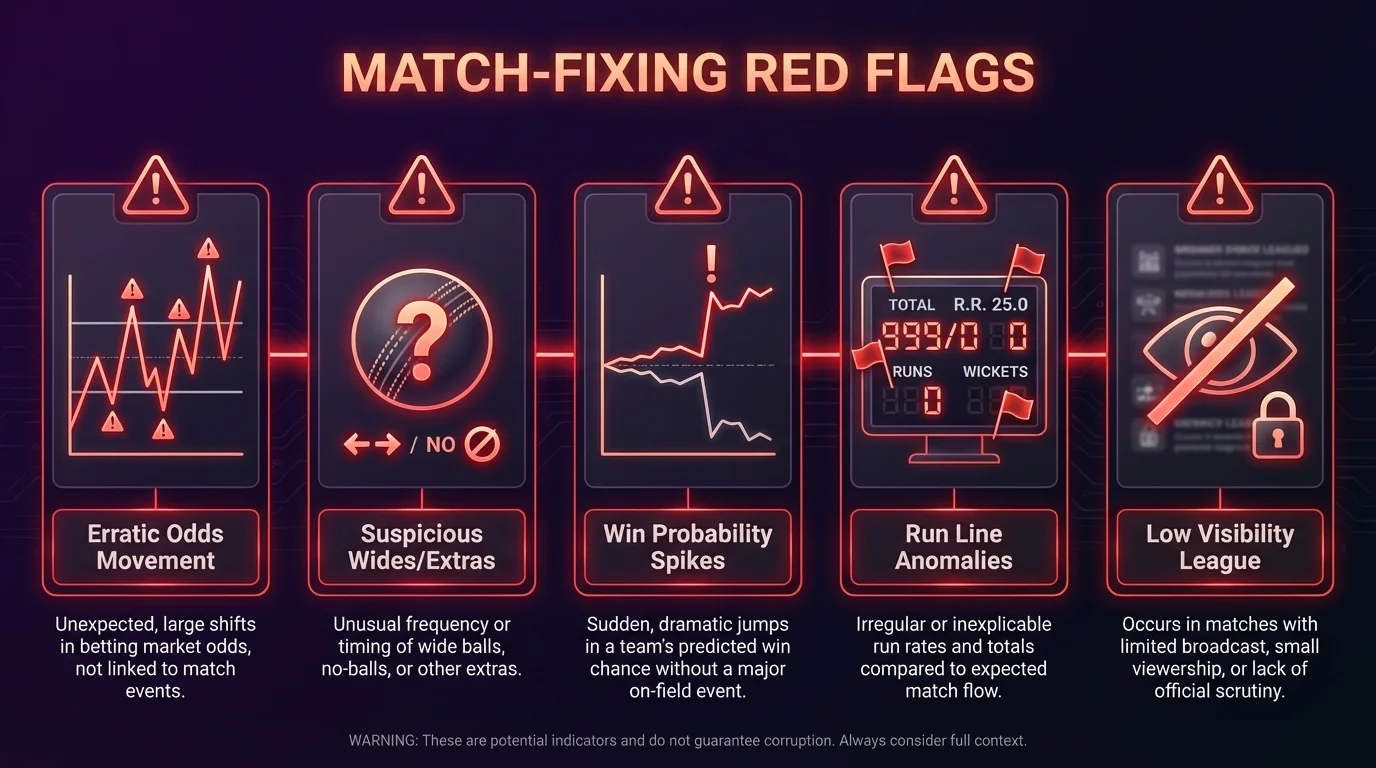
| Red Flag | What It Means | Why It Signals Fixing |
|---|---|---|
| Erratic Odds Movement | Lines shift disconnected from match events | Sharp money from those who “know” moves lines fast |
| Run Line Anomalies | Over/under shifts mid-match without cause | Pre-arranged scoring patterns affect run totals |
| Synchronized Wides/Extras | Unusual deliveries cluster in specific overs | Spot-fixing targets specific over markets |
| Win Probability Spikes | Dramatic swings after routine events | Outcome may already be predetermined |
| Low-Visibility League | Minimal oversight, lower player salaries | Easier to bribe, less scrutiny on results |
The Scale of Corruption: From $12,800 to $33 Million
The documented Tk 4 billion (~$33 million USD) offer to fix a single BPL match represents the staggering scale of the illegal betting market targeting the league.
For context: when Mohammad Ashraful—a former Bangladesh captain—admitted to match-fixing in 2013, he was paid approximately $12,800. The cheque bounced. The 2024-25 bribe offer represents a roughly 2,500x increase in a decade, illustrating how massively the illegal betting operation targeting BPL has grown.
This isn’t surprising when you understand the economics. Illegal cricket betting in Asia is estimated at hundreds of billions of dollars annually. A $33 million investment to guarantee a match outcome can generate multiples of that in betting profits when you control the result.
THE ASHRAFUL CASE
Mohammad Ashraful, former Bangladesh captain, received an 8-year ban (reduced to 5) after admitting to match-fixing in 2013. He was paid ~$12,800—and the cheque bounced. He later claimed he’d been involved in spot-fixing since 2004. The case illustrates how deep the rot goes: even the national captain was compromised, and for relatively small sums.
BPL’s Fixing History: A Structural Problem
The current investigation isn’t an aberration—it’s part of a pattern that stretches back to the league’s founding. BPL has had fixing scandals in essentially every era of its existence.
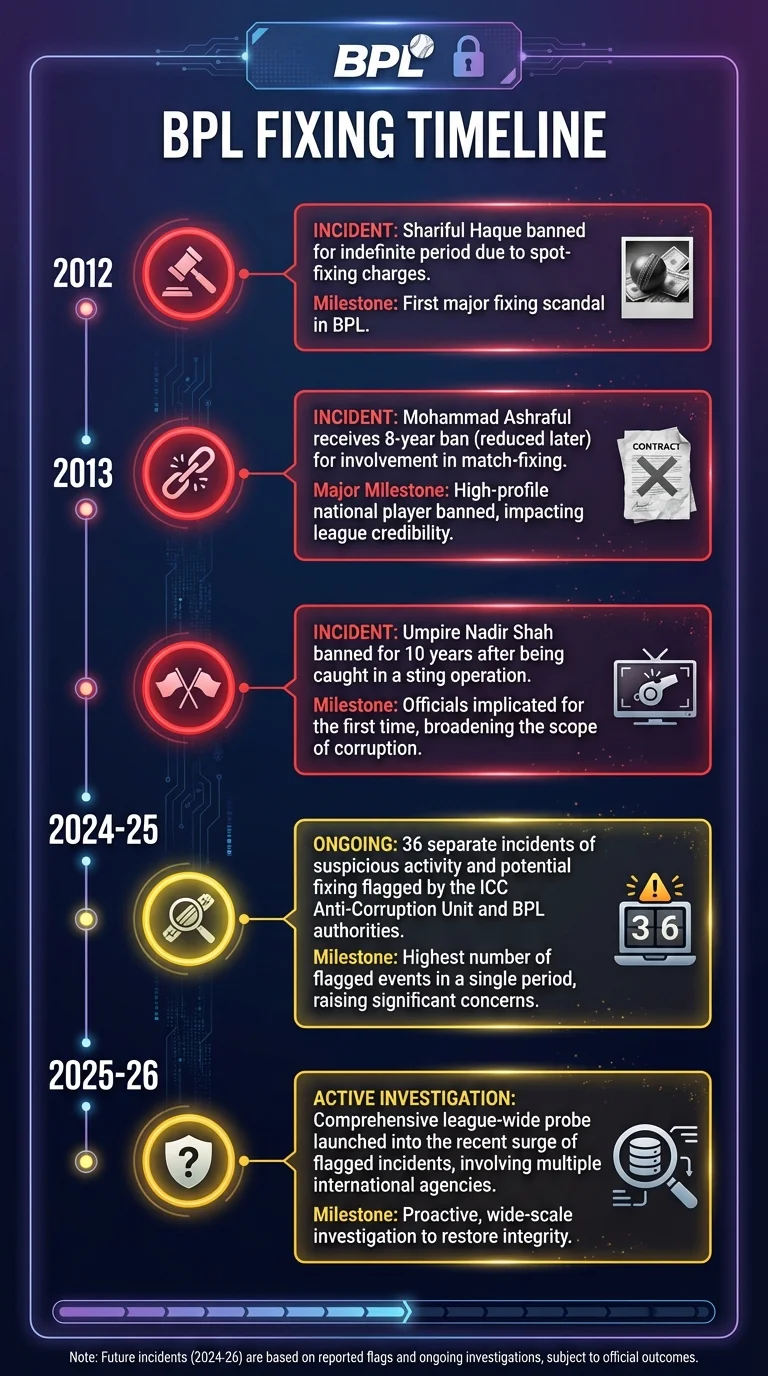
| Year | Incident | Outcome |
|---|---|---|
| 2012 | Shariful Haque spot-fixing | Banned |
| 2013 | Mohammad Ashraful admits fixing | 8-year ban (reduced to 5) |
| 2013 | 9 individuals charged | Multiple bans including franchise owner |
| 2013 | Umpire Nadir Shah sting operation | 10-year ban |
| 2024-25 | 36 suspicious incidents flagged | 9 players barred, investigation ongoing |
| 2025-26 | Current investigation | Active — phone seizures, player questioning |
The 900-page investigation report from the 2024-25 season documented 36 suspicious incidents and included 3,000+ pages of transcripts from 300 hours of audio recordings. This level of documentation suggests the problem is systemic rather than isolated to a few bad actors.
The Legislative Gap: Match-Fixing Isn’t a Crime in Bangladesh
Perhaps most remarkably, match-fixing is not a criminal offense in Bangladesh. The BCB can ban players and officials, but criminal prosecution isn’t an option under current law.
BCB Integrity Counsel Mahin M. Rahman has confirmed efforts are underway to change this. The 900-page investigation report will form the basis for a legislative push to criminalize match-fixing, with formal discussions planned after the February 12, 2026 general election. The model: Sri Lanka’s cricket-specific criminalization law.
This legislative gap matters because it limits deterrence. A player facing a 5-year ban can return to cricket afterward. Criminal prosecution—with potential imprisonment—is a fundamentally different calculus. The legislative efforts to criminalize betting market manipulation in other jurisdictions suggest Bangladesh may be following a broader global trend toward treating match-fixing as a criminal matter.
What This Means for Bettors
The bottom line: BPL represents a market where the integrity risks outweigh any potential edge.
THE BETTOR’S CALCULATION
Why Avoid BPL
- Documented erratic market behavior
- Professional bettors actively avoid it
- 140+ suspicious incidents over 5 seasons
- $33M bribe offers indicate serious criminal interest
- Match-fixing not criminalized = lower deterrence
What’s Improving
- CID officers now embedded in franchises
- 900-page investigation shows commitment
- 9 players already barred from 2025-26
- Legislative push to criminalize fixing
- Increased international scrutiny
Even if enforcement improves, the structural issues take time to resolve. For now, the risk-reward calculation for BPL betting is unfavorable. Stick to leagues with established integrity infrastructure and markets that behave predictably.
KEY TAKEAWAYS
- Avoid BPL betting markets — Professional bettors have flagged erratic market behavior disconnected from match events
- $33M bribe documented — The scale of illegal betting dwarfs athlete earnings, creating massive corruption incentives
- Structural problem — Fixing scandals in every era of BPL’s existence suggest systemic rather than isolated issues
- Legislative gap — Match-fixing isn’t criminalized in Bangladesh, limiting enforcement options
- Detection improving — BCB deploying CID officers and producing 900-page investigation reports shows growing commitment
Sources
- BCB Integrity Unit Actions During BPL 2025-26 — Tiger Cricket (Primary reporting)
- Nine Players Barred from BPL Auction — ESPNcricinfo
- IBIA Integrity Reports — International Betting Integrity Association
