The Prabowo administration’s aggressive anti-gambling campaign has achieved significant progress, with online gambling transactions declining from Rp359.8 trillion to Rp155 trillion in 2025.
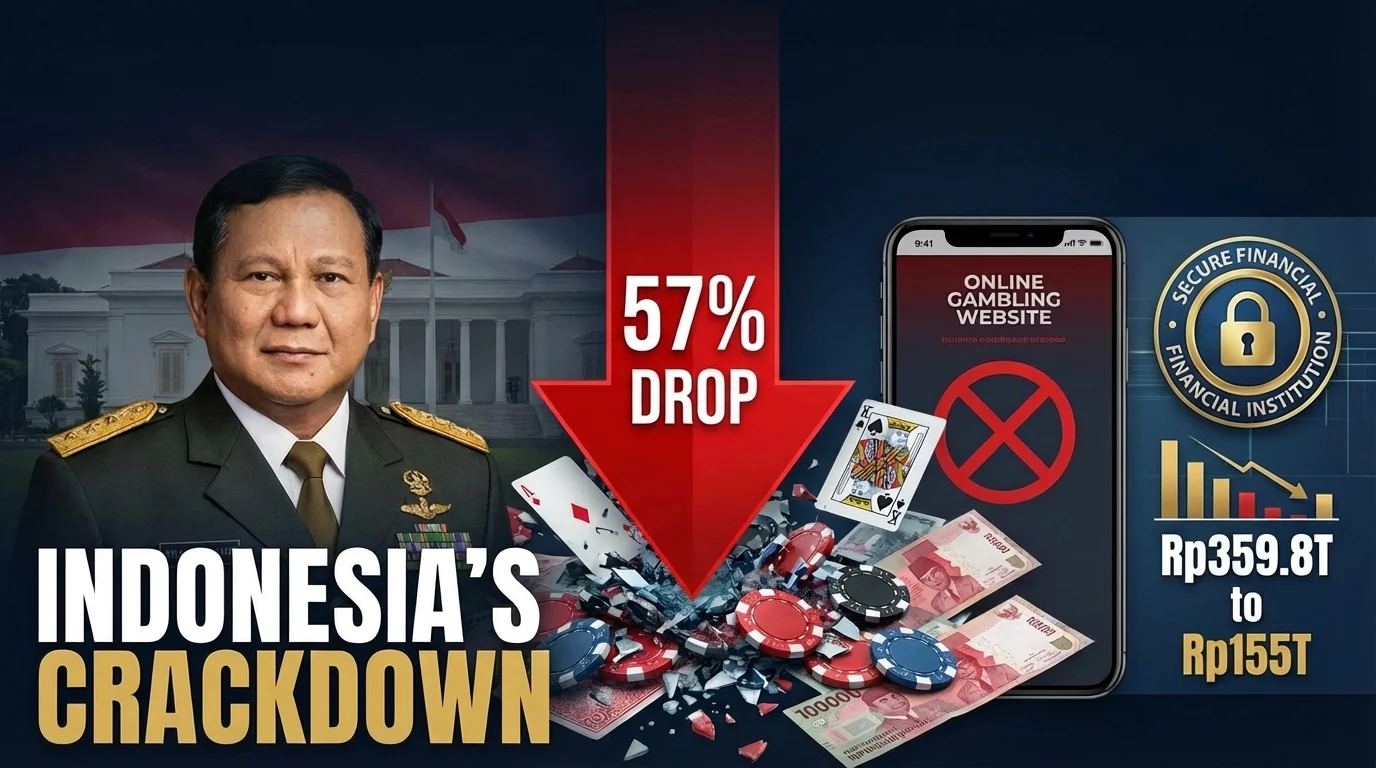
Indonesia’s year-long crackdown on online gambling (judol) has produced measurable results. According to the latest data from PPATK (Pusat Pelaporan dan Analisis Transaksi Keuangan), gambling transaction volumes dropped 57% throughout 2025, falling from Rp359.8 trillion ($23 billion) in 2024 to approximately Rp155 trillion ($9.8 billion). For more context on the earlier phases of this campaign, see our Indonesia gambling crackdown report.
The decline represents a major victory for President Prabowo Subianto’s administration, which has made gambling eradication a national priority since taking office in October 2024.
Key Statistics: The Numbers Behind the Drop
The enforcement campaign has impacted multiple metrics beyond just transaction volume:
| Metric | 2024 | 2025 | Change |
|---|---|---|---|
| Transaction Volume | Rp359.8 trillion | Rp155 trillion | -57% |
| Active Players | 9.7 million | 3.1 million | -68% |
| Gambling Deposits | Rp51.3 trillion | Rp24.9 trillion | -45% |
| Low-Income Gamblers | — | — | -67.9% |
The number of active online gamblers dropped even more dramatically—from 9.7 million to 3.1 million, representing a 68% reduction. Deposits into gambling accounts also fell by 45%, from Rp51.3 trillion to Rp24.9 trillion. Understanding concepts like RTP and house edge helps explain why these gambling platforms are designed to extract money from players over time.
Massive Content Blocking Campaign
The Ministry of Communication and Digital Affairs (Komdigi) has been at the forefront of the enforcement effort. As of November 11, 2025, the ministry has blocked approximately 7.39 million pieces of gambling-related content since 2017.
In a particularly intensive two-week period between October 20 and November 2, 2025, Komdigi removed 2.4 million gambling sites and content—demonstrating the scale and intensity of the current campaign.
Minister Meutya Hafid described the results as a “collective achievement” involving multiple government agencies working together to protect Indonesian citizens from gambling’s destructive effects.
Financial Enforcement: 29,000+ Bank Accounts Frozen
Beyond content blocking, financial authorities have targeted the money flowing through gambling networks. OJK (Otoritas Jasa Keuangan) has frozen more than 29,906 bank accounts linked to online gambling operations.
PPATK continues to provide real-time financial intelligence to law enforcement, enabling rapid identification and freezing of gambling-related accounts. The agency’s cooperation with banks and e-wallet providers has created significant friction for gambling operators trying to process payments.
Dana, one of Indonesia’s largest e-wallet providers, reported an 80% reduction in gambling-related activity on its platform following enhanced fraud detection measures.
Prabowo’s $8 Billion Warning
President Prabowo has repeatedly emphasized the economic damage caused by online gambling. Speaking at the APEC Summit in November 2025, he declared that Indonesia loses $8 billion (approximately Rp134 trillion) annually to gambling-related capital outflows.
“We are seriously handling the rampant online gambling,” Prabowo told world leaders, calling for international cooperation against cross-border gambling syndicates operating from countries like Cambodia and the Philippines.
The Road Ahead: Challenges Remain
Despite the encouraging statistics, officials acknowledge that the fight is far from over. Key challenges include:
VPN Usage: Indonesia ranks as the third-highest VPN user globally, with 41% of internet users employing VPN services—making it easy to circumvent website blocks.
Cloudflare Infrastructure: Government analysis found that 76% of blocked gambling sites use Cloudflare services to mask their IP addresses and rapidly rotate domains. Komdigi has summoned Cloudflare representatives and demanded the company register as an Electronic System Provider (PSE) in Indonesia.
Offshore Operations: Thousands of Indonesian citizens reportedly operate gambling platforms from the Philippines and Cambodia, complicating enforcement efforts.
The government is preparing new regulations, including a dedicated Government Regulation on Online Gambling Eradication that will impose stricter obligations on internet service providers and fintech companies.
Understanding Gambling Risks
For those interested in understanding the mathematical realities behind gambling, our risk of ruin calculator demonstrates how even small house edges lead to guaranteed long-term losses. The realistic expectations calculator shows why the odds always favor the house, and the gambler’s fallacy demonstrator explains common misconceptions that lead players to believe they can beat the system.
Conclusion
The 57% drop in gambling transactions represents genuine progress in Indonesia’s anti-gambling campaign. The combination of aggressive content blocking, financial account freezes, and high-profile arrests has disrupted the gambling ecosystem.
However, officials emphasize this is just the beginning. With operators adapting through VPNs, offshore platforms, and new payment methods, sustained enforcement will be required to maintain and extend these gains.
As Komdigi Minister Meutya Hafid stated, the government’s presence in protecting citizens from online gambling’s destructive impact must remain consistent and unwavering.
