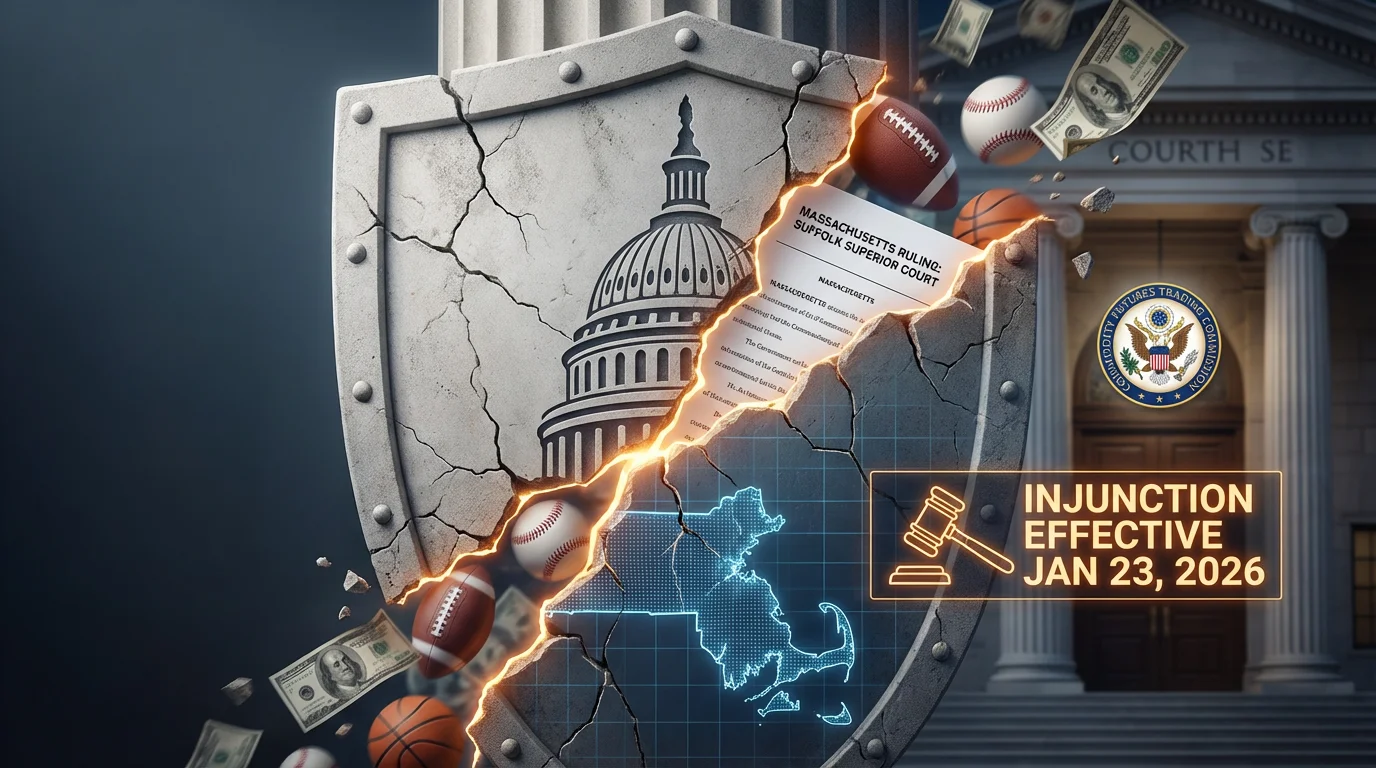
Massachusetts just became the first state to successfully block Kalshi’s sports contracts through judicial enforcement—not a cease-and-desist letter the company could litigate around, but an actual preliminary injunction with teeth. The timing couldn’t be more consequential: the order takes effect January 23, 2026, just 17 days before Super Bowl LX.
KEY FACTS AT A GLANCE
- Injunction Effective: January 23, 2026
- Ruling: Suffolk Superior Court, Judge Christopher Barry-Smith
- Key Finding: Federal preemption argument rejected as “overly broad”
- Doctrine Established: State and federal regulation can coexist “in harmony”
- Kalshi’s Sports Revenue: 89% of 2025 fee revenue came from sports
- Coalition Opposition: 38 states + DC filed amicus brief against Kalshi
What the Ruling Actually Says
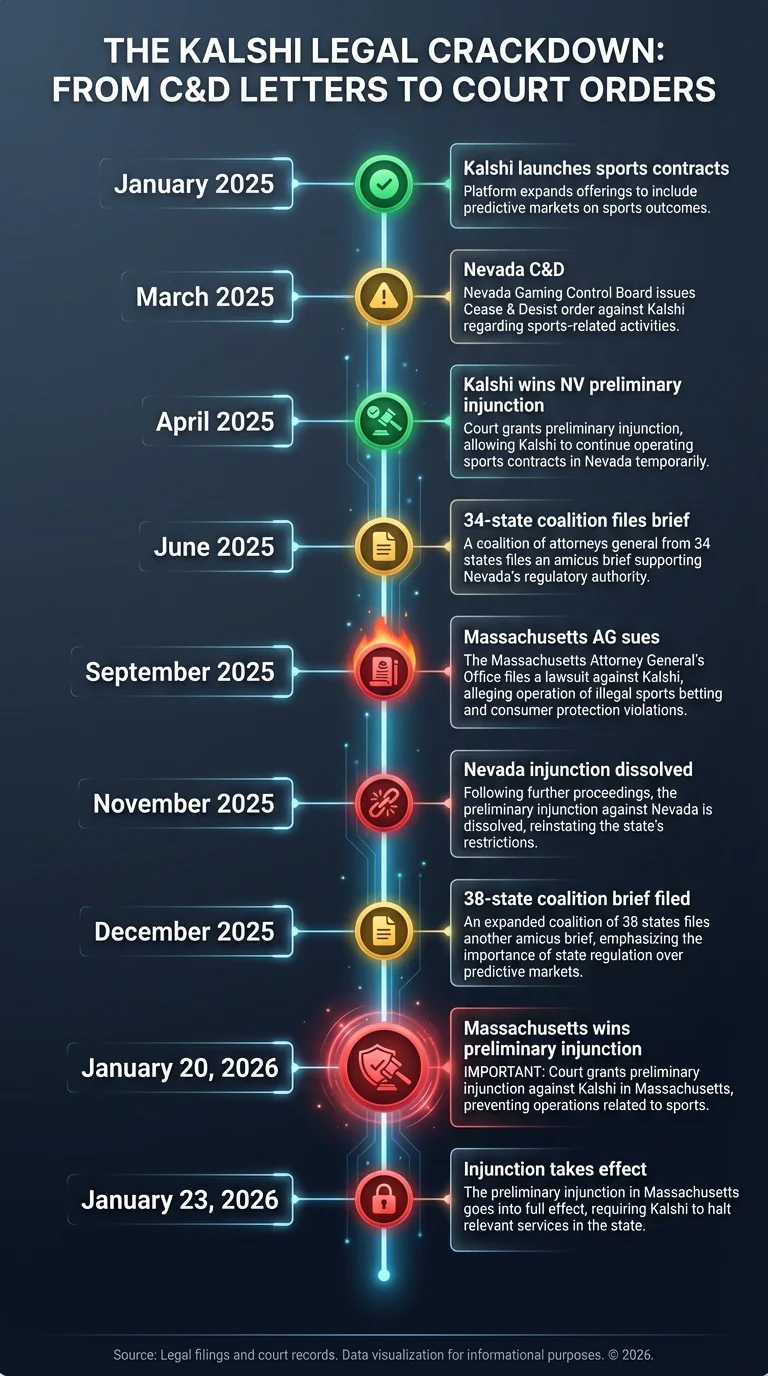
Judge Christopher Barry-Smith’s 17-page ruling systematically dismantles Kalshi’s core legal defense: that federal CFTC regulation preempts all state gambling laws. The prediction market operator has relied on this argument to deflect cease-and-desist letters from Arizona, Illinois, Montana, Ohio, and Tennessee. Massachusetts took a different approach—filing an offensive lawsuit in September 2025 rather than waiting for Kalshi to sue after enforcement action.
The judge found Kalshi’s reading of federal preemption “overly broad,” establishing what legal observers are calling the “coexistence doctrine.” As Barry-Smith wrote: “That both systems may operate in harmony demonstrates a lack of frustration against Congress’s intent.”
“Requiring Kalshi to become licensed to offer its sports related event contracts in Massachusetts neither displaces federal derivatives regulations or enforcement efforts, nor frustrates Congress’s purpose in consolidating regulatory power in the CFTC. The Sports Wagering Law is an exercise of traditional state police power.”
— Judge Christopher Barry-Smith, Suffolk Superior Court
The ruling builds on precedent from Kalshi’s November 2025 loss in Nevada federal court, where a judge reversed an earlier injunction that had protected the company’s operations. The Massachusetts decision is the first state-court injunction, and its reasoning—that Congress never intended to strip states of gambling authority—gives other state attorneys general a judicial roadmap.
The 90% Problem: Why Kalshi’s Own Data Sank Them
Kalshi’s argument has always been semantic: we’re a prediction market, not a sportsbook. We offer “event contracts,” not bets. We’re regulated by the CFTC, not state gaming commissions. The Massachusetts ruling eviscerates this distinction by pointing to Kalshi’s own business reality.
According to the ruling, Kalshi “profited more from sports-related event contracts than DraftKings and FanDuel during the same timeframe”—a remarkable claim for a company that insists it isn’t in the sports betting business. Sports contracts accounted for 89% of Kalshi’s $263.5 million in 2025 fee revenue, with the sports share exceeding 90% during the final four months of the year.
Judge Barry-Smith noted that Kalshi uses terminology indistinguishable from traditional sportsbooks: “point spread, over/under, proposition, parlay.” The ruling also observed that Kalshi’s platform “mirrors other digital gambling experiences, including through continuous feedback and engagement loops that are modeled after operant conditioning and slot machine dynamics, leaderboard rankings, and countdown clocks.”
The court even cited Kalshi CEO Tarek Mansour’s own public statements characterizing the platform’s offerings as “bets” and the company’s advertising of itself as “the first nationwide legal sports betting platform.” When you look like a sportsbook, profit like a sportsbook, and market like a sportsbook—courts will treat you like a sportsbook.
The 38-State Coalition: What Happens Next
Massachusetts didn’t act alone. On Christmas Eve 2025, Nevada Attorney General Aaron Ford announced he was co-leading a coalition of 38 states and the District of Columbia in filing an amicus brief with the Fourth Circuit Court of Appeals, defending states’ authority to regulate sports betting. Ohio AG Dave Yost joined as co-leader, making this a bipartisan effort spanning blue states with legalized betting and red states with gambling restrictions.
STATE ENFORCEMENT LANDSCAPE
Active Litigation
- Massachusetts (injunction granted)
- New York (decision imminent)
- Nevada (injunction dissolved Nov 2025)
- New Jersey (appeal pending)
- Maryland (ongoing)
Cease-and-Desist Letters
- Arizona
- Illinois
- Montana
- Ohio
- Tennessee
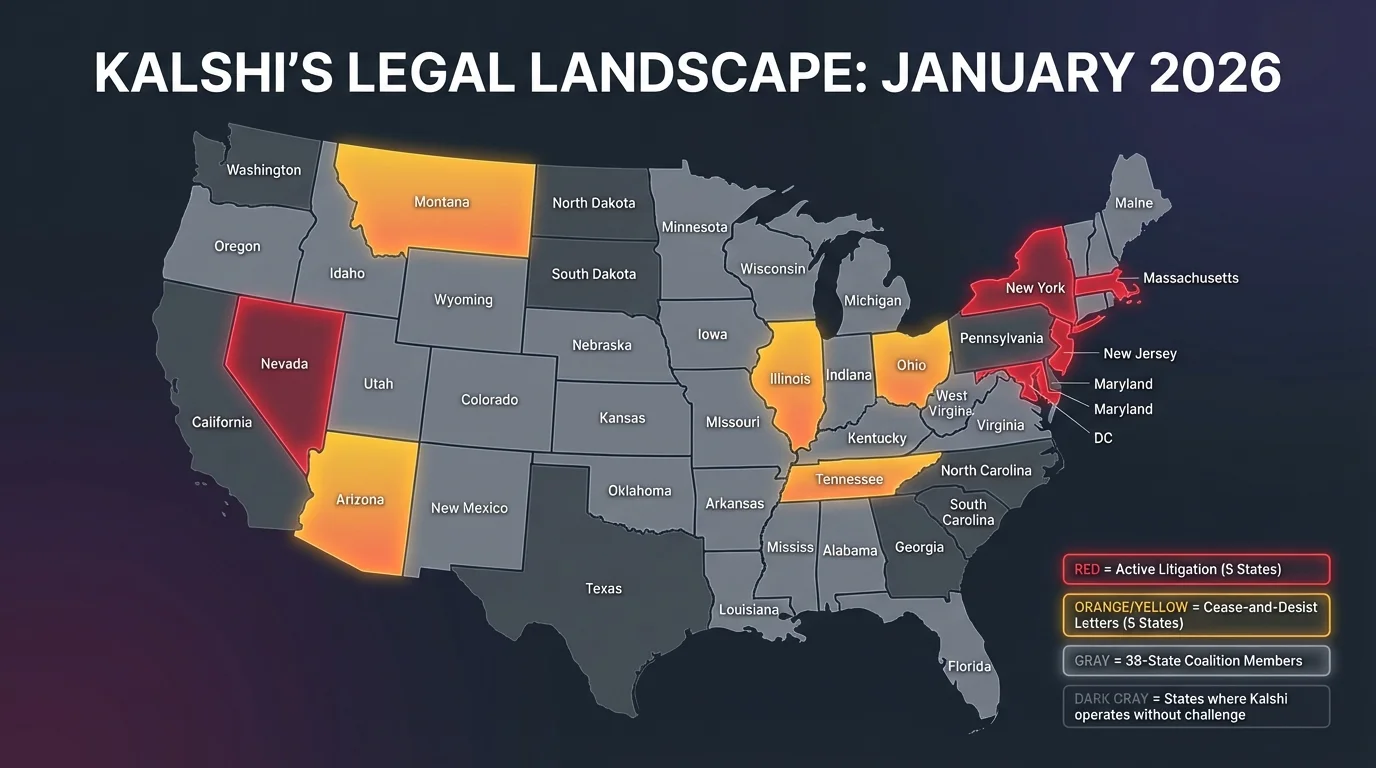
The coalition grew from 34 states in June 2025 to 38 states by December, reflecting mounting concern about Kalshi’s expansion. The brief argues that Kalshi’s sports contracts are “functionally indistinguishable” from sports wagering and should fall under state-level gambling regulations.
Within hours of the Massachusetts ruling, the New York State Gaming Commission entered the decision as supplemental authority in its pending case against Kalshi in the Southern District of New York. A decision on Kalshi’s motion for preliminary injunction is described as “imminent.” New York agreed not to enforce its October 2025 cease-and-desist order until the court rules, but the Massachusetts precedent significantly strengthens the state’s position.
Kalshi is now in court in eight states simultaneously. The company has indicated it will appeal the Massachusetts decision and request a stay pending appeal—but the “coexistence doctrine” established by Judge Barry-Smith gives every state in the coalition a template for enforcement.
The 18+ Age Gap: Consumer Protection as Weapon
One of the most pointed sections of the Massachusetts ruling addresses age requirements. Kalshi’s federal registration allows users as young as 18 to trade on sports contracts. Massachusetts sports betting law requires participants to be 21—the same minimum age enforced in most states with legal sports wagering.
AG Campbell explicitly cited this gap, noting that Kalshi exposes “consumers as young as 18 in high school” to an “addictive betting product without a license.” The court found this inconsistency relevant to the public interest analysis required for preliminary injunctions.
THE COLLEGE AMBASSADOR CONTROVERSY
In 2025, Kalshi launched an ambassador program targeting college campuses at Yale, Harvard, Berkeley, Penn, Cornell, UVA, Michigan, Texas, Stanford, and NYU. The company posted on social media that “college campuses are the best place to spark new financial movements.” Following backlash from regulators and gambling harm advocates, Kalshi deleted the posts and quietly pulled the program. Former FanDuel CEO Nigel Eccles responded sarcastically: “You can never start those kids too early on sports betting.”
The age gap creates a two-tier system where an 18-year-old in Massachusetts can legally trade $10,000 on Chiefs vs. Eagles through Kalshi’s “event contracts” but cannot place a $20 bet on the same game through DraftKings. This inconsistency strengthens the argument that prediction markets are exploiting a regulatory arbitrage rather than offering a genuinely different product.
Tax Implications: The Silent Advantage Eroding
Beyond regulatory status, the Massachusetts ruling has implications for how prediction market gains are taxed. Kalshi has positioned its contracts as CFTC-regulated derivatives, which could qualify for Section 1256 treatment—a favorable 60/40 capital gains split where 60% of profits are taxed at long-term rates regardless of holding period.
Traditional gambling winnings, by contrast, are taxed as ordinary income with W-2G reporting requirements. The IRS has been notably silent on prediction market taxation, forcing taxpayers to self-determine their treatment. But if courts continue ruling that Kalshi operates as a de facto sportsbook, tax treatment may follow the legal classification.
Complicating matters further: the federal gambling loss deduction cap took effect January 1, 2026. Under Section 70114 of the One Big Beautiful Bill Act, gambling loss deductions are now limited to 90% of winnings—down from the longstanding 100%. If Kalshi contracts are reclassified as gambling rather than derivatives, users would face both higher tax rates and reduced loss deductibility.
For Massachusetts Users: What Happens Now
The preliminary injunction takes effect January 23, 2026. Here’s what Massachusetts residents need to know:
EXISTING CONTRACTS
The injunction is forward-looking. Contracts opened before January 23 don’t require immediate unwinding.
NEW SPORTS CONTRACTS
Blocked starting January 23. Massachusetts residents cannot open new sports-related positions on Kalshi.
NON-SPORTS CONTRACTS
Politics, weather, economics, and entertainment contracts appear unaffected by this specific ruling.
Kalshi warned in November that an injunction could force the halting or liquidation of $650 million in contracts. The company is expected to appeal and request a stay pending appeal. Massachusetts users should monitor developments closely—if a stay is granted, access may continue during the appeals process.
The Bigger Picture: Prediction Markets at a Crossroads
The Massachusetts ruling arrives as prediction markets undergo a fundamental transformation. FanDuel Predicts launched in January 2026 through a partnership with CME Group, now operating in all 50 states with sports contracts available in 18 jurisdictions. DraftKings acquired Railbird Technologies in October 2025 and launched DraftKings Predictions in December. Coinbase acquired The Clearing Company. Robinhood integrated Kalshi contracts directly into its platform.
The prediction market wars have attracted massive capital—Kalshi closed a $1.1 billion Series E in December 2025, valuing the company at $11 billion. Annualized trading volume exploded from $300 million to $40-50 billion since August 2025. Weekly volume hit $2 billion for the first time in January 2026.
But this growth came almost entirely from sports. And the Massachusetts ruling poses an existential question: if the “coexistence doctrine” spreads, will prediction markets be forced into state-by-state licensing like traditional sportsbooks?
| Factor | Kalshi | DraftKings/FanDuel |
|---|---|---|
| Minimum Age | 18 | 21 (most states) |
| State License Required | No (claims federal preemption) | Yes |
| Responsible Gambling Tools | Minimal | Required by regulators |
| State Tax Contribution | None | Per state requirement |
| Consumer Protection Oversight | CFTC only | State gaming commissions |
FanDuel and DraftKings are taking a different approach. FanDuel Predicts restricts sports contracts to states where online sports betting isn’t already legal—effectively treating prediction markets as a bridge product rather than a workaround. DraftKings connects to multiple exchanges starting with CME Group. Both companies already hold state gaming licenses and have existing compliance infrastructure.
The irony: by pursuing aggressive nationwide expansion without state licensing, Kalshi may have accelerated the very regulatory framework its competitors are better positioned to navigate.
KEY TAKEAWAYS
- First judicial enforcement — Massachusetts secured the first state-court injunction against Kalshi, not just a cease-and-desist letter
- Coexistence doctrine established — The ruling found state gambling laws and federal CFTC regulation can operate “in harmony,” rejecting Kalshi’s preemption defense
- Sports dependency exposed — 89% of Kalshi’s 2025 fee revenue came from sports, undermining “we’re not a sportsbook” arguments
- 38-state coalition has a template — New York immediately filed the ruling as supplemental authority; more states will follow
- Super Bowl timing matters — Injunction takes effect January 23, 17 days before the biggest betting event of the year
- Appeal expected — Kalshi will likely request a stay, but the legal precedent is now established
The Massachusetts ruling represents an inflection point for prediction markets. Kalshi’s federal shield—the argument that CFTC regulation immunizes it from state gambling laws—just cracked. Whether that crack spreads into a collapse depends on decisions yet to come in New York, the Fourth Circuit, and the 36 other states watching closely.
For Massachusetts bettors planning Super Bowl wagers on Kalshi: you have 17 days.
Sources
- AG Campbell Secures Court Order That Will Block Kalshi from Offering Unlawful Sports Wagers in Massachusetts — Massachusetts Attorney General’s Office
- Kalshi Sports Bets to Be Banned in Massachusetts, Court Says — Bloomberg Law
- Kalshi can’t operate sports-prediction market in Massachusetts, judge rules — NBC News
- Kalshi Fee Revenue In 2025 Was $263.5 Million, With 89% Coming From Sports — Yahoo Finance
