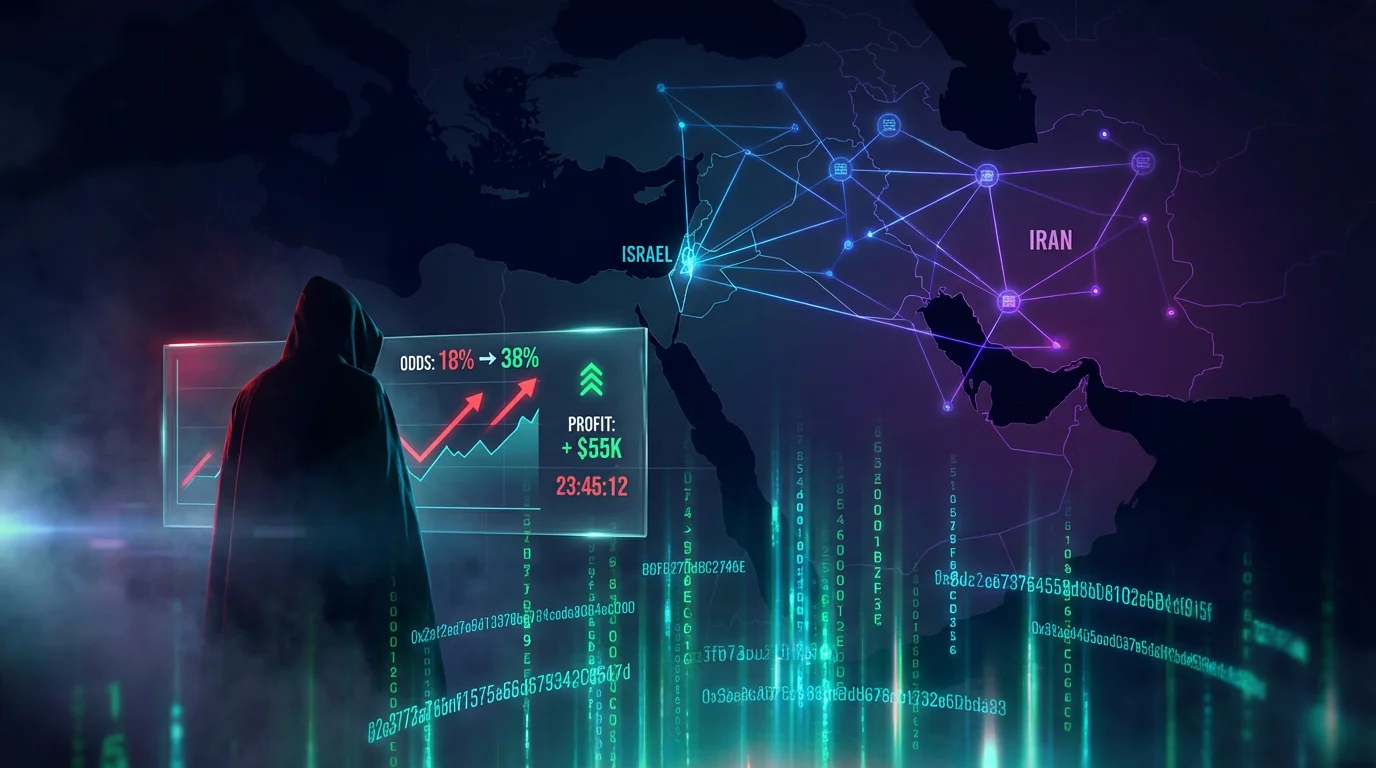
A dormant Polymarket whale with a 100% win rate on Israel-related bets has resurfaced after seven months of silence, placing $8,198 on potential Israeli military strikes against Iran—reactivating the same alarming pattern that saw a mysterious trader turn $30,000 into over $400,000 betting on Maduro’s capture just hours before it happened.
KEY FACTS AT A GLANCE
- Primary Wallet:
0x0afc7ce56285bde1fbe3a75efaffdfc86d6530b2(ricosuave666) - Total Profits: $155,699 from Israel-related bets alone
- Win Rate: 100% on all Israel-related positions over 7 months
- Current Bet: $8,198 on Israel strikes Iran by Jan 31 and Mar 31
- Odds at Entry: ~21% (now 38% for Jan 31, 54% for Mar 31)
- Pattern Match: Same behavior seen before Maduro capture ($30K → $400K)
The Traders and Their Suspicious Patterns
On January 7, 2026, blockchain analytics firm Lookonchain flagged unusual activity on Polymarket: a wallet that had been dormant for seven months suddenly reactivated with substantial bets on Israeli military strikes against Iran. The account, operating under the username ricosuave666, has a track record that raises serious questions about information asymmetry in prediction markets.
| Trader | Wallet/Identifier | Bet Amount | Profit | Track Record |
|---|---|---|---|---|
| ricosuave666 | 0x0afc7ce56285bde1fbe3a75efaffdfc86d6530b2 | $8,198 | $155,699 total | 100% win rate (7 months) |
| Rundeep | 0x0afc7ce56285bde1fbe3a75efaffdfc86d6530b2 | Unknown | $128,000+ | In-and-out within 24hrs |
| Fresh Wallet 1 | 0xEFD06D1A6cC221b747890DCe15F00bf05742BF24 | $2,888 | TBD | Only US/Iran strike bets |
| Fresh Wallet 2 | @zzx123 | $3,863 | TBD | Only US/Iran strike bets |
| Fresh Wallet 3 | @Memeretirement | $1,167 | TBD | Only US/Iran strike bets |
| Fresh Wallet 4 | @MrEsma | $9,933 | TBD | Only US/Iran strike bets |
The wallet address 0x0afc7ce56285bde1fbe3a75efaffdfc86d6530b2 is fully traceable on-chain. When ricosuave666 first appeared on Polymarket seven months ago, every single bet placed on Israel-related news proved profitable. Not a single loss. That alone doesn’t prove insider trading—but combined with the precise timing, the dormancy pattern, and the reactivation specifically for another geopolitical flashpoint, the circumstantial evidence is mounting.
The Red Flags: Why This Looks Like Insider Trading
| Red Flag | Detail |
|---|---|
| Perfect record | ricosuave666 has won every Israel-related bet over 7 months—statistically improbable |
| Dormant reactivation | Account went completely silent, reappeared specifically for this Iran strike bet |
| Single-purpose wallets | 4 fresh accounts with only Iran strike bets, no other activity whatsoever |
| Coordinated timing | Multiple wallets betting at same time when odds were just 18% |
| Quick exit strategy | Rundeep closed entire position within 24 hours, changed username, withdrew funds |
| Pattern match | Same behavioral fingerprint as the Maduro insider trading case ($30K → $400K) |
Blockchain analytics firm Lookonchain noted in a public post: “Notably, when ricosuave666 joined Polymarket 7 months ago, every bet he placed on Israel-related news was profitable. Is he an insider?” The question hangs heavy over a platform that has repeatedly found itself at the center of information-asymmetry controversies.
The Insider Playbook: A Repeating Pattern
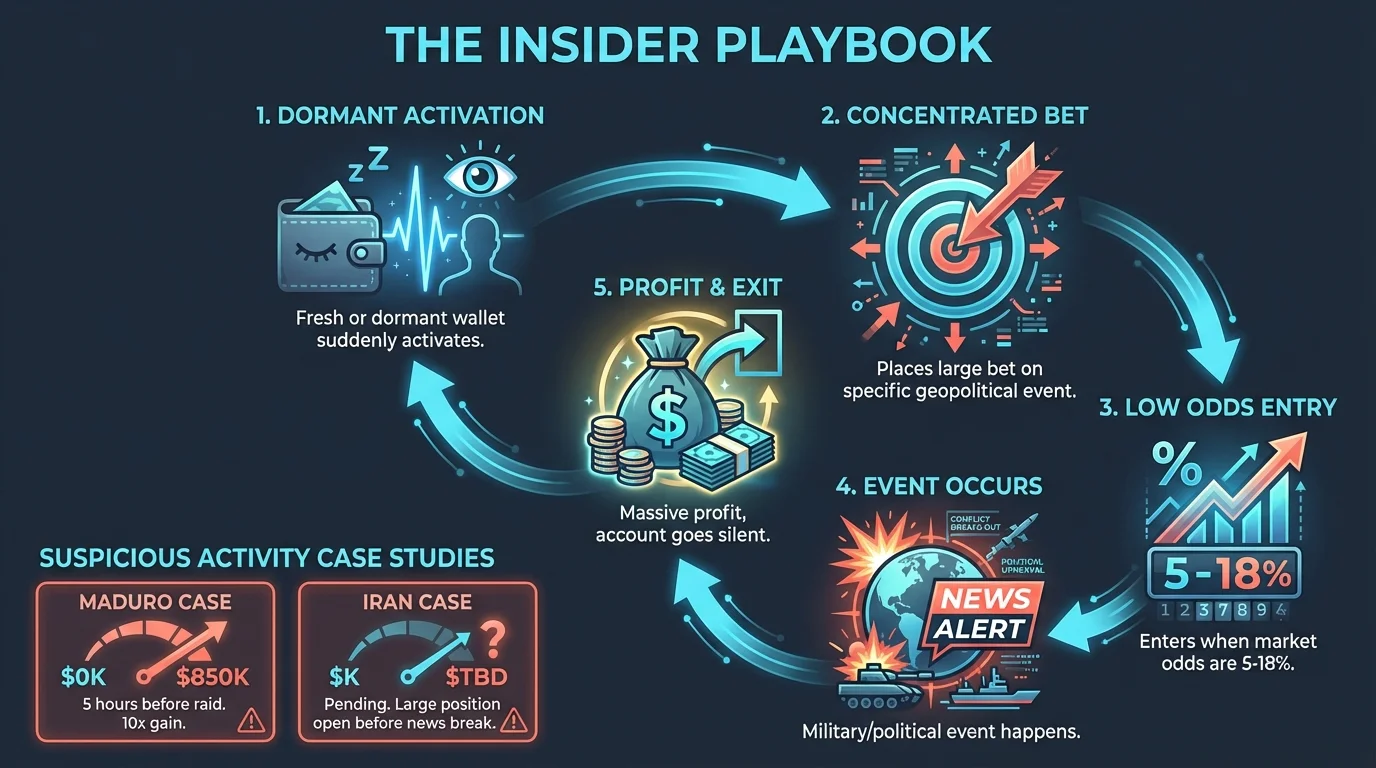
The behavioral pattern emerging from these incidents is disturbingly consistent. We’ve now seen the same playbook executed multiple times on Polymarket:
STEP 1: DORMANT ACTIVATION
Fresh or dormant wallet suddenly activates with no prior recent activity
STEP 2: CONCENTRATED BET
Places large, concentrated bet on specific geopolitical event
STEP 3: LOW ODDS ENTRY
Enters when market odds are extremely low (5-18%)
STEP 4: EVENT OCCURS
Military or political event happens as predicted
STEP 5: PROFIT & EXIT
Massive profit extraction, account goes dormant or disappears
The Maduro Parallel: Same Pattern, Different Target
The current Iran betting activity mirrors exactly what happened with the Maduro capture bet. In that case, a brand-new account wagered $32,000 that Venezuelan President Nicolás Maduro would leave office before February when odds stood at just 5.5%. The bet was placed at 9:58 PM ET on a Friday—less than five hours before explosions shook Caracas and U.S. forces captured Maduro.
MADURO VS. IRAN: SIDE-BY-SIDE COMPARISON
Maduro Case (January 2026)
- Entry: $32,000 at 5.5% odds
- Timing: 5 hours before raid
- Profit: $400,000+
- Account age: Less than 1 week
- Post-trade: Account disappeared
Iran Case (January 2026)
- Entry: $8,198 at 21% odds
- Timing: Unknown (pending)
- Profit: $155,699 (to date)
- Account age: 7 months dormant
- Post-trade: Position still open
The Maduro case wasn’t isolated. Three separate wallets were identified profiting from that event, netting a combined $630,000. Blockchain analysis pointed to potential links between one account and wallets bearing names similar to Steve Witkoff, co-founder of World Liberty Financial and current U.S. envoy to the Middle East—though no definitive evidence has emerged.
Current Market Odds: What the Numbers Show
| Contract | Current Odds | Odds at Entry | Change |
|---|---|---|---|
| Israel strikes Iran by Jan 31 | ~38% | ~21% | +17% |
| Israel strikes Iran by Mar 31 | ~54% | ~35% | +19% |
| US strikes Iran by Jan 31 | ~16% | ~18% | -2% |
The market has moved significantly since the suspicious wallets entered. Total volume on the “Israel attacks Iran by January 31” contract surged toward $2 million as other traders—including copy traders following whale activity—piled in. This amplification effect is a critical dynamic: when suspected insiders bet, others follow, creating a self-fulfilling prophecy that moves odds regardless of underlying reality.
The Geopolitical Context: Why January 2026 Is Critical
These bets aren’t occurring in a vacuum. The geopolitical situation has reached a critical inflection point:
CURRENT SITUATION
- Operation Iron Hammer: Israeli media reports Netanyahu has approved a new strike plan targeting Iran
- Iran protests: Largest uprising since 1979, with at least 2,000 protesters killed in recent days
- Currency collapse: Iranian rial hit 1.46 million to $1, down from 70:1 before 1979
- Trump statement: “Now I hear that Iran is trying to build up again, and if they are, we’re going to have to knock them down”
- Iranian warning: National Defense Council stated it “may act before an attack if it detects a threat”
- Israeli official: “If the Americans do not reach an agreement with the Iranians that halts their ballistic missile program, it may be necessary to confront Tehran”
Netanyahu discussed the possibility of “round two” strikes against Iran during his December 29 meeting with Trump, according to U.S. sources cited by Axios. The June 2025 strikes severely damaged Iranian nuclear facilities, but satellite imagery shows Tehran is rebuilding. Hudson Institute analysts assess that “there is no scenario in which the Islamic Republic survives 2026 with its power intact.”
The Copy Trading Amplification Problem
One factor making these insider patterns particularly dangerous is Polymarket’s whale-watching ecosystem. Tools like Stand, PolyTrack, and Polyfollow allow anyone to monitor and automatically copy large traders’ positions in real-time. When a wallet like ricosuave666 enters a position, copy traders pile in within minutes.
This creates a dangerous feedback loop: if an insider bets, copy traders amplify the signal, odds move dramatically, and the market becomes a self-fulfilling prophecy regardless of the underlying intelligence. The odds jump from 21% to 38% isn’t necessarily reflecting new information—it may just be reflecting that copy traders spotted a whale moving.
The Regulatory Gap: Why Polymarket Can’t (or Won’t) Stop This
Polymarket’s decentralized architecture is both its innovation and its vulnerability. All trades are recorded on public blockchain infrastructure—every transaction, position size, and timing detail is visible to anyone. But that transparency cuts both ways: while we can see suspicious patterns, there’s no mechanism to stop them.
THE DECENTRALIZATION PARADOX
What Transparency Enables
- Anyone can verify all trades
- Wallet addresses are public
- Position sizes are visible
- Timing is permanently recorded
What No KYC Enables
- Anonymous wallet creation
- Multiple accounts per person
- No identity verification
- No ability to ban bad actors
Traditional financial markets would have already launched investigations. The SEC, CFTC, or DOJ would subpoena records, identify traders, and pursue charges. But Polymarket operates largely outside U.S. jurisdiction with no know-your-customer requirements. The result: perfect transparency about what happened, zero accountability for who did it.
The Torres Bill: Congress Finally Responds
In direct response to the Maduro incident, Rep. Ritchie Torres (D-NY) introduced the Public Integrity in Financial Prediction Markets Act of 2026. The bill would bar federal officials, political appointees, and congressional staff from trading on prediction markets if they possess—or could reasonably obtain—material nonpublic information.
The bill has been co-sponsored by over 30 Democratic lawmakers, including Speaker Emerita Nancy Pelosi. Kalshi, Polymarket’s regulated competitor, has voiced support, noting they already ban insider trading on their platform. But the bill is intentionally narrow—it addresses government insiders, not military personnel or foreign intelligence operatives who might be behind wallets like ricosuave666.
The Counterargument: Just Good Forecasting?
Not everyone is convinced these patterns indicate insider trading. Defenders of the traders point to several factors:
THE CASE FOR LEGITIMATE SPECULATION
- Open-source intelligence: Sophisticated traders use OSINT tools, satellite imagery, and social media monitoring
- Probabilistic modeling: Some whales run sophisticated models on geopolitical scenarios
- Public signals: Netanyahu’s “round two” discussions were reported in media
- Survivorship bias: We notice the wins; losing wallets don’t make headlines
- No smoking gun: No concrete evidence ties any wallet to insider sources
However, these defenses struggle to explain the consistent behavioral pattern: dormant activation, low-odds entry, perfect timing, rapid exit. Open-source intelligence might explain one lucky bet. It doesn’t explain a 100% win rate across seven months of Israel-specific predictions, followed by convenient dormancy, followed by reactivation precisely when another Israel-Iran event appears imminent.
What This Means for Prediction Market Credibility
Polymarket’s value proposition is that it aggregates distributed knowledge more efficiently than polls or expert analysis. The mainstream financial integration of prediction markets depends on this credibility. But if markets can be exploited by insiders, they stop being information aggregators and become insider trading venues with better PR.
The Venezuela invasion payout dispute already damaged trust. The Maduro insider trading scandal compounded it. This Iran pattern—if it plays out similarly—would establish that Polymarket has a systemic integrity problem, not isolated incidents.
KEY TAKEAWAYS
- Pattern recognition: The ricosuave666 wallet shows the same behavioral fingerprint as the Maduro insider—dormant activation, concentrated bet, perfect timing
- On-chain evidence: Wallet
0x0afc7ce56285bde1fbe3a75efaffdfc86d6530b2has a 100% win rate on Israel bets over 7 months - Copy trading amplification: Whale watchers amplify suspicious positions, moving odds regardless of underlying intelligence
- Regulatory gap: Torres bill addresses government insiders but not military or foreign intelligence sources
- Credibility crisis: Third major suspected insider incident (Maduro, Venezuela dispute, Iran) suggests systemic problem
- Market integrity: If prediction markets reward insiders, they become exploitation venues, not information aggregators
Sources
- ricosuave666 Polymarket Profile — Polymarket
- Rep. Ritchie Torres Introduces Legislation to Crack Down on Insider Trading — U.S. House of Representatives
- Netanyahu raised possible “round 2” strikes on Iran with Trump — Axios
- Iran’s Currency Crisis Could Be the Regime’s Downfall — Foreign Policy
