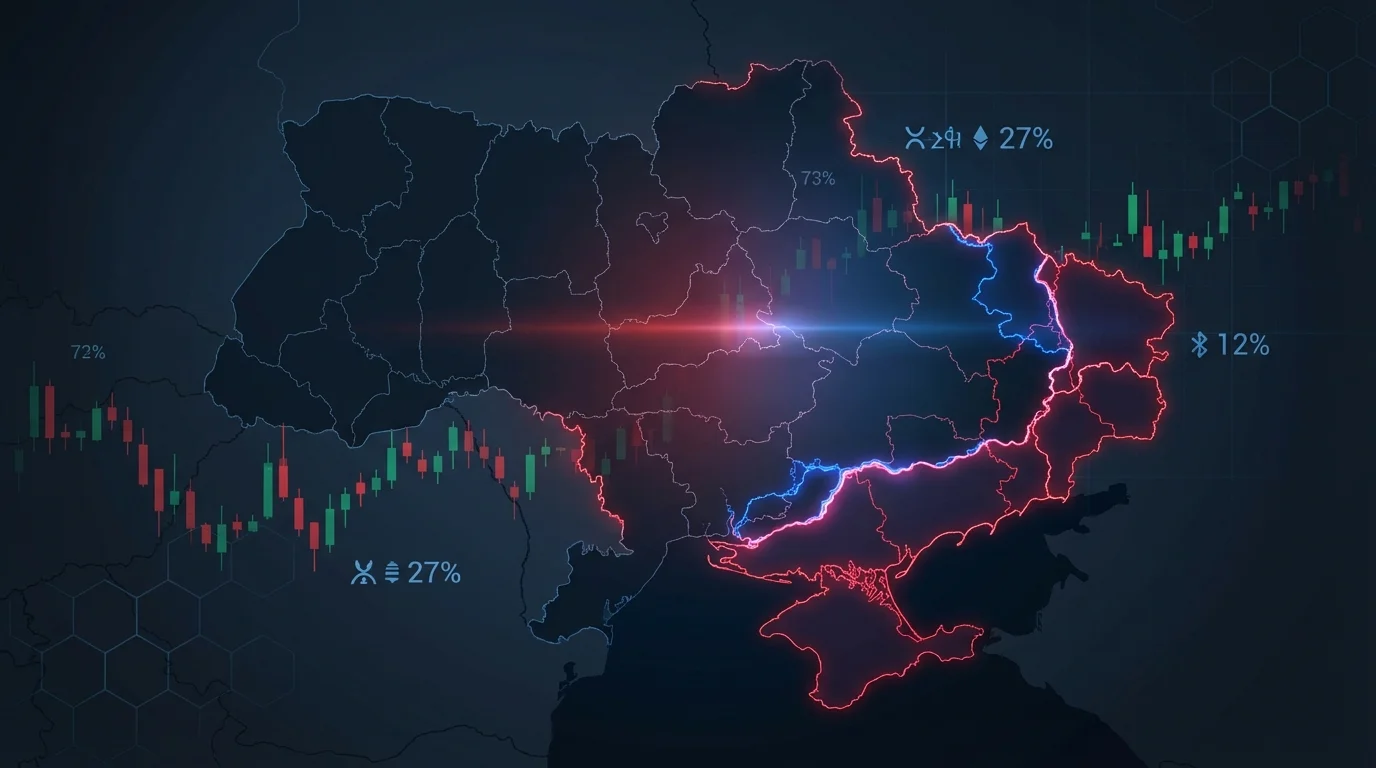
Ukraine has officially blocked Polymarket—the world’s largest prediction market platform valued at $9 billion—after more than $270 million was wagered on the outcomes of battles in their own backyard. But the ban isn’t just about licensing paperwork. It’s about foreign speculators betting on when Ukrainian cities will fall, data manipulation scandals that paid out $1.3 million on fabricated map edits, and a global reckoning over whether “prediction markets” are just gambling by another name.
KEY FACTS AT A GLANCE
- Ban Date: December 10, 2025 (Resolution No. 695)
- Regulatory Body: Ukraine’s National Commission for Electronic Communications (NCEC)
- Official Reason: Operating unlicensed gambling services
- War Bets Volume: $270M+ across 240 resolved markets
- Active Markets: $140M+ still open on Ukraine-related bets
- ISW Map Scandal: $1.3M paid out on manipulated data
- Countries Banning Polymarket: 15+ including France, Romania, Belgium, UK
What Exactly Did Ukraine Ban—And Why?
On December 10, 2025, Ukraine’s National Commission for the Regulation of Electronic Communications issued Resolution No. 695, adding polymarket.com to the country’s registry of blocked websites. The official justification: operating gambling services without a valid license from PlayCity, Ukraine’s state gambling regulator.
But the legal reasoning only tells half the story. Ukrainian media had spent months highlighting a troubling trend: foreign speculators were betting millions on the granular movements of front lines in an active war zone. Contracts like “Will Russia control Pokrovsk by April 1, 2026?” and “Will Ukraine recapture Crimea before 2027?” had turned the daily reality of Ukrainian civilians into just another market.
Ukrainian officials described Polymarket as a “parasitic entity that monetizes national trauma.” And they had receipts to back it up.
The Scale of War Betting: $270 Million and Counting
By December 2025, approximately 240 Ukraine-related bets had already resolved on Polymarket, with total trading volume exceeding $270 million. Another 120+ active markets held more than $140 million in open interest.
These weren’t abstract geopolitical questions. Bettors wagered on specific weeks when cities might fall. Odds shifted 20% or more within single hours based on Telegram footage from the front lines. In November 2025 alone, 97 war-related bets generated roughly $97 million in volume.
TYPES OF WAR BETS ON POLYMARKET
City Occupation Timing
- “Will Russia take Pokrovsk by [date]?”
- “Will Myrnohrad fall this week?”
- Resolution based on third-party maps
Territory Control
- “Will Ukraine recapture Crimea?”
- Long-term strategic outcome bets
- Higher volume, lower volatility
The ISW Map Manipulation Scandal
The controversy that crystallized Ukrainian outrage happened on November 15, 2025, in the city of Myrnohrad. Russian forces were advancing on the outskirts—a dangerous situation, but the city hadn’t fallen. On Polymarket, bettors had staked $1.3 million on whether Russia would capture it by nightfall. For most observers, it seemed unlikely. Some traders stood to gain 33,000% returns if it happened.
Then something unusual occurred. Polymarket bets on Ukrainian territory are resolved based on maps maintained by the Institute for the Study of War (ISW), a respected Washington D.C. think tank. Just before 6 a.m. EST on November 15, someone with access to ISW’s interactive map edited it to show that Russia had taken control of a key intersection in Myrnohrad—despite no evidence this had actually happened.
The bet resolved. Money paid out. Then the edit vanished.
“It has come to ISW’s attention that an unauthorized and unapproved edit to the interactive map of Russia’s invasion of Ukraine was made on the night of November 15-16 EST. The unauthorized edit was removed before the day’s normal workflow began on November 16.”
— Institute for the Study of War, Official Statement (November 17, 2025)
ISW stopped short of directly blaming Polymarket, but stated they “strongly disapprove of such activities and strenuously object to the use of our maps for such purposes, for which we emphatically do not give consent.” The next day, one of the researchers involved in creating ISW’s daily maps disappeared from the organization’s website. They had reportedly been fired.
Polymarket did not respond to media inquiries about the incident. No one disputed the bet within the allowed timeframe, so the payouts stood.
The DeepState Data Controversy
The ISW scandal wasn’t the only data controversy. DeepState, a prominent Ukrainian OSINT project that maintains its own interactive map of the invasion, discovered that its API had been integrated into Polymarket’s trading interface—without permission.
A third-party tool called Polyglobe had synced DeepState’s battlefield data directly into the platform, allowing traders to make real-time bets based on Ukrainian military intelligence volunteers tracking their own country’s invasion.
DeepState’s response was unequivocal. They declared they had not authorized “some bookmaker service” that “profits from wagers on the war” to use their map. Leadership accused the speculators of “vulture-like behavior.”
“They’re removed from it enough that it is just another market to them. It’s the same as you would bet on sports or horse racing. And I think that that’s part of what these betting markets do is they dehumanize what is a horrifying conflict.”
— Matthew Gault, 404 Media, in NPR interview
Ukrainian activist Serhiy Sternenko captured the national mood: the war has been a tragedy for Ukrainians, but for some foreigners, it’s little more than a gambling opportunity.
The Global Regulatory Domino Effect
Ukraine isn’t acting alone. Polymarket now faces restrictions in 15+ countries, each citing similar concerns about unlicensed gambling operations disguised as “prediction markets” or “event trading.”
| Country | Date | Trigger |
|---|---|---|
| France | Nov 2024 | “Théo” whale made $79M on US election bets |
| Belgium | Jan 2025 | Unlicensed gambling classification |
| Poland, Singapore, Thailand | Early 2025 | Gambling regulation enforcement |
| Romania | Oct 2025 | $600M wagered on presidential election |
| Australia | Aug 2025 | Interactive gambling restrictions |
| Ukraine | Dec 2025 | $270M war bets, ISW scandal |
| Tennessee (US) | Jan 2026 | Cease-and-desist for sports betting |
Romania’s case is particularly instructive. The country’s National Office of Gambling (ONJN) reported that local users wagered over $600 million on their presidential election alone, plus another $15 million on local Bucharest elections. ONJN President Vlad-Cristian Soare cut straight to the heart of the classification debate: “Accepting the idea that counterparty betting can be referred to as ‘trading’ would set a dangerous precedent.”
In January 2026, the Tennessee Sports Wagering Council sent cease-and-desist letters to Polymarket, Kalshi, and Crypto.com, demanding they halt sports-related markets and refund customer deposits by January 31. Tennessee became at least the ninth US state to take formal enforcement action against prediction market platforms.
The $9 Billion Contradiction
Here’s where the story gets surreal. While regulators worldwide are treating Polymarket as an unlicensed gambling operation, Wall Street is treating it as the future of finance.
In October 2025, Intercontinental Exchange (ICE)—the parent company of the New York Stock Exchange—announced a $2 billion strategic investment in Polymarket at a $9 billion valuation. ICE Chair Jeffrey Sprecher described the deal as blending “the NYSE, founded in 1792, with a forward-thinking, revolutionary company pioneering change within the Decentralized Finance space.”
On November 13, 2025, Polymarket founder Shayne Coplan—now one of the youngest self-made billionaires at 27—rang the opening bell at the New York Stock Exchange alongside Sprecher. A partnership with TKO Group Holdings for UFC and boxing betting was announced. The company is reportedly seeking new capital at a $12 billion valuation and may be eyeing an IPO.
Polymarket also acquired QCEX, a CFTC-licensed derivatives exchange, for $112 million in 2025—paving the way for a regulated US return. American users regained access in December 2025 after the platform had been blocked since a 2022 CFTC settlement.
THE CONTRADICTION
Polymarket is simultaneously valued at $9 billion with NYSE backing, partnered with major media (Dow Jones/WSJ for data distribution), and banned in 15+ countries for operating as an unlicensed gambling site. The regulatory classification question—gambling vs. trading—remains unresolved and will likely be tested in courts as states like Tennessee and Connecticut push enforcement.
Is It Gambling? The Question Nobody Wants to Answer
Crypto prediction markets have deliberately positioned themselves as “event trading” and “information markets” to sidestep gambling regulations. But country after country is rejecting this framing.
The distinction matters for users. Gambling platforms typically require:
LICENSED GAMBLING
Consumer protections, responsible gambling tools, AML compliance, dispute resolution, tax reporting
POLYMARKET
No consumer protections, no AML, no recourse for disputed resolutions, funds at regulatory risk
If Polymarket is gambling, users in restricted countries are participating in unlicensed gambling—with all the legal exposure that entails. Their winnings could potentially be voided or seized. And if resolution data gets manipulated (as happened with ISW), there’s no regulatory body to appeal to.
Notably, prediction markets are regulated by the Commodity Futures Trading Commission (CFTC) in the US, which does not address insider trading in prediction markets. The CFTC treats them as derivatives, not gambling—but this distinction isn’t recognized internationally.
What This Means for Bettors
For users currently active on Polymarket—or considering it—Ukraine’s ban highlights several practical realities:
RISK FACTORS FOR USERS
- VPN Usage: Using a VPN to access Polymarket from restricted countries violates Terms of Service and could void winnings. Polymarket has tightened VPN detection in 2026.
- No Dispute Resolution: When ISW map manipulation triggered a $1.3M payout, there was no mechanism to challenge it. The money stayed paid. (This follows a pattern—Polymarket also refused to pay out Venezuela invasion bets despite disputed resolution criteria.)
- Third-Party Oracle Risk: Your bets resolve based on data sources (ISW, DeepState) that have no contractual relationship with Polymarket and no obligation to you.
- Regulatory Exposure: If you’re in a restricted country, your funds are at legal risk—regardless of whether you access via VPN.
- Tax Ambiguity: Winnings may be classified as gambling income, trading income, or something else entirely depending on jurisdiction.
Following the ISW and DeepState controversies, OSINT organizations are expected to implement new Terms of Service specifically prohibiting the use of their data for financial betting. This could complicate bet resolution for future war-related markets.
The Ethics Question Nobody Wants to Touch
Set aside the legal questions for a moment. Is there something fundamentally different about betting on war compared to betting on sports or elections?
The gambling industry generally avoids this conversation because it makes the whole enterprise uncomfortable. But Ukraine’s ban forces it into the open.
Bettors wagered on the specific week Ukrainian cities would fall—cities where real people live, work, and die. Odds moved based on Telegram footage of drone strikes. Some traders cashed out six figures on manipulated data showing fake Russian advances.
Sports betting, election betting, entertainment prediction markets—these involve consenting participants in competitive or democratic processes. War betting involves monetizing the displacement and death of non-consenting civilians.
This isn’t a call to ban prediction markets. It’s an observation that “responsible gambling” might need to extend beyond deposit limits and self-exclusion tools to questions about what we normalize betting on in the first place.
KEY TAKEAWAYS
- Ukraine banned Polymarket — Resolution No. 695 (Dec 10, 2025) added the platform to the blocked website registry, citing unlicensed gambling operations.
- $270M+ wagered on war outcomes — Including bets on specific city occupation timing, with odds moving based on real-time battlefield footage.
- ISW map manipulation paid out $1.3M — An unauthorized edit triggered bet resolution before being removed; the payout stood with no recourse for bettors.
- DeepState data used without consent — Ukrainian OSINT volunteers found their battlefield tracking being integrated into the betting platform.
- 15+ countries now restrict Polymarket — Including France, Romania, Belgium, Poland, Singapore, Thailand, Australia, UK, and growing.
- Gambling vs. trading remains unresolved — Polymarket is valued at $9B with NYSE parent backing, yet banned as unlicensed gambling across multiple jurisdictions.
- User protections are minimal — No consumer safeguards, no AML compliance, no dispute resolution for manipulated data or contested resolutions.
