Futures betting lets you wager on outcomes that won’t be decided for weeks or even months—like picking the Super Bowl champion before the season starts or betting on who’ll win NBA MVP in October. These long-term bets offer some of the biggest payouts in sports betting, but they also tie up your money and require patience. This guide covers everything you need to know about futures betting, from the different types of bets to timing strategies and when to hedge.

QUICK SUMMARY
- What it is: Bets on outcomes decided later (championship winners, MVP, season totals)
- Typical payouts: Higher than single-game bets due to increased uncertainty
- When to bet: Earlier = better odds on longshots; later = more information
- Key strategy: Shop for value, manage bankroll (5-15% max in futures), consider hedging late
- Main risk: Money tied up for months; injuries/trades can derail your bet
What Is Futures Betting?
A futures bet is a wager on an outcome that will be determined at a later date—typically at the end of a season, tournament, or award cycle. Unlike moneyline bets or point spread bets that settle within hours, futures bets can take months to resolve.
The classic example: betting on the Kansas City Chiefs to win the Super Bowl in August. You place your bet before the season starts, and it doesn’t settle until February. If the Chiefs win, you cash your ticket. If they don’t make it, you lose your stake.
FUTURES VS. OTHER BET TYPES
Futures Bets
- Settle in weeks/months
- Higher potential payouts
- More uncertainty
- Money tied up longer
Single-Game Bets
- Settle same day
- Lower payouts typically
- More predictable
- Quick turnaround
Parlays
- Multiple bets combined
- High payouts possible
- All legs must hit
- Variable settlement time
Types of Futures Bets
Futures markets cover nearly every major outcome in sports. Here are the six main categories you’ll encounter at any sportsbook.
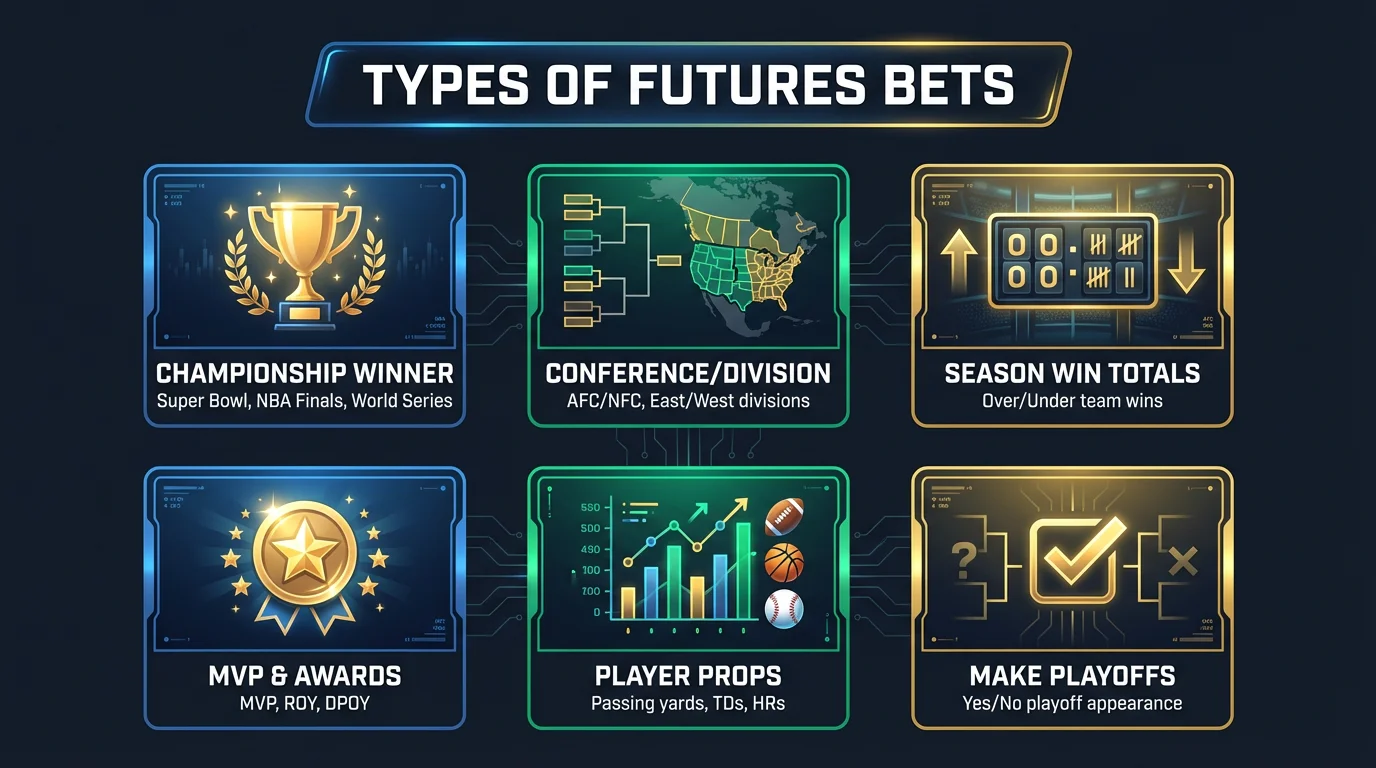
1. Championship Winner
The most popular futures market. You’re betting on which team will win the ultimate prize: Super Bowl, NBA Finals, World Series, Stanley Cup, College Football Playoff, etc. These markets open immediately after the previous season ends and remain active until the championship is decided.
EXAMPLE: SUPER BOWL FUTURES
Chiefs: +600 (bet $100 to win $600)
Bills: +800 (bet $100 to win $800)
Lions: +1000 (bet $100 to win $1,000)
Longshot team: +5000 (bet $100 to win $5,000)
2. Conference & Division Winners
Rather than picking the overall champion, you can bet on smaller segments: AFC/NFC champions, Eastern/Western Conference winners, or division winners (AFC East, NL West, etc.). These offer shorter odds than championship bets but are easier to hit.
3. Season Win Totals
A season-long over/under bet on how many games a team will win. The sportsbook sets a number (e.g., Cowboys 10.5 wins), and you bet whether they’ll go over or under that total. These settle at the end of the regular season.
EXAMPLE: NFL WIN TOTAL
Dallas Cowboys Win Total: 10.5
Over 10.5: -110 (Cowboys win 11+ games)
Under 10.5: -110 (Cowboys win 10 or fewer games)
4. MVP & Player Awards
Bet on who will win major individual awards: MVP, Rookie of the Year, Defensive Player of the Year, Cy Young, Heisman Trophy, etc. These markets are heavily influenced by team success—MVPs almost always come from playoff teams—and can shift dramatically during the season.
5. Season-Long Player Props
Over/under bets on individual player statistics for the entire season: passing yards, rushing touchdowns, home runs, points per game, etc. These require predicting both player performance and health over a full season.
EXAMPLE: PLAYER PROP FUTURES
Patrick Mahomes Passing Yards: 4,500.5
Derrick Henry Rushing TDs: 12.5
Shohei Ohtani Home Runs: 45.5
6. Make/Miss Playoffs
Simple yes/no markets on whether a team will make the postseason. These are useful for teams on the bubble where championship odds don’t offer good value but you believe they’ll at least make the playoffs.
How Futures Odds Work
Futures odds are displayed in American format (+/-), though you may also see decimal or fractional odds depending on your sportsbook. Here’s how to read them.
| American Odds | Decimal Odds | $100 Bet Wins | Implied Probability |
|---|---|---|---|
| +150 | 2.50 | $150 | 40.0% |
| +300 | 4.00 | $300 | 25.0% |
| +500 | 6.00 | $500 | 16.7% |
| +1000 | 11.00 | $1,000 | 9.1% |
| +2500 | 26.00 | $2,500 | 3.8% |
Calculating implied probability: For positive odds, divide 100 by (odds + 100). For +500 odds: 100 ÷ 600 = 16.7% implied probability. This tells you how likely the sportsbook thinks this outcome is.
When to Place Futures Bets: Timing Strategies
Timing is everything in futures betting. The odds you get depend heavily on when you place your bet, and there are strategic advantages to both early and late betting.
EARLY VS. LATE FUTURES BETTING
Bet Early (Preseason)
- + Best odds on longshots
- + Lock in value before hype
- + Larger potential payouts
- – More uncertainty (injuries, trades)
- – Money tied up longest
Bet Late (In-Season)
- + More information available
- + Clearer playoff picture
- + Can identify undervalued teams
- – Shorter odds (less value)
- – Best opportunities already gone
The “Buy Low” Strategy
One of the most effective futures strategies is waiting for a good team to stumble early. If a legitimate contender starts 2-3 or loses a few games in a row, their odds often lengthen significantly—creating value that didn’t exist preseason. This requires patience and the discipline to buy when others are selling.
“If a top team has an ugly start, this would be a good time to place a futures bet as their odds may lengthen significantly—waiting for a better price compared to before the season begins can be a rewarding strategy.”
Futures Betting Strategy Tips
1. Shop Multiple Sportsbooks
Futures odds vary more between sportsbooks than any other bet type. One book might have the Thunder at +400 to win the NBA title while another has them at +500. Over the course of a season, this difference is massive. Always compare before placing futures bets.
2. Manage Your Bankroll
Because futures tie up money for months, most sharp bettors limit their futures exposure to 5-15% of their total bankroll at any time. Individual position sizing is typically 0.25-1.0 units per bet. Don’t lock up so much capital that you can’t bet games during the season.
BANKROLL ALLOCATION EXAMPLE
Total Bankroll: $1,000
Max Futures Allocation: $100-$150 (10-15%)
Per-Bet Size: $25-$50 (0.5-1.0 units)
Number of Futures Positions: 3-6 bets
3. Avoid Correlated Bets
Don’t stack your futures portfolio with outcomes that win or lose together. If you bet heavily on the Chiefs to win the Super Bowl, also betting on Patrick Mahomes for MVP creates correlation—they’re more likely to win or lose together. Diversify across conferences, leagues, and bet types.
4. Understand the Juice
Futures markets have significant “overround”—the sum of all implied probabilities adds up to well over 100%, which is the sportsbook’s edge. A market where all teams’ implied probabilities sum to 130% means 30% goes to the house. This is higher than single-game bets, so you need to be more selective.
Hedging Futures Bets
Hedging means placing additional bets to guarantee profit (or minimize loss) regardless of outcome. This is most common with futures when your original bet is close to paying off and the potential payout is significant.
HEDGING EXAMPLE
Original Bet: $50 on Eagles to win Super Bowl at +2000 (potential win: $1,050)
Situation: Eagles reach the Super Bowl facing the Chiefs
Hedge Option: Bet $400 on Chiefs moneyline at -110 to win ~$364
Outcomes:
- Eagles win: Win $1,050 (futures) – $400 (hedge) = +$650 profit
- Chiefs win: Lose $50 (futures) + Win $364 (hedge) = +$314 profit
Without hedging: Win $1,050 or lose $50. With hedging: Guaranteed $314-$650 profit.
When to Hedge
Hedge when: Your potential payout is large relative to your stake, you’re risk-averse, or the guaranteed profit is meaningful to you. If you have a $10 bet to win $2,000 and your team is one game away from cashing, locking in profit often makes sense.
Don’t hedge when: The math doesn’t justify it, you’re comfortable with the original risk/reward, or hedging would cost more than it’s worth. “Hedge because the math says so, not because the ticket got shorter.”
Cash Out vs. Manual Hedge
Many sportsbooks offer a “cash out” button that settles your bet early for a guaranteed amount. While convenient, cash-out offers typically favor the book—they’re pricing in extra margin. Compare the cash-out offer to what you could get by manually hedging on the opponent, and choose the better value.
Pros and Cons of Futures Betting
ADVANTAGES VS. DISADVANTAGES
Pros
- Larger payouts than single-game bets
- Value on longshots before public catches on
- Keeps you engaged all season
- Hedging opportunities as odds move
- Less time-intensive than daily betting
Cons
- Money tied up for months
- High uncertainty (injuries, trades)
- Higher sportsbook margins
- Can’t reinvest capital until settled
- Emotional attachment to long bets
Futures Betting by Sport
Each sport has its own futures landscape. Here’s what to focus on for the major leagues.
NFL Futures
The NFL is the most popular futures market. Key bets include Super Bowl winner, conference champions, division winners, win totals, MVP, and Offensive/Defensive Player of the Year. The short 17-game season means fewer games for injuries to derail your bet, but also less time to recover from slow starts. See our complete NFL betting guide for more.
NBA Futures
The 82-game NBA season gives more time for true contenders to emerge, but also more opportunity for injuries. Popular markets include NBA Finals winner, conference champions, MVP, Rookie of the Year, and win totals. Star player health is crucial—one injury can tank a championship bet. Check out our NBA betting guide for detailed strategies.
MLB Futures
Baseball’s 162-game season is the longest, making win total and playoff bets more predictable (larger sample size). However, the playoff format is volatile—best-of-five series in the first round means anything can happen. Key markets: World Series, pennant winners, division winners, win totals, MVP, Cy Young, and home run leader.
NHL Futures
Hockey futures are similar to NBA—long regular season, playoff format where upsets are common. Goaltender health is critical. Markets include Stanley Cup, conference winners, division winners, and individual awards (Hart Trophy, Vezina Trophy).
Common Futures Betting Mistakes
OVER-ALLOCATING BANKROLL
Locking up too much capital in futures leaves you unable to bet games during the season. Keep futures to 5-15% of bankroll.
CHASING STEAM
Buying short numbers after odds have already moved without having new information. If the value is gone, the value is gone.
IGNORING CORRELATION
Stacking bets on outcomes that win or lose together (same division, player on championship team). Diversify your portfolio.
EMOTIONAL HEDGING
Hedging because you’re nervous, not because the math justifies it. Calculate expected value before hedging any position.
Frequently Asked Questions
Can I cash out a futures bet early?
Many sportsbooks offer early cash-out options for futures bets. The offered amount depends on current odds and how close your bet is to winning. However, cash-out offers typically include extra margin for the sportsbook, so compare to manual hedging before accepting.
What happens to my futures bet if a player gets traded?
For team futures (championship, win totals), trades don’t void your bet—you’re betting on the team, not individual players. For player props, check your sportsbook’s rules: some void bets if a player changes teams, others adjust or keep the bet active.
Are futures bets good value?
Futures can offer excellent value, especially on longshots early in the season before the public catches on. However, the overall market has higher juice than single-game bets, so you need to be selective. Shopping multiple sportsbooks is essential for finding the best prices.
When is the best time to place futures bets?
It depends on your strategy. Preseason offers the best odds on longshots and teams you believe are undervalued. In-season betting offers more information but shorter odds. The “buy low” strategy—waiting for good teams to stumble—can offer the best of both worlds.
Should I hedge my futures bet?
Hedge when the math makes sense and the guaranteed profit is meaningful to you. If you have a longshot bet that’s one game from paying off a large amount, locking in profit is often wise. But don’t hedge just because you’re nervous—calculate expected value first.
KEY TAKEAWAYS
- Futures bets are wagers on outcomes decided later—championships, awards, season totals—with payouts that can take months to settle
- Six main types: Championship winner, conference/division, win totals, MVP/awards, player props, and make playoffs
- Timing matters: Early bets offer better odds on longshots; in-season bets offer more information
- Shop around: Futures odds vary significantly between sportsbooks—always compare before betting
- Manage bankroll: Keep 5-15% max in futures to avoid locking up too much capital
- Consider hedging: When your bet is close to paying off, hedging can guarantee profit regardless of outcome
- Avoid mistakes: Don’t over-allocate, chase steam, stack correlated bets, or hedge emotionally
Related guides: Moneyline Betting · Spread Betting · Over/Under Betting · Parlay Betting
