Dunk Calculator

Find out exactly how high you need to jump to throw it down.

0 Inches
Enter Stats

How High Do You Need to Jump to Dunk?

A standard basketball hoop is exactly 10 feet (120 inches) off the floor. This is the universal standard for the NBA, NCAA, FIBA, and high school basketball. Use our basketball analytics tools to track your complete performance.

However, simply reaching 10 feet isn't enough to dunk. To successfully throw it down, you need to clear the rim with your fingers to snap the ball through. This creates three tiers of vertical requirements:

  • 🏀 Rim Grazer (123-124"): You can touch the rim and maybe squeeze a ball over if you are lucky.
  • 🔥 Standard Dunk (126"): You have 6 inches of clearance. This allows for a one-handed dunk with control.
  • 🚀 Power Dunk (130"+): You have 10+ inches of clearance. This is Vince Carter / Zach LaVine territory.
📏 The "Ape Index"

Your wingspan plays a huge role. An "Ape Index" of +2 means your wingspan is 2 inches wider than your height. A positive index significantly lowers the vertical jump needed to dunk.

👟 Shoes Matter

While no shoe adds 5 inches magically, lightweight basketball shoes with good traction (like Jordan 36s or GT Jumps) ensure you don't lose energy slipping on takeoff.

Can I Dunk at My Height?

Height Est. Reach Vertical Needed Famous Dunker Difficulty
5'7" (170cm) 7'3" 39 inches Spud Webb (46" vert) Elite
5'9" (175cm) 7'6" 36 inches Nate Robinson (43.5" vert) Very Hard
5'11" (180cm) 7'9" 33 inches Allen Iverson (41" vert) Hard
6'1" (185cm) 8'0" 30 inches Russell Westbrook (36.5" vert) Athletic
6'3" (190cm) 8'3" 27 inches Michael Jordan (46" vert) Achievable
6'5" (196cm) 8'6" 24 inches Zach LaVine (46" vert) Easy

*Estimated standing reach assumes average arm length. Measure your actual reach for accuracy.

How to Jump Higher to Dunk a Basketball

Dunking isn't just about genetics; it's about physics. Force × Velocity = Power. To jump higher, you need to put more force into the ground faster. Understanding metrics like True Shooting Percentage and Effective Field Goal % can help track how dunking improves your scoring efficiency.

1. Plyometrics (Elasticity)

Exercises like Depth Jumps and Box Jumps train your central nervous system to react quickly. This utilizes the "Stretch-Shortening Cycle" (SSC) of your muscles.

2. Strength Training (Force)

You need a strong base. Back Squats and Bulgarian Split Squats are king. A general rule of thumb: if you can't squat 1.5x your bodyweight, your primary focus should be strength.

3. Technique (The Penultimate Step)

Watch pro dunkers. They take a long, explosive second-to-last step (penultimate step) to lower their center of gravity before exploding upward. Perfecting this form can add 2-4 inches instantly.

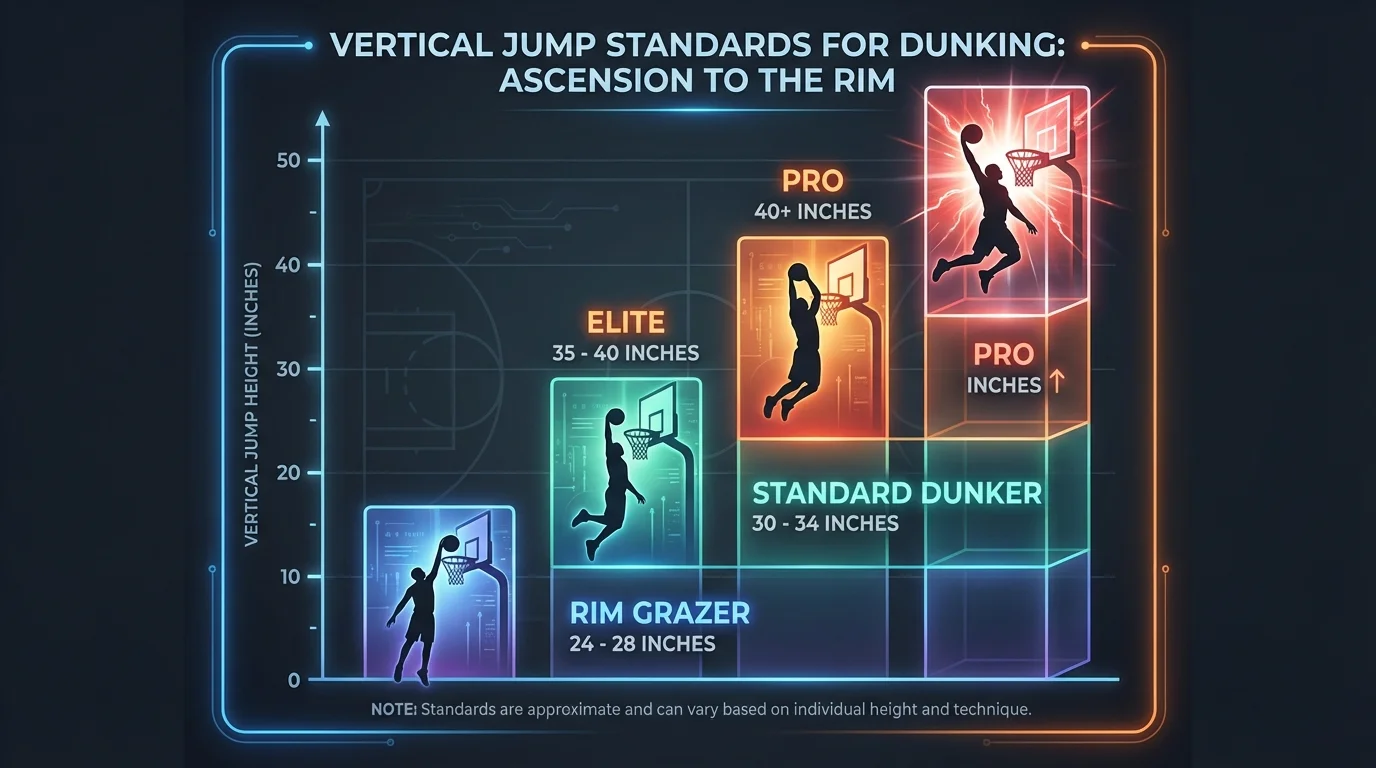
Vertical Jump Standards (Men)

Average 16 - 20"
Athletic 24 - 28"
Excellent (Dunk Territory) 30 - 34"
Elite (Pro) 35 - 40"+
Note: These are standing vertical jump numbers. A running vertical jump (which you use to dunk) is typically 2-5 inches higher.

How to Use This Calculator

  1. Enter Your Height: Input your height in feet and inches (e.g., 6' 0").
  2. Enter Your Standing Reach: This is how high you can reach flat-footed with one arm extended. We auto-estimate this for you, but for accuracy, measure it against a wall.
  3. Select Clearance: Choose "Standard Dunk" (6 inches over rim) for a clean dunk, or "Power Dunk" for advanced moves.
  4. Calculate: Click the button to see the vertical jump required to meet that goal.

Frequently Asked Questions

How high do you need to jump to dunk a basketball?

You need to reach at least 10 feet (120 inches) to touch the rim, plus 6 inches of clearance to dunk comfortably. The exact vertical jump needed depends on your standing reach. For example, someone with a 7'6" reach needs a 36-inch vertical, while someone with an 8'0" reach only needs 30 inches.

Can a 5'6 person dunk?

Yes, but it requires an elite vertical jump of 42+ inches. The shortest NBA player to win a dunk contest was Spud Webb at 5'7" with a 46-inch vertical. At 5'6", you would need roughly a 44-inch vertical to dunk cleanly, which is extremely rare but not impossible with dedicated training.

What was Spud Webb's vertical jump?

Spud Webb had a verified 46-inch vertical jump. Standing just 5'7" (170cm), he famously won the 1986 NBA Slam Dunk Contest, defeating his teammate Dominique Wilkins. His standing reach was approximately 7'2", meaning he could reach about 10'8" at his peak jump.

How long does it take to learn to dunk?

Most athletes can add 4-8 inches to their vertical jump within 8-12 weeks of dedicated plyometric and strength training. If you currently need to gain 6 inches or less, you could potentially dunk within 2-3 months. Needing 10+ inches may take 6-12 months of consistent training.

Can you dunk if you can touch the rim?

Barely. If you can only touch the rim, you have zero clearance. To dunk a basketball (which has a 9.4-inch diameter), you need your palm 6 inches above the rim minimum. Touching the rim means you need to add roughly 6 more inches to your vertical to dunk consistently.

What is the average vertical jump by age?

Average standing vertical jump for males: Ages 13-15: 15-18 inches, Ages 16-18: 18-22 inches, Ages 19-25: 20-24 inches (peak athletic years), Ages 30+: Gradual decline of 1-2 inches per decade. Elite athletes at any age can achieve 35-45 inches.

Does standing reach matter more than height for dunking?

Absolutely. Standing reach is the true starting point for calculating dunk ability. Two 6'0" players can have different reaches (7'8" vs 8'2") due to arm length. The player with longer arms needs 6 fewer inches of vertical to dunk. This is why wingspan ("Ape Index") is crucial.

How can I increase my vertical jump fast?

Focus on three pillars: 1) Plyometrics (Box Jumps, Depth Jumps) for explosive power, 2) Strength Training (Squats, Deadlifts) for force production, 3) Technique (Penultimate step approach). Train 3-4x per week with rest days. Most see 2-4 inch gains in 6-8 weeks with proper programming.