Fishing Reel Line Capacity Calculator
Updated:Calculate how much fishing line fits on your reel for mono, braid, and fluorocarbon.
What is Fishing Reel Line Capacity?
Fishing reel line capacity refers to the amount of fishing line that can be wound onto a reel's spool, typically measured in yards or meters. Understanding your reel's line capacity is crucial for matching the right line to your reel and ensuring you have enough line for your target species and fishing conditions.
Line capacity depends on several factors:
- Spool Diameter: The outer diameter of your reel's spool when empty
- Arbor Diameter: The inner diameter (the core around which line wraps)
- Spool Width: The width of the area where line is wound
- Line Diameter: The thickness of your fishing line, which varies by type and pound test
Different line types have dramatically different diameters for the same breaking strength. Braided line is significantly thinner than monofilament of the same pound test, meaning you can fit 3-4 times more braid on your reel. This calculator helps you determine exactly how much line you can spool based on your specific reel dimensions and line choice.
How to Calculate Line Capacity
The mathematical formula for line capacity is:
Capacity = π × Spool Width × ((Spool Diameter/2)² - (Arbor Diameter/2)²) / (Line Diameter²)
For a reel with:
- Spool Diameter: 52mm
- Arbor Diameter: 25mm
- Spool Width: 20mm
- Line: 20lb Monofilament (0.40mm diameter)
Capacity = 3.14159 × 20 × ((52/2)² - (25/2)²) / (0.40²)
= 3.14159 × 20 × (676 - 156.25) / 0.16
= 3.14159 × 20 × 3248.4
= 204,203 mm = 223 yards (204 meters)
Line Type Comparison
Understanding the diameter differences between line types is essential for maximizing your reel's capacity:
Monofilament Line
Monofilament is a single-strand nylon line that's been the standard for decades. It has moderate stretch, good knot strength, and is forgiving for beginners. However, it has the largest diameter among the three main line types, limiting capacity. Mono also has memory and degrades with UV exposure over time.
Braided Line
Braided line consists of multiple ultra-thin fibers woven together, resulting in exceptional strength-to-diameter ratio. A 20lb braid typically has the same diameter as 6lb mono, meaning you can spool 3-4 times more line. Braid has virtually no stretch, providing excellent sensitivity and hooksets, but requires careful knot selection and can be visible to fish in clear water.
Fluorocarbon Line
Fluorocarbon line is nearly invisible underwater due to its refractive index matching water. It has low stretch, excellent abrasion resistance, and sinks faster than mono. The diameter is slightly smaller than mono but larger than braid for equivalent pound test. Fluorocarbon is popular for leaders and clear-water applications but is stiffer and more expensive than monofilament.
Line Diameter Reference Chart
Here are typical diameter ranges for common line types and pound tests:
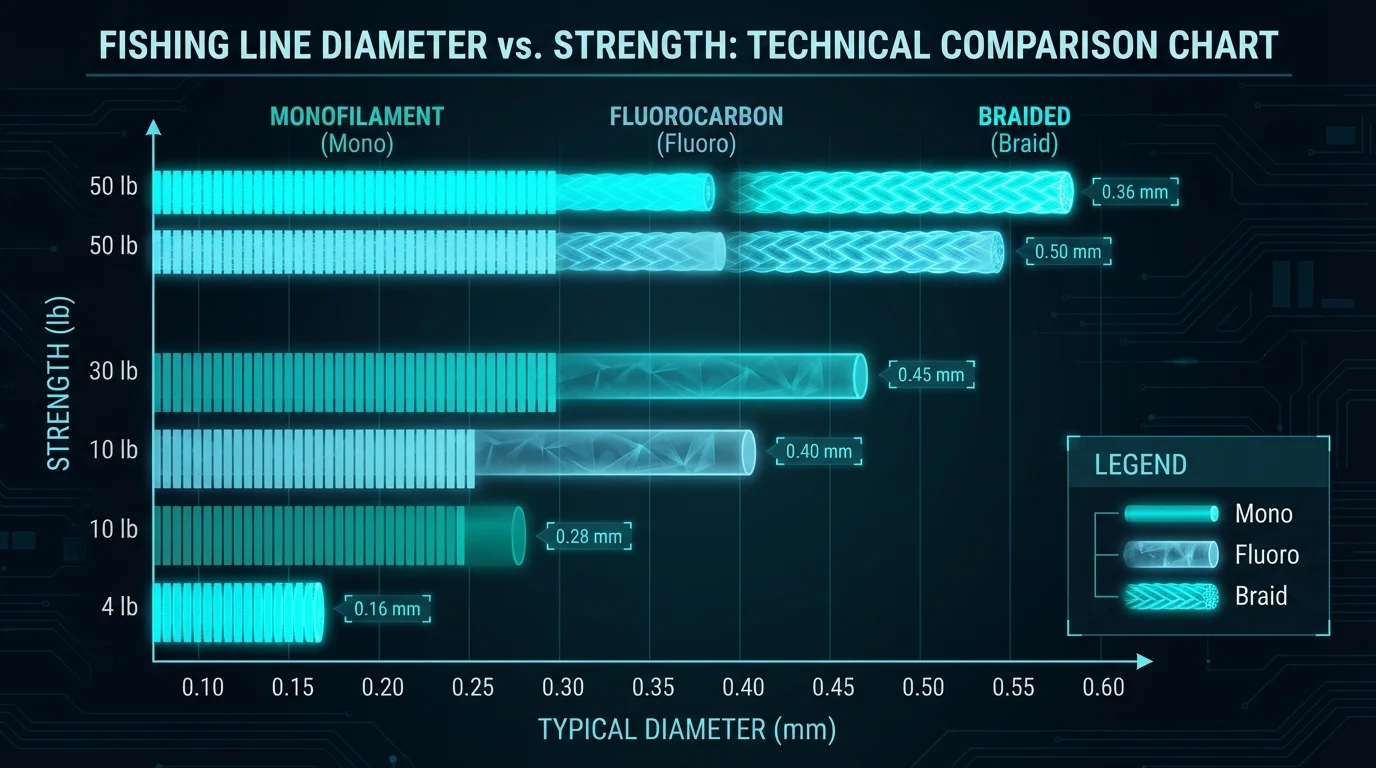
| Pound Test | Monofilament | Fluorocarbon | Braided Line |
|---|---|---|---|
| 6 lb | 0.23mm | 0.22mm | 0.13mm |
| 8 lb | 0.28mm | 0.26mm | 0.15mm |
| 10 lb | 0.30mm | 0.28mm | 0.16mm |
| 12 lb | 0.33mm | 0.31mm | 0.18mm |
| 15 lb | 0.37mm | 0.35mm | 0.19mm |
| 20 lb | 0.40mm | 0.38mm | 0.23mm |
| 30 lb | 0.55mm | 0.52mm | 0.28mm |
| 50 lb | 0.70mm | 0.66mm | 0.36mm |
Note: Diameters can vary between manufacturers. Always check the line spool for exact specifications.
Using Backing Line
Backing is an economical technique where you fill the bottom portion of your spool with inexpensive monofilament before adding your primary fishing line. This approach offers several benefits:
- Cost Savings: Expensive braid or fluorocarbon is only used where needed
- Optimal Spool Fill: Achieve proper line level for maximum casting distance
- Line Management: Prevents main line from slipping on the arbor
- Customization: Adjust total line amount based on fishing needs
When using backing, calculate your backing capacity first, then determine how much primary line remains. Most anglers use 100-200 yards of backing with 150-300 yards of main line, depending on reel size and target species.
Proper Spooling Techniques
Achieving accurate line capacity requires proper spooling technique:
- Maintain Tension: Keep consistent pressure while winding to prevent loose wraps
- Fill Level: Stop 1/8 inch (3mm) from the spool lip for optimal performance
- Line Twist: For spinning reels, ensure line comes off the filler spool in the correct direction
- Even Distribution: Modern reels have level-wind mechanisms; manual reels require careful cross-winding
Remember that real-world capacity may vary from calculated values due to line memory, winding tension, and how tightly line compacts on the spool. Manufacturers' stated capacities are guidelines based on ideal conditions.
Frequently Asked Questions
How do I calculate fishing line capacity?
Line capacity is calculated using the spool dimensions and line diameter. The formula is: Capacity = π × Spool Width × ((Spool Diameter/2)² - (Arbor Diameter/2)²) / (Line Diameter²). This gives you the volume available divided by the cross-sectional area of the line.
Does braid hold more line than monofilament?
Yes, braid typically has a smaller diameter than monofilament of the same pound test, so you can fit significantly more braid on a reel. For example, 20lb braid often has the diameter of 6lb mono, allowing you to spool 3-4 times more line.
What is backing and why use it?
Backing is less expensive line (usually monofilament) used to fill the bottom portion of your spool before adding your main fishing line. It saves money on expensive braid or fluorocarbon, and helps achieve optimal spool fill for better casting distance.
How full should I fill my fishing reel?
Most reels should be filled to within 1/8 inch (3mm) of the spool lip. Underfilling reduces casting distance and can cause tangles, while overfilling causes line spillage and bird nests. Proper spool fill is crucial for optimal performance.
Why does line diameter matter for capacity?
Line diameter directly affects how much line fits on your spool. Thinner line takes up less space, allowing more yardage. However, manufacturers' diameter ratings can vary, so actual capacity may differ slightly from calculations.
Can I use this calculator for fly fishing reels?
While this calculator works mathematically for any reel, fly fishing reels have unique considerations like backing requirements and weight-forward fly line tapers. It's best used for spinning and baitcasting reels with uniform line diameter.