Running Pace Calculator
Calculate Time, Distance, or Pace with precision for any running distance.
What is Running Pace?
Running pace is the time it takes to cover a specific distance, typically expressed as minutes per kilometer (min/km) or minutes per mile (min/mi). It's the fundamental metric that helps runners plan their training, set realistic race goals, and track their improvement over time.
Whether you're training for your first 5K or aiming to qualify for the Boston Marathon, understanding your pace is essential. This versatile calculator helps you:
- Calculate Pace: Find out how fast you need to run to hit a specific time goal for your target distance.
- Calculate Time: Predict your finish time based on maintaining a steady pace throughout your run.
- Calculate Distance: Determine how far you can run based on your available time and target pace.
How to Calculate Running Pace
The basic formula for calculating pace is: Pace = Time / Distance.
If you run a 5K race (5 kilometers) in 25 minutes:
25 minutes ÷ 5 km = 5:00 min/km
Your pace is 5:00 per kilometer (or approximately 8:03 per mile).
What is a "Good" Running Pace?
The definition of a "good" pace varies significantly based on several factors including age, gender, fitness level, and race distance. Here are some general benchmarks for common race distances:
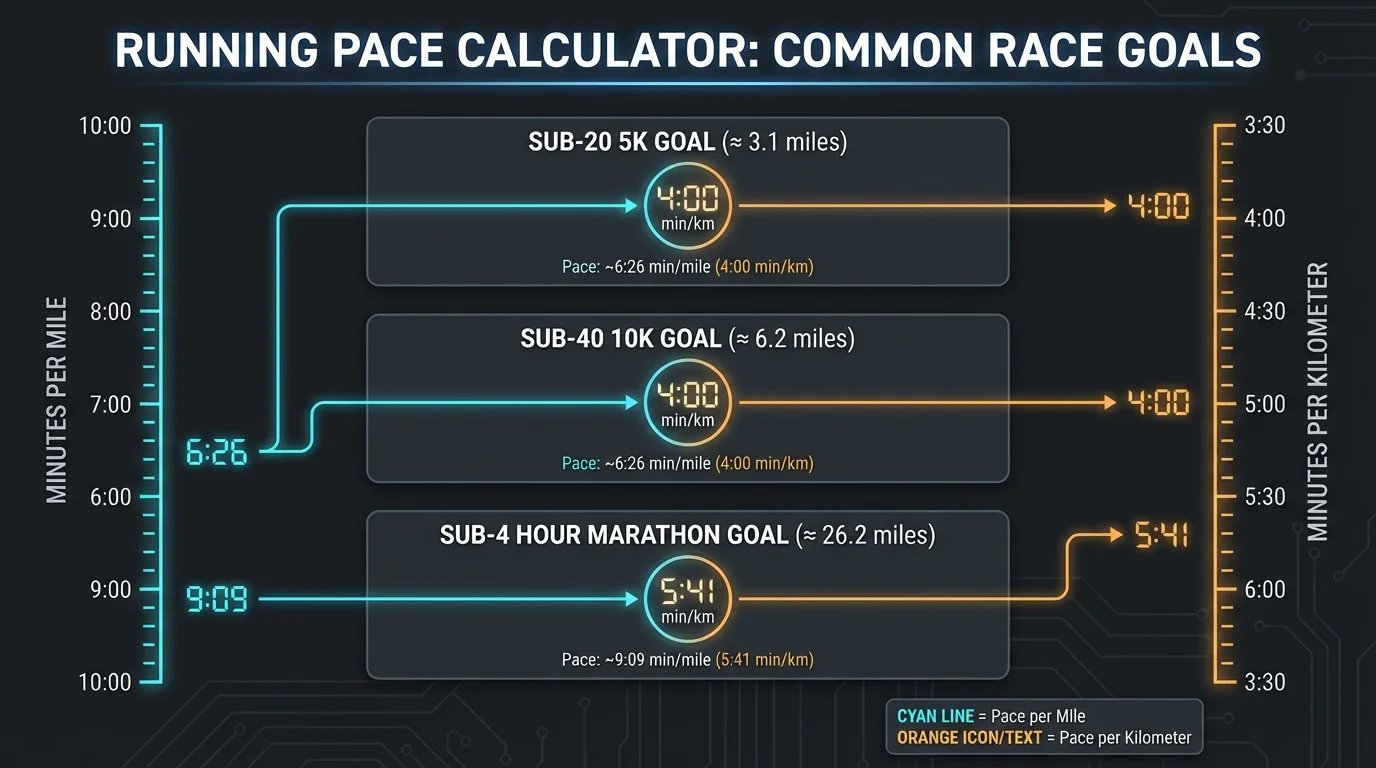
Pace Benchmarks by Distance
- 5K (3.1 miles): Beginners typically run 10-12 min/mi (6:13-7:27 min/km), while competitive runners target 6-8 min/mi (3:44-4:58 min/km). Elite runners can sustain under 5 min/mi (3:06 min/km).
- 10K (6.2 miles): Recreational runners average 9-11 min/mi (5:36-6:50 min/km), experienced runners aim for 7-9 min/mi (4:21-5:36 min/km), and elite athletes run under 5:30 min/mi (3:25 min/km).
- Half Marathon (13.1 miles): Beginner paces range from 10-13 min/mi (6:13-8:04 min/km), intermediate runners target 8-10 min/mi (4:58-6:13 min/km), while elite runners maintain sub-6 min/mi (3:44 min/km).
- Marathon (26.2 miles): First-time marathoners often run 11-13 min/mi (6:50-8:04 min/km), experienced runners aim for 8-10 min/mi (4:58-6:13 min/km), and elite marathoners sustain under 5 min/mi (3:06 min/km) - the world record pace is approximately 4:40 min/mi.
Understanding Pace Conversions
Since 1 mile equals approximately 1.609 kilometers, pace per kilometer will always be faster (lower time) than pace per mile. For quick mental math: your pace per mile is roughly 1.6 times your pace per kilometer. For example, 6:00 min/km translates to approximately 9:39 min/mi.
Using Pace for Training
Understanding and using pace effectively can transform your training. Most training plans incorporate different pace zones for various workout types:
- Easy Pace: 60-75% effort, used for recovery runs and building aerobic base. You should be able to hold a conversation comfortably.
- Tempo Pace: "Comfortably hard" effort you could sustain for about an hour, typically 10-15 seconds per mile slower than your 5K pace.
- Interval/Race Pace: Your target pace for races or speed work, requiring focused effort and regular recovery.
For more detailed training insights, check out our related running calculators below to plan mile splits, predict race times, and calculate training zones.
Frequently Asked Questions
How do I use this calculator?
Select what you want to calculate (Time, Distance, or Pace). Enter the other two known variables, and the tool will solve for the third.
What is a good running pace?
A "good" pace depends on age, gender, and distance. For a beginner 5K runner, 10-12 minutes per mile is common. Elite runners sustain 4:40/mile for a marathon.
What is the difference between pace per km and pace per mile?
Pace per kilometer is typically faster (lower time) than pace per mile since a kilometer is shorter. To convert, multiply pace/km by 1.609 to get pace/mile.
How accurate is this pace calculator?
The calculator provides mathematically accurate results based on the inputs. However, real-world running involves factors like terrain, weather, and fatigue that can affect your actual pace.