Kiteboarding Calculator
Updated:Calculate the perfect kite size based on wind conditions, rider weight, and experience level.
What is Kite Sizing?
Choosing the right kite size is the most critical decision in kiteboarding. The kite size, measured in square meters (m²), determines how much power you'll generate in given wind conditions. Too small, and you won't have enough power to ride. Too large, and you'll be overpowered and unable to control the kite safely.
Kite sizing is a dynamic calculation that considers multiple variables: your body weight, wind speed, skill level, and the type of board you're riding. This calculator uses industry-standard formulas to recommend the optimal kite size for your specific conditions, helping you stay safe while maximizing performance on the water.
How Kite Size is Calculated
The basic formula for kite sizing is:
Kite Size (m²) = Rider Weight (kg) / (Wind Speed (knots) × Factor)
The Factor varies based on skill level and board type:
- Beginners: Factor 0.9-1.0 (need more power/stability)
- Intermediate: Factor 1.1-1.2 (balanced approach)
- Advanced: Factor 1.3-1.5 (can handle less power)
A 75kg intermediate rider in 15 knots on a twin-tip board:
75 kg ÷ (15 knots × 1.1) = 4.55 m²
However, this raw calculation gives unrealistically small sizes. In practice, we apply scaling and adjustments to recommend a 10-11m² kite, which aligns with real-world kiteboarding standards.
Understanding Wind Windows
Every kite has an optimal wind range where it performs best, plus an extended range where it can work with adjusted technique:
- Optimal Range: The sweet spot where your kite provides perfect power and control. You can ride comfortably without being under or overpowered.
- Extended Low End: Below optimal range, you'll need advanced technique (kite looping, aggressive riding) to generate enough power.
- Extended High End: Above optimal range, you can still ride by detuning the kite (trimming, smaller bar movements), but power becomes harder to manage.
Wind Speed Guidelines
Understanding wind conditions is essential for safe kiteboarding:
- 5-10 knots (Light): Marginal conditions. Only experienced riders with large kites and foilboards can ride effectively.
- 10-15 knots (Moderate): Great for beginners and learning. Easier control with medium-large kites.
- 15-20 knots (Ideal): Perfect conditions for most riders. Plenty of power with manageable control.
- 20-25 knots (Strong): Exciting for advanced riders. Requires smaller kites and solid skills.
- 25-30 knots (Very Strong): Advanced/expert only. Small kites and excellent kite control required.
- 30+ knots (Extreme): Dangerous for most riders. Only highly experienced riders should attempt in these conditions.
Board Type Impact on Kite Size
The type of board you ride significantly affects kite size requirements:
Twin-Tip Boards
The standard kiteboarding setup. Twin-tips require full kite power to plane and maintain speed. Our calculator uses twin-tip as the baseline for sizing recommendations.
Surfboards
Directional surfboards have more glide than twin-tips and work better in waves. You can typically use a kite 1-2m² smaller than on a twin-tip in the same conditions.
Foilboards
Hydrofoil boards generate enormous lift at low speeds, requiring significantly less power. You'll typically need a kite 2-4m² smaller than on a twin-tip. This means you can ride in much lighter winds with smaller, more manageable kites.
Building Your Kite Quiver
Most dedicated kiteboarders own multiple kites to cover different wind conditions. Here's how to build a versatile quiver:
Starter Quiver (2 Kites)
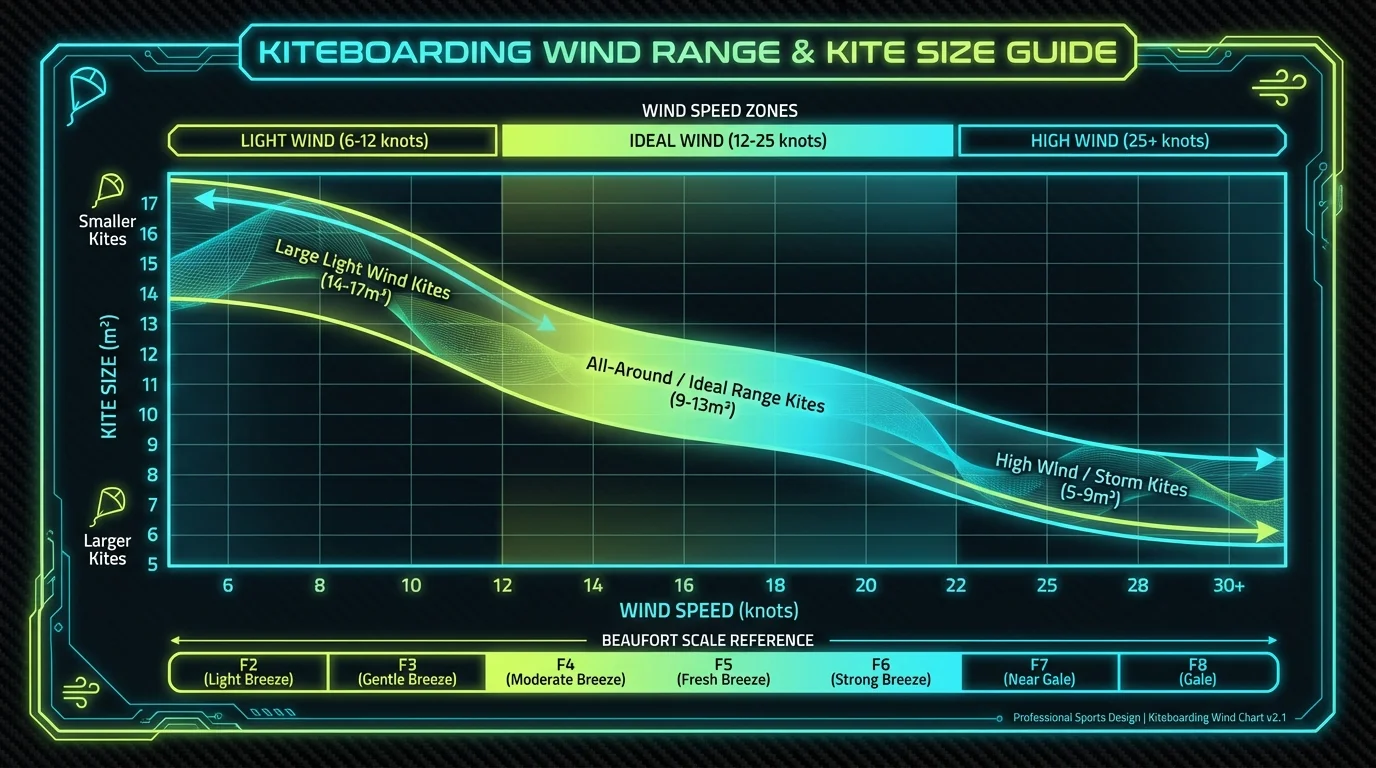
- Large Kite (12-14m²): For light to moderate winds (10-18 knots). Your go-to kite for most sessions.
- Medium Kite (9-10m²): For moderate to strong winds (16-25 knots). Covers stronger days and extends your riding range.
Complete Quiver (3-4 Kites)
- Large Kite (14-17m²): Light wind specialist (8-15 knots). Essential for marginal days.
- Medium Kite (10-12m²): All-around workhorse (12-20 knots). Most versatile size.
- Small Kite (7-9m²): Strong wind performer (18-28 knots). Safety-critical for windy conditions.
- Storm Kite (5-6m²): Extreme conditions (25-35+ knots). For experienced riders only.
Your specific location's wind patterns will determine your ideal quiver. Riders in consistently strong wind areas (like Cape Town or Tarifa) prioritize smaller kites, while those in lighter wind locations (many lake spots) invest in larger kites and foil equipment.
Safety Considerations
Choosing the correct kite size is not just about performance—it's critical for safety:
- Never Oversize: Being overpowered is dangerous. If in doubt, choose the smaller kite.
- Check Gusts: Wind rarely blows steady. If gusts exceed 10 knots above average, size down.
- Respect Your Limits: Don't push into conditions beyond your skill level, regardless of kite size.
- Practice Safety Systems: Know how to activate your quick release and safety leash in all conditions.
- Local Knowledge: Wind conditions vary by location. Learn from local riders about typical patterns and sizing norms.
Skill Level Differences
Beginner Recommendations
Beginners benefit from larger kites with more stable power delivery. Bigger kites are more forgiving, easier to relaunch from the water, and provide smoother feedback. Start in moderate winds (12-18 knots) with a 12-14m² kite regardless of body weight.
Intermediate Riders
Once you can ride upwind confidently and perform basic jumps, you can start riding slightly smaller kites. This gives more agility and reduces the risk of being overpowered as you progress into stronger winds and more dynamic riding.
Advanced Riders
Advanced riders can maximize smaller kites through technique (aggressive kite movement, loops, timing) and ride underpowered more effectively. They also have the control to handle larger kites in stronger winds, extending both ends of a kite's wind range.
Frequently Asked Questions
How do I choose the right kite size?
The right kite size depends on four key factors: your weight, wind conditions, skill level, and board type. Heavier riders need larger kites, stronger winds require smaller kites, beginners benefit from larger kites for easier control, and foilboards work with smaller kites than twin-tips.
What size kite should a beginner use?
Beginners should start with a larger kite (12-14m²) in moderate winds (12-20 knots). Larger kites provide more stability, smoother power delivery, and easier relaunch. As skills improve, riders can transition to a wider range of kite sizes.
What is the difference between kite sizes for twin-tip vs foil?
Foilboards generate significantly more lift and require less power, so you typically need a kite 2-4m² smaller than you would use on a twin-tip board. For example, if you use a 12m kite on a twin-tip, you might only need an 8-10m kite on a foil in the same conditions.
How many kites do I need for a complete quiver?
Most riders have 2-3 kites to cover typical wind ranges: a large kite (12-14m²) for light winds, a medium kite (9-11m²) for moderate winds, and a small kite (7-8m²) for strong winds. Your specific location's wind patterns will determine your ideal quiver.
Can I use a kite that is too small or too large?
Using an undersized kite in light winds means you won't generate enough power for riding. Using an oversized kite in strong winds is dangerous and can lead to loss of control, overpowered situations, and potential injury. Always size appropriately for conditions.
What wind speed range is best for kiteboarding?
The ideal wind range for kiteboarding is 12-25 knots. Beginners should avoid winds below 12 knots (underpowered) or above 25 knots (overpowered). Advanced riders can handle 8-35 knots with appropriate kite sizing and safety protocols.