Cycling Heart Rate Zone Calculator
Optimize your training intensity across all 5 zones
What are Heart Rate Zones?
Heart rate zones are specific ranges of heartbeats per minute (BPM) that correspond to different training intensities. Each zone targets distinct physiological adaptations, from active recovery to maximum anaerobic power. Training with heart rate zones allows cyclists to precisely control workout intensity and ensure proper stimulus for desired adaptations.
How to Calculate Your Zones
There are two primary methods for calculating heart rate zones:
- Age-Based Method (220 - Age): A simple estimation that works well for most cyclists. Your estimated maximum heart rate is calculated as 220 minus your age.
- Known Max HR Method: If you know your actual maximum heart rate from testing (lab test or all-out field test), you can input it directly for more accurate zones.
- Karvonen Formula (with Resting HR): For the most personalized zones, measure your resting heart rate and include it in the calculation. This method accounts for individual fitness levels.
Zone Breakdown
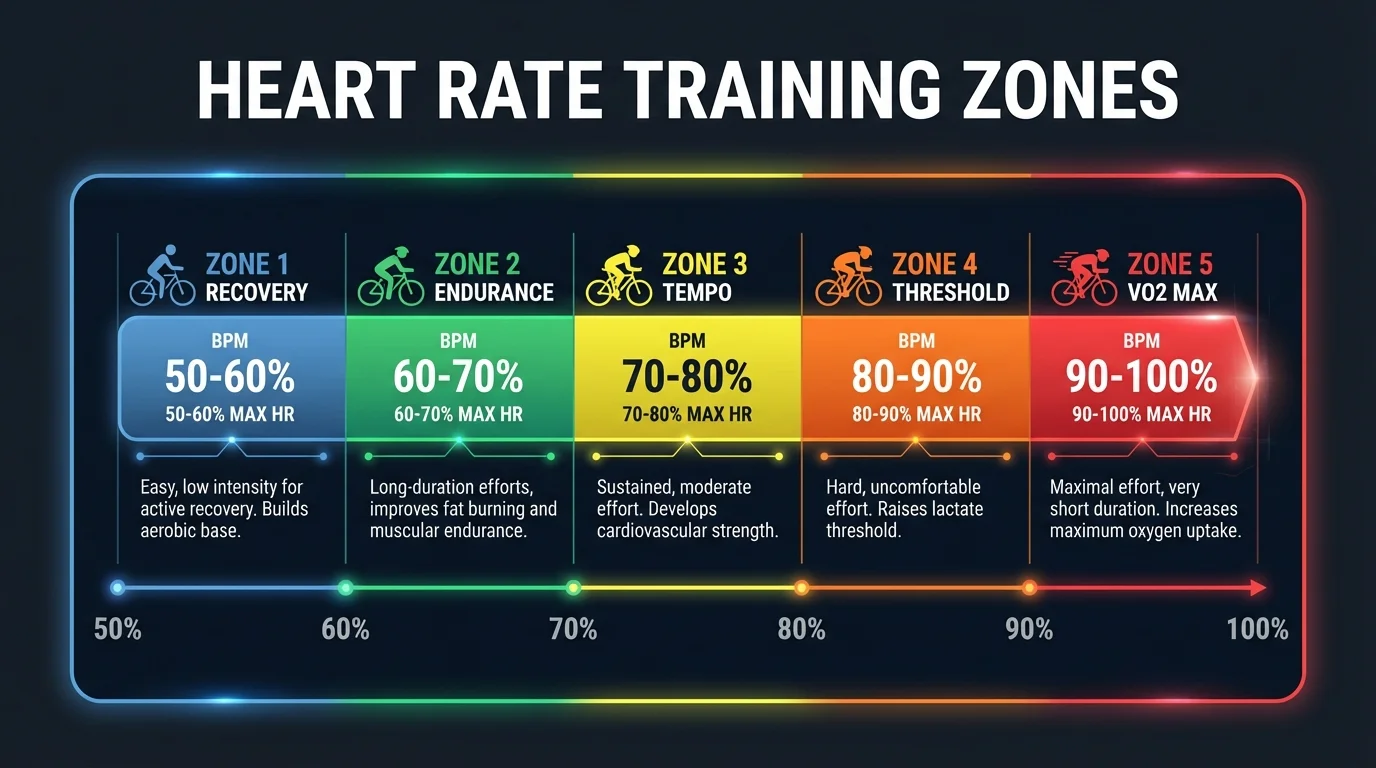
Each heart rate zone serves a specific training purpose:
Very light intensity. Used for active recovery rides, warm-ups, and cool-downs. At this intensity, you should be able to hold a conversation easily. Promotes blood flow and aids recovery without adding training stress.
The foundation zone for aerobic fitness. This is where you build endurance, improve fat oxidation, and develop mitochondrial density. Most recreational rides and base training sessions occur in Zone 2. You should still be able to talk in complete sentences.
Moderately hard effort. Also called the "tempo" or "aerobic" zone. Conversation becomes more difficult. This zone improves aerobic capacity and is useful for longer intervals and sustained efforts on rolling terrain.
Hard effort at or near your lactate threshold. This is the intensity you can sustain for about 30-60 minutes in a race. Training in Zone 4 improves your ability to clear lactate and sustain high power outputs. Talking is limited to short phrases.
Maximum effort. This zone develops your VO2 max (maximum oxygen uptake) and anaerobic capacity. Intervals in Zone 5 are typically 2-8 minutes with equal or longer recovery periods. Speaking is nearly impossible at this intensity.
Training Benefits by Zone
Strategic use of different zones produces specific adaptations:
- Zone 1-2 (70-80% of training volume): Builds aerobic base, improves fat burning, develops capillary density, and allows high training volume without excessive fatigue.
- Zone 3 (10-15% of training): Bridges endurance and threshold work, useful for race-pace efforts and tempo rides.
- Zone 4 (5-10% of training): Increases lactate threshold, improves sustained power, prepares you for race intensities.
- Zone 5 (2-5% of training): Maximizes VO2 max, develops peak power, improves ability to handle surges and attacks.
Limitations
While heart rate zones are valuable, they have some limitations to keep in mind:
- Individual Variation: The 220-age formula is an estimate that can vary by ±10-15 BPM between individuals. Field or lab testing provides more accurate max HR.
- Lag Time: Heart rate takes 1-2 minutes to respond to changes in effort, making it less useful for short, intense intervals. Power meters provide instant feedback.
- Daily Fluctuation: Heart rate can be affected by dehydration, heat, fatigue, caffeine, stress, and illness. Your zones are ranges, not precise targets.
- Cardiac Drift: During long rides, heart rate naturally rises even at constant power due to dehydration and fatigue (cardiac drift).
Frequently Asked Questions
What are heart rate zones?
Heart rate zones are specific ranges of heartbeats per minute that correspond to different training intensities. There are typically 5 zones, each targeting different physiological adaptations from recovery (Zone 1) to maximum effort (Zone 5).
How do I find my maximum heart rate?
The most accurate way is a lab test or field test (all-out 3-5 minute effort). The age-based formula (220 - age) provides a reasonable estimate but can vary by ±10-15 bpm between individuals.
Should I use resting heart rate (Karvonen method)?
The Karvonen formula (using resting HR) provides more personalized zones, especially for trained athletes with lower resting heart rates. If you know your resting HR, using it will give more accurate zones.
Why train with heart rate zones?
Training in specific zones targets different physiological adaptations. Zone 2 builds endurance and fat burning efficiency, Zone 3-4 improve lactate threshold, and Zone 5 develops VO2 max and peak power.
How long should I stay in each zone?
Zone 2 (endurance) sessions typically last 60-180 minutes. Zone 3 (tempo) sessions are 20-60 minutes. Zone 4 (threshold) intervals are 8-20 minutes. Zone 5 (VO2 max) intervals are 2-8 minutes with recovery periods.