VO2 Max Calculator for Runners
Estimate your aerobic capacity from race performance
What is VO2 Max?
VO2 Max (maximal oxygen uptake) is the gold standard measurement of aerobic fitness. It represents the maximum volume of oxygen your body can utilize during intense exercise, expressed in milliliters of oxygen per kilogram of body weight per minute (ml/kg/min).
Think of VO2 Max as the size of your body's aerobic engine. A higher VO2 Max means your cardiovascular system can deliver more oxygen to working muscles, allowing you to sustain faster paces for longer periods. Elite endurance athletes like marathon runners and cyclists typically have VO2 Max scores exceeding 70-80 ml/kg/min, while sedentary individuals may score below 35 ml/kg/min.
How to Estimate VO2 Max from Race Times
This calculator uses the Daniels/Gilbert formula, developed by renowned running coach Dr. Jack Daniels. The formula correlates race performance with laboratory-measured VO2 Max with strong accuracy. By inputting your race distance and finish time, the calculator determines your VDOT score—a running-specific measure of aerobic fitness that closely approximates true VO2 Max.
A runner completes a 5K race in 22 minutes and 30 seconds.
Distance: 5000 meters | Time: 22:30 (22.5 minutes)
Using the Daniels/Gilbert formula, this performance corresponds to an estimated VO2 Max of approximately 48 ml/kg/min.
This score falls in the "Good" to "Excellent" range for recreational runners.
What is a Good VO2 Max Score?
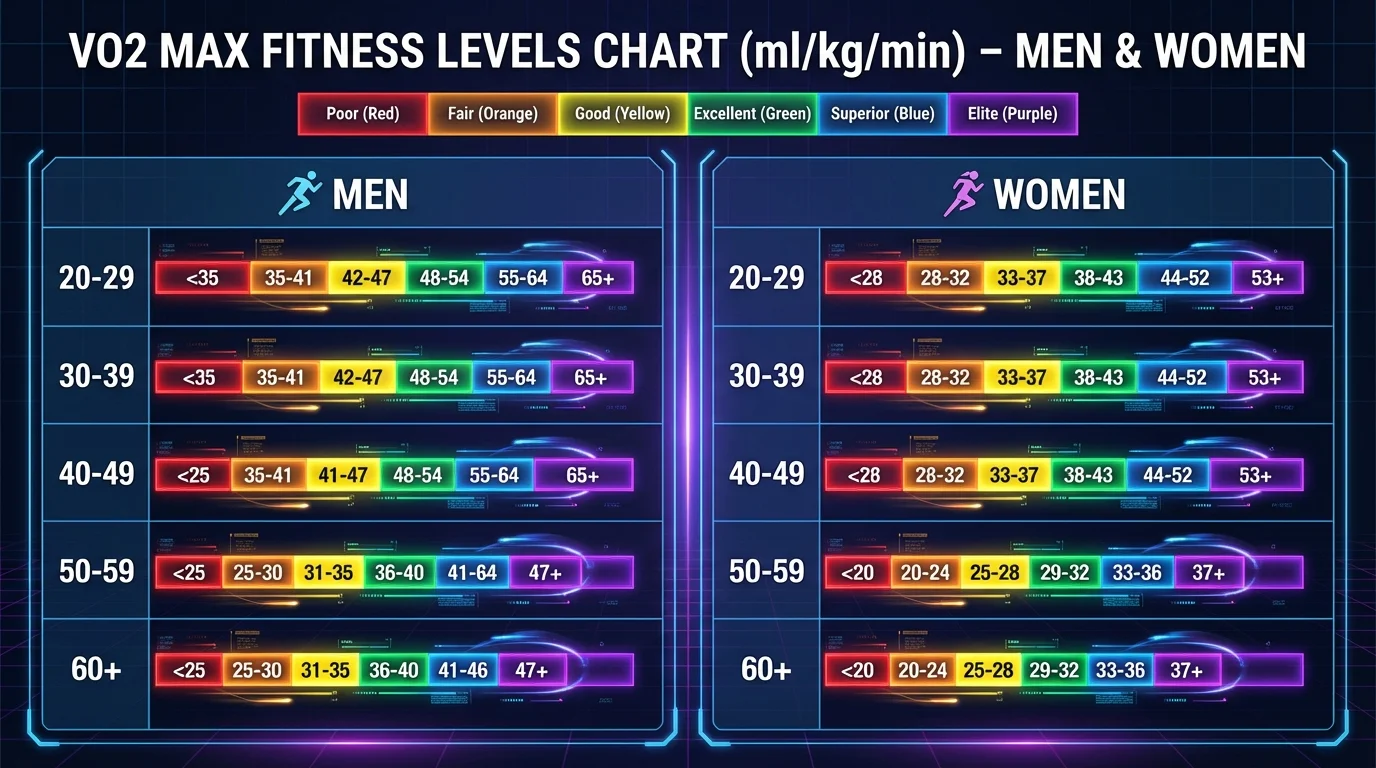
VO2 Max scores vary significantly by age, gender, and training status. Here are general benchmarks for adult runners:
Men's VO2 Max Standards
- Below 30: Poor fitness level
- 30-40: Fair fitness (typical recreational jogger)
- 40-50: Good fitness (trained runner)
- 50-60: Excellent fitness (competitive runner)
- Above 60: Elite/Superior (regional/national class athlete)
Women's VO2 Max Standards
- Below 25: Poor fitness level
- 25-35: Fair fitness (typical recreational jogger)
- 35-45: Good fitness (trained runner)
- 45-55: Excellent fitness (competitive runner)
- Above 55: Elite/Superior (regional/national class athlete)
How to Improve Your VO2 Max
VO2 Max can be significantly improved through specific training methods:
- High-Intensity Interval Training (HIIT): The most effective method. Run 3-5 minute intervals at 90-95% of maximum effort, with equal rest periods. Perform 2-3 sessions per week.
- Tempo Runs: Sustained efforts at "comfortably hard" pace (80-85% effort) for 20-40 minutes improve lactate threshold and aerobic efficiency.
- Long Slow Distance (LSD): Easy-paced runs build aerobic base and increase capillary density, supporting overall cardiovascular adaptation.
- Consistency: VO2 Max improvements require 8-12 weeks of dedicated training. Beginners may see gains of 15-20% in their first year.
VDOT vs. True VO2 Max
This calculator provides a VDOT score, which is Jack Daniels' running-specific interpretation of VO2 Max. VDOT accounts for running economy—how efficiently you use oxygen at a given pace. While closely related to lab-tested VO2 Max, VDOT is more practical for runners because it directly translates to training paces. Two runners with identical lab VO2 Max scores may have different VDOT values depending on their running efficiency.
Limitations and Accuracy
Race-based VO2 Max estimates are highly reliable when certain conditions are met:
- Use results from flat, measured courses in good weather conditions.
- Estimates are most accurate for races between 5K and Half Marathon distance.
- Heat, hills, wind, or poor pacing can lower your estimated score artificially.
- Lab testing (treadmill or bike with gas analyzer) remains the gold standard for precise measurement.
For comprehensive training planning, combine your VO2 Max estimate with other tools:
- Training Pace Calculator: Determine optimal paces for easy runs, tempo runs, and intervals based on your VDOT.
- Race Predictor Calculator: Forecast finish times for other race distances using your current fitness level.
Frequently Asked Questions
What is VO2 Max?
VO2 Max is the maximum amount of oxygen your body can utilize during intense exercise. It is measured in milliliters of oxygen used in one minute per kilogram of body weight (ml/kg/min).
How can I improve my VO2 Max?
High-intensity interval training (HIIT), such as 3-5 minute intervals at near-max effort, is the most effective way to boost VO2 Max. Consistent aerobic base building also helps over the long term.
What is a good VO2 Max score?
For men, a VO2 Max above 50 ml/kg/min is excellent, 40-50 is good, and below 30 indicates poor fitness. For women, above 45 is excellent, 35-45 is good. Elite endurance athletes can exceed 70-80 ml/kg/min.
How accurate is the estimated VO2 Max from race times?
Race-based estimates (VDOT) are reasonably accurate for trained runners and correlate well with lab testing. However, lab tests remain the gold standard. Factors like heat, hills, and pacing can affect the estimate.