Marathon Pace Calculator
Plan your perfect 26.2 mile race strategy
What is Marathon Pace?
Marathon pace is the average speed per mile (or kilometer) you need to maintain to achieve your target finish time. Running a marathon requires a precise pacing strategy because even small deviations in the early miles can compound into significant fatigue later. This calculator determines the exact pace you need to maintain to hit your goal time across all 26.2 miles (42.195 kilometers) of the race.
How to Calculate Marathon Pace
The formula is straightforward: divide your total goal time (in seconds) by the marathon distance. For miles: Pace = Total Seconds / 26.2188 miles. For kilometers: Pace = Total Seconds / 42.195 km.
If your goal is to finish in 4 hours:
4 hours × 3,600 = 14,400 seconds
14,400 ÷ 26.2188 = 549 seconds per mile
549 seconds = 9 minutes, 9 seconds
Your required pace is 9:09 per mile (or 5:41 per km).
Why Even Pacing Matters
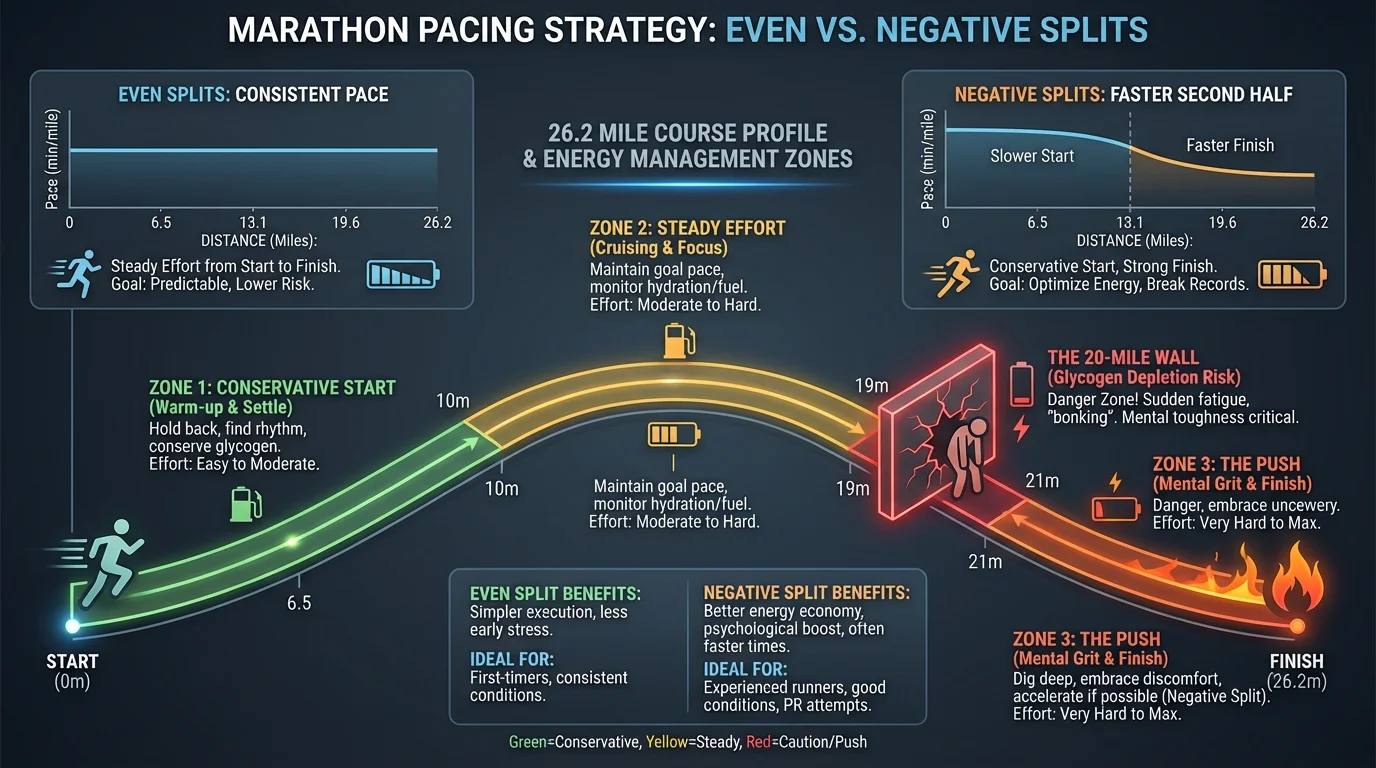
Physiologically, running an even pace (or slightly negative split) is the most efficient way to use your glycogen stores. Starting too fast burns carbohydrates at a higher rate, increasing the likelihood of "hitting the wall" around mile 20. Research consistently shows that elite marathoners rarely deviate more than 2-3% from their average pace throughout the race.
Common Marathon Time Goals
- Sub-4:00 Marathon: Requires 9:09 per mile pace. A popular goal for recreational runners.
- Sub-3:30 Marathon: Requires 8:00 per mile pace. Competitive amateur level.
- Sub-3:00 Marathon: Requires 6:52 per mile pace. Elite amateur/competitive level.
- Boston Qualifier: Varies by age and gender (typically 7:15-10:30 per mile).
Frequently Asked Questions
How accurate is this pace calculator?
It assumes an even pace strategy, which is generally the most efficient way to run a marathon. This approach minimizes energy waste and helps prevent hitting the wall.
Should I bank time in the first half?
Most coaches advise against "banking time" (running faster than goal pace early). It usually leads to a much slower second half due to glycogen depletion.
What is a good marathon time?
A good marathon time varies by age and experience. For recreational runners, finishing under 4 hours is a common goal. Competitive runners aim for sub-3 hours, while elite athletes break 2:10 (men) and 2:20 (women).
| Mi | Time | Km | Time |
|---|