Steps to Miles Calculator
Turn your daily step count into mileage
What is Steps to Miles Conversion?
Converting steps to miles helps you translate the data from your fitness tracker, pedometer, or smartphone into a distance metric that's easier to understand and compare. While modern devices count steps automatically, most runners, hikers, and athletes think in terms of miles or kilometers when tracking their fitness progress.
The conversion process uses your individual stride length - the distance covered with each step - to calculate the total distance traveled. This makes it possible to compare your daily walking activity to standard race distances like a 5K (3.1 miles) or understand how many steps it takes to reach popular fitness goals.
How to Calculate Steps to Miles
The formula for converting steps to miles requires two key pieces of information: your total step count and your stride length. The basic calculation is:
Miles = (Steps × Stride Length in inches) ÷ 63,360
The number 63,360 represents the total inches in one mile (12 inches per foot × 5,280 feet per mile).
If you walk 10,000 steps with an average stride length of 30 inches:
10,000 × 30 = 300,000 inches
300,000 ÷ 63,360 = 4.73 miles
You walked approximately 4.73 miles.
Why Stride Length Matters
The most critical factor in accurate steps-to-miles conversion is your stride length. Two people can walk the same number of steps and cover vastly different distances based on their height, leg length, and walking speed.
This calculator uses biomechanical formulas based on your height and gender to estimate your stride length. Research shows that:
- Walking Stride: Approximately 41-42% of your height for most adults
- Running Stride: Approximately 80-82% of your height, significantly longer than walking
- Gender Differences: Males typically have slightly longer strides (1-2%) than females of the same height
Walking vs. Running: Different Stride Lengths
Your stride length changes dramatically between walking and running. When you run, you spend more time in the air between steps, which allows you to cover more ground with each step. This is why 10,000 running steps covers significantly more distance than 10,000 walking steps.
For accurate tracking, always specify whether your steps came from walking or running when using this calculator.
Common Steps-to-Miles Benchmarks
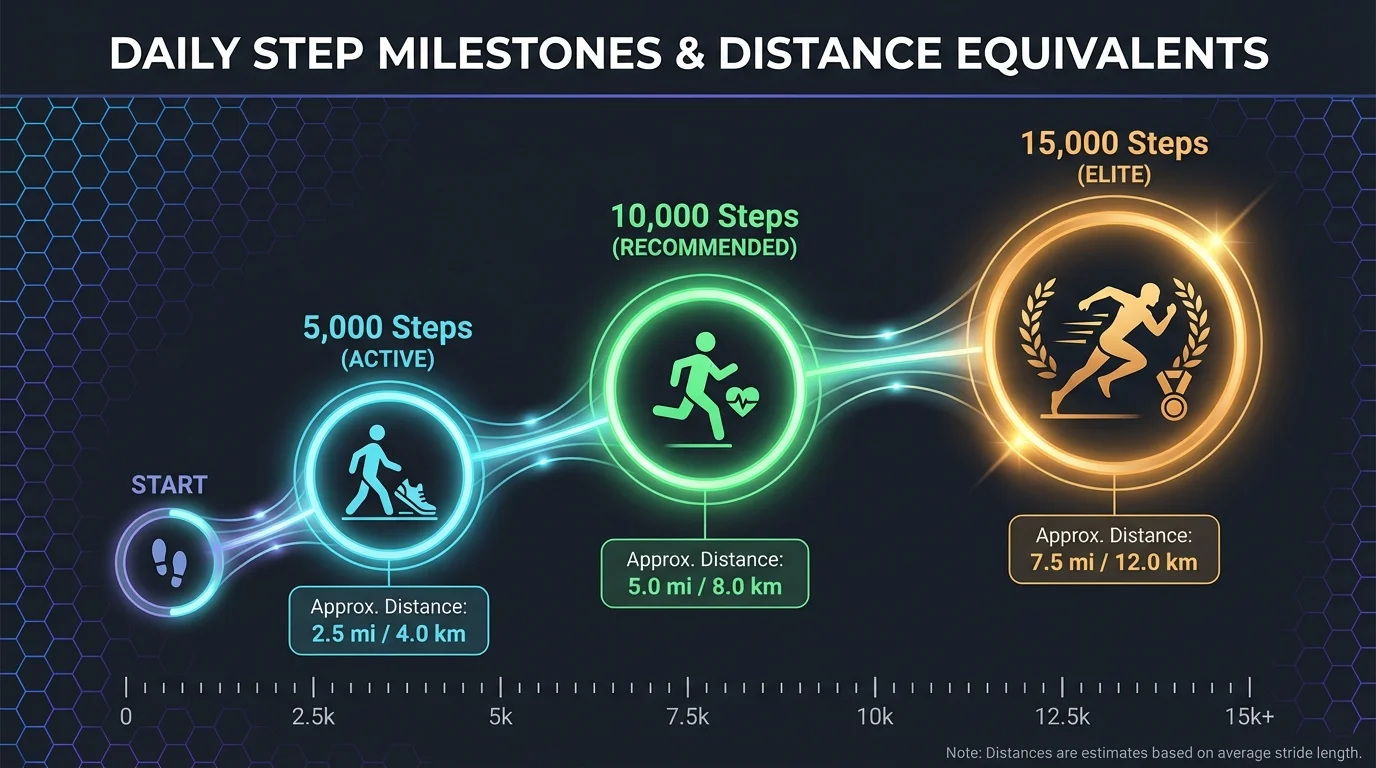
Understanding common step counts and their mile equivalents helps you set realistic fitness goals:
- 5,000 steps: Approximately 2-2.5 miles (basic daily activity)
- 10,000 steps: Approximately 4-5 miles (popular daily goal)
- 15,000 steps: Approximately 6-7.5 miles (active lifestyle)
- 20,000 steps: Approximately 8-10 miles (very active or athletic training)
The famous "10,000 steps per day" goal, popularized by Japanese pedometer marketing in the 1960s, translates to roughly 4-5 miles depending on your stride length.
Frequently Asked Questions
How many steps in a mile?
On average, there are about 2,000 to 2,500 walking steps in a mile. For running, it is usually between 1,400 and 1,700 steps per mile depending on stride length.
Does stride length matter?
Yes. A taller person covers more ground per step. This calculator uses your height to estimate a personalized stride length for better accuracy.
How accurate is this calculator?
This calculator uses standard biomechanical formulas based on height and gender to estimate stride length. While not as accurate as measuring your actual stride, it provides a reliable approximation for tracking daily activity.
Why does gender affect stride length?
On average, males tend to have slightly longer strides than females of the same height due to biomechanical differences. This calculator uses research-based factors to account for these differences.