Swim Time Converter
Updated:Convert swim times between SCY, SCM, and LCM pool types for accurate recruiting and qualifying comparisons.
What is Swim Time Conversion?
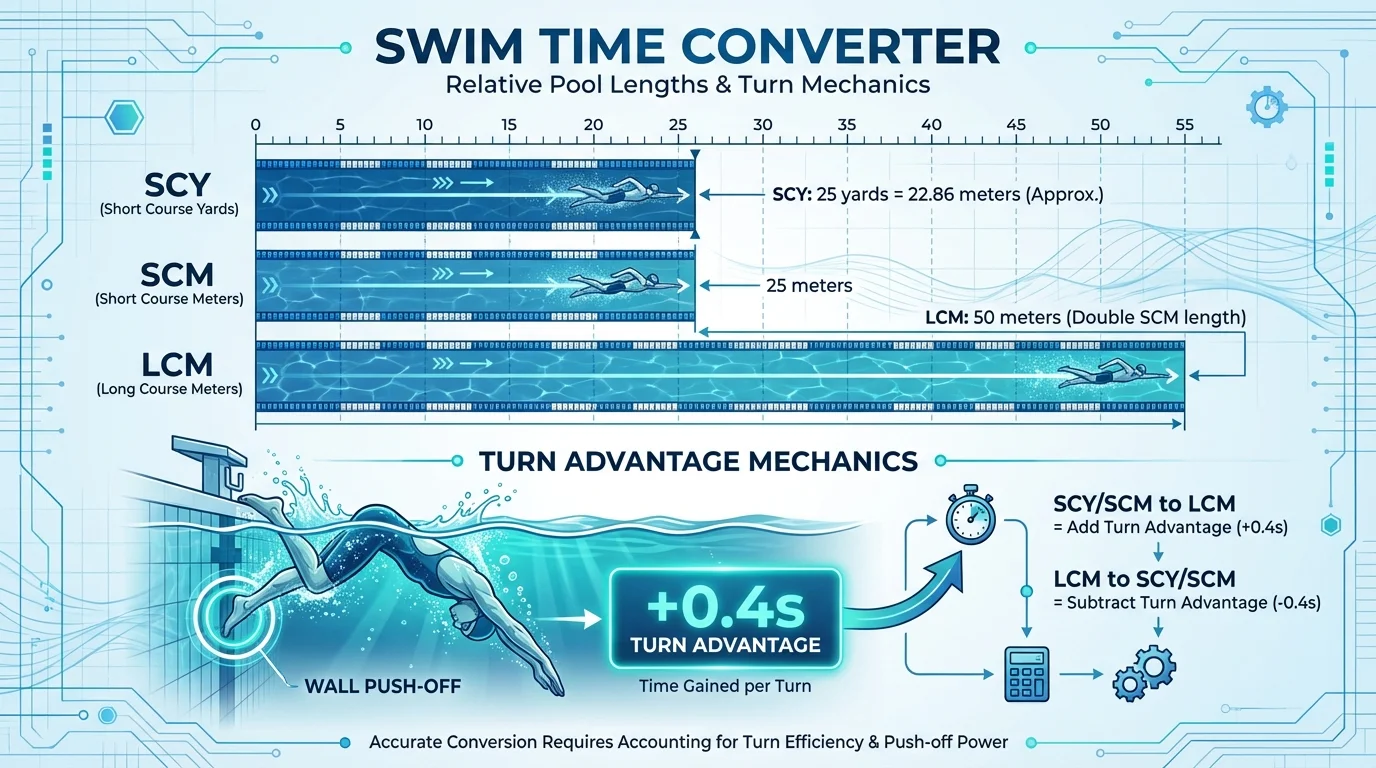
Swim time conversion is the process of estimating equivalent performance times across different pool types. The three standard pool configurations are Short Course Yards (SCY, 25 yards), Short Course Meters (SCM, 25 meters), and Long Course Meters (LCM, 50 meters). Pool length significantly impacts race times because each turn provides an opportunity for a powerful push-off and underwater dolphin kicking.
Converting times is essential for several reasons:
- College Recruiting: NCAA programs primarily compete in SCY, but international recruits often have times from SCM or LCM meets.
- Olympic Qualifying: International competitions use LCM, while many swimmers train primarily in short course pools.
- Training Benchmarks: Coaches need to set realistic goals when athletes train in different pool types throughout the season.
- Performance Tracking: Swimmers competing in different pool types can accurately track improvement over time.
Understanding Pool Types
Short Course Yards (SCY) - 25 Yards
Predominantly used in the United States for high school and NCAA competition. A 25-yard pool means more turns per race compared to metric pools. For example, a 500-yard freestyle has 19 turns, while a 400-meter freestyle (similar distance) has only 7 turns in LCM or 15 turns in SCM.
Short Course Meters (SCM) - 25 Meters
Common in international short course competitions and many club programs worldwide. The 25-meter pool is about 82 feet long, slightly longer than SCY but with the same advantage of frequent turns. World Championships alternate between LCM (even years) and SCM (odd years) formats.
Long Course Meters (LCM) - 50 Meters
The Olympic standard and the benchmark for international swimming. With half as many turns as short course meters, LCM times are typically 2-8% slower than equivalent SCM times, depending on distance and stroke. This is considered the "true" measure of swimming ability since it minimizes turn advantage.
How to Calculate Swim Time Conversions
The calculation of equivalent swim times involves applying a specific conversion factor based on the stroke and distance. These factors, established by USA Swimming, account for the difference in pool length and the number of turns.
Converted Time = Source Time × Conversion Factor
Step-by-Step Example: 100m Freestyle (SCM to SCY)
- Source Time: 1:00.00 (60.00 seconds)
- Conversion Factor (SCM to SCY): 0.890 (approximate factor for this event)
- Calculation: 60.00 × 0.890 = 53.40 seconds
- Converted Result: 53.40 (approximate SCY equivalent)
How Pool Length Affects Times
Elite swimmers can gain approximately 0.3 to 0.6 seconds per turn through explosive push-offs and efficient underwater streamlining. This advantage compounds significantly:
SCY (25y pool): 7 turns = potential 2.1-4.2 second advantage
SCM (25m pool): 7 turns = potential 2.1-4.2 second advantage
LCM (50m pool): 3 turns = potential 0.9-1.8 second advantage
Expected difference: SCY/SCM times are typically 1-3 seconds faster than LCM for this distance.
Conversion Factors by Stroke
Different strokes benefit unequally from turns due to varying underwater capabilities and stroke mechanics:
- Butterfly: Largest conversion factor. Strong underwater dolphin kick provides maximum turn advantage. Expect 3-5% difference between SCY and LCM.
- Backstroke: Similar to butterfly, backstroke benefits greatly from underwater kicking. Conversion factor: 3-5%.
- Freestyle: Moderate conversion factor of 2-4%. Turn advantage varies by swimmer's underwater skill.
- Breaststroke: Smallest conversion factor (1-3%) because rules limit underwater distance to one stroke and one kick per turn.
- Individual Medley (IM): Average of all strokes, typically 2.5-4% conversion.
USA Swimming Conversion Standards
USA Swimming provides standardized conversion factors used for qualifying times and national rankings. The calculator uses these official factors, which account for:
- Number of turns per race distance
- Average push-off and underwater advantage
- Stroke-specific variations in turn benefit
- Touch pad timing differences (minimal but measurable)
These factors are periodically updated based on statistical analysis of elite swimmer performances across pool types. While individual swimmers may vary slightly, the conversion factors provide reliable estimates for goal-setting and comparison purposes.
College Recruiting Context
When evaluating recruiting times, college coaches must often convert SCM or LCM times to SCY equivalents since NCAA competition is exclusively short course yards. A swimmer with a 1:50.0 LCM 200m freestyle might convert to approximately 1:43-1:45 SCY, which helps coaches assess fit for their program's standards.
Understanding these conversions helps prospective student-athletes set realistic goals and communicate their abilities accurately to coaches, regardless of which pool type they primarily train in.
Olympic Qualifying and International Competition
All Olympic Trials and Olympic Games are conducted in LCM pools. Swimmers who train primarily in short course facilities must account for the conversion when targeting Olympic qualifying times. For instance, the 2024 Olympic Trials qualifying time for women's 100m freestyle was 56.19 LCM, which converts to approximately 51-52 seconds SCY.
Many swimmers train short course during winter months for speed development, then transition to long course in spring and summer to prepare for Olympic qualifying meets. Understanding conversions helps athletes and coaches bridge these training phases effectively.
Frequently Asked Questions
What is the difference between SCY, SCM, and LCM?
SCY (Short Course Yards) is a 25-yard pool, SCM (Short Course Meters) is a 25-meter pool, and LCM (Long Course Meters) is a 50-meter pool. Pool length affects times due to the number of turns, with more turns typically resulting in faster times.
Why are times faster in short course pools?
Short course pools have more walls, which means more opportunities for push-offs and underwater kicking. Elite swimmers can gain 0.3-0.6 seconds per turn, making SCY and SCM times typically faster than LCM times for the same swimmer.
How accurate are these conversions?
Conversions are based on USA Swimming standard factors and are generally accurate within 1-2%. However, individual swimmers may vary based on their turn technique, underwater skills, and race strategy.
Do conversion factors differ by stroke?
Yes, different strokes benefit differently from turns. Butterfly and backstroke swimmers typically gain more from turns due to stronger underwater kicks, while breaststroke sees less benefit due to stroke restrictions.
Can I use this for college recruiting?
Yes, this converter helps you estimate equivalent times when colleges use different pool types for qualifying standards. Many NCAA programs compete in SCY but recruits may have times from SCM or LCM meets.
What pool type is used in the Olympics?
The Olympics and World Championships use LCM (Long Course Meters) 50-meter pools. This is considered the standard for international competition.