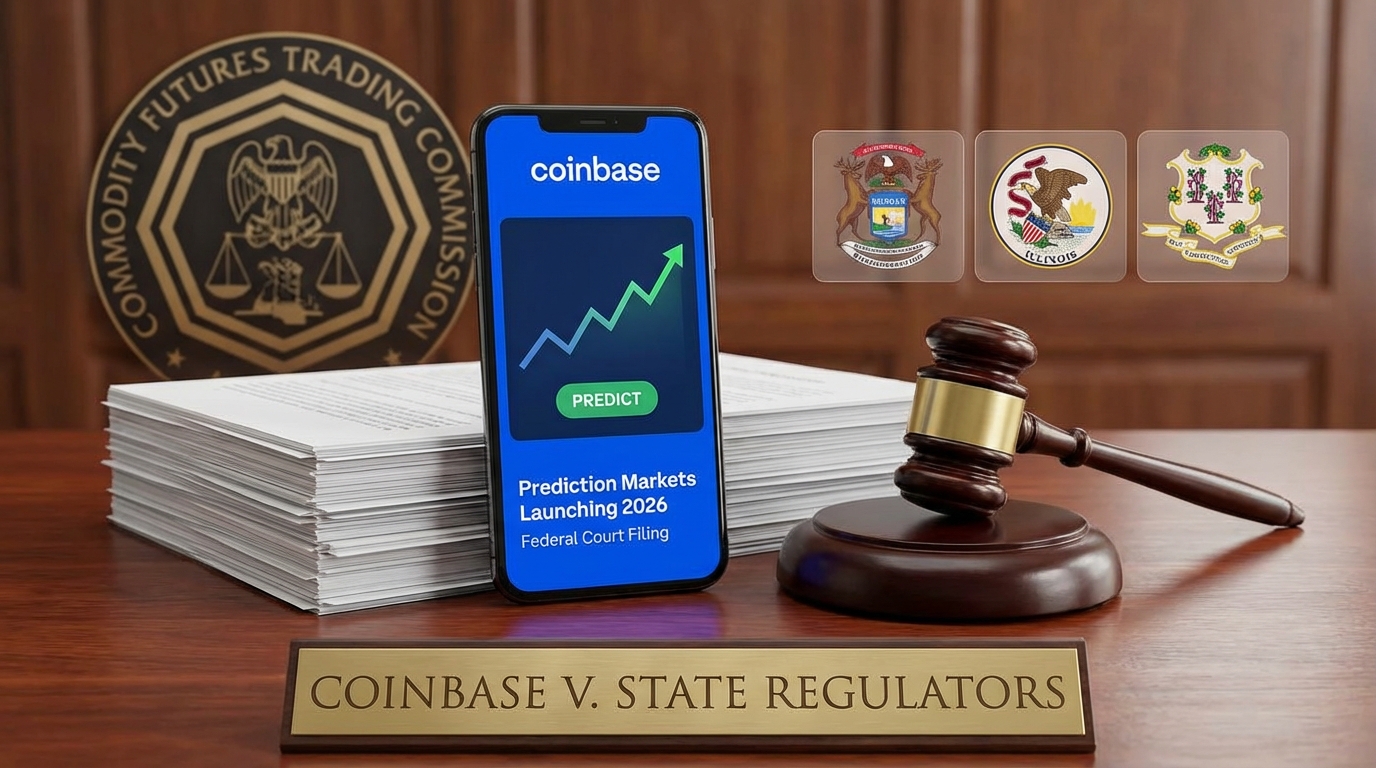
Coinbase Takes Prediction Markets Fight to Federal Court as January Launch Approaches
Coinbase sues three states, argues prediction markets are CFTC-regulated. January 2026 launch planned via Kalshi partnership.
Coinbase isn’t waiting for regulators to decide the fate of prediction markets in America. The crypto exchange giant has launched a preemptive legal strike against three states while simultaneously preparing to roll out prediction market trading to millions of users in January 2026.
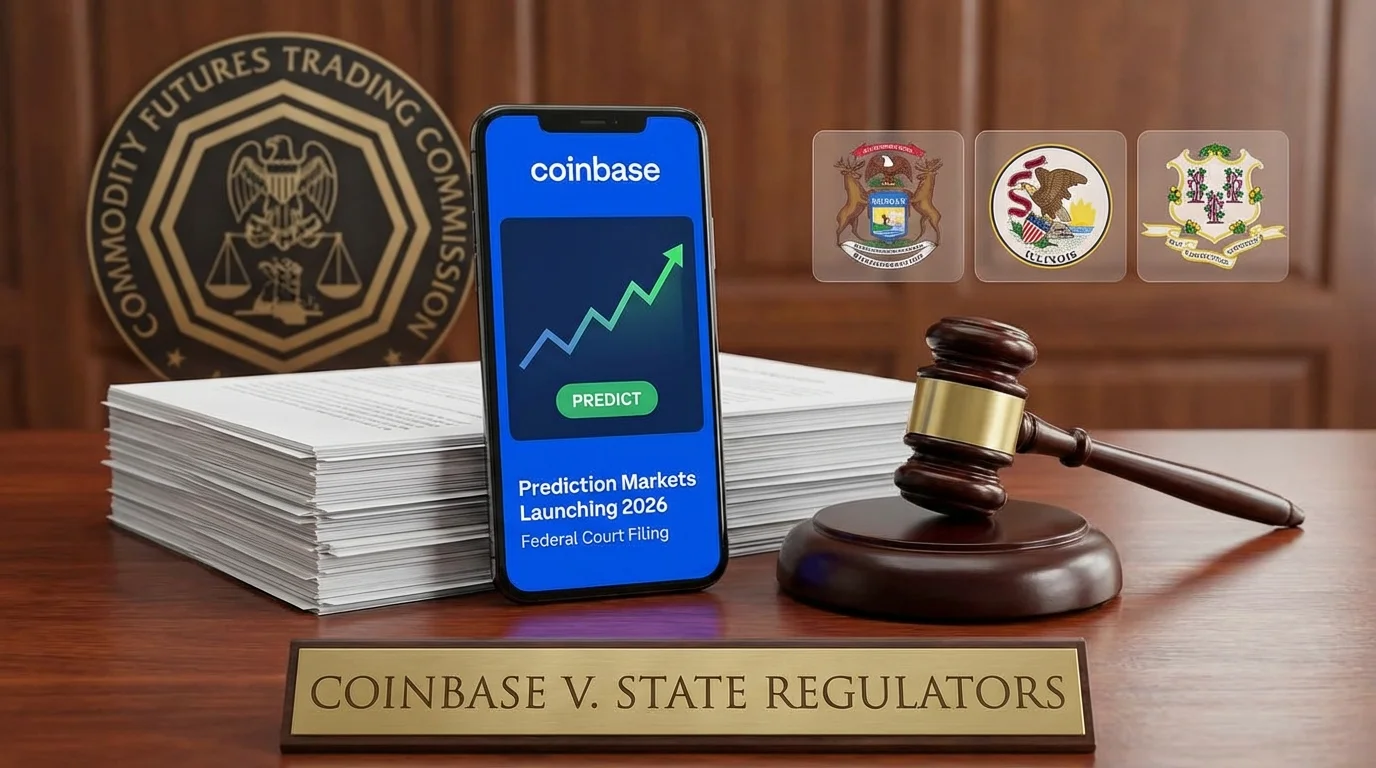
The company’s aggressive “sue first, launch second” strategy signals a pivotal moment for the prediction markets industry. With litigation now spanning 10 states and major players forming an unprecedented coalition, the battle over whether these platforms are financial instruments or gambling operations has reached a critical inflection point. This legal uncertainty mirrors the ongoing controversy surrounding crypto gambling platforms like Stake.us.
KEY FACTS AT A GLANCE
- What happened: Coinbase filed federal lawsuits against Michigan, Illinois, and Connecticut on December 19, 2025
- The argument: Prediction markets are CFTC-regulated commodities, not state-regulated gambling
- Launch timeline: Coinbase plans to offer prediction markets to U.S. customers in January 2026
- Partnership: Prediction markets powered by Kalshi, with contracts traded in the Coinbase app
- Industry coalition: Coinbase joined Kalshi, Robinhood, Crypto.com, and Underdog to form the Coalition for Prediction Markets
- Total states in litigation: 10 states now involved in prediction market legal battles
The Federal Preemption Argument
At the heart of Coinbase’s legal strategy is a constitutional showdown between federal and state authority. The company argues that Congress has already designated the Commodity Futures Trading Commission (CFTC) as the exclusive regulator for prediction markets through the Commodity Exchange Act.
The lawsuits, filed on December 19, 2025, target regulators in Michigan, Illinois, and Connecticut. Coinbase’s Chief Legal Officer Paul Grewal framed the litigation as a test of federal preemption, stating that “prediction markets fall squarely under the jurisdiction of the Commodity Futures Trading Commission, not any individual state gaming regulator.”
The exchange contends that prediction markets fundamentally differ from traditional gambling operations. Unlike casinos that set odds and profit from player losses, prediction market platforms match buyers and sellers without taking positions themselves. This distinction, Coinbase argues, places them firmly within the realm of financial derivatives rather than gambling—a classification that would exempt them from federal gambling tax regulations that apply to traditional betting.
THE LEGAL DIVIDE
Coinbase’s Position
- Prediction markets are financial derivatives
- CFTC has exclusive federal jurisdiction
- Commodity Exchange Act preempts state law
- Platforms match buyers/sellers, don’t set odds
- Supremacy Clause gives federal law priority
State Regulators’ Position
- Prediction markets function as gambling
- Sports contracts are unlicensed betting
- State gaming laws apply to wagering
- Platforms operate without required licenses
- Consumer protection concerns remain
The Kalshi Partnership and January Launch
Coinbase’s prediction markets offering will be powered by Kalshi, the largest CFTC-designated prediction market in the United States. Kalshi has been expanding its mainstream reach through media partnerships, and now gains access to Coinbase’s massive user base. The partnership, announced at Coinbase’s “System Upgrade” event on December 17, 2025, will allow users to trade event contracts within the main Coinbase app starting as early as January 2026.
Under this arrangement, Kalshi provides all prediction market contracts and liquidity, while Coinbase serves as a distribution platform. Users will be able to trade on outcomes ranging from elections and interest rate decisions to sports events and economic indicators—all with as little as $1 in USD or USDC.
“Coinbase is now the best place to trade every asset, not just crypto.”
— Brian Armstrong, CEO, Coinbase
The move is part of Armstrong’s broader vision to transform Coinbase into an “Everything Exchange”—a unified platform combining crypto, equities, prediction markets, and commodities. The company also announced traditional stock trading with 24-hour access five days a week and zero commissions at the same event.
A Timeline of Coinbase’s Prediction Markets Push
DEC 11: COALITION FORMED
Coinbase joins Kalshi, Robinhood, Crypto.com, and Underdog to form the Coalition for Prediction Markets (CPM)
DEC 17: SYSTEM UPGRADE
Brian Armstrong announces Kalshi partnership for prediction markets and stock trading at San Francisco event
DEC 19: LAWSUITS FILED
Coinbase sues Michigan, Illinois, and Connecticut regulators in federal court over prediction market jurisdiction
DEC 22: ACQUISITION
Coinbase announces acquisition of The Clearing Company, a prediction markets startup, closing in January 2026
The Acquisition of The Clearing Company
Coinbase’s commitment to prediction markets deepened further on December 22, 2025, when the company announced its acquisition of The Clearing Company. Coinbase isn’t the only major crypto exchange making moves—Gemini has also entered the prediction markets space. The Clearing Company startup, founded by Toni Gemayel—a former head of growth at both Polymarket and Kalshi—had raised a $15 million seed round backed by Coinbase Ventures earlier in the year.
The deal brings nearly the entire 10-person team to Coinbase, adding specialized expertise in building event-based trading systems. The acquisition marks Coinbase’s tenth deal announced in 2025, following major transactions including the $2.9 billion acquisition of derivatives exchange Deribit and the $375 million purchase of investment platform Echo.
The Coalition for Prediction Markets
Coinbase’s legal strategy aligns with a broader industry effort to establish federal regulatory dominance over prediction markets. On December 11, 2025, the company joined Kalshi, Robinhood, Crypto.com, and Underdog to launch the Coalition for Prediction Markets (CPM).
The coalition’s early priorities include reinforcing the federal framework governing prediction markets, establishing nationwide integrity standards to prevent insider trading, and defending against state-level regulatory actions.
“At Coinbase, our mission is to deliver financial freedom to the world – and prediction markets by nature democratize fact finding and the seeking of truth.”
— Faryar Shirzad, Chief Policy Officer, Coinbase
The formation comes as state-federal tensions reach a boiling point. Nearly half of Americans under 45 have already used an online financial or prediction market, according to industry data, making the regulatory outcome increasingly consequential for mainstream adoption.
The Broader Regulatory Landscape
Coinbase’s lawsuits bring the total number of states involved in prediction market litigation to 10. Beyond Michigan, Illinois, and Connecticut, legal battles are ongoing in Maryland, New Jersey, Ohio, Nevada, Massachusetts, New York, and other jurisdictions.
The regulatory landscape remains fractured. A federal judge in Connecticut temporarily blocked state enforcement against Kalshi on December 10, 2025, ordering regulators to halt action pending a preliminary injunction decision scheduled for February 12, 2026. However, Kalshi recently lost its preliminary injunction protection in Nevada, demonstrating the uncertain legal terrain.
| State | Status | Key Development |
|---|---|---|
| Connecticut | Enforcement Paused | Federal judge blocked enforcement; Feb 2026 hearing set |
| Michigan | Coinbase Lawsuit Filed | Federal preemption challenge pending |
| Illinois | Coinbase Lawsuit Filed | Federal preemption challenge pending |
| Massachusetts | AG Lawsuit Active | Filed December 9 against Kalshi |
| Nevada | Injunction Lost | Kalshi lost preliminary injunction protection |
What This Means for Crypto Prediction Platforms
Coinbase’s entry into prediction markets carries significant implications for the broader ecosystem, including crypto-native platforms like Polymarket, which recently gained CFTC approval for U.S. re-entry. The company’s aggressive legal strategy could establish precedents that benefit all federally-regulated prediction market operators.
If Coinbase prevails in its federal preemption argument, it would effectively clear a nationwide path for prediction market access, removing the patchwork of state gaming regulations that currently threatens to fragment the industry. Conversely, if state regulators win, platforms would face complex licensing requirements across jurisdictions—potentially limiting prediction markets to a handful of states. The crypto gambling industry is already facing similar multi-state legal challenges, as seen in the recent federal lawsuits targeting Drake and Adin Ross over Stake.us.
Coinbase’s distribution power adds another dimension. With millions of existing users and seamless integration into its main trading app, the company could dramatically accelerate mainstream adoption of prediction markets. The minimum $1 entry point removes barriers that have historically limited participation to more sophisticated traders.
The February 2026 Showdown
The most significant near-term event will be the February 12, 2026 preliminary injunction hearing in Connecticut. Under the court’s briefing schedule, Connecticut must file its response to Kalshi’s motion by January 9, 2026, with Kalshi’s reply due January 30, 2026.
The outcome could set the tone for prediction market regulation nationwide. A ruling favoring federal preemption would strengthen Coinbase’s position across its three lawsuits and potentially discourage other states from pursuing enforcement actions. A ruling favoring state authority could embolden regulators in the remaining states to take more aggressive action.
UPCOMING COURT DATES
- January 9, 2026: Connecticut files response to Kalshi’s preliminary injunction motion
- January 30, 2026: Kalshi files reply brief
- February 12, 2026: Oral arguments on preliminary injunction in Connecticut
Armstrong’s Vision for the “Everything Exchange”
Coinbase CEO Brian Armstrong has positioned prediction markets as part of a broader thesis that crypto technology will eventually upgrade all financial services. “Crypto is updating all financial services,” he stated at the System Upgrade event, suggesting every major asset class—from equities to commodities to real estate—will eventually move on-chain.
The prediction markets push intensifies Coinbase’s rivalry with fintech competitors like Robinhood, which has also partnered with Kalshi for prediction market distribution. Both platforms are now racing to capture the growing demand for event-based trading among younger users.
With total trading volumes exceeding $28 billion globally in 2025 and weekly peaks reaching $2 billion, the stakes for regulatory clarity have never been higher. Coinbase’s willingness to litigate before launching signals confidence in its federal preemption argument—and a determination to shape the regulatory landscape rather than wait for it to be defined by state-level enforcement actions.
KEY TAKEAWAYS
- Preemptive legal strategy — Coinbase filed lawsuits in three states before launching, arguing CFTC jurisdiction preempts state gambling laws
- January 2026 launch — Users will be able to trade Kalshi-powered prediction markets in the Coinbase app with as little as $1
- Industry coalition formed — Coinbase joined Kalshi, Robinhood, Crypto.com, and Underdog to advocate for federal regulatory framework
- 10 states now in litigation — The prediction markets regulatory battle has expanded significantly, with critical Connecticut hearing in February 2026
- Strategic acquisition — The Clearing Company deal adds prediction markets expertise from former Polymarket and Kalshi executives
- Massive distribution potential — Coinbase’s entry could accelerate mainstream adoption of prediction markets significantly
Sources
- Kalshi Prediction Markets Announcement — Coinbase Blog
- The Clearing Company Acquisition — Coinbase Blog
- Coalition for Prediction Markets Launch — Kalshi News

Aevan Lark
Aevan Lark is a gambling industry veteran with over 7 years of experience working behind the scenes at leading crypto casinos — from VIP management to risk analysis and customer operations. His insider perspective spans online gambling, sports betting, provably fair gaming, and prediction markets. On Dyutam, Aevan creates in-depth guides, builds verification tools, and delivers honest, data-driven reviews to help players understand the odds, verify fairness, and gamble responsibly.
Related coverage

A $10 Parlay Skips FanDuel’s Illinois Fee. A $10 Straight Bet Doesn’t.
FanDuel’s 50¢ Illinois fee favors qualifying parlays over equal-sized singles, with a steep cost for small stakes.

What Does a DraftKings Gambling Warning Actually Change?
Safety Prompt, Then Promotion: Inside ProPublica’s DraftKings Test

Yasin Kol Arrested: Match-Fixing Allegations and a Disputed Money Trail
The Süper Lig referee denies wrongdoing as reported bank totals raise questions about the evidence behind the match-fixing allegations.