When to Double Down in Blackjack: The Complete Strategy Guide
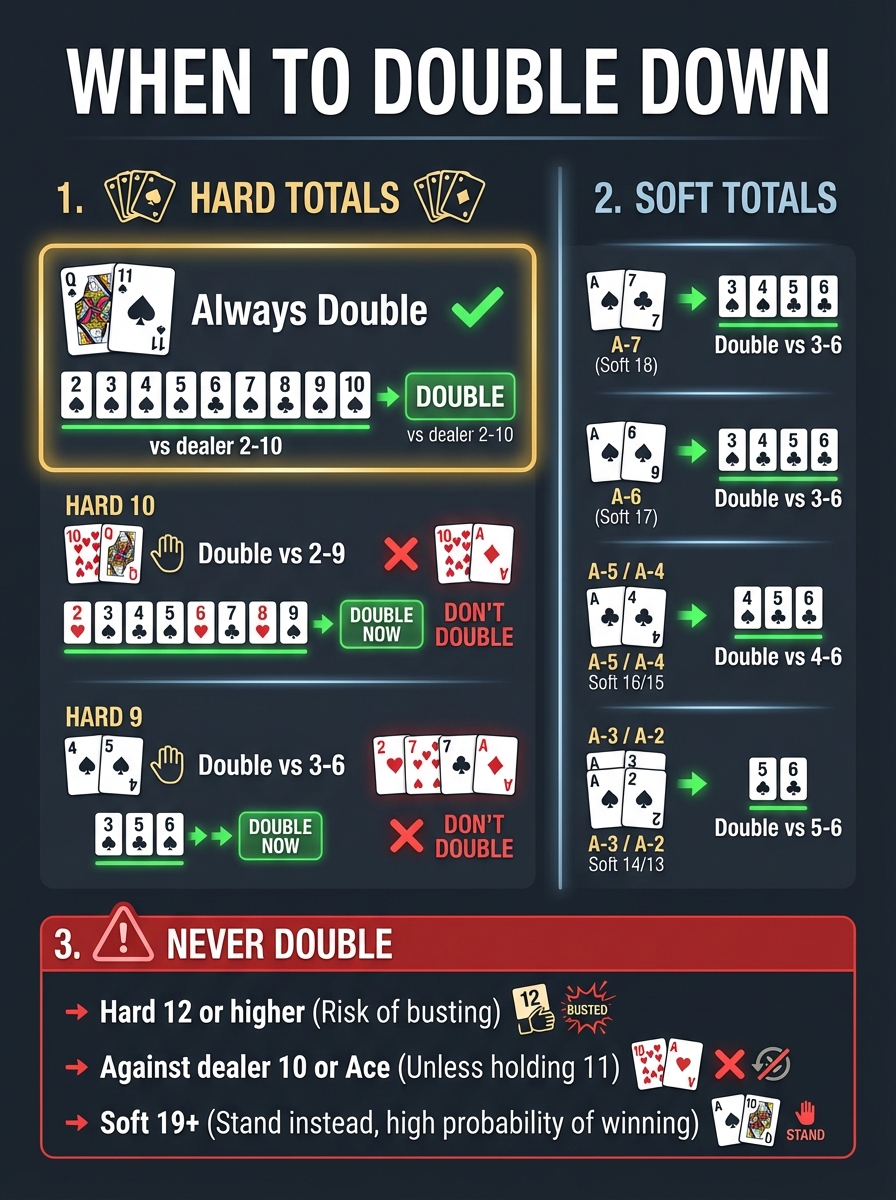
Double on hard 11 vs dealer 2-10, hard 10 vs 2-9, hard 9 vs 3-6. Soft hands double against dealer bust cards. Correct doubling cuts house edge by 1.6%.
Doubling down is the single most profitable move in blackjack—when you use it correctly. It’s also one of the fastest ways to hemorrhage chips if you don’t. The difference between a skilled player and a recreational one often comes down to knowing exactly when to push that extra bet forward and when to keep your hands off the chips. This guide breaks down every optimal doubling situation backed by basic strategy mathematics.
Key Highlights
- Always double on hard 11 against dealer 2-10 (hit against Ace in most games)
- Double on hard 10 against dealer 2-9 only
- Double on hard 9 against dealer 3-6 (the weakest dealer upcards)
- Soft hands (Ace + card) have specific doubling windows—A-7 and A-6 double against dealer 3-6
- Never double on hard 12+ or when the dealer shows strong cards (9, 10, Ace)
- Correct doubling reduces house edge by approximately 1.6% compared to never doubling
What Is Doubling Down?
Doubling down means placing an additional bet equal to your original wager after seeing your first two cards—but you only receive one more card. No hitting again. No changing your mind. You’re locked into whatever that third card gives you.
This restriction is precisely why doubling requires favorable conditions. You’re betting twice as much while limiting yourself to exactly one additional card. When the math works in your favor, doubling is the most +EV (positive expected value) play available. When it doesn’t, you’re just lighting money on fire.
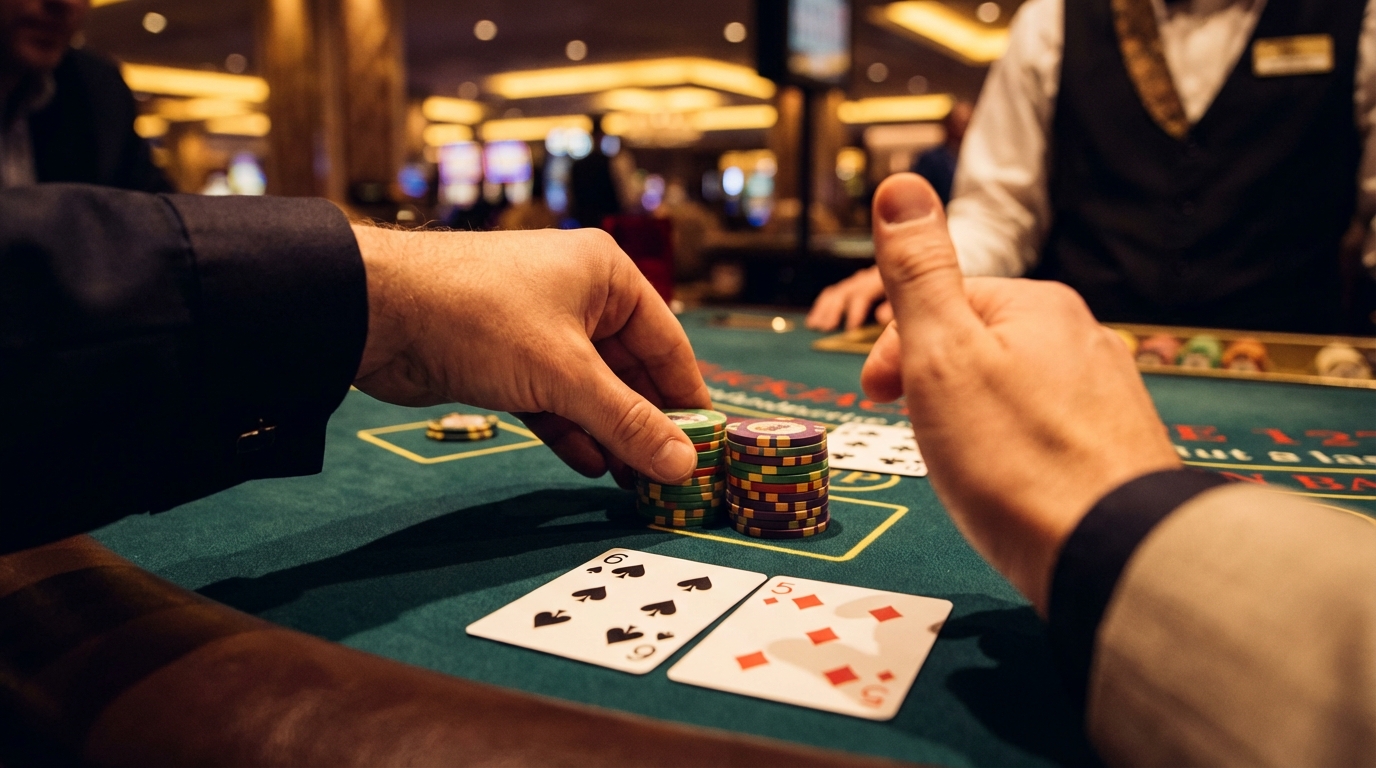
To signal a double at a physical casino, place a stack of chips equal to (or less than) your original bet next to your cards and hold up one finger. The dealer will slide you exactly one card, typically face-down, which you’ll reveal after all hands are played.
The Mathematics: Why Doubling Works
Doubling down is profitable because of two converging factors:
- Your hand has a high probability of improving to a winning total with one card
- The dealer’s upcard suggests they’re likely to bust or finish with a weak total
Consider holding 11 against a dealer’s 6. Drawing any 10-value card (10, J, Q, K—representing roughly 30.8% of the deck) gives you 21. Drawing a 9 gives you 20. Drawing an 8 gives you 19. Meanwhile, the dealer’s 6 is the weakest possible upcard—they’ll bust approximately 42% of the time.
The expected value of doubling on 11 versus dealer 6 exceeds the EV of simply hitting by about 18% of your original bet. That’s not a marginal gain—that’s a massive edge you’re leaving on the table if you don’t double.
Hard Total Doubling Strategy
Hard hands contain no Ace counted as 11, or an Ace that must count as 1 to avoid busting. These are your most straightforward doubling decisions.
Hard 11: The Golden Hand
Hard 11 is blackjack’s best doubling opportunity. You can’t bust, any 10-value card gives you 21, and even mediocre draws leave you competitive.
The Rule: Double on 11 against dealer 2-10. Against a dealer Ace, the correct play depends on the game rules—double if the dealer checks for blackjack first (hole card games), hit if they don’t (European no-hole-card rules).
This is one of the few situations where you double against strong dealer cards like 9 and 10. Your 11 is simply that powerful—the probability of drawing to 19, 20, or 21 is high enough to justify the extra bet even when the dealer shows strength.
Hard 10: Strong but Selective
Hard 10 (7+3, 6+4, or any combination totaling 10 without an Ace) is nearly as good as 11—but you’re one pip further from the magic 21.
The Rule: Double on 10 against dealer 2-9. Against dealer 10 or Ace, just hit—the dealer’s strength negates your advantage.
The key difference from hard 11: when the dealer shows a 10 or Ace, your winning probability drops enough that the extra bet isn’t justified. You’ll still win some of these hands, but not often enough to warrant doubling your risk.
Hard 9: Only Against Weak Dealers
Hard 9 occupies a narrower doubling window. Drawing a 10 gives you 19—solid but not overwhelming. You need the dealer to be in trouble.
The Rule: Double on 9 against dealer 3-6 only. Against dealer 2 or 7+, just hit.
Dealer upcards 3-6 are the “bust cards”—they lead to dealer busts more often than any other upcards. The 5 and 6 are particularly weak, with bust rates approaching 42-43%. This is when your marginal hand becomes worth an aggressive double.
Hard 8 and Below: Never Double
Basic strategy never recommends doubling on hard 8 or lower. Even against the worst dealer upcards, your hand simply isn’t strong enough to justify restricting yourself to one card with double the money at risk.
Hard Total Quick Reference
| Your Hand | Dealer 2 | Dealer 3 | Dealer 4 | Dealer 5 | Dealer 6 | Dealer 7 | Dealer 8 | Dealer 9 | Dealer 10 | Dealer A |
|---|---|---|---|---|---|---|---|---|---|---|
| Hard 11 | D | D | D | D | D | D | D | D | D | H* |
| Hard 10 | D | D | D | D | D | D | D | D | H | H |
| Hard 9 | H | D | D | D | D | H | H | H | H | H |
| Hard 8 or less | H | H | H | H | H | H | H | H | H | H |
D = Double | H = Hit | *Double in hole-card games, Hit in no-hole-card games
Soft Hand Doubling Strategy
Soft hands contain an Ace counted as 11. They’re uniquely valuable because you can’t bust with a single hit—the Ace simply converts to 1 if necessary. This flexibility creates doubling opportunities that many players overlook.
For a complete breakdown of when to hit or stand in blackjack, including soft hand play, see our dedicated strategy guide.
Soft 18 (Ace-7): The Tricky One
Soft 18 is one of blackjack’s most misplayed hands. Many players stand automatically because “18 is good enough.” It’s not always.
The Rule: Double on A-7 against dealer 3-6. Stand against dealer 2, 7, and 8. Hit against dealer 9, 10, and Ace.
Against dealer 3-6, you double because the dealer’s bust probability is high and you might improve your hand—drawing a 2 or 3 gives you 20 or 21. Against 9, 10, or Ace, you actually hit because 18 isn’t strong enough to beat those likely dealer totals, and you can’t bust.
Soft 17 (Ace-6): Always Take Action
Never stand on soft 17. The hand is too weak. You’ll either double or hit—never stand.
The Rule: Double on A-6 against dealer 3-6. Hit against everything else.
Soft 17 doubles in the same dealer range as soft 18 (3-6), but you never stand. Against strong dealer cards, you hit and hope to improve because 17 loses to any dealer hand of 18 or better.
Soft 16 and 15 (Ace-5, Ace-4)
These hands have a narrower doubling window because they need more improvement to compete.
The Rule: Double on A-5 and A-4 against dealer 4-6 only. Hit against everything else.
Notice the pattern: as your soft total decreases, the doubling window shrinks to only the weakest dealer upcards (4-6).
Soft 14 and 13 (Ace-3, Ace-2)
The lowest soft hands worth doubling, but only against the two worst dealer cards.
The Rule: Double on A-3 and A-2 against dealer 5-6 only. Hit against everything else.
Soft Hand Quick Reference
| Your Hand | Dealer 2 | Dealer 3 | Dealer 4 | Dealer 5 | Dealer 6 | Dealer 7 | Dealer 8 | Dealer 9 | Dealer 10 | Dealer A |
|---|---|---|---|---|---|---|---|---|---|---|
| A-7 (Soft 18) | S | D | D | D | D | S | S | H | H | H |
| A-6 (Soft 17) | H | D | D | D | D | H | H | H | H | H |
| A-5 (Soft 16) | H | H | D | D | D | H | H | H | H | H |
| A-4 (Soft 15) | H | H | D | D | D | H | H | H | H | H |
| A-3 (Soft 14) | H | H | H | D | D | H | H | H | H | H |
| A-2 (Soft 13) | H | H | H | D | D | H | H | H | H | H |
D = Double | H = Hit | S = Stand
When NOT to Double Down
Knowing when to pull back is just as important as knowing when to attack. Here are situations where doubling is a mistake:
Never Double on Hard 12 or Higher
Any hard total of 12+ risks busting with a single card. Drawing a 10 to a hard 12 gives you 22. Doubling when you might bust with one card defeats the entire purpose—you’re paying double to potentially lose immediately.
Never Double When the Dealer Shows an Ace
The dealer’s Ace is the strongest upcard. They’ll make a hand of 17+ approximately 83% of the time. Even with strong holdings like 10 or soft 18, the dealer’s advantage is too significant to warrant extra risk. The one exception: hard 11 in hole-card games where the dealer has already checked for blackjack.
Don’t Double When You Can’t Afford the Loss
Basic strategy assumes you’re maximizing long-term expected value. But if doubling would put you in financial distress, discretion overrides mathematics. A correct play you can’t mentally or financially handle isn’t actually optimal for you.
Casino Rule Variations
Not all blackjack tables are created equal. Doubling rules vary significantly between casinos and can affect your strategic decisions.
Double on Any Two Cards (Best for Players)
The most favorable rule allows doubling on any initial two cards. This is standard in Atlantic City and most Las Vegas casinos. It gives you maximum flexibility to double on soft hands and hard 9.
Double on 9, 10, or 11 Only
Some casinos (particularly with Reno rules) restrict doubling to hard totals of 9, 10, and 11. This eliminates all soft-hand doubling opportunities, adding roughly 0.1% to the house edge.
Double on 10 or 11 Only
The most restrictive common rule eliminates hard 9 doubling as well. This adds approximately 0.18% to the house edge. European casinos often use this restriction.
Double After Split (DAS)
Some casinos allow doubling after splitting a pair; others don’t. When DAS is allowed, it expands your strategic options—for example, splitting 4-4 against a dealer 5 becomes correct because you might split into two hands of 14, then draw a 6 or 7 and double. Without DAS, you’d hit the 4-4 instead.
Important: Before sitting at any blackjack table, verify the doubling rules. They should be printed on the felt or displayed on a placard. If you can’t find them, ask the dealer.
Common Doubling Mistakes
Even experienced players make these errors. Avoiding them will save you significant money over your blackjack career.
- Doubling on 11 against a dealer Ace without checking rules — In no-hole-card games, the dealer might have blackjack after you’ve doubled your bet
- Never doubling on soft hands — Many players treat soft hands like hard hands and miss profitable doubling opportunities
- Standing on soft 18 against dealer 9, 10, or Ace — You should be hitting these, and doubling against 3-6. Standing is only correct against 2, 7, and 8
- Doubling on “gut feeling” against strong dealer upcards — Strategy exists because intuition is unreliable. Stick to the charts
- Not doubling for the full amount — When doubling is correct, you want maximum money on the table. Doubling for less is leaving value behind
Doubling After Splitting
When casinos allow it, doubling after splitting pairs creates additional strategic value. For a comprehensive overview of blackjack rules and strategy, including pair splitting, see our beginner’s guide.
The most common scenario: you split a pair of 5s (never do this—double instead), or you split 4s against a 5 or 6. After splitting, if you receive a card that gives you 10 or 11, you can double again—essentially tripling or quadrupling your original bet across multiple hands.
When DAS is available, you should split more aggressively in borderline situations because the ability to double afterward increases the expected value of the split.
The Bottom Line
Doubling down correctly is one of the few ways players can swing the mathematical odds in their favor during specific hands. When you double in the right situations, you’re exploiting moments where your expected return exceeds 100% of your additional bet. Miss those opportunities, and you’re voluntarily accepting a higher house edge than necessary.
The core rules are straightforward: always double on 11 against dealer 2-10, double on 10 against 2-9, and double on 9 against 3-6. For soft hands, the doubling window shrinks as your total decreases, but the principle remains—capitalize when the dealer shows bust cards (3-6). Master these situations, avoid the common mistakes, and your bankroll will thank you over thousands of hands.
FAQs
Should I always double down on 11 in blackjack?
Double on 11 against dealer upcards 2-10 in standard games. Against a dealer Ace, it depends on the rules: double in hole-card games (where the dealer checks for blackjack first), but hit in no-hole-card games where the dealer might still have blackjack.
When should I double down on a soft 17?
Double on soft 17 (Ace-6) when the dealer shows 3, 4, 5, or 6—the bust cards. Against all other dealer upcards (2, 7, 8, 9, 10, Ace), you should hit. Never stand on soft 17.
Can I double down after hitting in blackjack?
No. In virtually all casino blackjack games, you can only double down on your original two cards. Once you’ve taken a hit, the doubling option disappears. This rule exists because allowing doubles after hitting would give players too much advantage.
What is the best hand to double down on in blackjack?
Hard 11 against a dealer 6 is the single best doubling situation. You’ll draw to 17+ about 63% of the time, while the dealer busts approximately 42% of the time. The expected value of doubling exceeds hitting by roughly 18% of your original bet.
Should I double down on 10 against a dealer 10?
No. When the dealer shows a 10-value card, basic strategy says to hit on hard 10, not double. The dealer’s strong position (they’ll make 17+ about 77% of the time) negates your advantage enough that the extra bet isn’t justified.
Can I double down for less than my original bet?
Most casinos allow doubling for any amount up to your original bet. However, doubling for less is mathematically suboptimal. When the situation calls for doubling, you have positive expected value—put maximum money on the table to maximize returns.
What does double after split mean in blackjack?
Double After Split (DAS) means you can double down on hands created after splitting a pair. For example, if you split 8-8 and receive a 3 on one hand (giving you 11), you can double that hand. Not all casinos offer DAS—check the table rules before playing.
How much does correct doubling reduce the house edge?
Correct doubling strategy reduces the house edge by approximately 1.6% compared to never doubling. Combined with other basic strategy decisions, proper doubling helps bring the house edge down to around 0.5% or lower under favorable rules.

Aevan Lark
Aevan Lark is a gambling industry veteran with over 7 years of experience working behind the scenes at leading crypto casinos — from VIP management to risk analysis and customer operations. His insider perspective spans online gambling, sports betting, provably fair gaming, and prediction markets. On Dyutam, Aevan creates in-depth guides, builds verification tools, and delivers honest, data-driven reviews to help players understand the odds, verify fairness, and gamble responsibly.
Related coverage
Shuffle’s $235M Revenue and SHFL’s Price Rally: How Much Value Reaches the Token, and What Is It Worth?
Shuffle’s revenue is substantial. We examine how lottery staking, burns and supply releases translate into SHFL token value.

Indian State Tamil Nadu’s 2023 Gambling Bill: Passed Twice, Governor Dispute Details
Why the Indian state of Tamil Nadu passed its gambling bill twice in 2023, and how the Governor dispute unfolded.

Crypto Casino Bonuses vs Traditional: The 25x Rule
Crypto vs traditional casino bonuses: the 25x break-even rule, rakeback's $10,000 gate, and the volatility that moves a bonus's value.