
Brazil’s Biometric Fortress: 30-Minute Facial Scans, 18,000 Blocked Sites, and a Black Market That Won’t Die
Brazil built the world's most surveillance-heavy gambling system. Facial recognition every 30 minutes. 18,000 blocked sites. The black market still thrives.
Brazil has constructed the most friction-heavy, identity-intensive gambling regulatory framework in the world—mandatory facial recognition every 30 minutes, geolocation checks at the same interval, CPF verification, and crypto banned entirely. After one year and 18,000+ blocked sites, the black market still controls 30-50% of volume, and 45% of banned welfare recipients say they’ll simply switch to illegal platforms.

KEY FACTS AT A GLANCE
- Facial recognition timeout: Every 30 minutes of inactivity
- Geolocation re-verification: Every 30 minutes during sessions
- License fee: BRL 30M (~$6M USD) for 5 years
- Licensed operators (Jan 2026): 79
- Illegal sites blocked (since Oct 2024): 18,000+
- Black market share: 30-50% (estimates vary)
- Lost annual tax revenue: R$10.8B (~$2B USD)
- Welfare recipients planning to use black market: 45%
The 30-Minute Surveillance State
No other country on Earth requires facial re-authentication after 30 minutes of inactivity. Brazil does. Under Ordinance No. 1231, every bettor must register their facial biometrics upon account creation. This isn’t a one-time verification—the system demands re-authentication every 30 minutes of inactivity to continue accessing the platform.
The surveillance doesn’t stop there. Ordinance No. 722 mandates geolocation checks every 30 minutes during active sessions, IP address logging at the same interval, and five-year data retention requirements. Operators must implement anti-spoofing technology to detect and block VPNs, proxies, remote desktop software, and rootkits.
This creates the most friction-heavy regulated gambling environment globally. Here’s how Brazil compares to other jurisdictions:
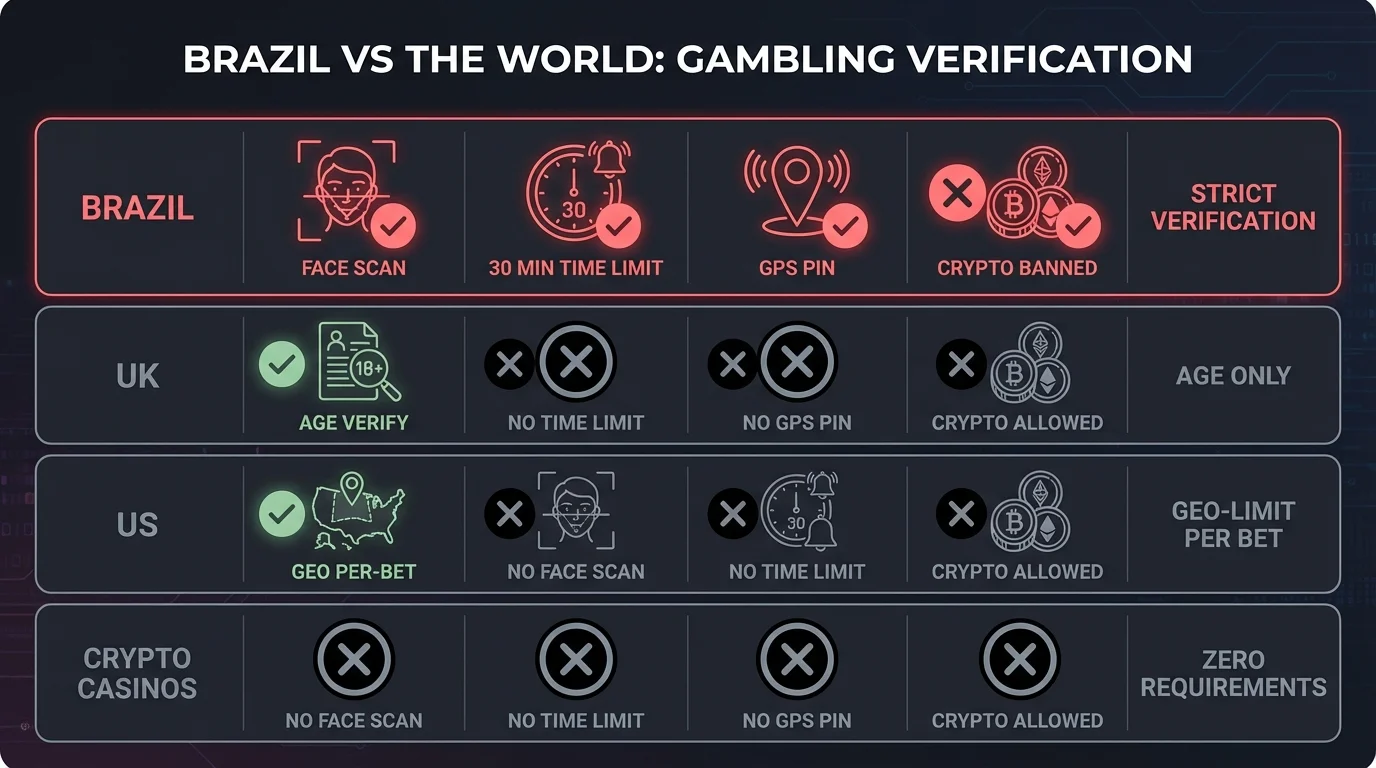
| Requirement | Brazil | UK | US States | Crypto Casinos |
|---|---|---|---|---|
| Facial recognition at login | Yes | No | No | No |
| 30-min re-authentication | Yes | No | No | No |
| 30-min geolocation check | Yes | No | Per-bet only | No |
| Crypto payments | Banned | Allowed | Varies | Only option |
| KYC at signup | Full biometric | Age verify | Varies | Often zero |
The justification is responsible gambling and fraud prevention. The reality is that this creates an arbitrage opportunity: offshore platforms offer the same products without the friction, the facial scans, or the mandatory bank account requirements.
The Prohibition Paradox: Welfare Ban Edition
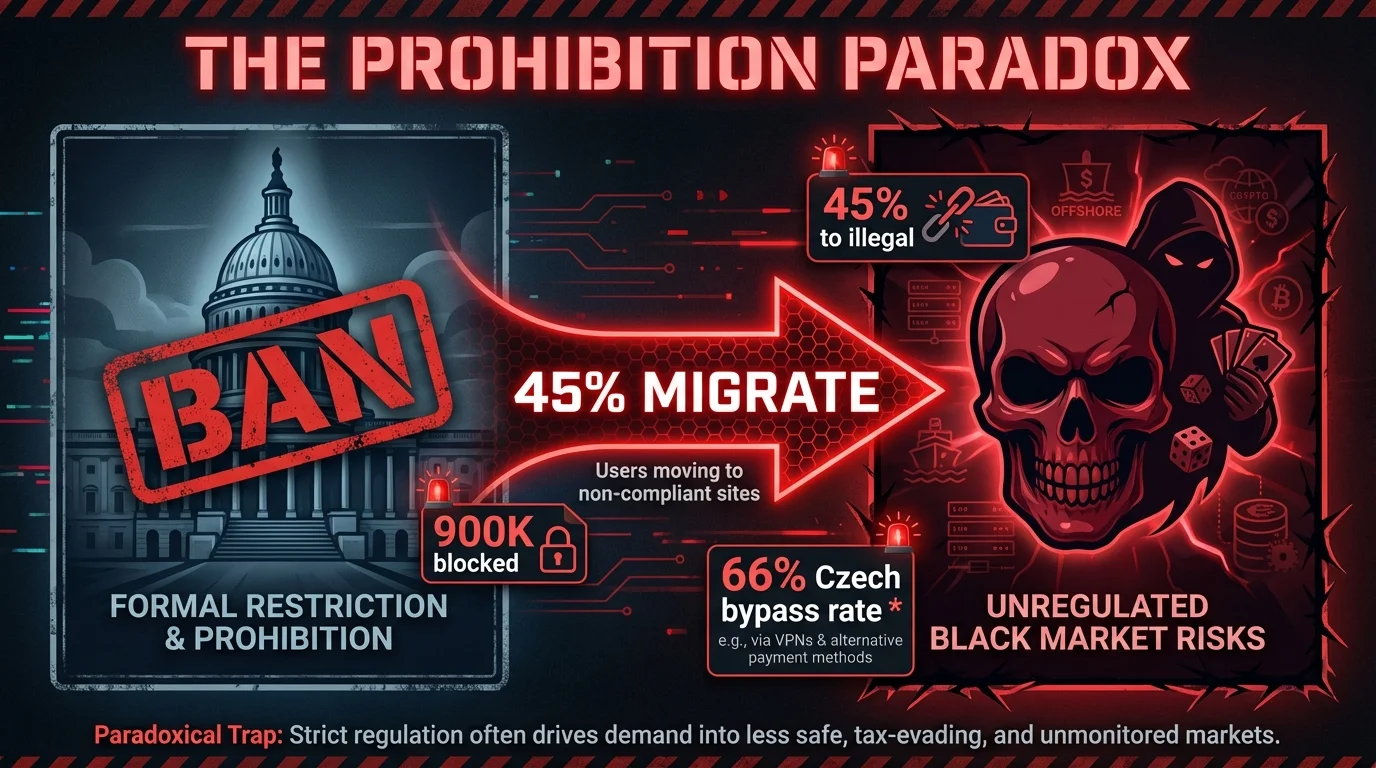
Brazil discovered that 20-27% of Bolsa Família welfare payments—approximately BRL 3 billion (€500 million)—were flowing to gambling platforms. The government’s response: ban all 54 million welfare recipients from gambling entirely.
In December 2025, approximately 900,000 Bolsa Família and BPC (Continuous Benefit Payment) recipients were blocked from accessing betting platforms. The ban was comprehensive—not just restricting use of welfare funds for gambling, but prohibiting these individuals from gambling at all on licensed platforms.
The result? An ANJL-commissioned study found that 45% of affected welfare recipients plan to continue gambling through illegal platforms. This mirrors the same pattern we documented in Czech Republic’s self-exclusion failure, where 66.2% of self-excluded players bypassed restrictions to gamble on black market sites.
“Unless they’re able to really go down to restricting almost what they can spend it on… they’re just spending with the illegal ones.”
— Ed Birkin, Managing Director, H2 Gambling Capital
The prohibition paradox is clear: banning access doesn’t eliminate demand—it redirects it to unregulated markets where there’s no player protection, no responsible gambling tools, and no tax revenue.
Regulatory Complexity as Market Design
Brazil’s licensing requirements read like a barrier designed to consolidate the market among major international operators. The numbers tell the story:
LICENSE REQUIREMENTS
- BRL 30M (~$6M) — License fee for 5 years (up to 3 brands)
- BRL 5M (~$950K) — Frozen guarantee fund for player protection
- ISO 27001 — Information security certification required
- GLI/Gaming Associates — Third-party system certification
- 20% Brazilian ownership — Mandatory local partnership
- .bet.br domain only — Other domains blocked
- ~50% effective tax burden — Including GGR tax + CSLL + COFINS + PIS + ISS
This isn’t accidental. A $6 million entry fee plus enterprise-grade biometric infrastructure plus ISO certification plus Brazilian ownership requirements equals a market engineered for Flutter, Bet365, and Entain. Smaller operators simply can’t compete.
Profitability is uncertain even for major players. One industry analysis noted that operators face “a non-refundable licence fee of up to R$30 million, mandatory financial reserves and an effective tax burden approaching 50%.”
Whack-a-Mole at Scale: 18,000 Blocks, 40% Black Market
Since October 2024, Brazil’s National Telecommunications Agency (Anatel) has blocked over 18,000 illegal betting websites in coordination with the Secretariat of Prizes and Betting (SPA). The enforcement numbers look impressive on paper.
The outcomes don’t. Despite this aggressive blocking campaign, estimates of Brazil’s black market share range from 30% (H2 Gambling Capital’s conservative estimate) to 41-51% (Instituto Brasileiro de Jogo Responsável). Some industry figures claim 70-80%—though H2’s Ed Birkin has called these estimates “hugely overblown.”
| Metric | Figure |
|---|---|
| Sites blocked (since Oct 2024) | 18,000+ |
| Licensed operators | 79 |
| H1 2025 licensed GGR | R$17.4B |
| Black market share (H2 estimate) | ~30% |
| Black market share (IBJR estimate) | 41-51% |
| Annual lost tax revenue | R$10.8B (~$2B) |
The problem is structural: mirror sites appear instantly after blocks. The SPA has only eight civil servants dedicated to preventing illegal payment processing. Meanwhile, the illegal market generates an estimated R$26-40 billion annually, with R$10.8 billion in lost tax revenue.
The Tax Squeeze: Pushing Players Underground
Brazil’s gambling tax regime is escalating rapidly. President Lula signed Complementary Law No. 224, implementing a phased increase in the GGR (Gross Gaming Revenue) tax:
2025
12%
Current GGR rate
2026
13%
First increase
2027
14%
Second increase
2028
15%
Target rate
But GGR tax is just the beginning. Players also face a 15% income tax on winnings above BRL 2,824. And there’s more on the horizon: the Senate has approved a 15% tax on player deposits (CIDE-Bets), though the final vote has been pushed to 2026. If implemented, this would generate an estimated BRL 30 billion ($5.5 billion) annually.
Additionally, social security contributions are rising from 1% in 2026 to 3% by 2028. Combined with corporate taxes (CSLL, COFINS, PIS, ISS), the effective tax burden approaches 50%.
The math is simple: every tax increase combined with biometric friction pushes more players and operators toward unregulated alternatives where none of these costs exist.
The Crypto Ban Creates Its Own Shadow Market
Normative Ordinance No. 615/2024 explicitly bans cryptocurrency payments for gambling. Credit cards, cash, and cheques are also prohibited. The only approved payment method is bank transfers through the Central Bank’s Pix system or authorized financial institutions.
This creates a clear arbitrage opportunity. Offshore crypto casino alternatives accept Brazilian players without:
WHAT OFFSHORE CRYPTO CASINOS OFFER
Brazil Licensed Sites
- Facial recognition every 30 min
- Geolocation every 30 min
- 15% winnings tax
- Bank account required
- CPF verification
Offshore Crypto Casinos
- No biometric verification
- No geolocation checks
- No winnings tax
- Crypto-only (no bank needed)
- Minimal or no KYC
THE UNBANKED PROBLEM
Nearly 10% of Brazilians don’t have a bank account. For these players, the only way to gamble is through illegal channels that accept cash or crypto. The payment restrictions that were designed to prevent money laundering are inadvertently pushing an entire segment of the population toward unregulated markets.
Industry analysts have warned that “the new measures may lead players who are used to paying with Bitcoin or cash to choose the black market or offshore websites.”
Signs of Progress (Despite the Numbers)
Not everything is failing. Brazil’s regulated market has shown genuine growth:
- Licensed market doubled in its first year of operation
- R$8.82B in taxes collected between January and November 2025
- 79 licensed operators as of January 2026, up from 14 at launch
- CID financial intelligence now sharing data with Central Bank
- Pix payment blocking for illegal operators gaining traction
The regulatory infrastructure is being built. The question is whether the friction and tax burden drive so many players offshore that the legal market never reaches its potential. H2 Gambling Capital projects the regulated market could reach BRL 50 billion by 2029—but only if the illegal market share shrinks significantly.
IBJR argues the path forward isn’t more taxes but better enforcement: “If Brazil shifts just 5 percentage points from the illegal to the regulated market, the additional revenue could reach R$1 billion per year. The solution is not to hastily increase taxes, but rather to invest in oversight, monitor financial transactions, certify suppliers, and raise consumer awareness.”
KEY TAKEAWAYS
- Most surveillance-heavy system globally — 30-minute biometric and geolocation checks are unprecedented in any jurisdiction
- Black market persists — 18,000 blocked sites haven’t eliminated 30-50% offshore market share
- Welfare ban backfiring — 45% plan to migrate to illegal platforms, mirroring Czech’s 66% bypass rate
- Consolidation by design — $6M license fee plus ISO requirements favor major international operators
- Crypto arbitrage — Ban creates clear pathway to offshore crypto casinos without friction or taxes
- Tax squeeze accelerating — Rising rates (12%→15% GGR plus potential deposit tax) push players offshore

Aevan Lark
Aevan Lark is a gambling industry veteran with over 7 years of experience working behind the scenes at leading crypto casinos — from VIP management to risk analysis and customer operations. His insider perspective spans online gambling, sports betting, provably fair gaming, and prediction markets. On Dyutam, Aevan creates in-depth guides, builds verification tools, and delivers honest, data-driven reviews to help players understand the odds, verify fairness, and gamble responsibly.
Related coverage
The 2022 FanDuel Withdrawal Lawsuit: Must You Bet Your Deposit First?
A recirculated 2022 lawsuit raises questions about unused FanDuel deposits, current New Jersey rules and an unverified case outcome.
New York’s AI Proposal Would Make Sportsbooks Prove Why Your Bonus Is Different
New York’s AI proposal would put data-linked betting offers under scrutiny, with public criteria, regulatory records and narrow exceptions.

Kick Florida Lawsuit: The August Ban Request and the Seizure Claim
Florida’s August complaint targets Kick with operating-ban and forfeiture requests, but does not expressly seek seizure of its domain.