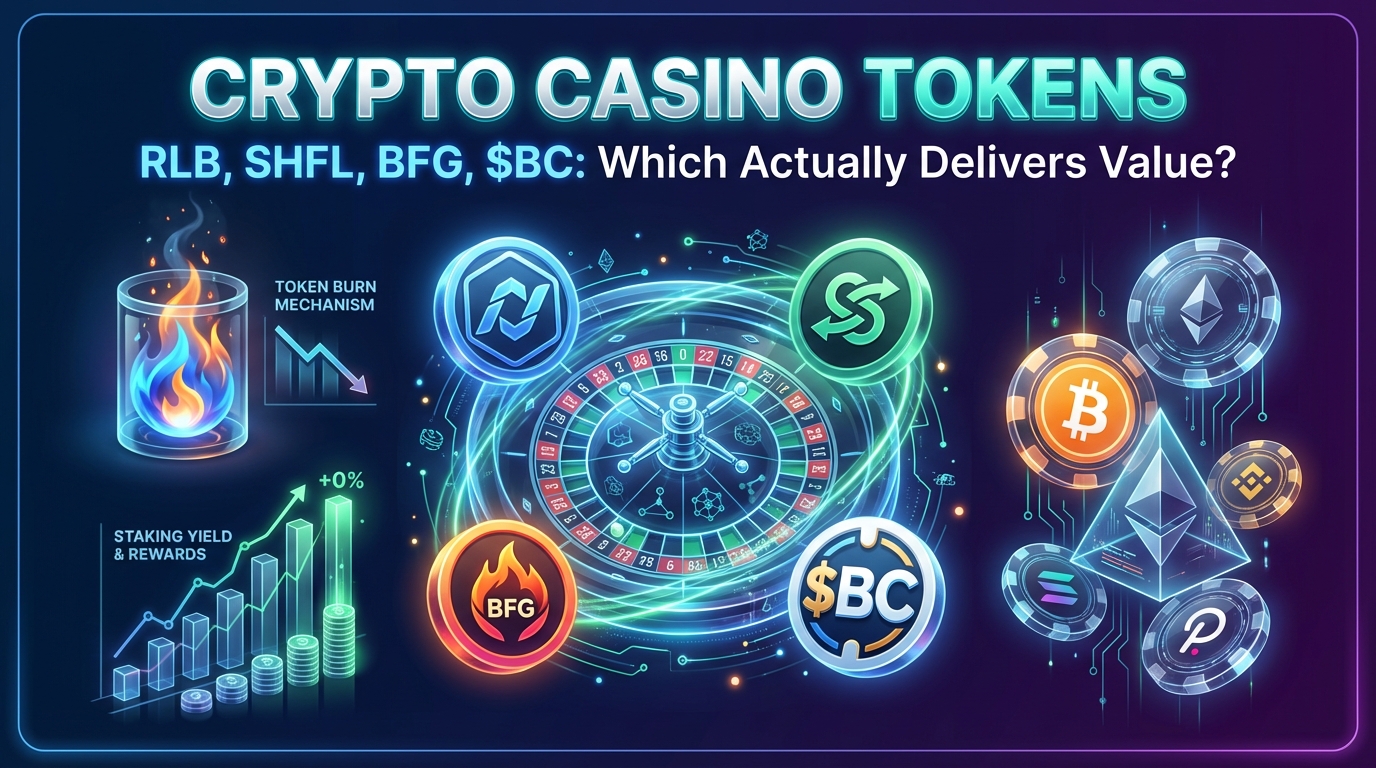
Crypto Casino Tokens Explained: RLB, SHFL, BFG, and $BC Compared
Compare RLB, SHFL, BFG and BC token mechanics. Distinguish lottery rewards, token burns and cash distributions, and check the date of each figure.

A casino token can fund buybacks, qualify a holder for rewards or grant entries in a prize draw. These mechanisms have different cash flows. A burn does not pay cash to holders, and a lottery entry can pay nothing. Here is what to look for in RLB, SHFL, BFG and $BC disclosures.
KEY FACTS AT A GLANCE
- Historical comparison: Prices and market capitalizations in the table are rounded January 2026 US-dollar snapshots, not current quotes.
- Mechanisms: RLB buybacks and burns, SHFL lottery entries, BFG staking distributions, and $BC’s reported buybacks.
- SHFL staking: 50 SHFL creates one continuing lottery ticket. A USDC prize depends on a winning draw.
- Most transparent: RLB and SHFL with on-chain dashboards — $BC lacks transparency
- Industry leader Stake: Has no token — Eddie confirmed no plans to launch one
- Risk: Platform failure, token liquidity and market price can overwhelm any rewards.
What Are Crypto Casino Tokens?
Crypto casino tokens are native cryptocurrencies issued by online gambling platforms that give holders a stake in the platform’s revenue. Unlike buying shares in a traditional casino company, these tokens operate within decentralized ecosystems where revenue flows are often verifiable on-chain.
An operator may use revenue to buy tokens, but holding the token does not necessarily give an enforceable right to that revenue. Check which transactions distribute money to holders and which only reduce supply.
THE ELEPHANT IN THE ROOM: STAKE HAS NO TOKEN
The industry’s largest crypto casino, Stake.com, deliberately operates without a native token. In a Kick stream, co-founder Ed Craven (Eddie) explicitly stated he has no intention of launching a token. While competitors use tokens to share revenue with holders, Stake retains 100% of profits internally. This makes Stake impossible to invest in directly—but also means no token risk, no rug pull possibility, and no speculative volatility for users who simply want to gamble. You can verify Stake game results using our Stake provably fair verification guide and Stake verification tools.
The Three Revenue Models Explained
Understanding how a casino token generates value is critical. There are three primary models, each with distinct risk/reward profiles.
1. Buy & Burn Model (RLB, $BC)
The platform uses a percentage of revenue to purchase tokens from the open market and permanently destroy them. This reduces circulating supply over time, theoretically increasing scarcity and price.
HOW ROLLBIT’S BURN WORKS
- 10% of casino revenue used for hourly buybacks
- 20% of sportsbook revenue used for buybacks
- 30% of futures trading fees used for buybacks
- 90% of purchased tokens burned, 10% distributed to Rollbots NFT holders
- Burns happen hourly, viewable on Etherscan
A burn reduces the number of tokens outstanding if confirmed on-chain. It does not by itself increase every holder’s purchasing power.
Cons: No direct income to holders, value dependent on continued platform revenue, burns can slow if revenue drops.
2. Dividend Model (BFG)
Token holders receive direct payouts from platform profits. BetFury’s BFG token releases 3% of the daily profit pool to stakers, paid in multiple cryptocurrencies including USDT, ETH, BTC, BNB, and TRX.
BETFURY DIVIDEND MECHANICS
- Minimum stake: 100 BFG tokens
- Distribution: Record amounts actually paid to the wallet, by asset and date.
- Locking: Check the position’s term and unlock rules before comparing rewards.
- Payout frequency: Daily in multiple cryptocurrencies
- Pool source: All funds from non-winning bets
Cash or crypto distributions can be measured by receipts. Their value still depends on the asset, the payout date and the value of the staked token.
Cons: Smaller market cap means less liquidity, platform must remain profitable for payouts, locked staking reduces flexibility.
3. Hybrid Model (SHFL)
Under Shuffle’s lottery rules, each 50 staked SHFL generates one perpetual ticket. Prizes are shared among winners of the qualifying tiers. A staker can receive no USDC in a draw. A platform-funded pool is a source of prize money, not an interest rate on a holder’s deposit.
SHUFFLE’S HYBRID TOKENOMICS
- Pool: Prize tiers and amounts vary by draw. Use the relevant draw history when measuring a return.
- Staking requirement: 50 SHFL per lottery ticket
- Measurement: USDC prizes received by this wallet in a stated period, divided by the stated USD cost basis. Zero prizes means zero cash reward for that period.
- Buybacks and burns: Report their transaction date and value separately from prize payouts.
- Eligibility: Check the draw cutoff. Unstaking before the draw closes forfeits that draw’s tickets under the published rules.
The lottery rules describe the draw and distribution of qualifying prizes. The token’s market price can change whether or not the holder wins.
Cons: Lottery-based distribution means variable returns, requires active staking participation.
Head-to-Head Token Comparison
Prices and market capitalization below reflect the original January 2026 snapshot, rounded in US dollars. The reward column describes the mechanism; it does not rank annual yields. No wallet-level return series for a common period is available here.
| Token | Casino | Approx. USD price (Jan 2026) | Approx. USD market cap (Jan 2026) | Key Mechanism | What a holder receives | Tradeable |
|---|---|---|---|---|---|---|
| RLB | Rollbit | ~$0.10 | $251M | Operator buybacks and burns | No cash from a burn itself | Yes (Uniswap) |
| SHFL | Shuffle | ~$0.35 | $124M | Lottery staking and separate token buybacks | One ticket per 50 staked SHFL; prizes depend on winning | Yes (XT, Uniswap) |
| $BC ⚠️ | BC.Game | ~$0.008 | $87M | Buybacks reported by the operator | No comparable wallet distribution verified here | Yes (Raydium/Solana) |
| BFG | BetFury | ~$0.015 | $13M | Token staking reward pool | Variable distributions in the payout assets | Yes (PancakeSwap) |
Verify game results: Shuffle Tools · BC.Game Tools · Stake Tools | Bonus calculators: Shuffle Monthly · BC.Game Monthly · Stake Monthly
⚠️ $BC TOKEN TRANSPARENCY WARNING
The original January 2026 review found one specifically announced $BC burn. This is a dated description of that review, not a count of all burns through today.
- Only 1 documented burn: 250M tokens burned on July 18, 2025 (~$2.8M) — announced via press release, not routine disclosure
- No recurring dashboard was established in the January 2026 review.
- The January 2026 comparison did not substantiate a cumulative burn total.
- Provider supply estimates alone do not establish the amount destroyed on-chain.
- A wallet label alone does not establish which transfers constitute a burn.
Due to this transparency gap between promises and verifiable implementation, $BC should be considered a highly speculative and risky investment compared to RLB and SHFL.
Revenue Transparency: The Differentiator
The ability to verify revenue claims on-chain separates legitimate casino tokens from speculation. RLB and SHFL both provide on-chain dashboards showing real revenue—and you can verify every claim independently.
Rollbit (RLB) Revenue Verification
Rollbit’s burn mechanism is fully on-chain and auditable. The token contract address is 0x046eee2cc3188071c02bfc1745a6b17c656e3f3d on Ethereum. You can verify burns by checking transfers to the null address (0x0000000000000000000000000000000000000000) on Etherscan.
HOW TO VERIFY RLB BURNS
STEP 1: Visit Etherscan
Go to etherscan.io/token/0x046eee2cc3188071c02bfc1745a6b17c656e3f3d
STEP 2: Check Null Address
Click “Holders” tab and look for transfers to 0x0000…0000
STEP 3: Verify Burn Rate
Burns happen hourly—check timestamps to verify frequency matches claims
Historical snapshot: the original guide reported 58.67% of maximum RLB supply burned in August 2025. Verify current supply and transfer history at the stated block date before comparing it with any later figure.
Shuffle (SHFL) Revenue Verification
SHFL’s lottery and burns operate on Ethereum with the contract address 0x8881562783028f5c1bcb985d2283d5e170d88888. The lottery system uses Bitcoin block hashes for provable randomness.
SHFL PROVABLY FAIR LOTTERY
- Randomness source: Bitcoin block number + Bitcoin hash + server seed
- Anti-cheating: Downloadable CSV of tickets before draw, plus hash verification
- Payment: Eligible winning tickets receive the relevant tier’s share. Owning a ticket does not guarantee a prize.
- Verification: All token burns, rewards, and airdrops trackable on-chain
Reconcile prize receipts against draw results and record the currency, window and number of tickets. Keep lottery payouts distinct from market-price changes. Dyutam’s SHFL tokenomics analysis covers the later revenue and valuation questions.
Shuffle verification tools: Crash · Dice · Mines · Plinko · Limbo · Keno · HiLo · Roulette · Blackjack · All Shuffle Tools
How to Evaluate Casino Token Tokenomics
Before investing in any casino token, run through this evaluation framework. Understanding how house edge works and what wager means will help you assess whether a platform’s revenue claims are realistic.
1. Supply Mechanics
| Metric | What to Look For | Red Flag |
|---|---|---|
| Max Supply | Fixed cap (RLB: 5B, SHFL: 1B, $BC: 10B) | No max supply + no burn = infinite dilution |
| Circulating vs Max | Healthy: 50%+ circulating | 10% circulating = 90% still to unlock |
| Burn Rate | Identify the token, source and block or observation date for each burn. | Claims burns but no on-chain proof |
| Unlock Schedule | Gradual vesting (12-48 months) | Large cliff unlocks coming soon |
2. Revenue Verification
Can you independently verify the platform’s revenue claims? For RLB, you can track hourly burns on Etherscan and calculate implied revenue. For SHFL, weekly lottery payouts are on-chain. For BFG and $BC, verification is more challenging—you’re trusting platform-provided data.
3. Liquidity Analysis
A token with a $100M market cap but only $50K daily volume on a single DEX is a trap. Check:
- Number of exchanges: More listings = better exit liquidity
- 24h volume vs market cap: Healthy ratio is 5-15%
- Liquidity depth: Can you sell $10K without 5%+ slippage?
- DEX vs CEX balance: DEX-only tokens have higher manipulation risk
4. Team Allocation
Team allocations above 30% are a concern. Check:
- Team allocation %: Under 20% is healthy
- Vesting period: 2+ years with linear unlock is standard
- Lock status: BetFury locked 1 billion BFG for 4.8 years
The Platform Risk Reality Check
Here’s the uncomfortable truth nobody discusses honestly: if the casino fails, your tokens are worthless. Unlike Bitcoin or Ethereum, which have value independent of any single platform, RLB is worth nothing without Rollbit. SHFL dies if Shuffle does. This is fundamentally different from holding BTC.
PLATFORM RISK FACTORS
- Regulatory crackdown: Rollbit is blocked in US, UK, and France (35% of global iGaming spend)
- Hacks and exploits: Shuffle suffered a data breach via third party in October 2025
- Competition: The $81B crypto casino sector is intensely competitive (see our Stake 2025 stats for market context)
- Key person risk: Anonymous teams mean no accountability
- Bank run risk: If users lose confidence, mass withdrawals can crash a platform
This doesn’t mean casino tokens are bad investments—it means you should size positions accordingly. These are high-risk, high-reward plays that deserve a different portfolio allocation than blue-chip crypto.
Red Flags to Watch For
The crypto casino space has produced some of the most brazen scams in crypto history. ZKasino alone stole $33 million in April 2024. SafeMoon’s CEO was convicted in May 2025 for defrauding investors of millions. Learn to spot the warning signs.
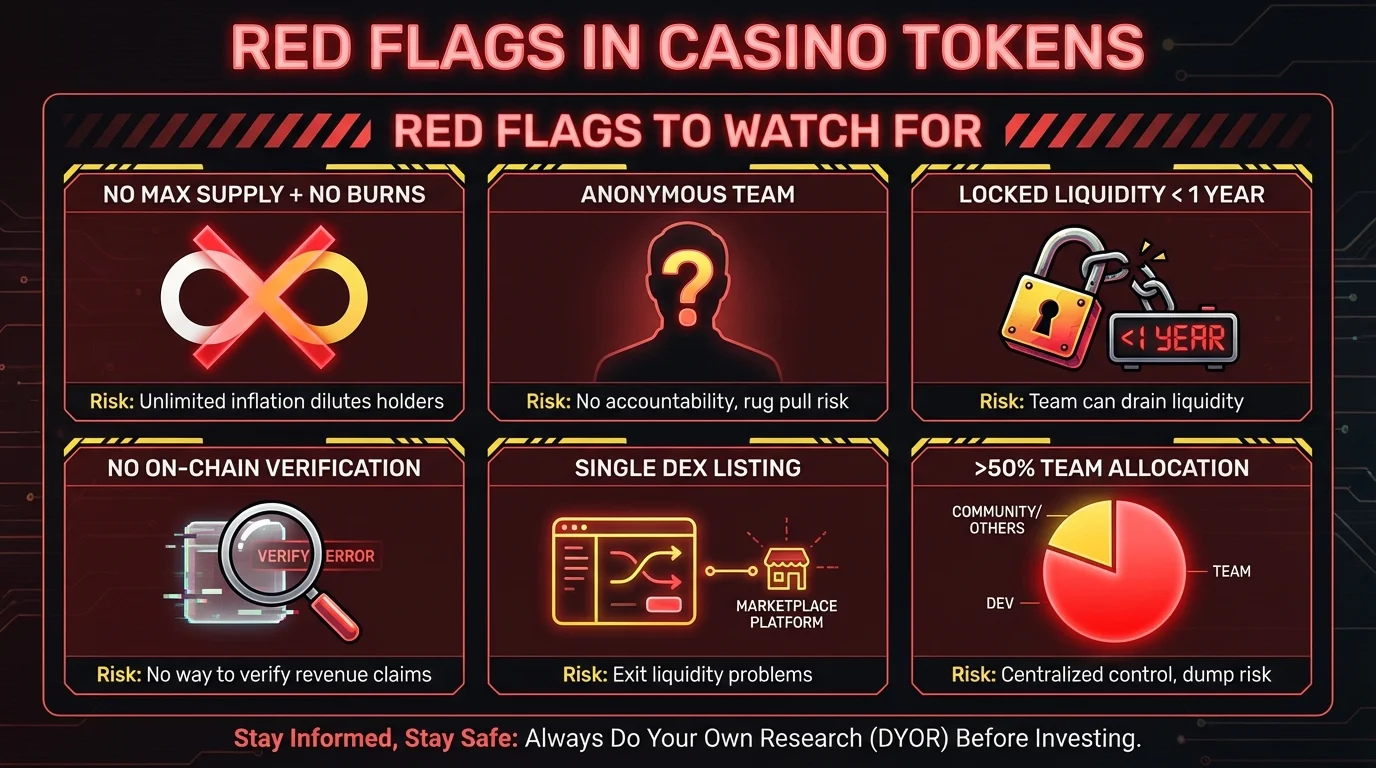
NO MAX SUPPLY + NO BURNS
Unlimited token minting means your holdings get diluted forever. Legitimate projects have fixed supplies and deflationary mechanisms.
ANONYMOUS TEAM
No doxxed founders = no accountability. ZKasino’s team had ties to previous scams. ZachXBT called them “proven bad actors” before the rug.
PROMISES OF GUARANTEED RETURNS
No investment has guaranteed returns. “100% APY guaranteed” is a Ponzi flag. Legitimate yields vary with platform revenue.
SINGLE DEX LISTING
Tokens only tradeable on one DEX have exit liquidity problems. When you need to sell, there may be no buyers.
NO ON-CHAIN VERIFICATION
If you can’t verify revenue, burns, or distributions on-chain, you’re trusting claims you can’t verify. RLB and SHFL pass this test.
>50% TEAM ALLOCATION
Massive insider holdings mean centralized control and dump risk. Check tokenomics before buying.
Case Study: ZKasino $33M Rug Pull
In April 2024, ZKasino raised $33 million by promising users they could bridge ETH into a layer-2 chain, earn yield, and withdraw their ETH at any time. Instead, the team transferred 10,500+ ETH to Lido, converted deposits into vested ZKAS tokens, and disappeared.
| Warning Sign | What Happened |
|---|---|
| Team history | ZachXBT warned team were “proven bad actors” in December |
| False claims | Vitalik Buterin disputed their zero-knowledge technology claims |
| Linked to scams | Team connected to failed ZigZagExchange ($15M misallocated) |
| Outcome | Dutch police arrested suspect, seized $12.2M. Only 35% of victims refunded as of Nov 2025 |
Case Study: SafeMoon Fraud Conviction
In May 2025, SafeMoon CEO Braden Karony was convicted on all counts for securities fraud, wire fraud, and money laundering. Despite SafeMoon reaching an $8 billion market cap with millions of holders, Karony used stolen investor funds to buy a $2.2 million home, two Audi R8s, a Tesla, and properties in Kansas.
The Justice Department said the defendant “fraudulently diverted and misappropriated millions of dollars’ worth of liquidity from the SafeMoon liquidity pool for their personal benefit.”
US Department of Justice, May 21, 2025
On February 10, 2026, the court sentenced Karony to 100 months in prison. The conviction and the subsequent sentence are documented separately in the Justice Department’s sentencing notice.
How to compare what each holder receives
For a like-for-like cash comparison, use the same observation window and currency. For example, over one hypothetical 30-day period, an RLB burn credits its holder $0 directly. A nonwinning SHFL ticket earns $0 USDC. A BFG account with a verified $6 receipt has $6 before fees. These are example cash flows, not forecasts or total token returns.
Buyback exposure
RLB (Rollbit)
- Market capitalization is a price-times-supply snapshot.
- Compare dated buyback transactions with the operator’s stated formula.
- August 2025 supply snapshot; see the historical figure above.
- No action required from holder
Considerations
- Blocked in major markets (US, UK, France)
- No direct yield to holders
- Market price can fall despite buybacks.
Prize-draw exposure
SHFL (Shuffle)
- One continuing lottery ticket per 50 SHFL staked.
- Hybrid burn + rewards model
- Compare payout tiers for a particular draw.
- Read the applicable terms for the platform on which the tokens are staked.
Considerations
- A nonwinning ticket receives no cash prize for the draw.
- Data breach in October 2025
- The market price of SHFL can change while the tokens are staked.
Staking distribution exposure
BFG (BetFury)
- Daily dividend payouts
- Multi-currency rewards (USDT, BTC, ETH)
- Calculate realized rewards from dated wallet receipts.
- Low entry (100 BFG minimum)
Considerations
- The January 2026 snapshot gave an approximate $13M market capitalization.
- Longer locks reduce access to the tokens during the term.
- Less transparent than RLB/SHFL
⚠️ FOR HIGH-RISK SPECULATORS ONLY: $BC (BC.Game)
What They Claim
- Solana ecosystem (fast, low fees)
- “Weekly buyback and burn” mechanism
- Platform sponsors major esports teams (s1mple, electronic)
- Burn address: BCBurn1111…111
Reality Check (Critical Issues)
- The January 2026 review identified one July 2025 burn announcement.
- Check current disclosures against on-chain transfers.
- The January 2026 review could not verify a weekly cadence.
- A complete historical burn total was not established in that review.
- Supply data conflicts with burn claims
- Launched Oct 2024 = minimal track record
Bottom line: $BC is a highly speculative bet. The platform (BC.Game) is legitimate, but the token’s burn mechanism lacks the transparency of RLB and SHFL. You cannot verify their claims independently. Only invest what you can afford to lose entirely.
The Broader GambleFi Landscape
Casino tokens exist within the larger GambleFi ecosystem—the intersection of decentralized finance and online gambling. The sector has grown from niche crypto casinos to a legitimate market segment with traded tokens, on-chain revenue, and institutional-grade analytics.
Key developments shaping the space:
- Regulation: Check the product and jurisdiction before assuming that trading a token makes the casino available there.
- Esports integration: BC.Game signed s1mple, electronic, and saw for CS2; 100 Thieves partnered with Roobet
- On-chain transparency: Treat a proposed product as a plan until the team publishes a working release, contract address and transaction history.
- Market consolidation: Smaller platforms are failing; the Solidus Labs report shows 98.6% of new gambling tokens are scams
Practical Steps Before Investing
STEP 1: VERIFY ON-CHAIN
Check Etherscan/Solscan for burn transactions, staking distributions, and holder distribution. Use our verification tools for game results. If you can’t verify it, don’t trust it.
STEP 2: CHECK LIQUIDITY
Simulate a trade. Can you buy/sell $10K without significant slippage? Check 24h volume and exchange depth.
STEP 3: RESEARCH TEAM
Search for prior scams. Check ZachXBT, Rekt News, and crypto Twitter for warnings. Anonymous team = higher risk.
STEP 4: SIZE APPROPRIATELY
Platform risk means total loss is possible. Position size accordingly—these are not blue-chip allocations.
KEY TAKEAWAYS
- Holder returns: Separate token-price movement from a verified cash or token distribution.
- Three revenue models exist: Burn (RLB, $BC), Dividend (BFG), Hybrid (SHFL) — each with different risk/reward
- RLB and SHFL lead in transparency — on-chain verification of burns and distributions is possible
- $BC: The January 2026 comparison could not substantiate a weekly buyback schedule.
- Stake has no token by design — Eddie confirmed on Kick he has no intention to launch one
- Platform risk is the key concern — if the casino fails, tokens go to zero (unlike BTC/ETH)
- Data quality: Check what population and period a quoted fraud study actually measured before generalizing it to casino tokens.
- Buybacks: A burn reduces supply but pays the passive holder no cash.
- SHFL: A lottery prize depends on ticket results. Present realized or modeled awards with a stated window and denominator.
- Always verify on-chain — if you can’t confirm claims independently, the risk is too high
For more on verifying crypto casino fairness, see our guides on BC.Game provably fair verification, Shuffle verification, Stake verification, and the math behind provably fair systems.
PROVABLY FAIR VERIFICATION TOOLS
BC.Game
Crash · Dice · Mines · Plinko · Limbo · Keno · HiLo · Roulette · Blackjack · Hash Dice · Wheel · Limbo Finder · Mines Finder · All BC.Game →
Shuffle
Crash · Dice · Mines · Plinko · Limbo · Keno · HiLo · Roulette · Blackjack · Wheel · Limbo Finder · Mines Finder · VIP Progress · All Shuffle →
Stake (No Token)
Crash · Dice · Mines · Plinko · Limbo · Keno · HiLo · Roulette · Slide · Wheel · Limbo Finder · Mines Finder · VIP Progress · All Stake →
Game guides: Blackjack Guide · Hit or Stand · Double Down Strategy · Roulette Guide · Martingale Strategy · Baccarat Guide · Aviator Strategies

Aevan Lark
Aevan Lark is a gambling industry veteran with over 7 years of experience working behind the scenes at leading crypto casinos — from VIP management to risk analysis and customer operations. His insider perspective spans online gambling, sports betting, provably fair gaming, and prediction markets. On Dyutam, Aevan creates in-depth guides, builds verification tools, and delivers honest, data-driven reviews to help players understand the odds, verify fairness, and gamble responsibly.
Related coverage
Shuffle Revenue and SHFL Token Value in September 2026
A September 2026 snapshot of Shuffle’s revenue, token supply, burns and lottery staking, with the assumptions behind the SHFL valuation.
Crypto Casino Bonuses and Traditional Offers Compared
Compare crypto and traditional casino bonuses using the wagering base, game contribution, withdrawal cap and the currency in which the operator settles.
No Smoke, Just Math: “Provably Fair” Gaming: Seeds, Hashes, and How You Can Check the Trick
Learn what the server seed, client seed and nonce establish, and how to reproduce a completed game using the published verification method.