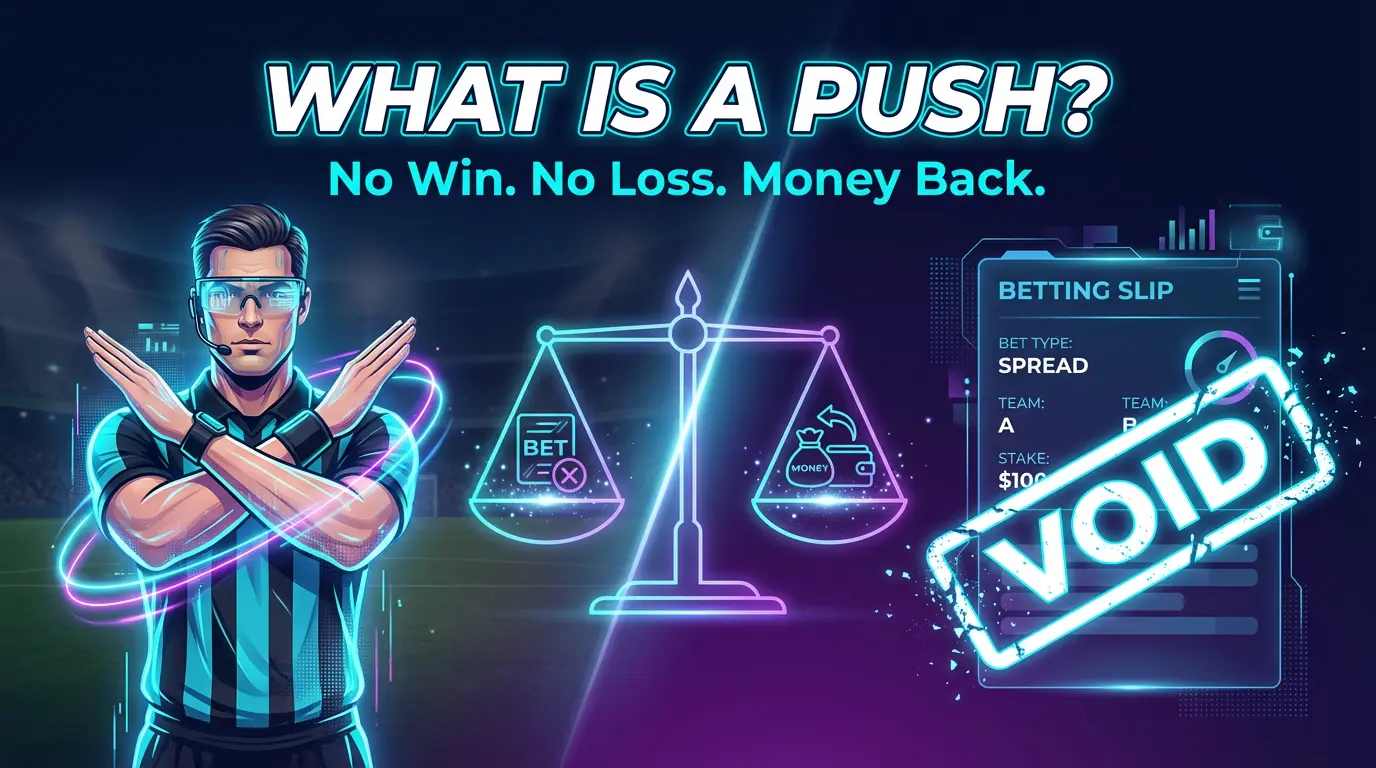
What Is a Push in Sports Betting? Ties Explained
A push returns your stake when results land exactly on the betting line. Learn how pushes affect spreads, parlays, and why the hook exists.
You bet the Chiefs -7 against the Raiders. Kansas City wins 24-17—exactly seven points. Your bet didn’t win. It didn’t lose either. It pushed. A push is the sports betting equivalent of a tie: your original stake comes back to you as if the bet never happened. Understanding when pushes occur and how different bet types handle them separates informed bettors from confused ones staring at their account wondering where their winnings went.
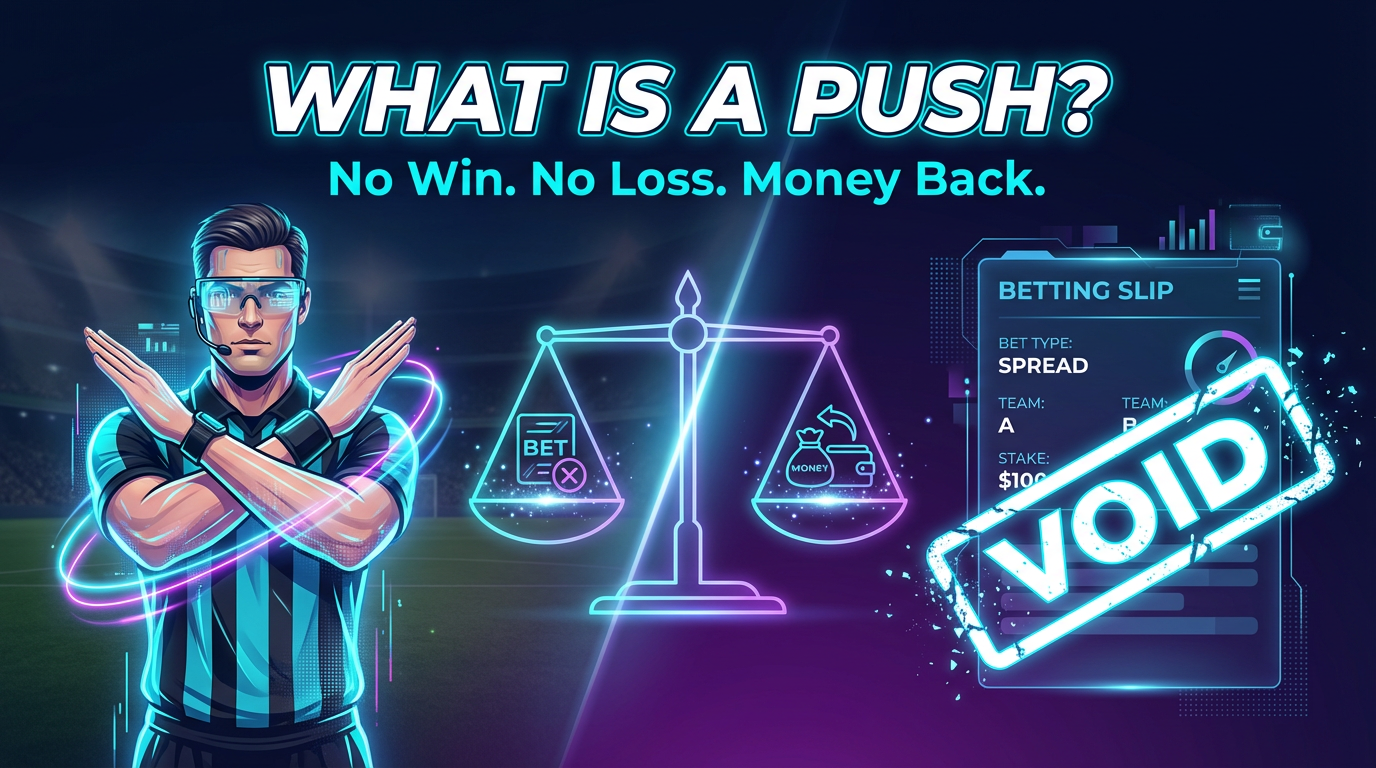
KEY FACTS AT A GLANCE
- What Happens: Your original stake is returned—no win, no loss
- When It Occurs: Final result lands exactly on the spread, total, or prop line
- Parlay Impact: Push leg is removed, parlay recalculates at reduced odds
- Half-Point Lines: The “.5” (hook) exists specifically to eliminate push possibility
- NFL Key Numbers: 3 and 7 are most common margins—pushes happen more on these
- Moneylines: Cannot push (games end in a winner, or bets void if tie occurs)
What Is a Push?
A push occurs when the final result lands exactly on the betting line. No side wins, no side loses. The sportsbook returns your original wager as if the bet was never placed. Your account balance ends up exactly where it started before you made the bet.
Think of it like calling a coin flip and having it land on its edge. The event happened, but nobody wins. In practical terms, if you bet $110 to win $100 on a spread and it pushes, you get your $110 back. You don’t win the $100, but you don’t lose the $110 either.
When Do Pushes Happen?
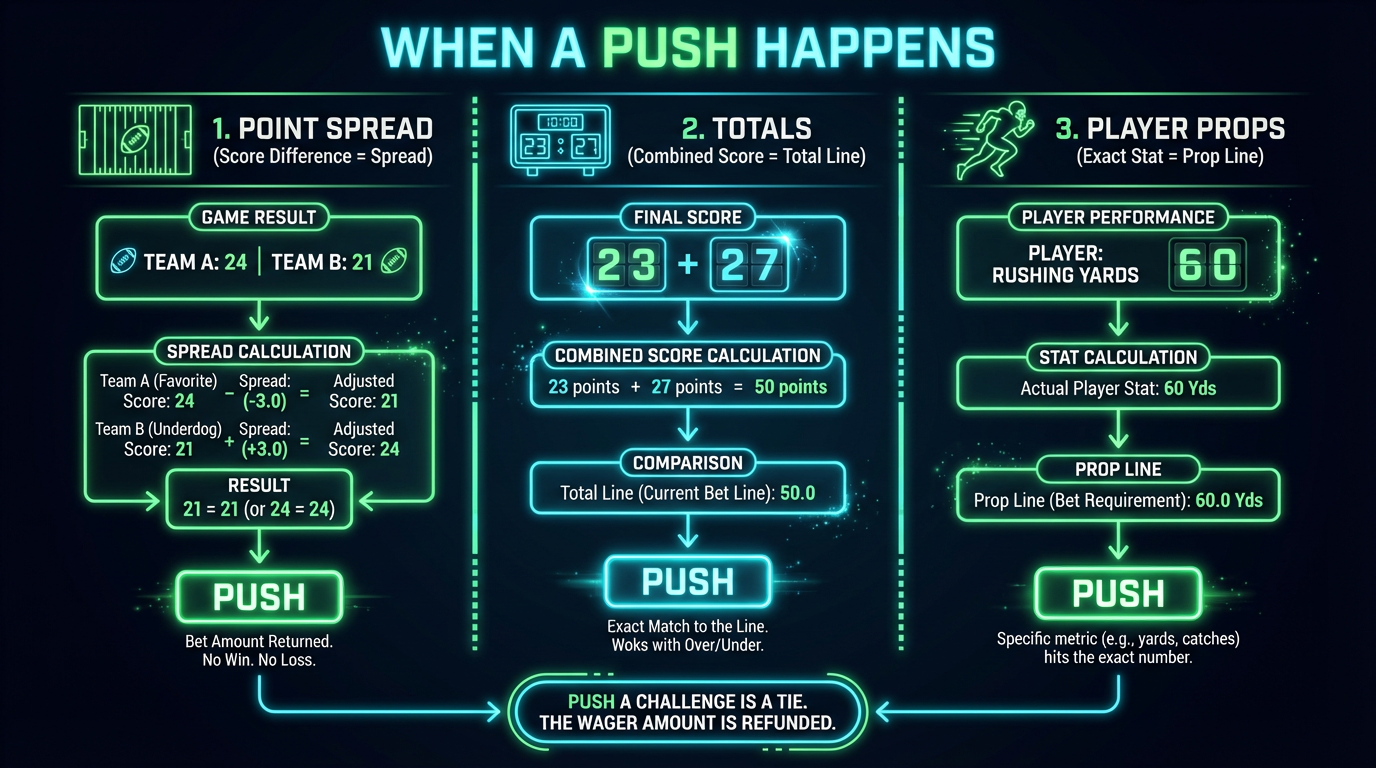
Point Spread Pushes
Point spread pushes happen when the favorite wins by exactly the spread number. If the line is Cowboys -6 and Dallas wins 27-21, the adjusted score is tied (27-27 after subtracting 6), resulting in a push for both sides.
| Bet | Final Score | Result |
|---|---|---|
| Cowboys -6 | Cowboys 27, Eagles 21 | PUSH |
| Cowboys -6 | Cowboys 28, Eagles 21 | WIN |
| Cowboys -6 | Cowboys 26, Eagles 21 | LOSS |
Totals (Over/Under) Pushes
Totals push when the combined score equals exactly the posted number. If the over/under is 47 and the game ends 27-20, both over and under bets push. Neither the “over 47” nor “under 47” bettors win or lose.
Player Prop Pushes
Player props push when the stat lands exactly on the line. Patrick Mahomes passing yards set at 275.5 can’t push (he’ll have either 275 or 276, never 275.5). But if his line is 275.0 and he throws for exactly 275 yards, both over and under bettors get their money back.
Pro Tip: Half-point lines on player props exist specifically to prevent pushes. When you see 24.5 receiving yards instead of 25, the sportsbook is ensuring someone wins and someone loses.
The Hook: Why Half-Points Exist
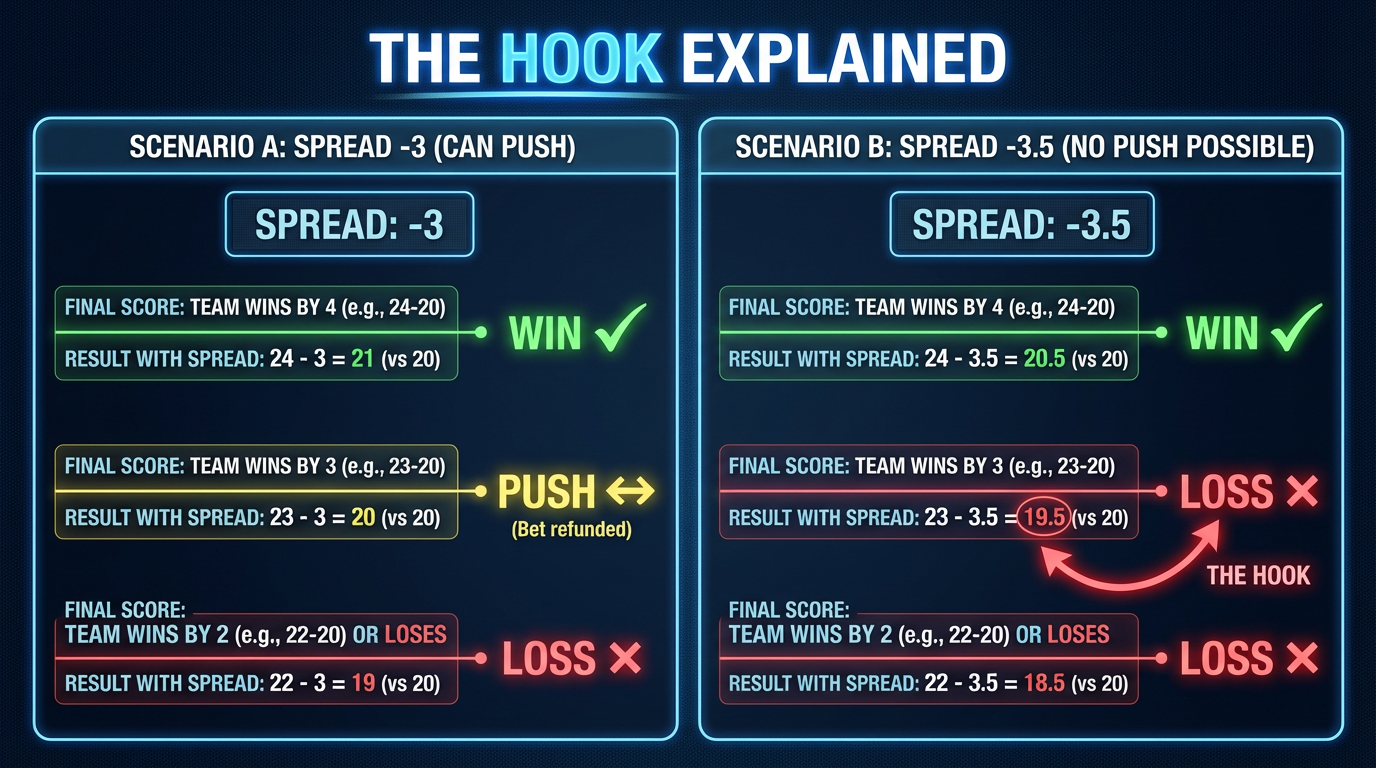
That “.5” you see on most betting lines is called “the hook.” Its sole purpose is eliminating push possibilities. A spread of -3.5 can never push—the favorite either wins by 4+ (covers) or wins by 3 or less (doesn’t cover). There’s no middle ground.
Sportsbooks prefer half-point lines because pushes create administrative hassle and reduce their hold percentage. When bets push, the book collects no juice. By adding the hook, every bet resolves to a winner and loser, and the house collects its cut on every wager.
Whole number lines (called “flat” numbers) still exist because they attract action on key numbers. Books know bettors feel more comfortable with -7 than -7.5, so they’ll occasionally post flat lines and accept the push risk in exchange for higher betting volume.
How Different Bet Types Handle Pushes
Straight Bets
Simplest case: your stake returns. Bet $100, get $100 back. No profit, no loss. Your betting record might show it as a “no action” result rather than a win or loss.
Parlays
When one leg of a parlay pushes, that leg is removed and the parlay recalculates at reduced odds. A 4-team parlay with one push becomes a 3-team parlay. You can still win, but the payout drops accordingly.
| Scenario | Original Odds | After Push |
|---|---|---|
| 4-leg parlay, 1 push | +1228 (approx) | +596 (3-leg) |
| 3-leg parlay, 1 push | +596 (approx) | +264 (2-leg) |
| 2-leg parlay, 1 push | +264 (approx) | -110 (straight bet) |
Use our parlay calculator to see exactly how a push affects your potential payout. Need to convert between American, decimal, and fractional odds? Try our odds converter.
Teasers
Teaser push rules vary by sportsbook—always check before betting. Most books treat a push in one leg the same as parlays (leg removed, odds reduced). However, some books grade teaser pushes as losses, particularly on 2-team teasers. Read the house rules.
Moneylines
Moneyline bets essentially can’t push because games have winners. If a game ends in an actual tie (rare in most sports), moneyline bets are typically voided and stakes returned. Some sportsbooks offer “tie” as a third betting option in sports where draws are more common (soccer, for instance).
NFL Key Numbers and Push Frequency
In NFL betting, certain margins of victory occur far more frequently than others due to football’s scoring structure (6 for TD, 3 for FG, 1-2 for conversions). Understanding these helps you evaluate push risk.
A flat -3 line has meaningful push risk because roughly 15% of NFL games end with a 3-point margin. Conversely, lines like -5 or -8 rarely push. When evaluating whether to bet -3 versus -3.5 (or buy off the 3), that push frequency matters significantly.
Buying Points to Avoid Pushes
Most sportsbooks let you “buy” points—moving the line in your favor for worse odds. If a line is -3 (-110), you might buy a half-point to -2.5 (-120). You’re paying extra juice to eliminate push risk and potentially turn losses into wins.
Whether buying points makes mathematical sense depends on the specific number. Buying off 3 in the NFL (from -3 to -2.5 on favorites, or +3 to +3.5 on underdogs) is often worthwhile because of how frequently games land exactly on 3. Buying off non-key numbers like 5 or 8 rarely justifies the extra juice.
Pro Tip: If you’re considering buying points, first check other sportsbooks. You might find -2.5 (-110) at one book while paying -2.5 (-120) at another for the same game. Line shopping before buying points saves money.
Push Strategy Considerations
Flat numbers aren’t always bad. Getting -7 instead of -7.5 gives you push protection—if the favorite wins by exactly 7, you get your money back rather than losing. On favorites, flat numbers are slightly better than having the hook against you.
Parlays become riskier on flat numbers. A push in a parlay reduces your payout even when you don’t lose. If you’re parlaying multiple NFL sides, those flat numbers add cumulative push risk that eats into expected value.
Totals push less than spreads. While spreads cluster around key numbers (3, 7), game totals are more evenly distributed. A total of 47 doesn’t push more often than 46 or 48. This makes buying points on totals less valuable than on spreads.
Conclusion
A push is neither a win nor a loss—your stake returns and you move on. They’re uncommon enough that most bettors don’t think about them until one happens, but understanding push mechanics matters for parlay construction and point-buying decisions. The hook exists to eliminate pushes; flat numbers accept push risk in exchange for better pricing.
Don’t overthink pushes on straight bets. Getting your money back beats losing. But if you’re building parlays or teasers, recognize that flat numbers introduce variance you might want to avoid. And before buying points off key numbers, always check if another sportsbook offers the line you want without the extra juice.
KEY TAKEAWAYS
- Definition: A push returns your stake—no win, no loss, bet treated as if it never happened
- When It Happens: Result lands exactly on the spread, total, or prop line
- The Hook: Half-point lines (.5) exist specifically to prevent pushes
- Parlays: Push legs are removed and odds recalculate—you can still win but at lower payout
- Key Numbers: NFL spreads of 3 and 7 push most frequently due to scoring structure
- Strategy: Buying off key numbers can be worthwhile; buying off non-key numbers rarely is
FAQs
What happens to my money when a bet pushes?
Your original stake is returned to your account in full. If you bet $100, you get $100 back. You don’t win any profit, but you don’t lose anything either. The bet is essentially voided and treated as if it never happened.
Can moneyline bets push?
Moneylines typically cannot push because games have winners. If a game ends in an actual tie (rare in most sports), moneyline bets are usually voided and stakes returned. In sports where ties are possible like soccer, some books offer ‘draw’ as a separate betting option.
What happens if one leg of my parlay pushes?
When a parlay leg pushes, that leg is removed and your parlay recalculates at reduced odds. A 4-team parlay becomes a 3-team parlay, a 3-team becomes a 2-team, and so on. You can still win, but your payout will be lower than originally expected.
Why do betting lines have half points?
The half-point (called ‘the hook’) exists to eliminate the possibility of a push. A line of -3.5 can never push—the favorite either wins by 4+ or doesn’t. Sportsbooks prefer half-point lines because pushes create administrative work and reduce their profit since no juice is collected when bets push.
What are key numbers in NFL betting?
Key numbers are margins of victory that occur most frequently. In the NFL, 3 is the most common margin (~15% of games) because of field goal scoring, followed by 7 (~9%) due to touchdown + PAT. Lines set at these numbers push more often, which affects their value and point-buying decisions.
Is it worth buying points to avoid a push?
It depends on the number. Buying off key numbers like 3 or 7 in NFL betting can be worthwhile because games frequently land on these margins. Buying off non-key numbers like 5 or 8 rarely justifies the extra juice. Always check other sportsbooks first—you might find your desired line without paying extra.
Does a push count as a win or loss in my betting record?
A push typically counts as neither a win nor a loss. Most sportsbooks label it as ‘no action’ or ‘push’ in your betting history. It shouldn’t affect your win-loss record or any promotional requirements that track wins, though specific rules vary by sportsbook.

Aevan Lark
Aevan Lark is a gambling industry veteran with over 7 years of experience working behind the scenes at leading crypto casinos — from VIP management to risk analysis and customer operations. His insider perspective spans online gambling, sports betting, provably fair gaming, and prediction markets. On Dyutam, Aevan creates in-depth guides, builds verification tools, and delivers honest, data-driven reviews to help players understand the odds, verify fairness, and gamble responsibly.
Related coverage

Fresno State Betting Scandal: First Nevada Felony Arrest
Nevada made its first arrest in the Fresno State betting scandal, filing fraud and money-laundering charges with more suspects to come.

CFTC Sports Prediction Market Rules: 38 States vs Kalshi
The CFTC's proposed sports prediction market rules would let Kalshi keep most bets — but 38 states are fighting back.

World Cup 2026: The Biggest Betting Event in History, by the Numbers
Analysts project $60 billion in global wagers on the 2026 World Cup — the biggest betting event ever staged.