What Is Moneyline Betting? How It Works, Examples & Strategy
Use American odds to calculate a moneyline ticket’s profit and gross return, or compare draw-no-bet settlement with a three-way market.

Moneyline betting is the simplest way to bet on sports—you pick who wins, full stop. No point spreads, no over/unders, no complicated math. If your team wins, you win. But “simple” doesn’t mean there’s nothing to learn. Those plus and minus signs next to the odds? They’re telling you exactly how much risk you’re taking and how much you stand to gain.
Key Highlights
A moneyline grades the stated winner market. Match the two prices and check whether a draw is a losing outcome or a refund. The American price tells you the payout and break-even rate for a settled win or loss.
What Is Moneyline Betting?
A moneyline bet is a wager on which team or player will win a game. That’s it. Unlike point spread betting where you need to win by a certain margin, moneyline betting only cares about the final outcome. Win by 1 point or win by 50—if you picked the winner, you cash.
This makes moneyline the go-to bet type for beginners, but it’s also heavily used by sharp bettors who see value in specific matchups. The tradeoff? Betting on heavy favorites requires risking a lot to win a little, while underdogs offer big payouts but win less often.
How Moneyline Odds Work
American moneyline odds use a baseline of $100. The number tells you either how much you need to risk or how much you’ll win, depending on whether it’s positive or negative.
Negative Odds (Favorites)
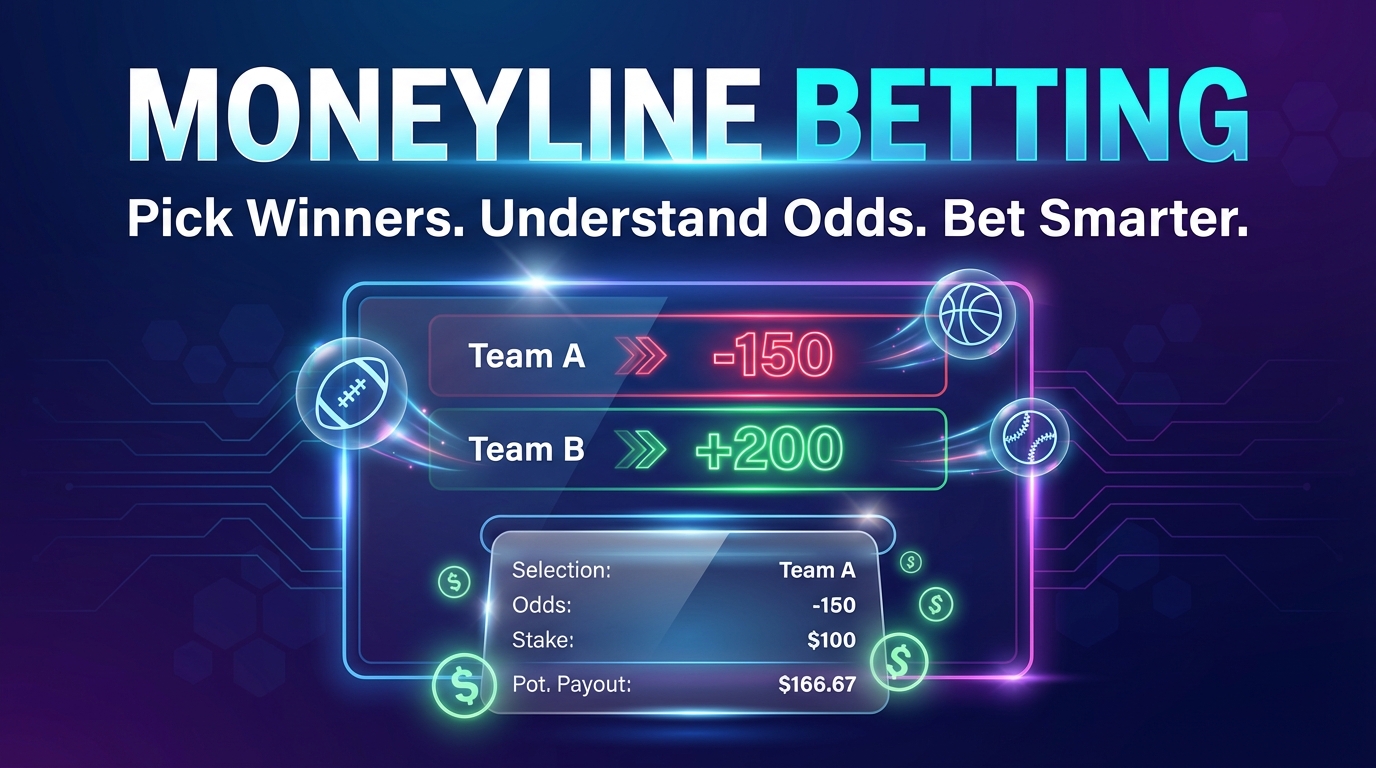
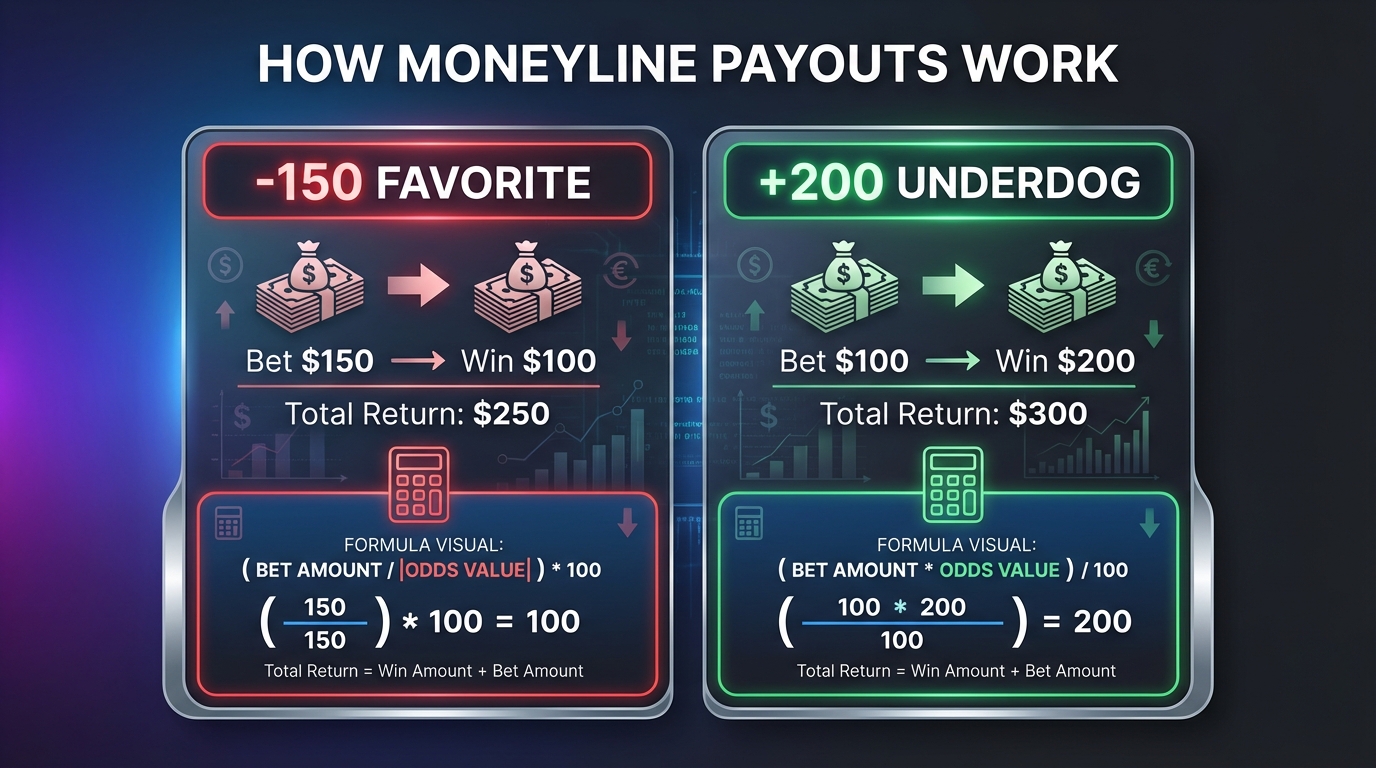
At −150, a $150 stake earns $100 profit if the bet wins. Compare all prices to identify the favorite. Two evenly matched teams can both have negative odds because the prices include the book’s margin.
EXAMPLE: -150 FAVORITE
Bet: $150
Potential Win: $100
Total Return: $250 (your $150 stake + $100 profit)
The bigger the negative number, the heavier the favorite. A -300 favorite requires $300 to win $100, meaning the sportsbook expects them to win handily.
Positive Odds (Underdogs)
At +200, a $100 stake earns $200 profit if the bet wins. In a multiway field even the shortest-priced selection can have positive odds.
EXAMPLE: +200 UNDERDOG
Bet: $100
Potential Win: $200
Total Return: $300 (your $100 stake + $200 profit)
The bigger the positive number, the longer the odds. A +500 underdog would pay $500 on a $100 bet—great payout, but the sportsbook thinks they’re unlikely to win.
Convert Your Odds Instantly
Don’t want to do the math in your head? Use our Moneyline Converter to instantly calculate payouts, implied probability, and convert between American, decimal, and fractional odds formats.
Try Our Betting Calculators
Understanding Implied Probability
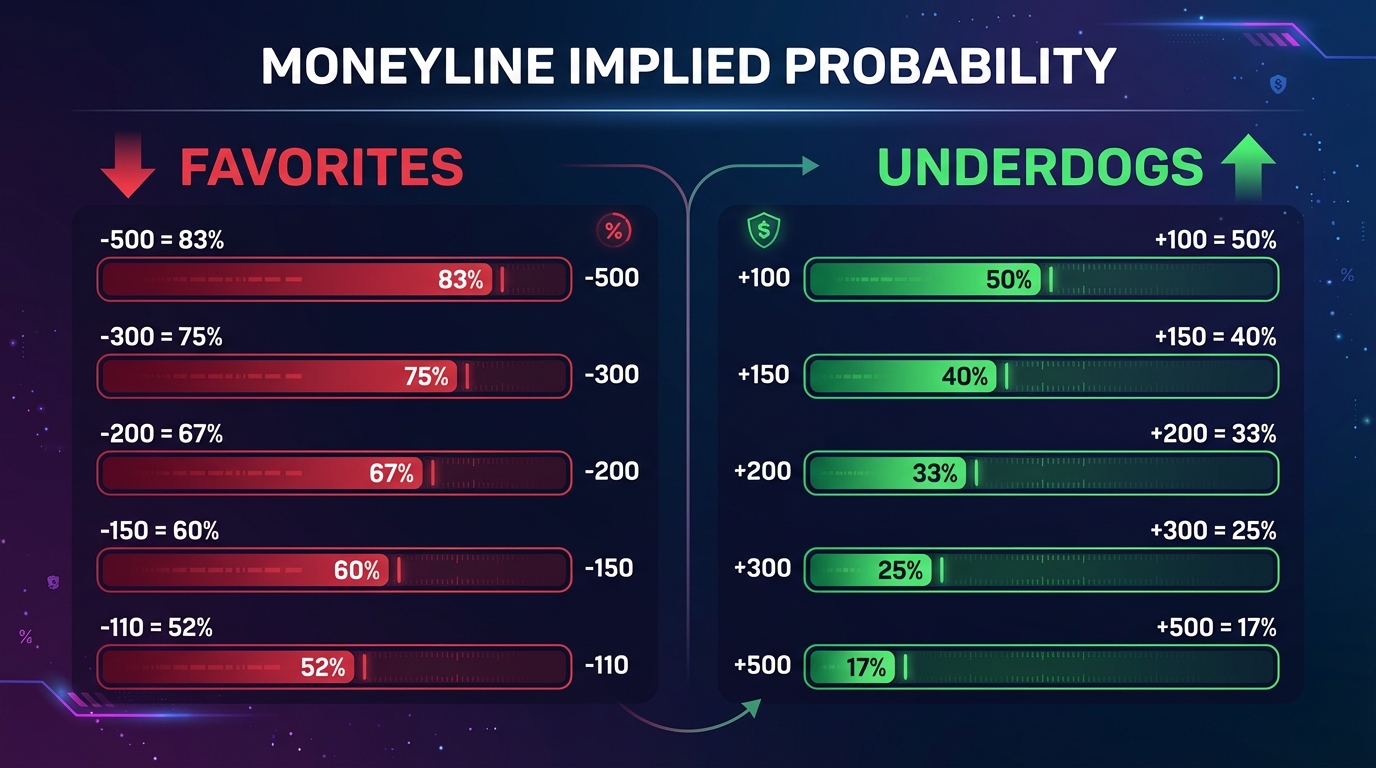
Implied probability is the break-even rate embedded in the price. Outcomes in the same book usually add up to more than 100%, so the individual prices need adjustment before using them as market estimates.
The Formulas
CONVERTING ODDS TO PROBABILITY
For Negative Odds
Probability = |Odds| ÷ (|Odds| + 100)
Example: -150 → 150 ÷ 250 = 60%
For Positive Odds
Probability = 100 ÷ (Odds + 100)
Example: +200 → 100 ÷ 300 = 33.3%
Implied Probability Reference Table
| American Odds | Implied Probability | $100 Bet Payout | Type |
|---|---|---|---|
| -500 | 83.3% | $120 | Heavy Favorite |
| -300 | 75.0% | $133 | Strong Favorite |
| -200 | 66.7% | $150 | Moderate Favorite |
| -150 | 60.0% | $167 | Slight Favorite |
| -110 | 52.4% | $191 | Near Even |
| +100 | 50.0% | $200 | Even Money |
| +150 | 40.0% | $250 | Slight Underdog |
| +200 | 33.3% | $300 | Moderate Underdog |
| +300 | 25.0% | $400 | Strong Underdog |
| +500 | 16.7% | $600 | Heavy Underdog |
Implied Probability Calculator
Moneyline vs Point Spread
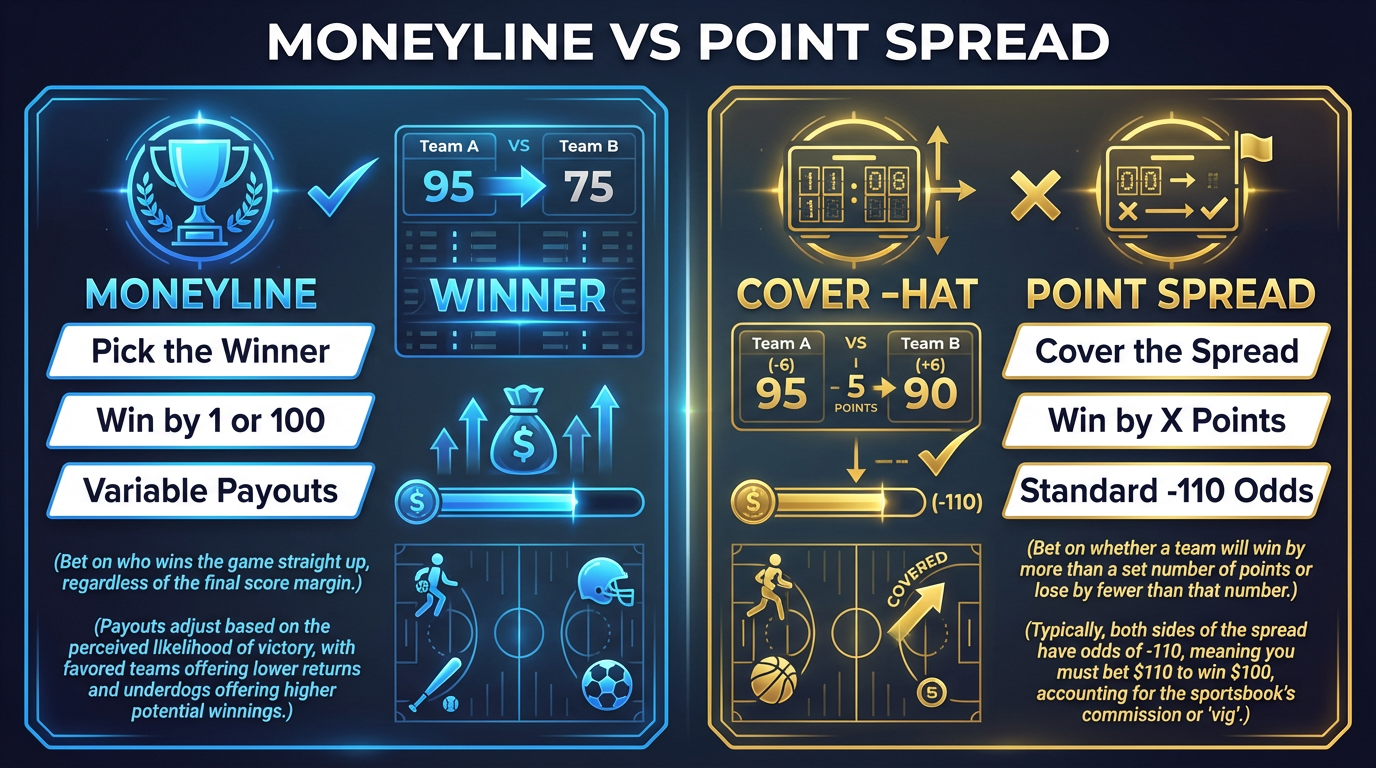
Point spread betting and moneyline betting answer different questions. Point spreads ask "will Team A win by more than X points?" while moneyline asks simply "will Team A win?"
MONEYLINE VS POINT SPREAD
Moneyline
- Pick the outright winner
- No margin of victory matters
- Variable payouts based on odds
- Better for lopsided matchups
- Simpler to understand
Point Spread
- Pick winner against the spread
- Must win/lose by specific margin
- Typically -110 on both sides
- Evens out mismatched games
- More strategic complexity
Here's a real-world example to illustrate the difference:
EXAMPLE: CHIEFS VS BRONCOS
Point Spread: Chiefs -7.5 (-110) vs Broncos +7.5 (-110)
Moneyline: Chiefs -320 vs Broncos +250
If the Chiefs win 24-20, a Chiefs spread bet loses (they didn't cover 7.5), but a Chiefs moneyline bet wins. If you're confident the Chiefs win but unsure about the margin, moneyline is your play—though you'll need to risk $320 to win $100.
Need to convert between spread and moneyline odds? Try our Spread-Moneyline Converter.
The Vig (Juice) Explained
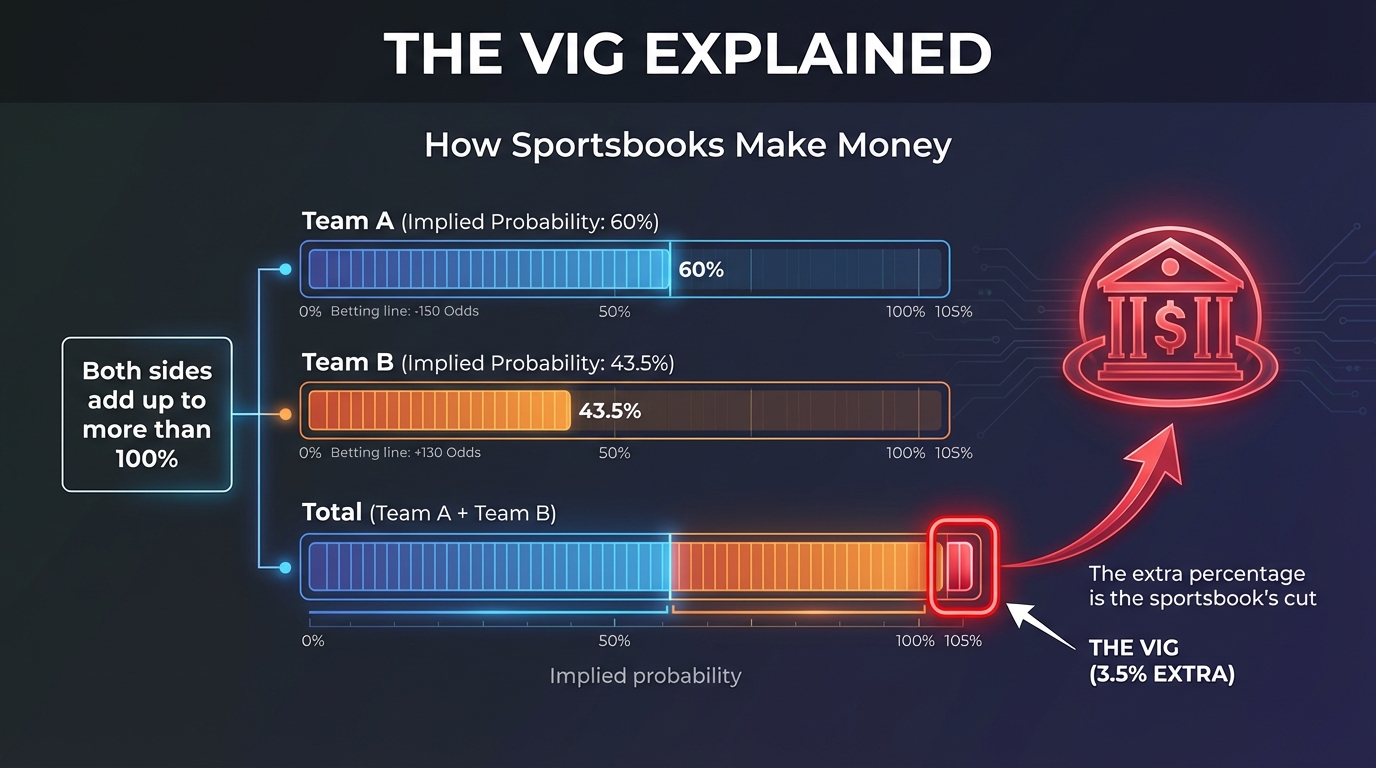
If you add up the implied probabilities of both sides in a moneyline bet, you'll notice they exceed 100%. That extra percentage is the vigorish—the sportsbook's built-in commission.
| Lakers −150 / Celtics +130 | Lakers | Celtics |
|---|---|---|
| Raw implied probability | 150/250 = 60.00% | 100/230 ≈ 43.48% |
| Proportional no-vig estimate | 60.00/103.48 ≈ 58.0% | 43.48/103.48 ≈ 42.0% |
The overround is about 3.48 percentage points. Proportional normalization assumes the margin is allocated proportionally. Neither the adjusted estimate nor the posted spread of prices guarantees the true win probability or the book’s profit on this game.
Calculating Your Payout
Let's walk through the math for calculating exact payouts on any moneyline bet.
For Favorites (Negative Odds)
Profit = (Bet Amount × 100) ÷ |Odds|
Example: $50 bet on -175 favorite
Profit = ($50 × 100) ÷ 175 = $28.57
Total Return = $50 + $28.57 = $78.57
For Underdogs (Positive Odds)
Profit = (Bet Amount × Odds) ÷ 100
Example: $50 bet on +175 underdog
Profit = ($50 × 175) ÷ 100 = $87.50
Total Return = $50 + $87.50 = $137.50
Moneyline Payout Calculator
When to Use Moneyline Bets
Moneyline betting makes the most sense in specific situations. Here's when it shines—and when you might want to look elsewhere.
BEST USE CASES FOR MONEYLINE
When Moneyline Works
- You're confident in the winner but not the margin
- Betting on slight underdogs (+100 to +200)
- Low-scoring sports like hockey, soccer, baseball
- Playoff games where margin is unpredictable
- Building parlays with multiple favorites
When to Avoid Moneyline
- Heavy favorites beyond -300 (poor risk/reward)
- You have strong feelings about the margin
- High-scoring sports with predictable margins
- The spread offers better value
- You need to limit variance
Moneyline Betting Strategy
Successful moneyline betting isn't about picking winners—it's about finding value. Here are strategies that separate profitable bettors from the pack.
1. Shop for the Best Lines
Different sportsbooks offer different odds on the same game. A team might be -145 at one book and -160 at another. Over hundreds of bets, this difference compounds significantly. Always compare lines before placing a bet.
Compare estimated chance with the price
A +150 ticket needs to win 40% of settled bets to break even. It has positive expected value at an independently estimated 45% chance and negative expected value at 35%. The price range alone establishes neither.
3. Understand Break-Even Points
For any moneyline bet to be profitable long-term, your win rate must exceed the implied probability. At -150 odds (60% implied), you need to win more than 60% of those bets to profit. Use our Expected Value Calculator to determine if a bet has positive expected value.
4. Consider Moneyline Parlays Carefully
If three distinct results were independent and each really had a two-thirds chance, all three would win 8/27 of the time, about 29.6%. A posted price of −200 alone does not establish that underlying probability.
5. Apply Kelly Criterion for Sizing
When you find a value bet, proper sizing matters. Bet too small and you're leaving money on the table. Bet too large and a losing streak wrecks your bankroll. The Kelly Criterion Calculator tells you the optimal percentage of your bankroll to wager based on your edge.
Common Moneyline Mistakes
MISTAKES TO AVOID
- Chasing heavy favorites blindly — A -400 favorite needs to win 80% of the time just to break even. One upset wipes out four wins.
- Ignoring the vig — If you're not accounting for the sportsbook's margin, you're overestimating your edge.
- Betting based on name recognition — The Yankees might be famous, but the odds reflect that. Value often hides with lesser-known teams.
- Not line shopping — Taking -150 when you could get -140 elsewhere is leaving money on the table.
- Forgetting about ties — A soccer team selection loses on a draw in a three-way market. A draw-no-bet ticket refunds the stake.
Moneyline in Different Sports
Take one match that ends 1–1 after regulation and stoppage time. A three-way home-win ticket loses; the draw selection wins. A draw-no-bet home ticket returns the stake. A separate to-qualify market can include extra time or penalties. Check DraftKings’ soccer settlement rules.
| Sport | Typical Range | Moneyline Behavior | Key Note |
|---|---|---|---|
| NFL | -200 to +200 | Moderate swings | Spread more popular |
| NBA | -300 to +300 | Wide spreads | Home court matters |
| MLB | -150 to +150 | Tighter lines | Pitcher-dependent |
| NHL | -180 to +180 | Competitive | Puck line often used |
| Soccer | -200 to +400 | 3-way lines | Draw option included |
| UFC/Boxing | -500 to +500 | Extreme variance | High upset potential |
Conclusion
Moneyline betting is the foundation of sports wagering—pick the winner, get paid. While the concept is simple, profitable moneyline betting requires understanding implied probability, recognizing value, managing bankroll, and knowing when moneyline is the right bet type versus point spreads or totals.
The key insight? Those plus and minus signs aren't just numbers—they're the sportsbook's assessment of probability wrapped in a profit margin. When your assessment differs from theirs, and you're right more often than the math requires, that's where the edge lives. Use our calculators to crunch the numbers, shop for the best lines, and never chase heavy favorites without a compelling reason.
For a worked explanation, see how to read betting odds.
FAQs
What does -110 mean in moneyline betting?
At −110, risking $110 returns $210 on a win, including $100 profit. The break-even rate on settled bets is 52.38%.
How do you calculate moneyline payout?
For a negative price divide stake × 100 by the absolute value of the price. For a positive price multiply the stake by the price and divide by 100. Add the original stake to the profit for total return.
Is moneyline or spread betting better?
Neither is universally better—it depends on the situation. Moneyline is better when you're confident in the winner but not the margin, or in low-scoring sports. Point spreads offer better value on heavy favorites and normalize payouts between mismatched teams.
What happens if a moneyline bet ties?
A 1–1 regulation draw loses for either team selection in a three-way soccer market, pays the draw selection and refunds a draw-no-bet ticket. Read the market name and settlement period.
What is the vig or juice on moneyline bets?
The sum above 100% is the overround. It measures how the market is priced. The book’s actual result also depends on amounts staked and the outcome.
Can you parlay moneyline bets?
Yes, moneyline parlays are common. You combine multiple moneyline selections into one bet with multiplied odds. All selections must win for the parlay to pay. Parlaying favorites improves the payout but multiplies risk—use a parlay calculator to see combined odds.
What does +100 mean on a moneyline?
A winning $100 bet at +100 pays $100 profit plus the original stake. Its break-even rate is 50%. The other side can have a different implied rate.
Why do moneyline odds change before a game?
Odds move based on betting action, injury news, weather, and other factors. If heavy money comes in on one side, sportsbooks adjust odds to balance their liability. Sharp bettors often cause early line movements, while public betting affects odds closer to game time.

Aevan Lark
Aevan Lark is a gambling industry veteran with over 7 years of experience working behind the scenes at leading crypto casinos — from VIP management to risk analysis and customer operations. His insider perspective spans online gambling, sports betting, provably fair gaming, and prediction markets. On Dyutam, Aevan creates in-depth guides, builds verification tools, and delivers honest, data-driven reviews to help players understand the odds, verify fairness, and gamble responsibly.
Related coverage

How to Read Betting Odds: Decimal, Fractional, and American
Betting odds encode probability, a hidden tax, and real-time market information. This guide breaks down all three formats and what the numbers…
Spread Betting in Sports – What is it? How it Works with Examples
Read a point spread, grade the final margin and compare the cost of buying a half-point using the actual price on each…

What Is a Push in Sports Betting? Ties Explained
A push returns your stake when results land exactly on the betting line. Learn how pushes affect spreads, parlays, and why the…