Pragmatic Play Pulls Games from US Sweepstakes Casinos – What It Means for Players
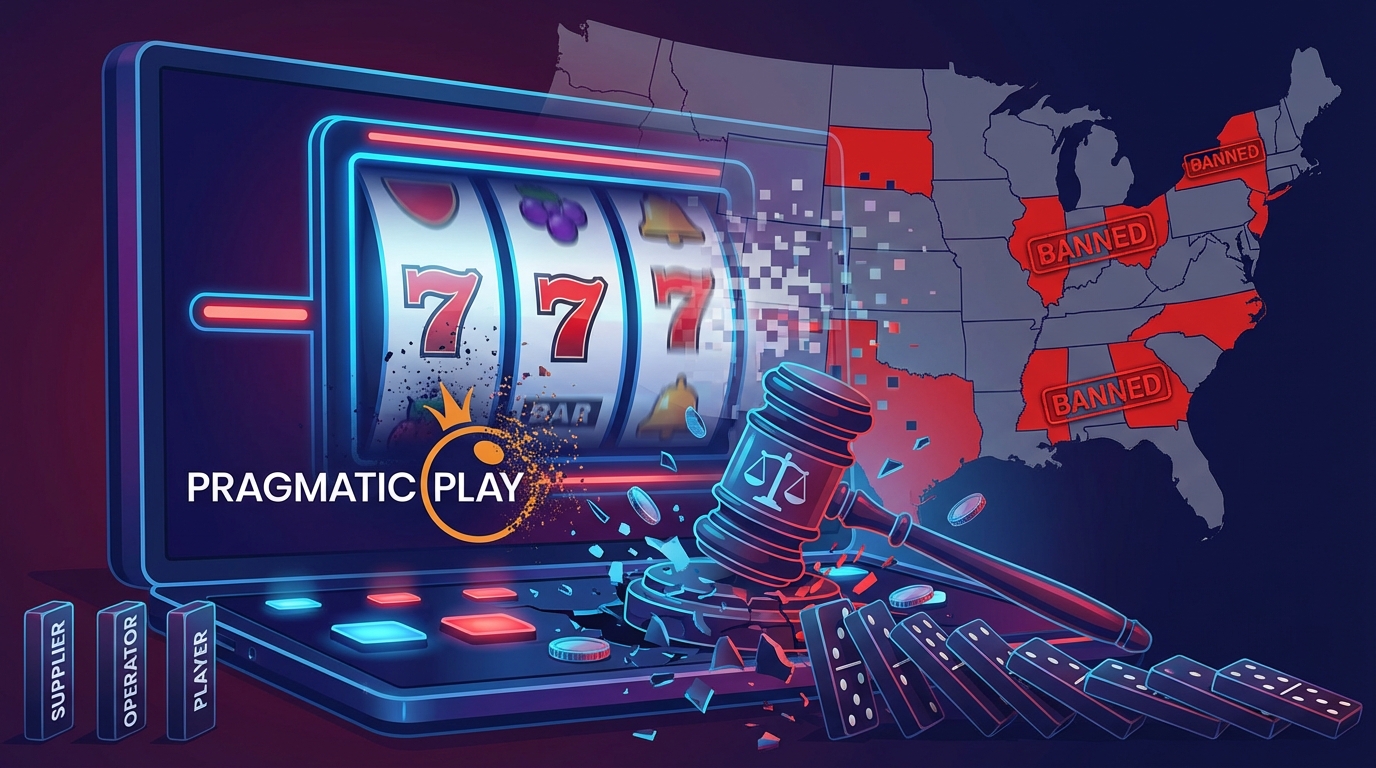
Pragmatic Play exits entire US sweepstakes market after LA lawsuit names suppliers as co-defendants. Seven states now ban sweepstakes casinos.
Pragmatic Play, the industry’s most prolific slot developer, has pulled its entire game library from US sweepstakes casinos—becoming the first major supplier to execute a complete nationwide exit. The decision, announced in early September 2025 just days after being named as a co-defendant in Los Angeles’ landmark lawsuit against Stake.us, signals a fundamental shift in how regulators are attacking the sweepstakes model: not through operators, but through their supply chain.
KEY FACTS AT A GLANCE
- Exit Scope: Pragmatic Play ceased ALL US sweepstakes licensing—not just California
- Trigger: Named co-defendant in LA City Attorney’s August 28, 2025 lawsuit against Stake.us
- Other Defendants: Evolution, Hacksaw Gaming, NetEnt, Red Tiger, Big Time Gaming, Nolimit City
- Games Lost: Gates of Olympus, Sweet Bonanza, Big Bass Bonanza, Sugar Rush, Wolf Gold, Dog House series
- Industry Impact: First top-tier provider to formally exit entire US sweepstakes market
- States Banned: 7 states now have sweepstakes bans; 10+ states have issued cease-and-desist orders
The Supplier Choke Point Strategy
The LA City Attorney’s lawsuit represents a tactical evolution in how regulators attack sweepstakes casinos. Rather than targeting operators who can simply relocate offshore, the suit names game suppliers—companies with established reputations and, critically, ambitions in regulated US markets.
Gaming attorney Daniel Wallach articulated the strategy’s genius on X: “It turns out that game content suppliers—and not payment processors (as previously thought)—may be the choke point in the sweepstakes casino ecosystem.”
Wallach’s insight cuts to the core of why this matters. “The regulatory risk regarding licensing suitability and the reputational risk—especially for publicly traded companies—make them the weak links in the chain.”
This is the same playbook federal regulators deployed against offshore poker sites in the 2000s with UIGEA—except now they’re targeting the supply chain rather than payment processors. The difference: suppliers have far more to lose. Pragmatic Play isn’t currently licensed in any regulated US iGaming market, but it clearly wants to be. A lawsuit alleging complicity in illegal gambling would complicate any future partnership with DraftKings, FanDuel, or BetMGM.
“Pragmatic Play has chosen to discontinue licensing its games to sweepstake operators in US States where restrictions were not already in place, in light of regulatory developments and evolving legislation. We remain committed to the highest standards of compliance and will continue to engage transparently with regulators.”
— Pragmatic Play spokesperson, September 2025
The LA Lawsuit: What’s Actually Being Alleged
Los Angeles City Attorney Hydee Feldstein Soto filed the civil suit on August 28, 2025, making history as the first government official in the US to take civil enforcement action against a sweepstakes casino. The filing doesn’t mince words.
“Stake.us is not a social casino because it does not offer only free, just for fun games of chance,” the complaint states. “Instead, Stake.us provides players with the opportunity to exchange their real money for virtual casino chips, gamble those chips, and then convert the winnings back into cash. It looks like gambling, sounds like gambling, and feels like gambling because it is gambling.”
The defendants read like an industry who’s-who: Pragmatic Play, Evolution Gaming (along with subsidiaries NetEnt, Red Tiger, Big Time Gaming, and Nolimit City), Hacksaw Gaming, streaming platform Kick, and Stake.us co-founders Ed Craven and Bijan Tehrani.
According to Wallach, financial penalties “could easily tally hundreds of millions” given Stake.us’s operational scale. Under California’s Unfair Competition Law, violations carry civil penalties of up to $2,500 per violation—which can be tripled when involving senior citizens, disabled persons, or veterans.
The Domino Effect: Who Else Is Leaving
Pragmatic Play’s exit wasn’t isolated. Evolution pulled its content from Stake.us immediately after the lawsuit, and has withdrawn from multiple states where cease-and-desist orders have been issued—including Arizona, Louisiana, and Mississippi. Hacksaw Gaming announced in November 2025 that it would remove all games from California before the January 1, 2026 deadline.
| Provider | Action Taken | States Affected |
|---|---|---|
| Pragmatic Play | Complete US exit | All US states |
| Evolution Gaming | Pulled from Stake.us + C&D states | CA, AZ, LA, MS |
| Hacksaw Gaming | California exit by Jan 1, 2026 | CA + C&D states |
| NetEnt/Red Tiger | Following Evolution (parent) | CA, AZ, LA, MS |
| Relax Gaming | Pulled from C&D states | LA, MS |
The trend extends beyond suppliers. VGW, operator of Chumba Casino and LuckyLand Slots—the two largest sweepstakes platforms in the US—has now exited 12 states, with 8 of those exits occurring in 2025 alone. The company pulled out of New York in May, New Jersey in July, and announced withdrawals from West Virginia and Tennessee in November.
State-by-State: The Shrinking Map
2025 marked a turning point for sweepstakes regulation. Six states enacted new bans, while at least 10 others have issued cease-and-desist orders. The momentum shows no signs of slowing.
| State | Status | Effective Date | Details |
|---|---|---|---|
| Montana | BANNED | Oct 1, 2025 | SB 555 – First state to pass sweepstakes ban |
| Connecticut | BANNED | Oct 1, 2025 | SB 1235 – Expanded existing sweepstakes ban |
| New Jersey | BANNED | Aug 15, 2025 | AB 5447 – $100K first offense, $250K repeat |
| California | BANNED | Jan 1, 2026 | AB 831 – Extends liability to vendors/suppliers |
| New York | BANNED | Dec 5, 2025 | S5935 – Effective immediately upon signing |
| Nevada | BANNED | 2025 | Regulatory prohibition |
| Washington | BANNED | Longstanding | Strict online gambling laws |
| Idaho | BANNED | Longstanding | Broad gambling prohibition |
| Michigan | Regulatory Action | — | Operators voluntarily exited |
STATES WITH ACTIVE CEASE-AND-DESIST CAMPAIGNS
Arizona, Arkansas, Delaware, Louisiana, Maryland, Mississippi, Minnesota, Pennsylvania, Tennessee, and West Virginia have all issued cease-and-desist orders to sweepstakes operators in 2025. Maryland has issued two rounds of C&D letters to VGW after the company failed to comply with the first notice.
The Games You Can’t Play Anymore
Pragmatic Play’s departure removes some of the most popular titles in the sweepstakes ecosystem. Gates of Olympus, the Zeus-themed tumbling slot with 5,000x max win potential, was a flagship title on nearly every US sweepstakes platform. Sweet Bonanza’s candy-themed cascade mechanic at 21,175x max win was equally ubiquitous.
| Lost Pragmatic Title | RTP | Max Win | Key Mechanic |
|---|---|---|---|
| Gates of Olympus | 96.5% | 5,000x | Tumble + multipliers |
| Sweet Bonanza | 96.5% | 21,175x | Cluster cascade |
| Sugar Rush | 96.5% | 25,000x | 7×7 cluster pays |
| Big Bass Bonanza | 96.7% | 2,100x | Fish collect mechanic |
| Wolf Gold | 96.0% | 2,500x | Money respin feature |
| The Dog House | 96.5% | 6,750x | Sticky wilds + multipliers |
For players seeking similar experiences, alternatives exist—but direct replacements are rare. Relax Gaming’s Money Train series offers comparable tumble mechanics, while Hacksaw’s titles (where still available) provide high-volatility cluster pays. Understanding the underlying math—concepts like RTP and house edge—becomes more important when evaluating unfamiliar titles.
What This Means for Players
WHAT THIS MEANS FOR PLAYERS
- Check your state: If you’re in CA, NY, NJ, CT, MT, WA, ID, or NV, sweepstakes platforms are either banned or exiting
- Reduced game selection: Even in legal states, expect fewer titles as suppliers pull content from C&D states
- Balance concerns: If your platform exits your state, inquire about Gold Coin/Sweeps Coin redemption timelines
- Regulated alternatives: If you’re in NJ, PA, MI, CT, WV, DE, or RI, legal real-money online casinos are available
- Avoid offshore migration: Some players may be tempted by offshore crypto casinos—verify provably fair mechanics if you go this route
The Industry Response: SGLA Pushes for Regulation
The sweepstakes industry isn’t going quietly. The Social Gaming Leadership Alliance (SGLA), formed in May 2025 with VGW as its founding partner, merged with the Social & Promotional Games Association (SPGA) in September to create a unified lobbying voice. Former South Carolina Congressman Jeff Duncan leads the combined group.
The SGLA’s position: we want to be regulated. The group has established four core principles—free-to-play access, responsible gameplay, platform protections, and strict age restrictions—and is actively lobbying for licensing frameworks rather than outright bans.
Whether regulators are interested in that compromise remains uncertain. New Jersey state Sen. Joseph Cryan has proposed legislation to regulate rather than ban sweepstakes operators, potentially reversing the state’s prohibition. But the trajectory nationally suggests bans are winning the political argument.
The Uncomfortable Question: Is the Model Dying?
With approximately 20% of the US population now living in states where sweepstakes casinos are banned (California and New York alone account for 18%), major suppliers exiting, and enforcement escalating, the sweepstakes model faces existential pressure.
According to Eilers & Krejcik Gaming, California represented about 17% of total US sweepstakes industry revenue. Add New York, New Jersey, Connecticut, and Montana, and the addressable market has contracted significantly. Looking ahead, Florida, Indiana, Iowa, Maine, and Oklahoma are all considering legislation for 2026.
The supplier exodus accelerates this contraction. When players can’t find their favorite titles, some will migrate—either to regulated real-money casinos where available, or to offshore platforms where verification of provably fair game results becomes essential consumer protection.
KEY TAKEAWAYS
- First major supplier to fully exit — Pragmatic Play’s complete US withdrawal sets a precedent other providers may follow
- Supplier targeting is the new strategy — Regulators discovered that threatening licensing suitability is more effective than chasing operators
- Seven states now have bans — CA, NY, NJ, CT, MT, WA, ID, NV all prohibit or severely restrict sweepstakes casinos
- VGW has exited 12+ states — The largest operator’s retreat signals the industry’s deteriorating position
- California’s AB 831 extends to vendors — Suppliers, payment processors, and affiliates face criminal liability starting January 1, 2026
- Content library shrinking — Gates of Olympus, Sweet Bonanza, and other popular titles are now unavailable on US sweeps
- SGLA lobbying for regulation — Industry prefers licensing frameworks to outright bans, but political momentum favors prohibition
- Migration risk exists — Players losing access may turn to offshore platforms without consumer protections
Sources
- California AB 831 — California Legislative Information
- New York S5935A — New York State Senate
- New Jersey AB 5447 — New Jersey Legislature
- Daniel Wallach (@WALLACHLEGAL) — Gaming attorney analysis on X
- Los Angeles City Attorney v. Stake.us Filing — SBC Americas

Aevan Lark
Aevan Lark is a gambling industry veteran with over 7 years of experience working behind the scenes at leading crypto casinos — from VIP management to risk analysis and customer operations. His insider perspective spans online gambling, sports betting, provably fair gaming, and prediction markets. On Dyutam, Aevan creates in-depth guides, builds verification tools, and delivers honest, data-driven reviews to help players understand the odds, verify fairness, and gamble responsibly.
Related coverage
Two Bookmakers, One Tally: Unpacking SteveWillDoIt’s Gamdom Bets
A compiler’s tally separates Gamdom and Red Rock. Its conflicting figures show the limits of SteveWillDoIt’s public betting record.

Offset’s Paris Casino Clip: The Skit Claim and the $100K MotorCity Lawsuit
Offset’s reported skit explanation, conflicting Paris money claims and the dated court order in MotorCity’s separate $100,000 lawsuit.

Who Answers for a Gambling Ad? Greece’s Case Against 18 Influencers
Greek complaints against 18 influencers over alleged unlicensed gambling promotion: the case status, the fine framework and how Dutch rules compare.