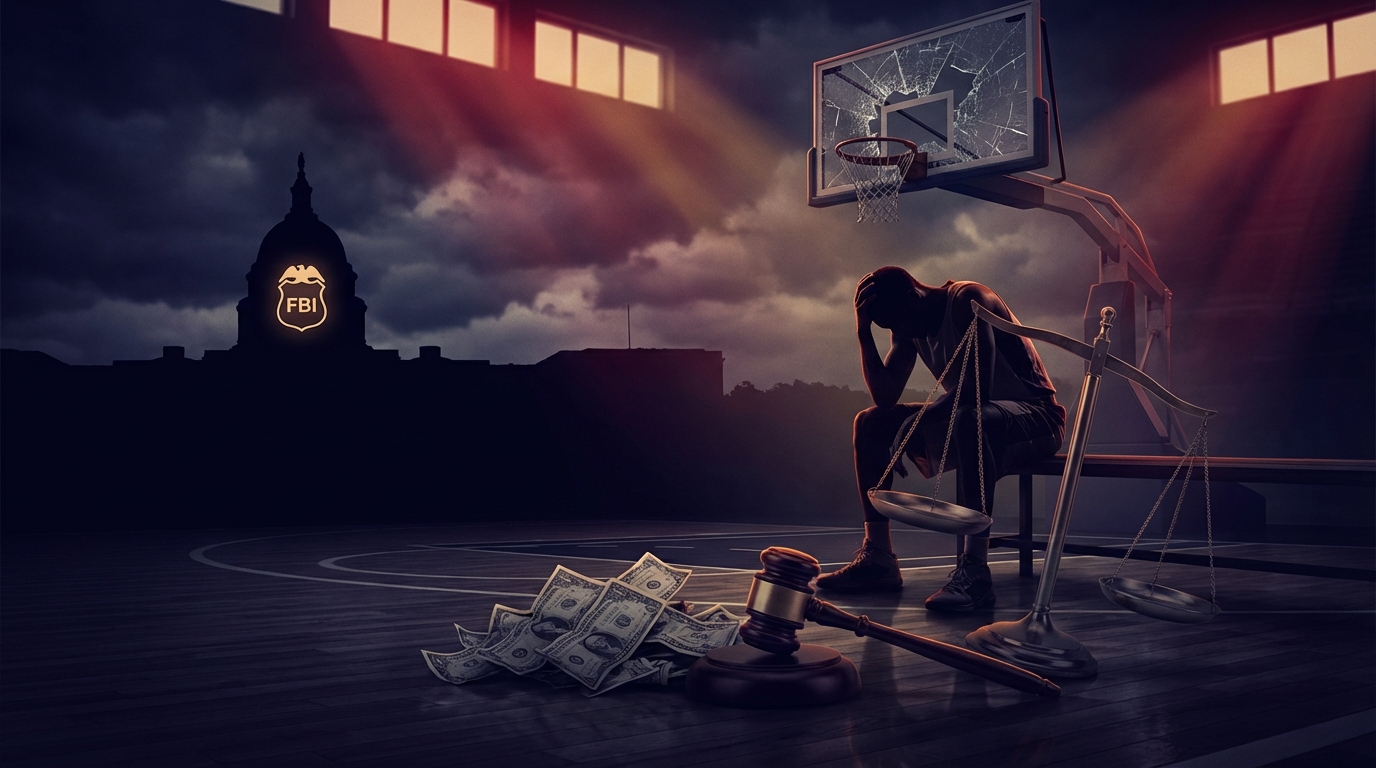
Inside the NCAA Point-Shaving Scandal: 26 Defendants, 29 Rigged Games, 17 Programs
Federal prosecutors unseal the largest college sports corruption case ever, charging 26 in a point-shaving conspiracy that infected 17 NCAA programs and fixed 29 games.
Federal prosecutors have unsealed one of the largest sports corruption cases in American history—charging 26 individuals in a sprawling point-shaving conspiracy that infected at least 17 NCAA basketball programs, with investigators alleging that a network of gamblers, trainers, and former players manipulated 29 games over three years while laundering millions through offshore betting markets.
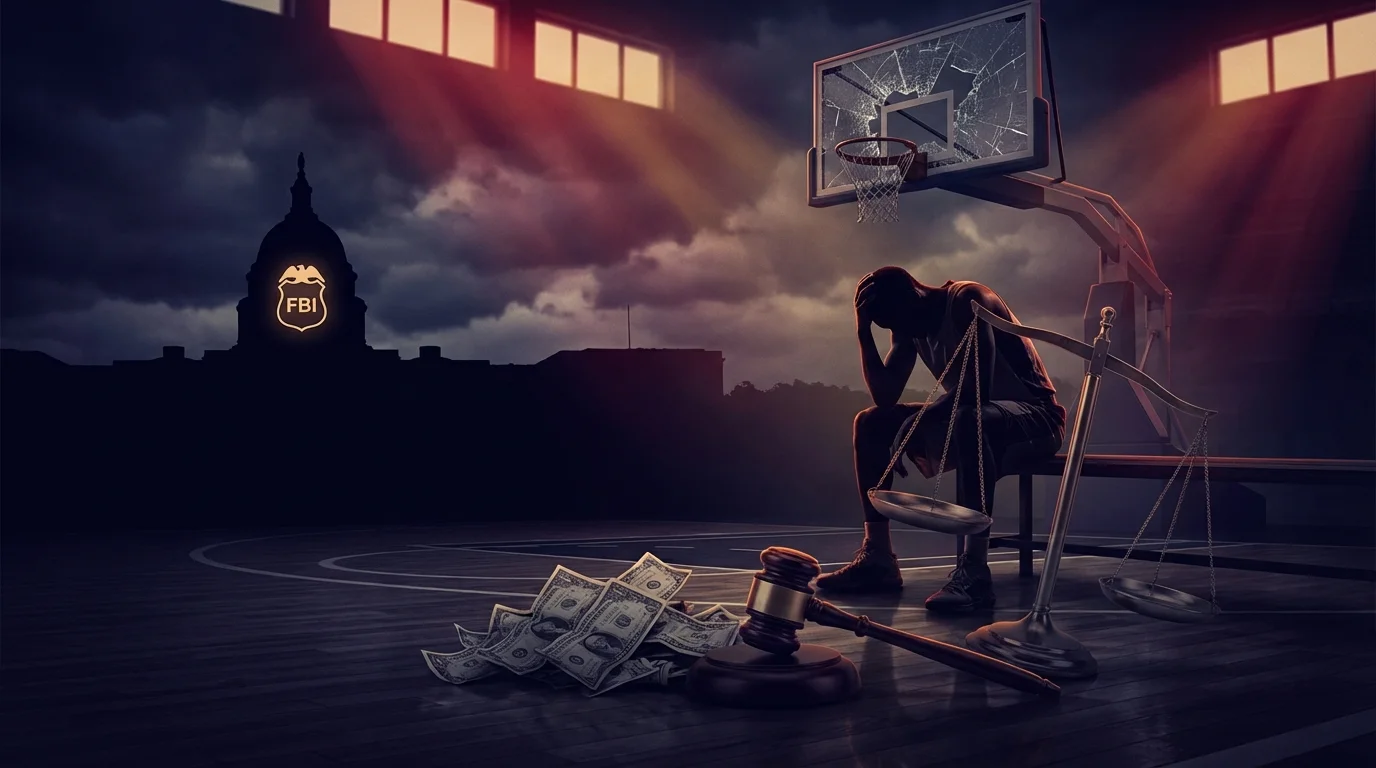
KEY FACTS AT A GLANCE
- Case: United States v. Jalen Smith et al., unsealed January 2026
- Defendants: 26 charged, including 15+ current/former NCAA players
- Games fixed: 29 confirmed, spanning September 2022 – February 2025
- Schools implicated: 17+ NCAA Division I programs
- Charges: Bribery in sporting contests (5 years max), wire fraud conspiracy (20 years max)
- Origin: Chinese Basketball Association (CBA) — scheme refined before targeting NCAA
- Key evidence: Encrypted texts, including “Death, taxes, and Chinese basketball” message
The Indictment: A Systemic Failure Exposed
The U.S. Attorney’s Office for the Eastern District of Pennsylvania, led by U.S. Attorney David Metcalf, revealed the charges in January 2026 through the case United States v. Jalen Smith et al. The indictment describes a conspiracy running from September 2022 to February 2025 that fundamentally challenged public assumptions about integrity in collegiate athletics.
Unlike historical scandals such as the 1951 CCNY affair or the 1978 Boston College point-shaving case—which were typically contained to single locker rooms or regional crime syndicates—this investigation exposed a decentralized, transnational enterprise. The charging documents list over 39 involved players, 29 specific games fixed or attempted to be fixed, and millions of dollars in illicit wagers placed across offshore and domestic betting markets.
The FBI’s Philadelphia Field Office spearheaded the investigation, discovering how the conspirators exploited two major structural changes in NCAA history: Name, Image, and Likeness (NIL) deregulations and the Transfer Portal’s player mobility. By targeting athletes in what prosecutors call the “NIL Gap”—players talented enough to influence betting lines but not famous enough to command lucrative endorsements—the fixers weaponized the economic inequality of college sports.
The Fixers: From Mob Enforcers to Digital Influencers
The conspiracy’s leadership was not the stereotypical mob enforcers of past scandals. The modern fixers utilized encrypted messaging apps, cryptocurrency, and peer-to-peer payment platforms to orchestrate their crimes.
| Fixer | Base | Role |
|---|---|---|
| Shane “Sugar Shane” Hennen | Las Vegas / Philadelphia | Mastermind — high-stakes gambler who operated as a gambling “influencer” while allegedly orchestrating fixes; also charged in separate NBA gambling scheme |
| Marves “Yez” Fairley | Mississippi | Logistics coordinator — managed capital flow and recruited professional-level talent; also faces charges in related NBA probes |
| Jalen Smith | North Carolina | Basketball trainer and “bagman” — used legitimate access to student-athletes to groom them for corruption; personally delivered cash payments |
| Antonio Blakeney | Former LSU / Chicago Bulls | “Patient Zero” — former NBA player who bridged the scheme from China to the US; recruited CBA teammates while playing for Jiangsu Dragons |
| Roderick Winkler / Alberto Laureano | Various | Intermediaries — former coaches/players who normalized bribery solicitation as “business transactions” |
The Chinese Incubator: Origins in the CBA
Before targeting the NCAA, the fixers refined their methodology in the Chinese Basketball Association. The CBA offered a testing ground: a professional league with high betting liquidity in Asian markets, significant time zone differences complicating real-time monitoring, and American import players operating with autonomy from local oversight.
Beginning in September 2022, the fixers targeted Antonio Blakeney, then a star for the Jiangsu Dragons averaging over 30 points per game. His ability to control scoring output made him a “whale” target for point-shaving operations.
CASE STUDY: MARCH 6, 2023 — JIANGSU DRAGONS
The Setup: Fixers placed wagers totaling nearly $200,000 at BetRivers Sportsbook (Rivers Casino, Philadelphia) and other outlets. The bet: Dragons would lose by a significant margin.
The Execution: Blakeney, who had been averaging 32 points per season, scored only 11 points.
The Result: Without their primary scorer at capacity, the Dragons collapsed, losing by 31 points — easily covering the spread and generating substantial payouts.
Eleven days after that game, fixers bet another $100,000 that the Dragons would lose by more than 15 points. Although Blakeney didn’t play, he reportedly acted as a broker, assuring fixers that a teammate would ensure the loss. The Dragons lost by 41 points, and the teammate was paid $20,000.
“Nothing guaranteed in this world but death, taxes, and Chinese basketball.”
— Shane Hennen, intercepted text message to co-conspirator
At the conclusion of the 2022-23 CBA season, prosecutors allege that Fairley and others delivered a package containing $200,000 in cash to a Florida storage unit belonging to Blakeney — payment for a season’s worth of compromising professional basketball integrity.
How They Targeted NCAA Players
When the conspiracy pivoted to the NCAA in the 2023-24 season, the fixers adapted their strategy. They did not pursue “one-and-done” lottery picks at elite programs who were shielded by massive NIL collectives and professional handlers. Instead, they targeted the “middle class” of Division I basketball — players at mid-major schools or transfers facing financial uncertainty.
The indictment explicitly states that fixers targeted players “for whom the bribe payments would meaningfully supplement, or exceed, the student-athletes’ legitimate opportunities for Name-Image-Likeness compensation.”
THE CORRUPTION PLAYBOOK
Bribe Structure
- $10,000 – $30,000 per game
- For Southland/Horizon League players, one payment could exceed entire annual cost of attendance
- “Proof of funds” photos sent via encrypted text
Recruitment Tactics
- Social media DMs, encrypted texts
- In-person approaches via trainers (Smith) or former players (Blakeney)
- One fixer texted: “send that to him if he bite he bite if he don’t so be it lol”
The Mechanics: Point-Shaving and First-Half Fixes
The fixes were designed for subtlety. The goal was rarely to throw games outright but to manipulate the margin of victory relative to the betting line — classic point-shaving.
Related guides: Spread Betting Explained · Over/Under Betting Guide · Parlay Betting Guide
TARGETING THE UNDERDOG
Preferred bribing players on teams already underdogs. Instruction: lose by more than predicted. A 5-point underdog becoming a 10-point loss raises fewer flags than a good team tanking.
THE FIRST-HALF FIX
Sophisticated evolution: target first-half spreads. Play disastrously for 20 minutes (turnovers, missed rotations, bad shots), then play normally in second half to mask the fix.
PROP BETS & MICRO-BETTING
The “Fresno Three” (Robinson, Vasquez, Weaver) bet on themselves to hit “under” on their own stat lines — incentivizing poor individual performance.
Forensic Breakdown: The Compromised Games
The indictment identifies at least 29 games that were fixed or attempted to be fixed. By cross-referencing the indictment with historical box scores and betting line movement, investigators reconstructed the anatomy of specific fixes.
THE BUFFALO MELTDOWN — FEB 27, 2024
Game: Buffalo vs. Kent State | Target: First-Half Spread (Kent State -8.5)
Compromised Players: Shawn Fulcher, Isaiah Adams, and “Person #5” (likely Sy Chatman)
Wagers Placed: $424,000 on Kent State to cover the first-half spread
The Anomaly: In the final 13 minutes of the first half, the three compromised players — Buffalo’s primary offensive options — combined to score exactly ONE point.
Result: Kent State went on a 12-0 run to close the half, leading 39-27. They covered by 3.5 points. The clumsy execution left evidence in the game tape.
THE DEPAUL CONSPIRACY — FEB 24, 2024
Game: DePaul vs. Georgetown | Target: First-Half Spread (Georgetown -2.5)
Compromised Players: Jalen Terry, Da’Sean Nelson, Micawber “Mac” Etienne, plus an unnamed player
Wagers Placed: $27,000 on Georgetown to cover
Complication: Uncompromised teammates played well. Text messages show fixers panicking: one texted Etienne (on bench) complaining that a specific DePaul player needed to “chill the f— out” because his performance was jeopardizing the spread.
Result: DePaul lost by only 1 point (77-76), but the first-half fix was successful. Smith delivered $40,000 to the players in Chicago afterward.
THE FAILED TULANE FIX — MARCH 2, 2024
Game: Tulane vs. Florida Atlantic | Target: Full Game Spread (FAU -15)
Compromised Player: Kevin Cross ($30,000 payment)
Wagers Placed: ~$200,000 on FAU to cover -15
What Went Wrong: Despite Cross’s alleged participation, his teammates played well. Tulane lost 79-73 — a margin of only 6 points.
Consequence: The fixers lost $200,000, driving them to become more aggressive in subsequent weeks to recoup losses — a classic risk-of-ruin spiral that led to riskier behavior.
ROBERT MORRIS POSTSEASON — MARCH 5, 2024
Game: Robert Morris vs. Purdue Fort Wayne (Horizon League Tournament)
Compromised Player: Markeese Hastings
Incriminating Evidence: Hastings texted fixers: “We might as well do the next one too… Too easy,” referencing a previous fix against Northern Kentucky.
Result: Purdue Fort Wayne won 78-63. The casual attitude (“Too easy”) demonstrates how normalized corruption had become.
The Accused: Full Roster of Defendants
| Name | School/Affiliation | Role/Allegation | Status |
|---|---|---|---|
| Antonio Blakeney | Jiangsu Dragons (CBA) | Recruiter/Fixer, “Patient Zero” | Indicted |
| Shane Hennen | Gambler | Mastermind/Fixer, placed bets | Indicted |
| Marves Fairley | Gambler | Fixer/Logistics, coordinated payments | Indicted |
| Jalen Smith | Trainer | Fixer/Bagman, delivered cash | Indicted |
| Shawn Fulcher | Buffalo / Alabama State | Player/Recruiter, organized “Buffalo Three” | Indicted |
| Isaiah Adams | Buffalo | Player, Buffalo fixes | Charged via Information |
| Jalen Terry | DePaul / Eastern Michigan | Player, central to DePaul fixes | Indicted |
| Da’Sean Nelson | DePaul / Eastern Michigan | Player, DePaul fixes | Indicted |
| Micawber Etienne | DePaul / La Salle | Player/Liaison, texted fixers from bench | Charged via Information |
| Kevin Cross | Tulane | Player, accepted $30k for FAU fix | Indicted |
| Bradley Ezewiro | Saint Louis / UAB | Player, bribery/wire fraud at SLU | Indicted |
| Markeese Hastings | Robert Morris / Western Michigan | Player, “Too easy” text | Indicted |
| Airion Simmons | Abilene Christian | Player, fixed CIT postseason games | Indicted |
| Simeon Cottle | Kennesaw State | Player, received $100k cash photos as bait | Indicted |
| Cedquavious Hunter | New Orleans | Player, admitted on Good Morning America | Banned by NCAA |
| Arlando Arnold | Southern Miss | Player, fixed games to cover fixer losses | Indicted |
| Diante Smith | Nicholls State / UT Arlington | Player, paid $32k to tank vs. McNeese | Indicted |
| Camian Shell | NC A&T / Delaware State | Player, recruited teammates | Indicted |
The Transfer Portal: A Contagion Vector
A critical insight from the defendant roster is the prevalence of transfers. Players like Carlos Hart, Jalen Terry, Da’Sean Nelson, Bradley Ezewiro, and Shawn Fulcher moved between schools during the conspiracy timeline.
The Transfer Portal acted as a contagion vector. A player compromised at School A (like Buffalo) could transfer to School B (like Alabama State) and immediately begin recruiting new teammates. This decentralized the corruption, making it impossible to contain by investigating a single program. The mobility afforded by modern college basketball rules allowed the scheme to spread across 17+ institutions.
The Response: NCAA, Legal, and Legislative
The scandal has triggered responses across institutional, legal, and legislative spheres.
MULTI-FRONT RESPONSE
NCAA Actions
- De facto lifetime ban for athletes who bet on own team or influenced outcomes
- Players like Hunter, Short, and “Fresno Three” stripped of eligibility pre-indictment
- “Layered integrity monitoring” covers 22,000+ contests annually
Legislative Push
- NCAA President Charlie Baker campaigning to ban collegiate prop bets
- Ohio, Maryland, Vermont, Louisiana have moved to ban college prop bets
- NCAA requesting CFTC halt “prediction markets” on college sports
The campaign against prop bets follows clear logic: prop bets (wagers on individual statistics) are the “gateway drug” to match-fixing. It’s easier for a single player to miss shots to hit an “Under 12.5 Points” prop than to manipulate a final score without alerting teammates. The “Fresno Three” case specifically involved players betting on their own stat lines. Understanding how betting expected value works reveals why these prop markets were so attractive to fixers.
Institutional Statements
The universities implicated have largely framed themselves as victims of their own student-athletes.
“We will cooperate fully… neither the university nor current staff are subjects.”
— Tulane University statement
Kennesaw State suspended Simeon Cottle indefinitely following the indictment. Eastern Michigan suspended Carlos Hart, emphasizing that the conduct occurred prior to his enrollment or was concealed. La Salle clarified that the fix attempted against them failed, positioning the university as a target rather than a participant.
The Bigger Picture: A Systemic Vulnerability
The 2024-25 NCAA Point-Shaving Scandal is a watershed moment for American sports. It demonstrates that the integration of legalized gambling into the sports ecosystem has created systemic vulnerabilities that cannot be policed by traditional means.
Three forces converged to create the perfect storm:
| Factor | How It Enabled Corruption |
|---|---|
| Economic Inequality | High-earning NIL stars vs. “working poor” mid-major athletes created exploitable desperation |
| Player Mobility | Transfer Portal allowed compromised players to spread corruption across multiple programs |
| Betting Technology | Micro-betting, first-half spreads, prop bets, and Asian market liquidity created new attack vectors |
The indictment of 26 individuals is likely only the first wave. As “Person #1” through “Person #10” are identified and flipped by prosecutors, the circle of implication will widen. The cynical text message — “Death, taxes, and Chinese basketball” — serves as an epitaph for the era of amateurism. In the new economy of college sports, the fixers discovered, everything and everyone had a price.
KEY TAKEAWAYS
- Largest collegiate corruption case ever — 26 defendants, 29 fixed games, 17+ programs over 3 years
- Scheme originated in China — Fixers refined point-shaving tactics in CBA before targeting NCAA
- NIL Gap exploitation — Targeted mid-major players whose bribes exceeded legitimate NIL earnings
- Transfer Portal spread corruption — Compromised players carried the scheme across multiple institutions
- First-half fixes were preferred — Easier to mask poor play when limiting it to 20 minutes
- Failed fixes drove riskier behavior — The $200k loss on Tulane led to more aggressive scheming
- NCAA pushing for prop bet bans — Individual stat wagers identified as “gateway” to match-fixing
- More charges likely coming — “Person #1” through “Person #10” remain unidentified co-conspirators
RELATED STORIES
Sources
- U.S. Attorney’s Office, Eastern District of Pennsylvania — Federal indictment announcement
- NCAA Official Statement — Integrity monitoring and eligibility sanctions

Aevan Lark
Aevan Lark is a gambling industry veteran with over 7 years of experience working behind the scenes at leading crypto casinos — from VIP management to risk analysis and customer operations. His insider perspective spans online gambling, sports betting, provably fair gaming, and prediction markets. On Dyutam, Aevan creates in-depth guides, builds verification tools, and delivers honest, data-driven reviews to help players understand the odds, verify fairness, and gamble responsibly.
Related coverage
Two Bookmakers, One Tally: Unpacking SteveWillDoIt’s Gamdom Bets
A compiler’s tally separates Gamdom and Red Rock. Its conflicting figures show the limits of SteveWillDoIt’s public betting record.
Offset’s Paris Casino Clip: The Skit Claim and the $100K MotorCity Lawsuit
Offset’s reported skit explanation, conflicting Paris money claims and the dated court order in MotorCity’s separate $100,000 lawsuit.
Who Answers for a Gambling Ad? Greece’s Case Against 18 Influencers
Greek complaints against 18 influencers over alleged unlicensed gambling promotion: the case status, the fine framework and how Dutch rules compare.