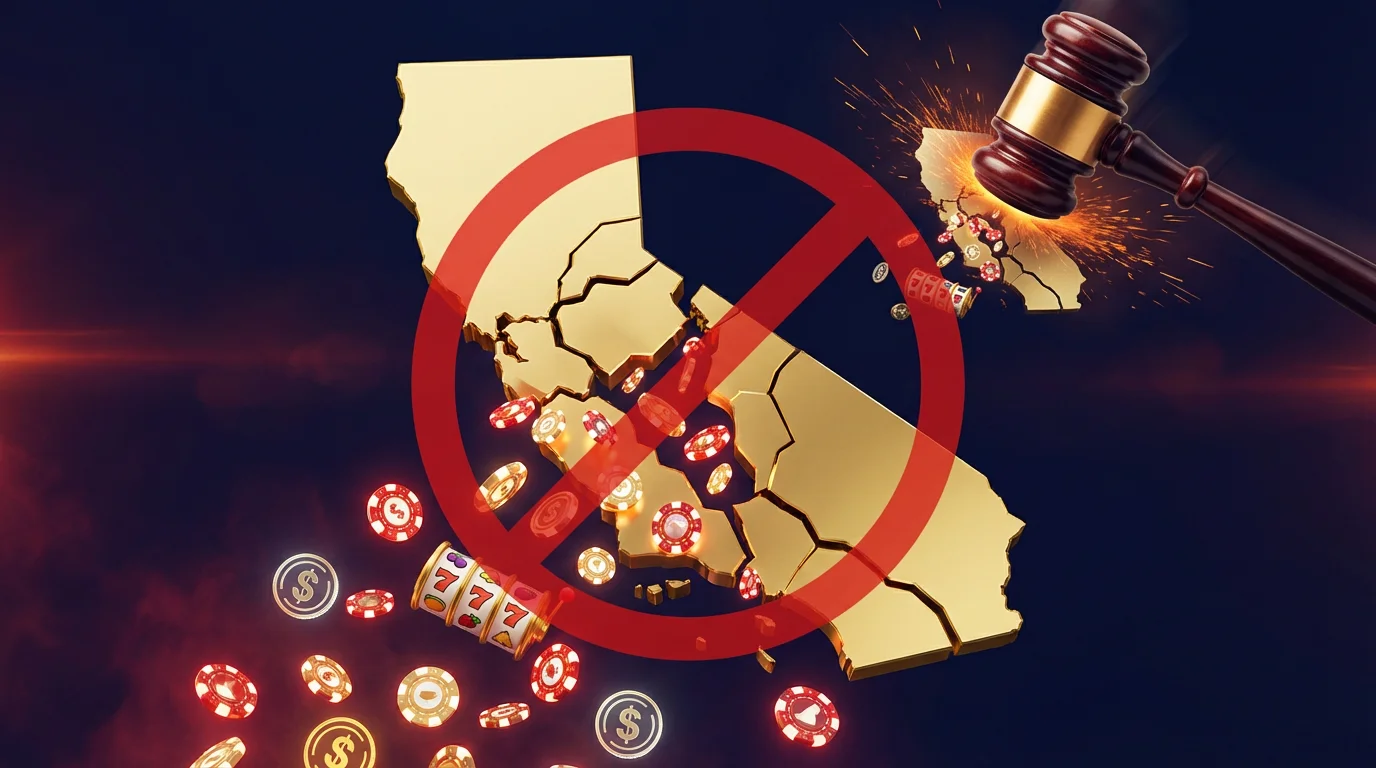
California’s Exit Wipes $1 Billion from Sweepstakes Industry
AB 831 takes effect January 1, triggering projected 10% industry decline as operators and suppliers flee the state.
On January 1, 2026, California’s AB 831 went into effect, eliminating approximately $1 billion in annual sweepstakes revenue overnight and triggering the largest single market exit in the industry’s history—a regulatory earthquake that analysts at Eilers & Krejcik Gaming say will drive a 10% industry-wide decline this year, shrinking the market from $4 billion to $3.6 billion.
KEY FACTS AT A GLANCE
- Law: AB 831, signed October 11, 2025 — effective January 1, 2026
- Vote: Passed unanimously — Senate 36-0, Assembly 79-0
- Market impact: ~$1 billion in annual California sweepstakes revenue eliminated
- 2026 industry forecast: 10% decline projected ($4B → $3.6B)
- Key differentiator: Criminalizes vendors, payment processors, and affiliates — not just operators
- Operator exits: 20+ platforms have ceased California operations since October 2025
- Sponsored by: San Manuel Band, CNIGA, and TASIN (tribal coalition)
What AB 831 Actually Does
Assemblymember Avelino Valencia’s AB 831 passed both chambers without a single opposing vote—36-0 in the Senate and 79-0 in the Assembly on final concurrence—before Governor Gavin Newsom signed it into law on October 11, 2025. It was chaptered as Chapter 623, Statutes of 2025, with an effective date of January 1, 2026.
The law amends Business & Professions Code §17539.1 and adds Penal Code §337o, targeting the dual-currency model that sweepstakes platforms use to simulate gambling while claiming promotional exemptions. Specifically, it prohibits operating, conducting, or offering any “online sweepstakes game” where virtual currency can be exchanged for cash or cash equivalents, and where games “simulate gambling”—slots, video poker, table games, bingo, or sports wagering.
Penalties are classified as misdemeanor offenses: fines of $1,000 to $25,000 per violation, up to one year in county jail, or both. The law exempts licensed gambling enterprises under the California Gambling Control Act, California State Lottery operations, and “bona fide” promotional sweepstakes that are “limited and occasional” and “incidental to substantial sales of consumer products.”
The “Supplier as Choke Point” Architecture
What separates AB 831 from every previous sweepstakes enforcement action is its vendor liability framework. Under the new Penal Code §337o, it is unlawful for “any entity, financial institution, payment processor, geolocation provider, gaming content supplier, platform provider, or media affiliate to knowingly and willfully support directly or indirectly the operation, conduct, or promotion of an online sweepstakes game” in California.
AB 831’s VENDOR LIABILITY: WHO’S CRIMINALLY EXPOSED?
Under California Penal Code §337o, the following entities face criminal liability (up to 1 year jail, $25,000 fine) for “knowingly and willfully” supporting sweepstakes operations:
- Financial institutions
- Payment processors
- Geolocation providers
- Gaming content suppliers
- Platform providers
- Media affiliates
This is the first US sweepstakes law to explicitly criminalize the supply chain—not just operators.
This is an evolution in enforcement strategy. The old model targeted operators, letting them play whack-a-mole with new domains and corporate structures. AB 831 targets everyone who enables operations. The result is content supply-side collapse: Pragmatic Play exited the entire US sweepstakes market in September 2025—days after being named in a lawsuit against Stake.us in Los Angeles. Evolution and Hacksaw Gaming pulled their content from California platforms. Multiple smaller providers followed.
The Los Angeles City Attorney’s civil action against Stake.us in August 2025 previewed this approach, naming game suppliers and streaming partners as defendants alongside the operator. AB 831 codifies this joint operator-vendor enforcement model into criminal statute.
Who Drove This: The Tribal Interest Story
AB 831 was co-sponsored by the Yuhaaviatam of San Manuel Nation, the California Nations Indian Gaming Association (CNIGA), and the Tribal Alliance of Sovereign Indian Nations (TASIN). Their collective stake: over 70 tribal casinos generating $9 billion or more in annual revenue, protected by tribal-state compacts that grant exclusive gaming rights.
The tribal argument was straightforward: sweepstakes platforms violated compact-protected gaming exclusivity, the dual-currency model was a legal fiction to circumvent gambling laws, and the state was losing both regulatory oversight and tax revenue. Given the tribes’ political influence in Sacramento, the result was predictable—unanimous passage with zero organized opposition in either chamber.
The Social Gaming Leadership Alliance (SGLA) urged a veto, claiming the ban would cost $1 billion in annual economic activity and citing a survey showing 77% of Californians believed sweepstakes should continue operating. SGLA Executive Director Jeff Duncan stated: “California has always been a leader in innovation, not a place where opportunity is shut down overnight.” The industry’s lobbying effort was outmatched. The broader Social and Promotional Games Association (SPGA) also opposed the bill, earning support from the ACLU and the Association of National Advertisers—but it wasn’t enough to generate a single opposing vote.
This is the “Fortress State” pattern—established gaming interests using legislation to block online competition. The same dynamic drove Mississippi’s SB 2104, where brick-and-mortar casino interests pushed to classify sweepstakes under existing illegal gambling statutes.
The Industry Fallout
The damage is concrete. Six sweepstakes casinos have permanently shut down since October 2025: Vivaro.us (cited “regulatory uncertainty”), Starlight Casino, Bitsler.io, LuckyStars Casino, OnPoint Casino, and Turbo Stakes Casino. Beyond full closures, more than 20 operators exited California specifically—including Ruby Sweeps, High 5 Casino, McLuck, Pulsz, Hello Millions, and Casino.click.
OPERATOR EXITS & SHUTDOWNS
Permanently Shut Down
- Vivaro.us (October 2025)
- Starlight Casino
- Bitsler.io
- LuckyStars Casino (November 2025)
- OnPoint Casino (November 2025)
- Turbo Stakes Casino (November 2025)
Exited California
- Ruby Sweeps
- High 5 Casino
- McLuck
- Pulsz
- Hello Millions
- Casino.click
- Carnival Citi, Dora Casino, LuckyStake, PlayFame, Rebet, SpinBlitz, Spinfinite, Thrillzz
On the supply side, Pragmatic Play’s exit removed arguably the largest game library from US sweepstakes platforms entirely. Evolution pulled games from California. Smaller providers—Booming Games, Live88, Fat Panda, Just Slots—pulled games from various platforms. The content supply chain is contracting alongside the operator base.
Eilers & Krejcik Gaming revised their 2025 US sweepstakes revenue estimate down to $4 billion (from an earlier $4.7 billion projection) and forecast a further 10% decline to $3.6 billion in 2026. Their bear case: a 30% decline if more states follow California’s lead.
The State-by-State Domino Effect
California isn’t acting alone. A wave of state-level action in 2025 has fundamentally reshaped the sweepstakes map, and 2026 legislation is already advancing in multiple jurisdictions.
| State | Status | Method | Effective |
|---|---|---|---|
| California | Banned | AB 831 legislation | Jan 1, 2026 |
| New York | Banned | S5935A + AG enforcement | Dec 8, 2025 |
| New Jersey | Banned | A5447 legislation | Aug 15, 2025 |
| Montana | Banned | SB 555 legislation | Oct 1, 2025 |
| Connecticut | Banned | SB 1235 legislation | Oct 1, 2025 |
| Nevada | Restricted | Legislation (not explicit ban) | 2025 |
| Michigan | Banned | Regulatory enforcement | 2024 |
| Washington | Banned | Existing gambling law | Pre-2025 |
| West Virginia | Exiting | 47 AG subpoenas | Dec 2025 |
| Tennessee | Exiting | 38 cease-and-desist orders | Dec 2025 |
| Louisiana | Enforcement | 40 cease-and-desist letters | 2025 |
| Delaware | Enforcement | Gaming enforcement orders | 2025 |
| Maryland | Enforcement | Lottery/Gaming Commission | 2025 |
Beyond enforcement actions, Tennessee sent 38 cease-and-desist orders in December 2025, driving 30+ operators out of the state. West Virginia issued 47 AG subpoenas with similar results. Maryland has refiled its sweepstakes ban, and Louisiana’s AG sent 40 cease-and-desist letters (though the governor vetoed a legislative ban).
For 2026, bills are already advancing. Florida’s HB 591—an 86-page bill that makes sweepstakes operation a third-degree felony—would eliminate another 8.5% of industry revenue if passed. Indiana’s HB 1052 is in committee, though some lawmakers are pushing regulation over prohibition. Virginia’s HB 161, Maine, and Mississippi have all introduced bills. Indiana Gaming Commission Chairman Nate Friend has predicted nine states will consider sweepstakes bans in 2026.
The population math is stark: with California (39.5M), New York (19.8M), and the other banned or restricted states combined, approximately 20% of Americans are now excluded from sweepstakes casinos.
What This Means for 2026
The sweepstakes industry’s growth story is over. Eilers & Krejcik Gaming frames the outlook with “an enormous amount of uncertainty related to potential regulatory developments.” Their scenarios: a bull case of +14% growth (increasingly unlikely given legislative momentum), a base case of -10% decline, and a bear case of -30% contraction if Florida and other large states follow California’s template.
BULL CASE
+14% growth. Assumes no additional state bans and industry stabilization. Increasingly unlikely.
BASE CASE
-10% decline ($4B → $3.6B). California exit plus continued state-level pressure.
BEAR CASE
-30% decline. Florida passes HB 591, multiple states follow California’s vendor liability model.
The SGLA’s counter-strategy is pivoting from defense to regulation: “We want to be regulated. We want to pay taxes,” Duncan has argued. Some operators are re-entering previously exited states—a risky gamble given the enforcement trajectory. Class action litigation against VGW, Stake.us, and others remains ongoing, adding legal costs to an already contracting market.
The core question for 2026 isn’t whether the sweepstakes industry survives—it will, in reduced form. It’s whether AB 831’s vendor liability architecture becomes the national template. If Florida, Indiana, and other pending states adopt the “supplier as choke point” model, the industry’s content supply chain faces existential pressure regardless of how many operators remain willing to take the risk.
KEY TAKEAWAYS
- AB 831 is the most aggressive US sweepstakes law — it criminalizes the entire supply chain, not just operators, creating a “choke point” enforcement model
- California alone wiped ~$1 billion — representing 17-20% of US sweepstakes revenue, the largest single market exit in industry history
- Tribal interests drove unanimous passage — the $9B+ California tribal gaming industry used its political leverage to protect compact-protected exclusivity
- The domino effect is accelerating — 6+ states banned sweepstakes in 2025, with Florida, Indiana, Virginia, and others advancing 2026 legislation
- Industry contraction has begun — Eilers & Krejcik projects -10% decline in 2026, with a -30% bear case if more states adopt California’s template
- Content suppliers are fleeing — Pragmatic Play’s full US exit signals that the supply chain, not just operators, is retreating
Sources
- AB 831 Full Text — California Legislature
- S5935A Bill Text — New York State Senate
- AG Enforcement Action Against Sweepstakes Casinos — New York Attorney General
- A5447 Bill Details — New Jersey Legislature (via LegiScan)

Aevan Lark
Aevan Lark is a gambling industry veteran with over 7 years of experience working behind the scenes at leading crypto casinos — from VIP management to risk analysis and customer operations. His insider perspective spans online gambling, sports betting, provably fair gaming, and prediction markets. On Dyutam, Aevan creates in-depth guides, builds verification tools, and delivers honest, data-driven reviews to help players understand the odds, verify fairness, and gamble responsibly.
Related coverage
Two Bookmakers, One Tally: Unpacking SteveWillDoIt’s Gamdom Bets
A compiler’s tally separates Gamdom and Red Rock. Its conflicting figures show the limits of SteveWillDoIt’s public betting record.

Offset’s Paris Casino Clip: The Skit Claim and the $100K MotorCity Lawsuit
Offset’s reported skit explanation, conflicting Paris money claims and the dated court order in MotorCity’s separate $100,000 lawsuit.

Who Answers for a Gambling Ad? Greece’s Case Against 18 Influencers
Greek complaints against 18 influencers over alleged unlicensed gambling promotion: the case status, the fine framework and how Dutch rules compare.