Indiana HB 1052: The Sweepstakes Casino Ban That Could Reshape the Industry
Indiana's HB 1052 targets sweepstakes casinos with dual-currency bans and $100K penalties — and it's on a deadline.
Indiana is days away from potentially becoming the first state in 2026 to enact an explicit sweepstakes casino prohibition — and the bill’s approach to defining and penalizing dual-currency gaming could become the template for a dozen other states watching closely.

KEY FACTS AT A GLANCE
- Bill: Indiana HB 1052
- Status: Conference committee (as of Feb 23, 2026)
- House vote: 87-11 (Feb 2, 2026)
- Senate vote: 37-8 (Feb 17-18, 2026)
- Deadline: Legislature adjourns Feb 27, 2026
- Penalties: Up to $100,000 per violation (civil)
- Enforcement: Indiana Gaming Commission
- Effective date: July 1, 2026 (if enacted)
What HB 1052 Actually Does
At its core, HB 1052 targets the mechanism that makes sweepstakes casinos possible: the dual-currency system. The bill defines a “sweepstakes game” as any internet-accessible contest that uses a dual or multi-currency structure where at least one currency can be exchanged for cash or cash equivalents. If a platform lets you buy gold coins, gives you free sweep coins as a “bonus,” and then lets you redeem those sweep coins for real money — that’s exactly what this bill is designed to prohibit.
The definition is deliberately broad. It covers any game accessible via computer, tablet, or mobile device that uses this purchase-play-redeem loop, regardless of whether the operator calls it a “sweepstakes,” “promotional contest,” or any other label. What matters is the functional reality: if consideration flows in and prizes flow out through a multi-currency intermediary, HB 1052 treats it as illegal gambling.
Penalties are civil, not criminal — up to $100,000 per violation, enforced by the Indiana Gaming Commission. The IGC can also pursue cross-border enforcement against out-of-state operators that serve Indiana users, closing the loophole that has allowed offshore-based sweepstakes platforms to operate with impunity in states that lack explicit statutory prohibitions.
WHAT’S BANNED VS WHAT’S EXCLUDED
BANNED UNDER HB 1052
- Dual/multi-currency sweepstakes games
- Internet-accessible contests with cash redemption
- Platforms using purchase-play-redeem model
- Out-of-state operators serving Indiana users
- Any “promotional contest” functioning as gambling
EXCLUDED FROM THE BAN
- Indiana state lottery operations
- Licensed casino and sports betting operators
- Peer-to-peer skill-based poker (Senate amendment)
- Daily fantasy sports (existing regulation)
- Horse racing wagering (existing regulation)
The Bill’s Journey
HB 1052 has moved through the Indiana legislature at unusual speed, reflecting the bipartisan urgency behind the sweepstakes crackdown. From its initial committee hearings in January to its current conference committee stage, the bill has faced remarkably little opposition — clearing both chambers with supermajority votes.
| Date | Event | Result |
|---|---|---|
| Dec 5, 2025 | Filed by Rep. Ethan Manning | Introduced |
| Jan 2026 | House committee hearings — IGC + SGLA testimony | Testimony heard |
| Jan 30, 2026 | Reprinted after committee amendments | Amended |
| Feb 2, 2026 | House floor vote | Passed 87-11 |
| Feb 12, 2026 | Senate committee reports favorably | Advanced |
| Feb 17-18, 2026 | Senate amends (poker carve-out), floor vote | Passed 37-8 |
| Feb 18, 2026 | House dissents from Senate amendments | Conference requested |
| Feb 24 (expected) | Conference committee meets | Pending |
| Feb 27, 2026 | Session adjourns (hard deadline) | Deadline |
Why Indiana Matters More Than Other States
Indiana’s approach represents a philosophical shift in how states are tackling the sweepstakes problem. Rather than relying on administrative pressure — cease-and-desist letters, attorney general opinions, or regulatory interpretations — Indiana is going straight to statute. And the results from states that tried the softer approach explain why.
Illinois sent 65 cease-and-desist letters to sweepstakes operators. The compliance rate? Three percent. Just 2 of 65 operators actually stopped serving Illinois users. New York’s attorney general had better luck — 100% compliance from C&D letters — but that success was backstopped by imminent legislation that operators knew was coming. Without the threat of statutory enforcement, administrative pressure is largely performative.
Indiana’s IGC Chairman Nate Friend made the case directly during committee hearings: the commission cannot send cease-and-desist letters “in good faith” under current Indiana law because sweepstakes casinos occupy a gray zone that existing statutes don’t explicitly address. HB 1052 eliminates that ambiguity. It defines what a sweepstakes game is, declares it illegal, attaches a $100,000 penalty, and gives the IGC enforcement authority. Define it, penalize it, enforce it — that’s the model other states are now watching.
“The Indiana Gaming Commission cannot send cease-and-desist letters in good faith under current law. We need explicit statutory authority to act.”
— Nate Friend, Chairman, Indiana Gaming Commission
The $11 Billion Industry Under Siege
The sweepstakes casino industry’s growth trajectory has been staggering. From an estimated $3.1 billion in gross revenue in 2022, the sector exploded to over $11 billion by 2025 — a compound annual growth rate of 60-70% that outpaced virtually every other segment of the gambling industry. VGW, the parent company of Chumba Casino, LuckyLand Slots, and Global Poker, alone generated $6.13 billion in global revenue, making it one of the largest gambling operators most people have never heard of.
But that growth has attracted exactly the kind of regulatory attention the industry spent years avoiding. Five states enacted sweepstakes bans in 2025 alone: California, New York, Montana, Connecticut, and New Jersey. IGC Chairman Friend predicted during Indiana’s hearings that nine or more additional states would consider bans in 2026 — a prediction that is already proving conservative.
The financial impact is already being priced in. Eilers & Krejcik Gaming, one of the industry’s most-cited research firms, revised its sweepstakes revenue forecasts downward by 17.5% in late 2025 due to regulatory pressure. The American Gaming Association’s own consumer research found that 90% of Americans consider sweepstakes casinos to be gambling — undermining the industry’s core legal argument that these are promotional contests, not gambling operations.
“Consumers know what sweepstakes casinos are. Ninety percent of Americans consider them gambling. The promotional contest framing doesn’t survive contact with reality.”
— American Gaming Association, 2025 Consumer Survey
The Industry Fights Back
The sweepstakes industry hasn’t gone quietly. The Sweepstakes Gaming Lawyers Association (SGLA) mounted a coordinated “regulate, don’t ban” campaign, proposing a licensing framework that would have generated an estimated $20 million or more in state revenue for Indiana. Their argument: sweepstakes casinos are legitimate businesses operating in a legal gray zone, and outright prohibition would push players to unregulated offshore sites that offer no consumer protections whatsoever.
“You’re criminalizing law-abiding businesses that employ thousands of people and generate millions in economic activity. Regulation is the responsible path.”
— Sean Ostrow, Sweepstakes Gaming Lawyers Association
ARB Interactive’s Dan Marks echoed the concern, warning that a ban would simply drive Indiana players to offshore gambling sites that operate entirely outside U.S. jurisdiction. The argument has historical precedent — the U.S. experience with online poker prohibition in 2006 created a thriving offshore market that took years to unwind.
On the legislative floor, Rep. Bartels introduced an amendment to replace the ban with a regulate-and-tax framework. It was defeated 54-34. Sen. Alting proposed a similar amendment in the Senate but withdrew it before a vote, recognizing the supermajority support for prohibition. The regulate-instead-of-ban camp lost decisively — but they may have a template in Virginia, where SB 118 passed the Senate 19-17 with a hybrid approach: ban sweepstakes casinos but create a licensing pathway for operators willing to submit to full state regulation.
What Operators Are Parsing in the Bill Text
For sweepstakes operators and their legal teams, the devil is in HB 1052’s definitions. The bill’s use of “consideration” in the context of dual-currency systems is the crux: sweepstakes operators have long argued that because players receive free sweep coins without purchase, no “consideration” exists and therefore no gambling occurs. HB 1052 sidesteps this argument by targeting the dual-currency mechanism itself rather than relying on the traditional consideration-chance-prize gambling test.
The definition of “cash equivalents” and how narrowly the bill scopes prize redemption pathways will determine whether operators can restructure around the prohibition. If “cash equivalents” is interpreted broadly — covering gift cards, cryptocurrency, and merchandise of substantial value — the exits are limited. If interpreted narrowly, operators may attempt creative workarounds.
Perhaps the most scrutinized question is whether any social-casino exceptions exist. Pure social casinos — platforms where you play with virtual currency that can never be redeemed for anything of real value — appear to fall outside HB 1052’s scope. But the line between “social casino” and “sweepstakes casino” has always been blurry, and operators fear that an aggressive IGC interpretation could sweep social gaming into the prohibition.
Then there’s the poker carve-out. The Senate added an exclusion for peer-to-peer skill-based poker — an amendment the House hasn’t accepted. This is expected to be the primary sticking point in conference committee. Whether the carve-out survives, gets narrowed, or gets dropped entirely could determine how quickly the bill reaches the governor’s desk before the February 27 deadline.
The National Crackdown Map
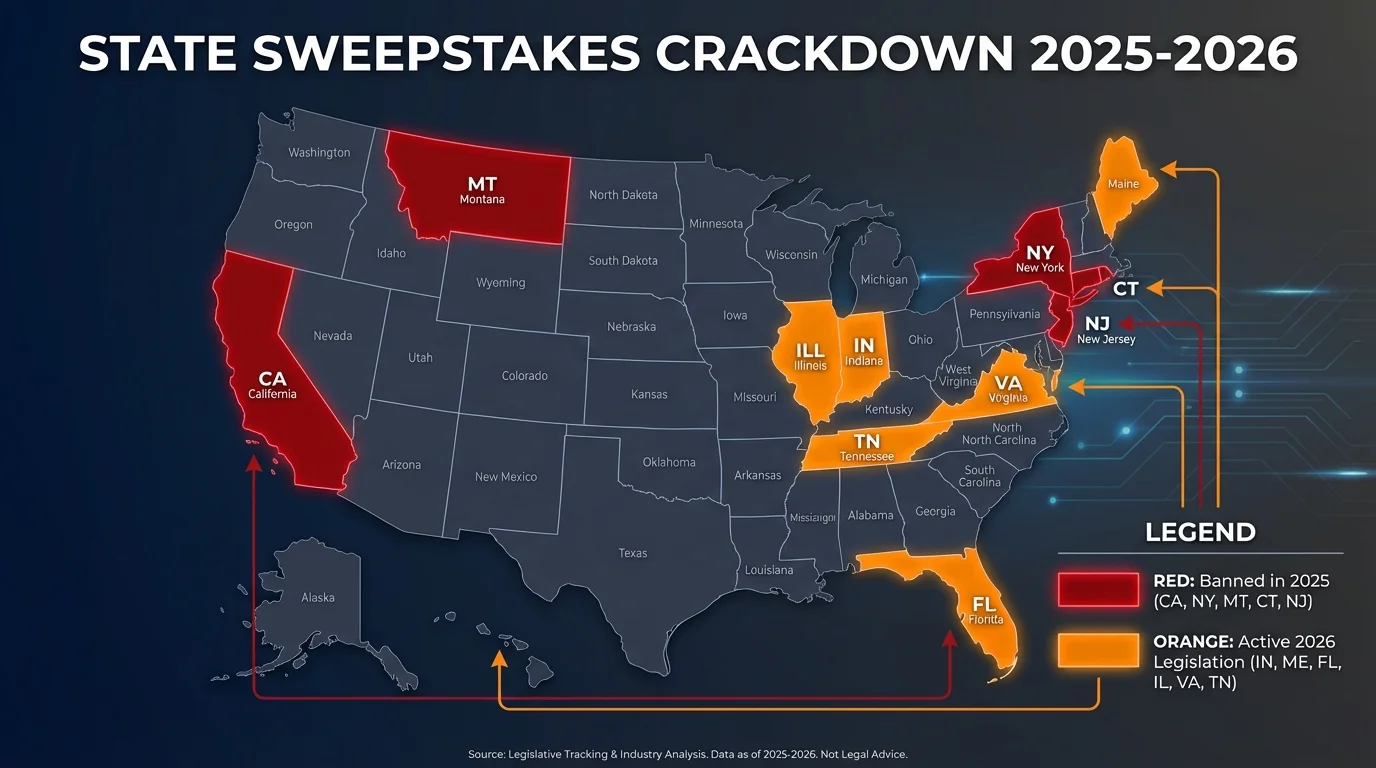
Indiana’s HB 1052 doesn’t exist in a vacuum. It’s part of a nationwide wave of sweepstakes regulation that accelerated dramatically in 2025 and shows no signs of slowing. Here’s where things stand across the country.
BANNED IN 2025
California (AB 831)
Full ban on sweepstakes casinos. Triggered the largest operator exits in sweepstakes history.
New York (S5935)
Statutory ban backed by AG C&D letters. 100% operator compliance before law took effect.
Montana (SB 555)
Sweepstakes prohibition protecting existing tribal and state-licensed gambling.
Connecticut (SB 1235)
Ban protecting the Mohegan and Mashantucket Pequot tribal gaming compacts.
New Jersey (A5447)
Prohibition protecting the state’s $6B+ regulated online gambling market.
2026 LEGISLATION IN PROGRESS
Indiana (HB 1052)
Conference committee. Full ban with $100K civil penalties. Closest to enactment.
Maine (LD 2007)
Sweepstakes prohibition bill in committee. Early stages.
Florida (HB 189)
Ban bill filed. Tribal gaming interests driving support.
Illinois (SB 3439)
After C&D letters achieved just 3% compliance, moving to statutory ban.
Virginia (SB 118)
Hybrid model: ban + licensing pathway. Passed Senate 19-17.
Tennessee (HB 1885)
Sweepstakes gaming prohibition bill filed and in committee.
What Happens Next
The conference committee is expected to convene as early as February 24 to reconcile the House and Senate versions of HB 1052. The primary disagreements are narrow: the Senate’s peer-to-peer poker carve-out and minor definition refinements. Given the supermajority support in both chambers, the substantive ban itself is not in question — the conference is about details, not direction.
The hard deadline is February 27, when the Indiana legislative session adjourns. If the conference committee reaches agreement and both chambers approve the reconciled version, the bill goes to Governor Mike Braun. Braun hasn’t publicly signaled a position on sweepstakes casinos, but a veto is considered unlikely given the overwhelming bipartisan margins — 87-11 and 37-8 are both well above veto-override thresholds.
If enacted, HB 1052 takes effect July 1, 2026. What to watch between now and then: operator geo-withdrawal announcements from Indiana (some may exit preemptively, as happened in New York), potential litigation challenging the law’s definitions or cross-border enforceability, and — perhaps most importantly — copycat bill filings in the nine-plus other states the IGC chairman predicted would act in 2026.
DEADLINE WATCH
The conference committee has four days to reconcile HB 1052 before the Indiana legislature adjourns on February 27. If the committee fails to reach agreement or either chamber rejects the conference report, the bill dies — and Indiana’s sweepstakes enforcement returns to the gray zone the IGC says it cannot navigate.
KEY TAKEAWAYS
- First 2026 ban — Indiana could become the first state this year to convert sweepstakes ambiguity into enforceable prohibition
- Dual-currency targeting — The bill specifically targets the mechanism sweepstakes casinos rely on, not just the activity broadly
- Civil, not criminal — $100K penalties with IGC enforcement are meaningful but stop short of criminal prosecution
- Administrative pressure fails — Illinois’s 3% C&D compliance rate proves statutory bans are far more effective than letters
- Four-day deadline — Conference committee must reconcile House and Senate versions before session adjourns February 27
- Conference sticking points — The poker carve-out and definition scope are the key issues to watch
Sources
- Indiana HB 1052 — Full Bill Text and Status — Indiana General Assembly
- Indiana HB 1052 Tracking and Vote History — LegiScan
- Indiana Gaming Commission Testimony Records — Indiana General Assembly Committee Records

Aevan Lark
Aevan Lark is a gambling industry veteran with over 7 years of experience working behind the scenes at leading crypto casinos — from VIP management to risk analysis and customer operations. His insider perspective spans online gambling, sports betting, provably fair gaming, and prediction markets. On Dyutam, Aevan creates in-depth guides, builds verification tools, and delivers honest, data-driven reviews to help players understand the odds, verify fairness, and gamble responsibly.
Related coverage

Vikas Garg Mahadev Case: ED’s ₹940.77 Crore Attachment Explained
The June attachment, ED’s allegations, Ebix’s corporate links and the company responses, explained from dated records.
A $10 Parlay Skips FanDuel’s Illinois Fee. A $10 Straight Bet Doesn’t.
FanDuel’s 50¢ Illinois fee favors qualifying parlays over equal-sized singles, with a steep cost for small stakes.
What Does a DraftKings Gambling Warning Actually Change?
Safety Prompt, Then Promotion: Inside ProPublica’s DraftKings Test