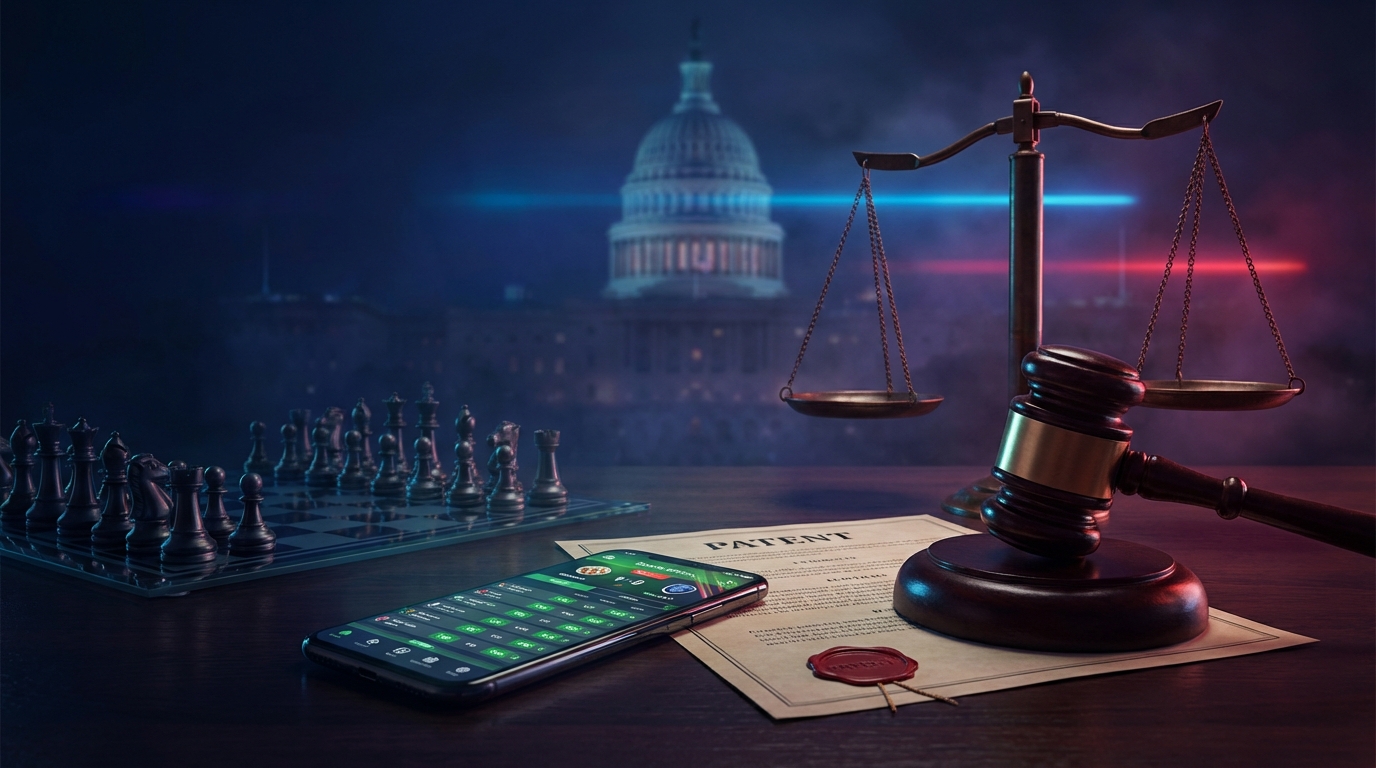
Cantor Fitzgerald Affiliate Sues DraftKings and FanDuel Using Patents Co-Invented by Commerce Secretary Lutnick
Cantor affiliate sues DraftKings and FanDuel for patent infringement using inventions co-created by Commerce Secretary Lutnick.
A company that once paid $22.5 million to settle illegal gambling charges is now suing the two platforms that control nearly 80% of legal U.S. sports betting — using patents co-invented by a Trump cabinet member. Interactive Games LLC, a Cantor Fitzgerald affiliate and successor to the scandal-ridden Cantor Gaming, filed twin federal lawsuits against DraftKings and FanDuel in early April 2026, alleging that the sports betting giants built their mobile platforms on patented technology tied to Commerce Secretary Howard Lutnick.
KEY FACTS AT A GLANCE
- Plaintiff: Interactive Games LLC (Cantor Fitzgerald affiliate, successor to Cantor Gaming)
- Defendants: DraftKings Inc. (Massachusetts) and FanDuel Inc. / Betfair (New Jersey)
- Patents: 5 patents covering identity verification, location authentication, and tamper detection for mobile gambling
- Lutnick connection: Commerce Secretary Howard Lutnick co-invented 2 of the 5 patents while serving as Cantor Fitzgerald CEO
- Cantor Gaming history: Paid $22.5M in federal settlements for illegal gambling and money laundering before disbanding in 2019
- Lutnick now oversees the USPTO — the very agency that granted and can review these patents
The Lawsuits
Interactive Games LLC filed two separate complaints on April 1–2, 2026, in U.S. District Court for the District of New Jersey (targeting FanDuel and Betfair) and U.S. District Court for the District of Massachusetts (targeting DraftKings). The suits allege infringement of five patents and seek unspecified monetary damages.
The patents at the heart of the dispute cover systems that verify users’ identities and locations and detect tampering on smartphones — protections that sit at the core of how mobile sports wagering and digital casino play function in regulated U.S. markets. Two of the five patents list Howard Lutnick as a co-inventor, created when he served as CEO of Cantor Fitzgerald.
The law firms Sterne Kessler and Lando & Anastasi are representing Interactive Games. DraftKings is no stranger to IP litigation — the company has faced multiple intellectual property challenges in recent years, though few carry the political weight of this case.
Who Is Interactive Games LLC?
Interactive Games LLC is a successor to Cantor Gaming, the now-defunct gambling technology subsidiary that Lutnick co-founded around 2004 with Lee Amaitis. The company obtained a Nevada gambling license in 2006 and pioneered mobile betting technology for sportsbook customers. But its history is anything but clean.
From 2009 through 2012, Cantor Gaming knowingly allowed an illegal gambling operation known as the “Jersey Boys” to place bets through its licensed Nevada sportsbooks. The scheme involved offshore bookmakers in Costa Rica and illegal gambling rings operating through the company’s legal infrastructure. Vice President of Risk Management Michael Colbert facilitated the illegal activity and pleaded guilty to a felony gambling conspiracy charge in August 2013.
The legal consequences were staggering. In 2014, Nevada regulators imposed a $5.5 million fine — the largest penalty the state had ever levied against a licensee. Then in 2016, the federal government delivered a $22.5 million combined settlement: $16.5 million from the DOJ to avoid criminal prosecution and $12 million from FinCEN for what regulators called “egregious and systemic violations” of anti-money laundering rules. That same year, the company was fined an additional $1.5 million for shortchanging customers more than $700,000 across 20,000 separate bets due to a software glitch. A 2018 fine of $2 million followed for accepting out-of-state bets and incorrect payouts. By 2019, the company had disbanded entirely.
Despite stepping down as CEO of Cantor Gaming in 2009, Lutnick reportedly remained “personally involved” with the operation’s day-to-day business. The patents created during that era now form the basis of the lawsuit against two of the largest companies in legal U.S. sports betting.
The Lutnick Connection
Howard Lutnick was confirmed as Commerce Secretary in February 2025 by a 51–45 Senate vote. He stepped down from his roles as CEO of Cantor Fitzgerald and chairman of Interactive Games upon confirmation, and the Commerce Department has stated he complied with the divestiture and recusal terms of his ethics agreement. But the picture is more complicated than that.
Lutnick is a named inventor on more than 400 U.S. patents and over 800 patent applications worldwide, making him one of the most prolific inventors in modern American corporate history. He is the first Commerce Secretary to ever be a patented inventor — and as Commerce Secretary, he oversees the U.S. Patent and Trademark Office (USPTO), the very agency that granted these patents and has the authority to review them.
“For the first time, the Secretary of Commerce understands the Patent Office. You have a friend, you have a supporter, and you have an admirer.”
— Howard Lutnick, addressing inventors at the 2025 National Inventors Hall of Fame ceremony
In July 2025, Lutnick received a “limited” ethics waiver from White House counsel allowing him to retain financial interests in Cantor Fitzgerald, Newmark Group, and BGC Group — holdings valued in the “hundreds of millions, and possibly billions of dollars.” His divestiture remains pending regulatory approvals, with prospective buyers including 26North, Oak Hill Advisors, and Cantor Fitzgerald itself.
Meanwhile, Lutnick’s sons Brandon and Kyle now run Cantor Fitzgerald — Brandon as Chairman and CEO, Kyle as Executive Vice Chairman. Cantor Fitzgerald owns Interactive Games LLC, the entity now suing DraftKings and FanDuel. The patent lawsuits add to a growing list of conflict-of-interest investigations: Senators Wyden and Warren probed Cantor for tariff-related conflicts in August 2025, Rep. Jamie Raskin opened an investigation into the firm’s tariff refund trading in 2026, and Brandon Lutnick himself has faced scrutiny over alleged tariff ruling profits.
“A five-star rating for conflicts of interest.”
— Robert Weissman, President of Public Citizen, assessing Lutnick’s ethics situation
The Defendants
DraftKings and FanDuel are not small targets. Together, the two companies control an estimated 78% of the U.S. sports betting market as of Q1 2026. FanDuel leads with a 44% share of gross gaming revenue, while DraftKings holds 34%. The total U.S. sports betting industry generated more than $16 billion in revenue in 2025, and DraftKings has issued 2026 revenue guidance of $6.5–6.9 billion.
Both companies have navigated regulatory challenges across multiple states as they expanded aggressively from their daily fantasy sports roots into full-scale mobile betting platforms. The duopoly has solidified over the past five years through billions in marketing spend and rapid state-by-state expansion. They are also facing financial pressures from market volatility, rising competition, and regulatory headwinds — a context that makes an unspecified-damages patent suit from a politically connected plaintiff all the more significant.
What Happens Next
DraftKings and FanDuel are widely expected to challenge the patents' validity aggressively. Legal observers anticipate motions to dismiss based on Alice Corp. v. CLS Bank — the 2014 Supreme Court decision that made business method patents harder to enforce — along with inter partes review (IPR) petitions at the Patent Trial and Appeal Board (PTAB). The PTAB has already invalidated at least three other patents listing Lutnick as an inventor.
Patent quality is a real question mark. Many of the Cantor portfolio patents were issued in the early 2000s when the USPTO more readily approved business method claims. Patent attorney Evan Rothstein of Arnold & Porter assessed the broader Cantor portfolio bluntly.
"Most of these patents were garbage."
— Evan Rothstein, patent attorney at Arnold & Porter, assessing the Cantor patent portfolio
Former Cantor IP lawyer David Boundy offered a contrasting view, arguing the patents represent "really subtle sophisticated use of computers to achieve deals that can't be done on a naïve trading system." How courts weigh these arguments will determine whether the five patents at issue survive scrutiny.
The broader competitive dynamics of the sports betting industry add another layer. With prediction markets encroaching on traditional sportsbook territory and growing public scrutiny of betting companies' practices, a high-profile patent fight with political undertones is the last thing DraftKings and FanDuel need — and exactly the kind of pressure that could push toward a settlement.
There is also a deeper structural irony: if DraftKings or FanDuel petition the PTAB to invalidate these patents, the review would ultimately fall under the institutional authority of the Commerce Department — led by the man who co-invented two of them. Lutnick's ethics agreement requires recusal from specific matters involving his former companies, but whether a PTAB review rises to that threshold is an open legal question.
KEY TAKEAWAYS
- Twin lawsuits filed — Interactive Games LLC sued DraftKings (Massachusetts) and FanDuel/Betfair (New Jersey) in April 2026, asserting five patents covering mobile gambling verification technology
- Lutnick co-invented 2 of the 5 patents — Commerce Secretary Howard Lutnick is a named inventor on two patents now being used to sue the industry's two largest companies
- Cantor Gaming's troubled past — The plaintiff entity's predecessor paid $22.5M in federal settlements for illegal gambling and money laundering, and was fined repeatedly by Nevada regulators before disbanding in 2019
- Conflict of interest questions — Lutnick oversees the USPTO, his sons run Cantor Fitzgerald (which owns the plaintiff), and his "limited" ethics waiver allows continued financial interests in the firm
- Patent validity will be challenged — DraftKings and FanDuel are expected to use PTAB reviews and Alice motions to attack the patents, but any PTAB review falls under Commerce Department authority
Sources
- DraftKings, FanDuel Apps Targeted by Cantor Unit Patent Lawsuits — Bloomberg Law
- Lutnick's Inventor Past Offers Glimpse Into Commerce Patent Role — Bloomberg Law
- FinCEN Fines Cantor Gaming $12 Million for Egregious and Systemic Violations of Anti-Money Laundering Rules — U.S. Department of the Treasury (FinCEN)
- Wyden, Warren Probe Lutnick Firm's Potential Conflicts of Interest Related to Massive Tariff Bets — U.S. Senate Finance Committee
- Cantor Fitzgerald Affiliate Sues DraftKings, FanDuel Over Patents Invented by Commerce Secretary — CDC Gaming Reports
- Interactive Games LLC v. DraftKings, Inc., Case No. 1:26-cv-11544 — CourtListener (Federal Docket)
- CG Technology Fined $22.5M by U.S. for Role in Illegal Scheme — ESPN

Aevan Lark
Aevan Lark is a gambling industry veteran with over 7 years of experience working behind the scenes at leading crypto casinos — from VIP management to risk analysis and customer operations. His insider perspective spans online gambling, sports betting, provably fair gaming, and prediction markets. On Dyutam, Aevan creates in-depth guides, builds verification tools, and delivers honest, data-driven reviews to help players understand the odds, verify fairness, and gamble responsibly.
Related coverage

Two Bookmakers, One Tally: Unpacking SteveWillDoIt’s Gamdom Bets
A compiler’s tally separates Gamdom and Red Rock. Its conflicting figures show the limits of SteveWillDoIt’s public betting record.

Offset’s Paris Casino Clip: The Skit Claim and the $100K MotorCity Lawsuit
Offset’s reported skit explanation, conflicting Paris money claims and the dated court order in MotorCity’s separate $100,000 lawsuit.
Who Answers for a Gambling Ad? Greece’s Case Against 18 Influencers
Greek complaints against 18 influencers over alleged unlicensed gambling promotion: the case status, the fine framework and how Dutch rules compare.