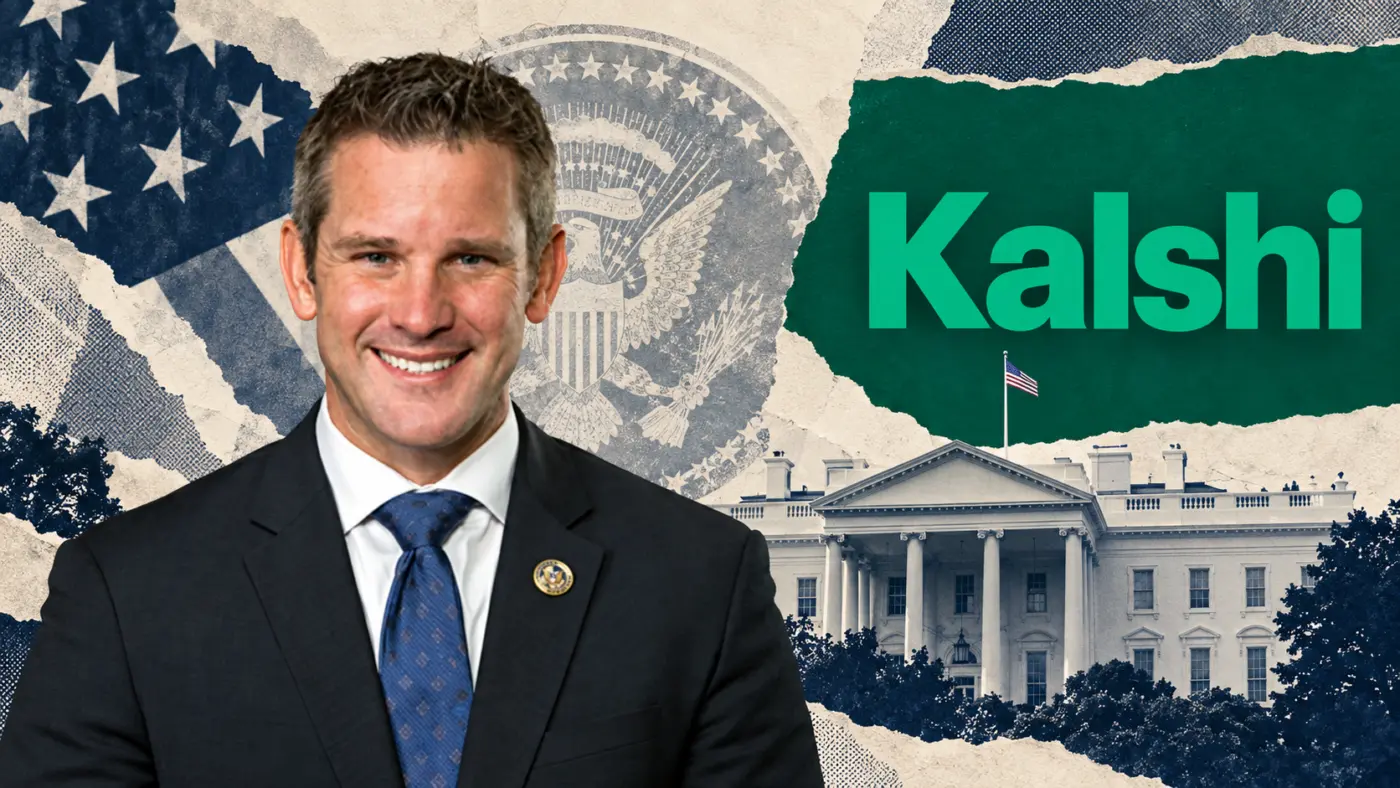
Can You Bet on Your Own Pardon? The Adam Kinzinger–Kalshi Case Explained
Adam Kinzinger’s pardon trades face reported CFTC scrutiny. The historical rules and his response leave key questions unresolved.
Adam Kinzinger’s Kalshi bets on presidential pardons are reportedly being examined by the Commodity Futures Trading Commission (CFTC), according to POLITICO and CNN. The former congressman acknowledges trading and denies having inside information. The available record leaves his compliance with the applicable rules unresolved.
KEY FACTS AT A GLANCE
- Reported scrutiny: POLITICO and CNN describe a CFTC inquiry into pardon-related Kalshi trading.
- Kinzinger’s response: He acknowledges the trades and denies having inside information.
- Historical rules: Information access and influence over the outcome feature in the contemporaneous rulebook reviewed.
- Public record: No public CFTC charge or order against Kinzinger was found in the material checked through September 30, 2026.
The pardon trades behind the reports
POLITICO reported that an account linked to Kinzinger traded in December 2024 and January 2025. He described positions on whether he would receive a presidential pardon and whether Joe Biden would issue preemptive pardons before leaving office. The report also said Kalshi was reviewing the transactions.
Kinzinger was a private citizen during that period: his congressional service ended on January 3, 2023, according to the House’s official biography. On January 20, 2025, Biden announced pardons for members and staff of the January 6 committee. The White House statement said the pardons should not be interpreted as admissions of guilt.
What the reported money figures measure
CNN reported that screenshots Kinzinger supplied showed $669 wagered and $823 netted on the pardon trades. Those figures come from participant-supplied material described by the newsroom; they are not an independently audited account statement.
Separately, Kinzinger told POLITICO he had made roughly 25 trades overall and mostly lost money. That broader description does not disclose a total account loss or change what the pardon positions reportedly earned. It also does not resolve whether a particular trade complied with the rules.
The trades, the criticism and the later reporting
Kinzinger’s criticism of Kalshi came later. His November 25, 2025 essay warned about markets tied to public officials’ conduct. Keeping that date separate from the trading window matters: the essay followed the pardon trades, while reports of regulatory scrutiny appeared in September 2026.
-
Congressional service endsAdam Kinzinger leaves Congress.Documented date
-
Reviewed rulebook takes effectThe reviewed Kalshi filing identifies this effective date. It is not a complete operative-rule record for every trade.Documented rulebook version
-
December 2024–
January 2025Reported trading windowPardon-related trades are reported during this period. Exact fills remain unavailable.Reported interval -
Biden announces committee pardonsThe announcement covers members of the House January 6 committee.Documented announcement
-
Kinzinger criticizes KalshiHe publishes his own essay criticizing the platform.Documented publication
-
U.S. publication datePOLITICO publishes its reportThe Yahoo syndication timestamp is September 30 in UTC.Reporting date, not inquiry start -
CNN publishes additional reportingFurther reporting includes conflicting accounts of exchange contact.Reporting date, not inquiry start
What the historical Kalshi rules establish
Being the subject of a contract does not, by itself, supply enough information to decide this case. The November 2024 rulebook reviewed here addresses access to material nonpublic information, affiliation with a contract’s source agency and influence over an outcome in Rules 5.13(s) and 5.13(t).
That version contains no standalone prohibition based solely on being named in a market. It is a contemporaneous document, however, not a complete reconstruction of every operative amendment or the terms attached to Kinzinger’s exact contracts. It establishes neither a violation nor permission for these trades.
The distinction matters for anyone reading a prediction market’s eligibility rules. A market being available on a platform does not answer whether every potential participant is eligible to trade it. The restrictions address the participant’s relationship to the information and the outcome.
The CFTC’s February 2026 enforcement advisory explains a separate federal concern: trading on confidential information obtained in breach of a pre-existing duty of trust and confidence. Establishing that kind of misconduct requires evidence about the information and how it was obtained. An interview acknowledgment that a trade occurred does not establish those elements.
| Issue | Evidence status | Still unresolved |
|---|---|---|
| Trading on pardon-related outcomes | Acknowledged in interviews (POLITICO/CNN) | Full account and transaction records remain unavailable |
| Reported financial result | Participant-supplied screenshots described by newsrooms | Independent audit and account-wide performance unresolved |
| Historical restrictions | Primary rulebook reviewed | Complete operative rules and application to each position unresolved |
| Exchange contact | Conflicting accounts in CNN | Whether outreach occurred and was received unresolved |
| Regulatory outcome | Reported inquiry; public-case search | Agency allegations, findings or disposition unresolved |
Kinzinger’s response and the disputed contact
“It was a dumb bet, to bet on myself.”
— Adam Kinzinger, speaking to CNN
Kinzinger told CNN he believed the rules allowed the trades and had no advance knowledge of the pardons. CNN also reported a source’s account that Kalshi tried to reach him without receiving a response. Kinzinger said he never heard from the exchange. That disagreement remains unresolved.
Neither Kalshi nor the CFTC commented to the newsrooms. Their silence does not establish the reported inquiry’s scope or outcome. The public material checked through September 30 contains no CFTC charge, order or finding against Kinzinger concerning these trades.
Exchange discipline and federal enforcement are separate
Kalshi can investigate trading under its exchange rules; the CFTC can pursue violations of federal commodities law. The agency’s February advisory explicitly distinguished matters handled by Kalshi’s internal enforcement program from its own authority. Dyutam’s coverage of Kalshi’s earlier exchange-level discipline provides background on that distinction.
There are also published agency outcomes to compare with a reported inquiry. The CFTC announced a July 2026 settlement involving George Santos’s manipulation of an attendance contract, followed by an August settlement involving Gabriel Perez’s use of advance presidential speech information. Those findings concern different conduct and different individuals.
Dyutam’s earlier reporting on the Santos trading controversy and the teleprompter-operator investigation covers their earlier stages. The CFTC’s later settlement announcements are the sources for the outcomes described here.
A September 22 staff advisory adds current context. It addresses contracts tied to individual mentions, attendance and interactions, identifying manipulation risks while expressly creating no new obligations. It does not name Kinzinger or decide the legality of his pardon trades. It should not be presented as a new rule governing transactions from 2024–25.
What would move the case beyond the headlines
A published agency filing, an exchange disciplinary notice or a fuller transaction record would provide evidence the public reporting currently lacks. Until then, the defensible account is narrower: reported scrutiny, acknowledged trading, a denial of inside information and unresolved questions about the applicable terms and facts.
For the exchange, identifying users’ connections to a contract is part of enforcing its restrictions. That is the practical context for Kalshi’s employer-disclosure requirements. Screening procedures can help identify potential conflicts; their existence does not determine whether an individual trader broke a rule.
FAQs
What did Adam Kinzinger bet on?
He described two pardon-related Kalshi markets to POLITICO: whether he would receive a pardon and whether Biden would issue preemptive pardons before leaving office.
How much did the pardon trades reportedly earn?
CNN reported $823 netted on $669 wagered, based on screenshots Kinzinger supplied. Those figures are not an independently audited account-wide result.
Has the CFTC publicly charged Adam Kinzinger?
No public CFTC charge or order concerning these trades was found in the material checked through September 30, 2026. That does not rule out a nonpublic investigation.
What has Kinzinger said about inside information?
Kinzinger denies having advance knowledge of the pardons and says he believed the trades complied with Kalshi’s rules. These are his statements, not a finding about compliance.
Can someone trade on a prediction market involving themselves?
The applicable exchange and contract rules matter. The historical version reviewed addresses information access and influence over the outcome; it does not settle Kinzinger’s compliance.
How does Kalshi discipline differ from CFTC enforcement?
Kalshi enforces its exchange rules. The CFTC separately enforces federal commodities law. The agency’s February 2026 advisory distinguishes internally handled exchange cases from its own enforcement authority.
KEY TAKEAWAYS
- The inquiry is reported — the public records checked did not disclose a CFTC charge or finding against Kinzinger.
- His response remains central — he acknowledges trading and denies having inside information.
- The historical record has limits — the rulebook reviewed does not resolve compliance with every applicable term.
- Different enforcement processes must stay distinct — exchange discipline and a CFTC order are separate actions.
Sources
- Kalshi rulebook filing, November 14, 2024 — KalshiEX / CFTC
- Prediction markets enforcement advisory, February 25, 2026 — CFTC
- Staff Letter 26-27 on individual event contracts, September 22, 2026 — CFTC
- Pardon announcement, January 20, 2025 — Archived Biden White House
- Adam Kinzinger congressional biography — U.S. House of Representatives
- George Santos settlement announcement, July 31, 2026 — CFTC
- Gabriel Perez settlement announcement, August 28, 2026 — CFTC
- Public enforcement actions index — CFTC; checked September 30, 2026
- Reporting and interview on the pardon trades, September 30, 2026 — CNN
- Reporting on regulatory scrutiny of Kinzinger’s Kalshi trading — POLITICO, syndicated by Yahoo
- Kinzinger’s criticism of political-conduct markets, November 25, 2025 — Adam Kinzinger; primary source for his own views

Aevan Lark
Aevan Lark is a gambling industry veteran with over 7 years of experience working behind the scenes at leading crypto casinos — from VIP management to risk analysis and customer operations. His insider perspective spans online gambling, sports betting, provably fair gaming, and prediction markets. On Dyutam, Aevan creates in-depth guides, builds verification tools, and delivers honest, data-driven reviews to help players understand the odds, verify fairness, and gamble responsibly.
Related coverage

Who Answers for a Gambling Ad? Greece’s Case Against 18 Influencers
Greek complaints against 18 influencers over alleged unlicensed gambling promotion: the case status, the fine framework and how Dutch rules compare.

Ohio Sends Cease-and-Desist Letters to 10 Prediction Market Firms
Ohio demands an immediate stop to sports contracts from ten prediction market firms, with written compliance confirmation due October 16.
UK Remote Gaming Duty Receipts Rise 108% in July
HMRC collected £589.7 million in July. Payment timing and the original forecasts explain what the increase proves.