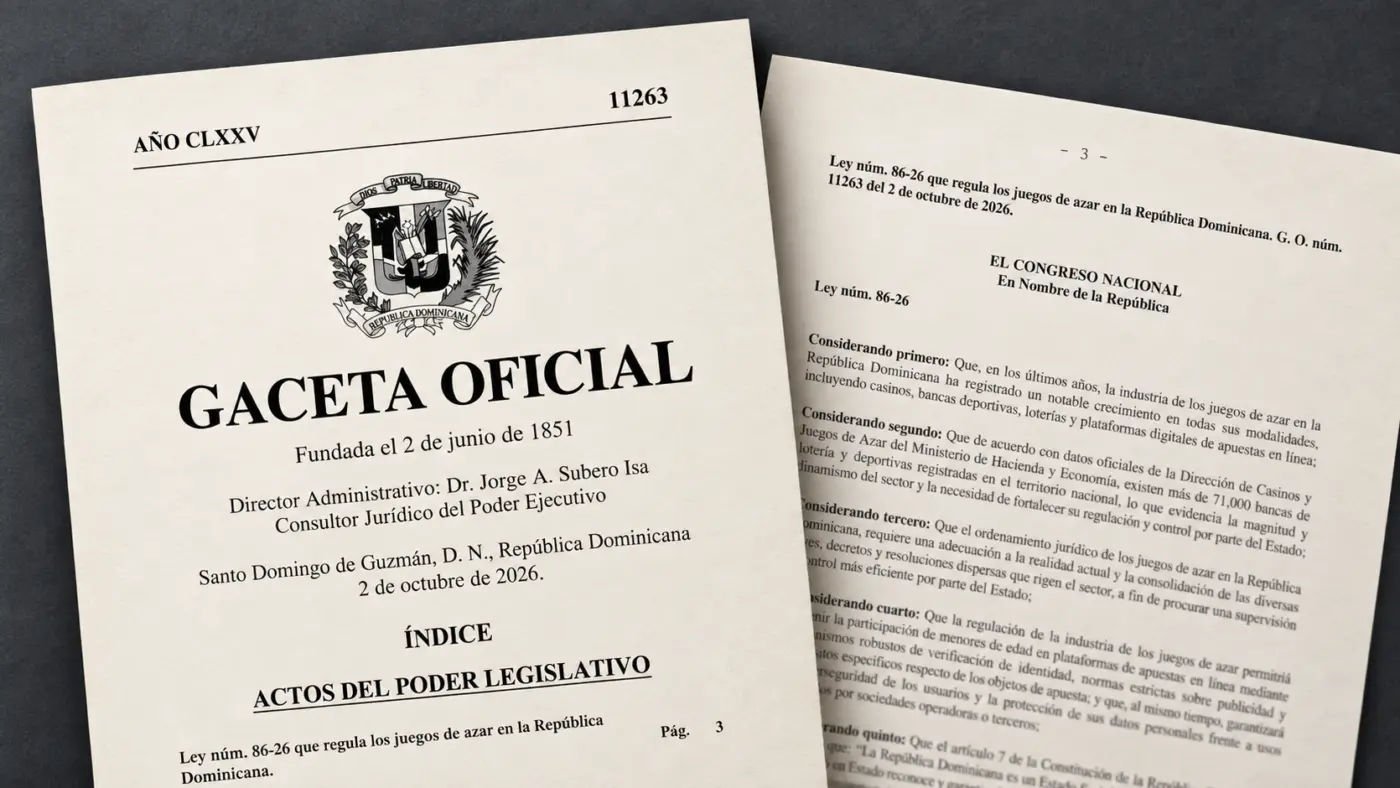
Dominican Republic Gambling Law Sets One-Year Licence Transition
Law 86-26 sets a one-year license transition and earlier platform deadline, with online market-entry questions unresolved.
The new Dominican Republic gambling law gives existing licensed operators one year from its entry into force to complete an adaptation process for new licenses, with a separate three-month deadline for platform and operational changes. Law 86-26 also creates the General Directorate of Gambling (DGJA), putting implementation deadlines at the center of the reform.
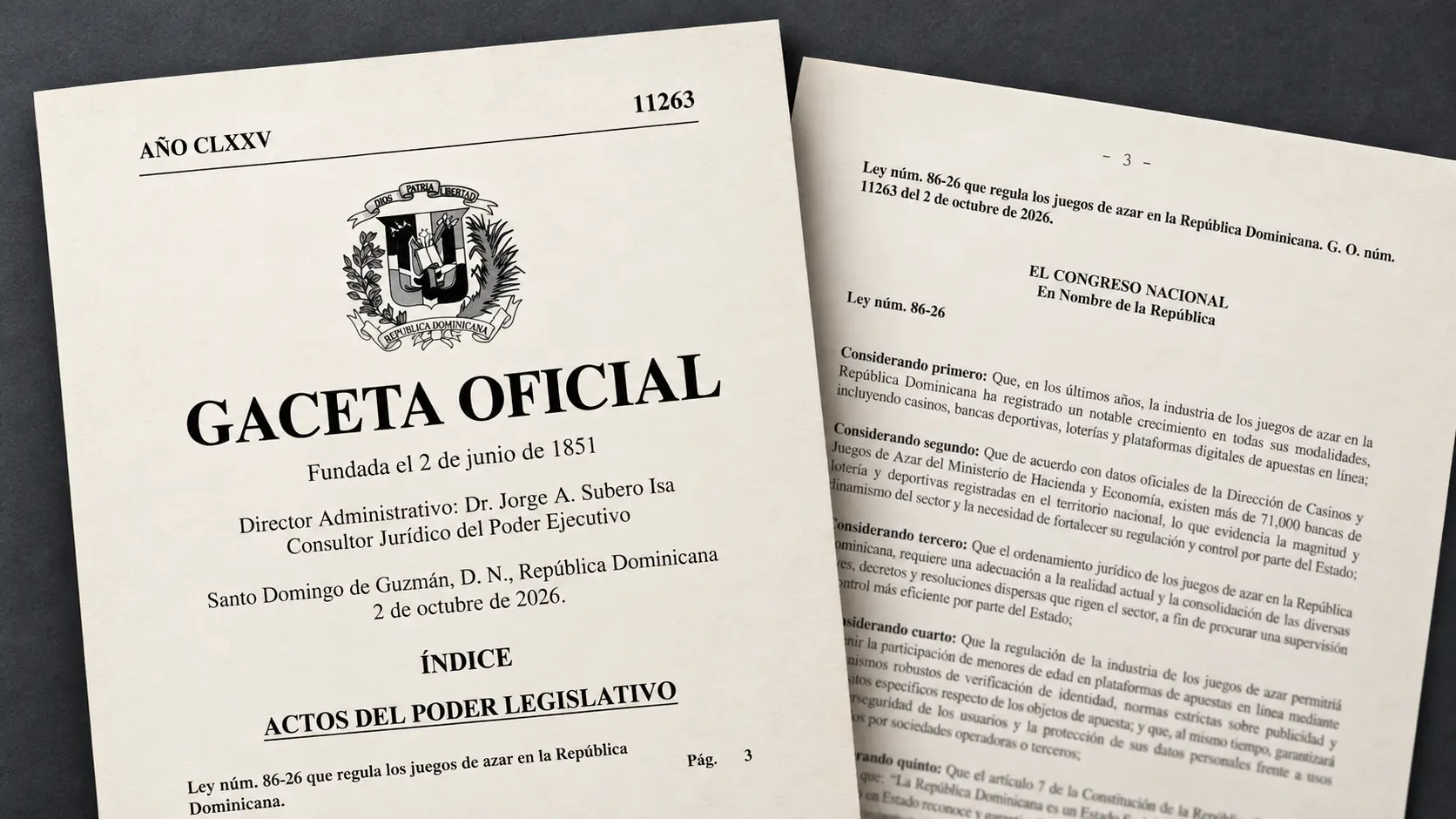
KEY FACTS AT A GLANCE
- Publication: Law 86-26 appeared in Official Gazette 11263 on October 2, 2026.
- Transition: Article 181 gives existing licensees one year to complete adaptation for a new operating license and states that adaptation must not prejudice acquired rights.
- Earlier deadline: Article 184 requires platform and operational adaptation within three months.
- Market entry: The law’s future license moratorium leaves its application to online operators unresolved.
What the one-year license transition requires
Article 181 expressly includes internet gambling among the activities covered. Existing licensees must complete the adaptation process for issuance of a new license, including payment of taxes and fees, submission of documents and connection to the technological systems required by the law. The law states that adaptation must not prejudice acquired rights or consolidated legal positions.
The one-year deadline applies to the operator’s adaptation process; Article 181 does not state a separate deadline for the authority to issue replacement licenses. Operators also face the earlier three-month requirement to adapt their platforms, activities and operations under Article 184.
DGJA takes over an existing online framework
Dominican Republic online gambling already had a licensing framework under Resolution 136-2024. Contemporary reports from G3 Newswire and iGaming Business described five-year online licenses.
Law 86-26 creates an autonomous DGJA attached to the Ministry of Finance and Economy, covering land-based and online gambling. Under Articles 75–77, online operators must be legal entities with licenses issued by the Gambling Council. The term is ten years from issuance, while requirements and fees are set through DGJA resolutions approved by the Council.
Vice President Raquel Peña, exercising executive authority, promulgated the law on September 22. President Luis Abinader appointed Teófilo Tabar Manzur, known as Quico Tabar, as transitional DGJA director through Decree 684-26 on October 2.
Under Article 185, until the DGJA’s structure is operating, its director general exercises the agency’s powers provisionally under Gambling Council supervision. Ongoing DCJA operations, obligations and responsibilities pass to the DGJA, and operations and decisions taken during the transition retain full legal validity.
The 10% online tax and RD$5 million interim payment
The 10% monthly rate already appeared in Article 7 of Law 139-11. The earlier law also tied the tax to the authorized website regardless of where the activity occurred. Law 86-26 carries the rate into the new framework; those elements do not establish a newly introduced tax.
Article 78 refers only to online gambling operations, while transitional Article 186 refers to gross sales or gross operations. Article 4 defines gross sales as total receipts before prizes, commissions, taxes, refunds, discounts or expenses are deducted. These provisions do not support presenting the levy as a tax on gross gaming revenue after player payouts.
Article 186 requires a fixed monthly payment of RD$5 million per corporate entity until installation of the collection technology is complete. It does not specify credits or reconciliation against the percentage tax.
The six-month deadline in Article 183 is for developing the technological tools. It does not automatically end the interim payment at six months: Article 186 ties that endpoint to completed installation.
Blocking powers and online compliance requirements
Article 79 directs the DGJA, in coordination with telecommunications regulator INDOTEL, to order blocking of unlicensed domains, addresses and applications, and require payment providers to suspend related transactions. These statutory provisions do not establish how many sites have actually been blocked. The same distinction matters when assessing Brazil’s enforcement against illegal betting.
The DGJA may also suspend an operator’s website for unpaid taxes or administrative fees, fraud or money laundering. It must publish and update lists of authorized operators and blocked sites.
Online and virtual operators must check identity and adulthood against Central Electoral Board records before enabling deposits or bets. Article 82 also requires configurable deposit, loss and session limits, plus session-duration notices. Technical standards are left to implementing regulations. Article 147 separately treats internet gambling that is not registered under a .do domain as a serious infringement.
Under Article 81, online licensees must also enable remote connection of their systems to the DGJA’s inspection system, in accordance with personal-data protection Law 172-13.
For players, authorization remains the practical starting point. Our guide to checking an online casino’s license explains what to verify before relying on a licensing claim.
Implementation deadlines run on separate clocks
The President must issue implementing regulations within 90 days. Within 120 days, the Gambling Council must issue the DGJA’s internal rules, organizational structure and management provisions. Other provisions give authorities six months to develop oversight tools and set administrative fees. Existing fees continue until the replacement resolutions are issued.
Article 196 ties entry into force to promulgation, publication and the applicable Civil Code periods. The timeline therefore uses statutory periods rather than fixed calendar dates; the three-month platform deadline and 90-day regulation deadline are distinct.
- 90 days · Article 193President issues implementing regulations.
- 120 days · Article 194Gambling Council issues the DGJA’s internal rules, organizational structure and management provisions.
- 6 months · Articles 183 and 188Develop collection and oversight tools, and set the fees.The tools deadline concerns development; it does not certify completed installation.
- 3 months · Article 184Adapt existing licensees’ platforms, activities and operations to the law.
- 1 year · Articles 181–182Existing licensees must complete adaptation for new licenses (Article 181). Holders of state concessions or similar legal instruments must undergo adaptation for a new operating license replacing the concession (Article 182).Adaptation does not prejudice acquired rights. This compliance period is separate from a new license’s duration.
- 12 months · Article 190Qualifying existing operations must enroll in the unified register.Publication follows under a separate deadline.
Why the license moratorium leaves an online question
Article 190 gives qualifying existing operations 12 months to enroll in the register. The Council then has 90 days to publish it. Actual publication triggers Article 191’s ten-year suspension of new licenses for the installation of gambling establishments.
Article 190’s registration requirement covers establishments and games, while Article 191 refers to the installation of establishments. That wording supports a possible premises-focused reading. However, Article 191 also cross-references Article 21, which includes internet gambling, so the text does not establish an online exemption or an open application window.
Article 191 exempts casinos located in hotels and tourist locations. Article 4 also defines a casino as an establishment in a hotel with at least four stars. Neither provision resolves the online question. The ten-year moratorium must also be kept separate from the ten-year duration of an individual online license.
For operators following Caribbean regulation, the useful comparison is the sequence from legislation to usable permissions, also explored in our coverage of Trinidad and Tobago’s remote gambling order. Here, the immediate work is adaptation, documentation and systems readiness, while the DGJA’s implementing measures will determine how the statutory framework operates.
FAQs
How long do existing operators have to adapt?
Article 181 gives existing licensees one year from the law’s entry into force to complete adaptation for a new operating license, and states that adaptation does not prejudice acquired rights. Article 184 separately requires platform, activity and operational changes within three months.
Was online gambling already regulated in the Dominican Republic?
Yes. Resolution 136-2024 provided an online licensing framework before Law 86-26. Law 86-26 creates a new regulator, sets a statutory licensing framework and requires existing licensees to complete an adaptation process.
Is the 10% online gambling tax new?
No. Law 139-11 already specified a 10% monthly tax on operations or gross sales. Law 86-26 retains the rate within the new framework.
How long does an online gambling license last?
Article 77 sets a ten-year term from issuance. That term is separate from the ten-year moratorium triggered by publication of the register.
What is the RD$5 million monthly payment?
For online gambling, Article 186 requires a fixed RD$5 million monthly payment per corporate entity until installation of collection technology is complete. It does not specify reconciliation with the 10% tax.
Can new online operators enter the market?
The law alone does not settle that question. The moratorium’s wording and cross-reference leave its online scope unresolved. It is not confirmed whether new online applications are currently being processed.
Can the DGJA block unlicensed gambling sites?
Article 79 provides for blocking through coordination with INDOTEL and for restrictions on related payments. Those powers do not establish that particular sites have already been blocked.
KEY TAKEAWAYS
- Existing licensees face an adaptation process. The one-year license transition and three-month platform deadline are separate obligations.
- The 10% rate predates this law. The interim RD$5 million payment needs further clarity on reconciliation.
- Ten-year online licenses do not prove open market entry. The moratorium’s online scope remains unresolved.
Sources
- Official Gazette 11263: Law 86-26 — Consultoría Jurídica del Poder Ejecutivo; Articles 4–5, 21, 75–82, 147 and 181–196.
- Law 139-11, Article 7 — Dirección General de Impuestos Internos; preexisting online gambling tax.
- Decree 684-26 — Presidency of the Dominican Republic; transitional DGJA appointment.
- Ministry of Finance regulates online casino and betting licenses — G3 Newswire, April 8, 2024; historical licensing coverage.
- Dominican Republic introduces online gambling regulation — iGaming Business, April 3, 2024; historical licensing coverage.

Aevan Lark
Aevan Lark is a gambling industry veteran with over 7 years of experience working behind the scenes at leading crypto casinos — from VIP management to risk analysis and customer operations. His insider perspective spans online gambling, sports betting, provably fair gaming, and prediction markets. On Dyutam, Aevan creates in-depth guides, builds verification tools, and delivers honest, data-driven reviews to help players understand the odds, verify fairness, and gamble responsibly.
Related coverage

Who Answers for a Gambling Ad? Greece’s Case Against 18 Influencers
Greek complaints against 18 influencers over alleged unlicensed gambling promotion: the case status, the fine framework and how Dutch rules compare.

Ohio Sends Cease-and-Desist Letters to 10 Prediction Market Firms
Ohio demands an immediate stop to sports contracts from ten prediction market firms, with written compliance confirmation due October 16.

UK Remote Gaming Duty Receipts Rise 108% in July
HMRC collected £589.7 million in July. Payment timing and the original forecasts explain what the increase proves.