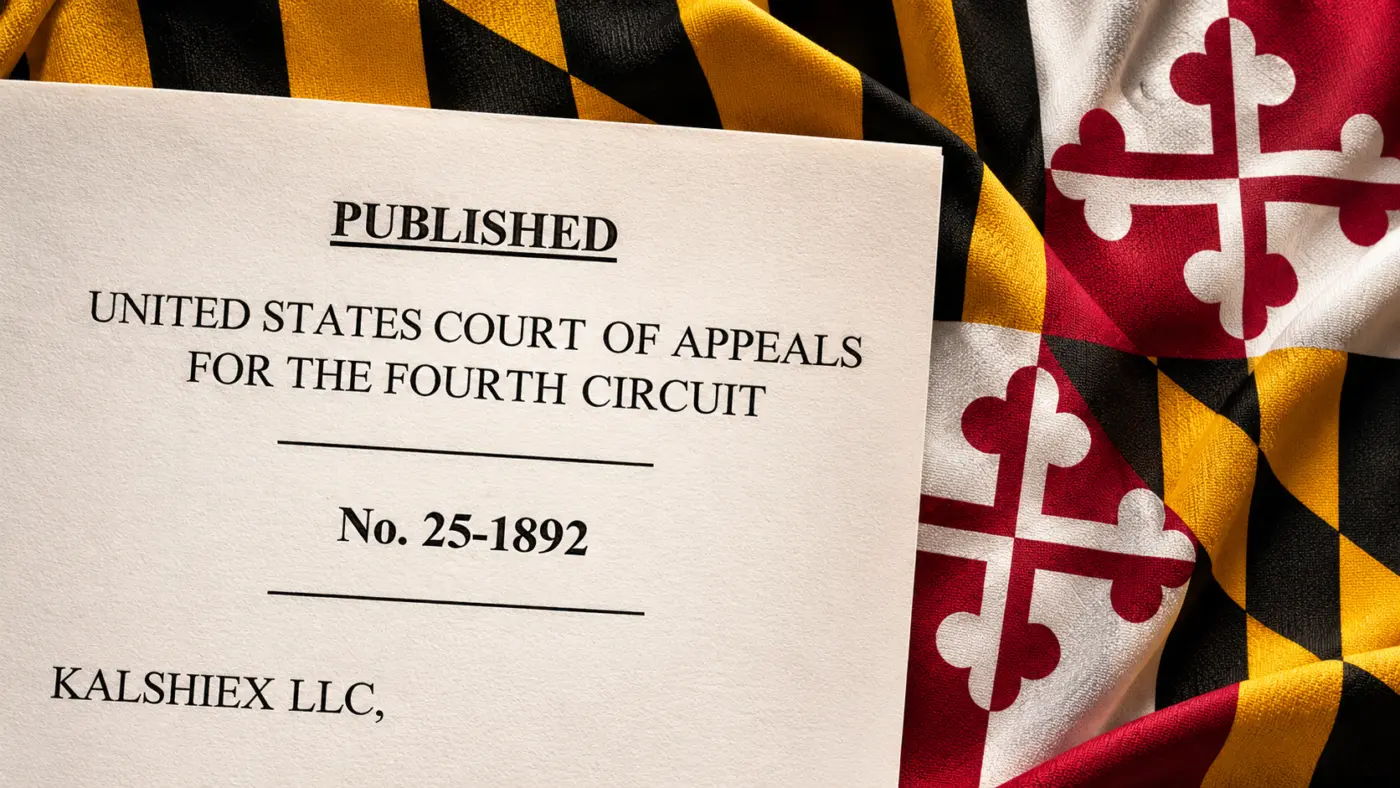
Fourth Circuit Lets Maryland Enforce Sports Betting Laws Against Kalshi
Maryland can enforce its sports betting laws against Kalshi. Three appeals courts now back states in the fight over sports contracts.

The Kalshi Fourth Circuit ruling lets Maryland pursue the exchange for offering sports contracts without a state license. In an opinion dated November 18, the panel voted 2–1 to uphold a judge’s refusal to block enforcement while Kalshi’s lawsuit proceeds.
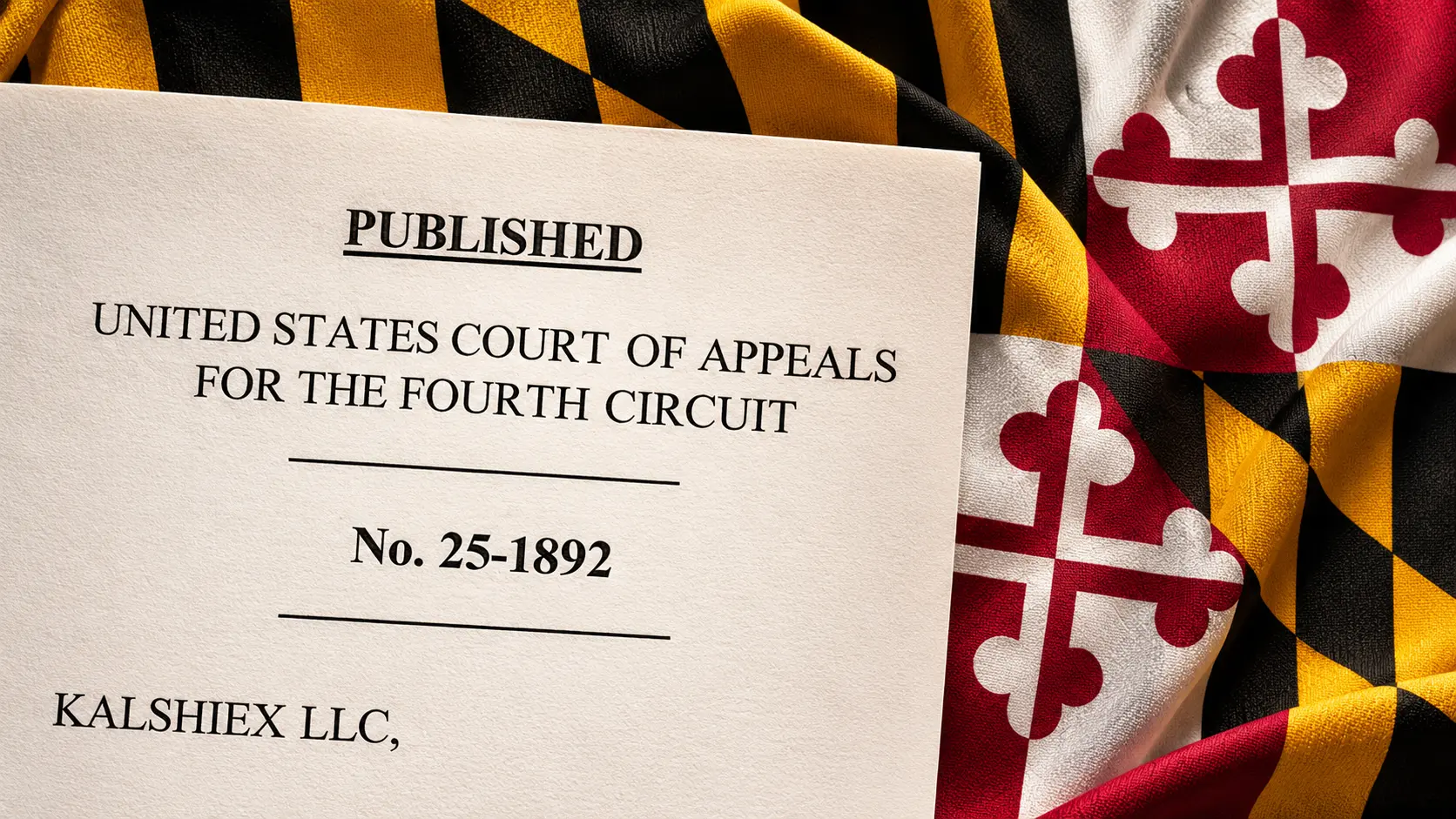
KEY FACTS AT A GLANCE
- Case: KalshiEX LLC v. Martin, Fourth Circuit No. 25-1892.
- Maryland access: The panel set no deadline to stop taking trades or close open positions.
- Next dated filing: Kalshi’s response to New Jersey’s separate Supreme Court petition is due December 7.
What the ruling means for Maryland traders
Maryland’s gaming regulator told Kalshi in April 2025 to stop offering sports contracts in the state. The exchange had no Maryland sports wagering license. In response, Kalshi sued, arguing that federal commodities law gives the Commodity Futures Trading Commission (CFTC) exclusive authority over the contracts. U.S. District Judge Adam Abelson declined to block the state on August 1, 2025.
For traders, the distinction is timing. On August 12, 2025, Maryland gave Kalshi a written assurance that it would hold off on enforcement pending the outcome of the appeal. Kalshi then withdrew its request for emergency protection. The panel has now ruled, but its opinion gives no instructions for handling new orders, settling open positions or processing withdrawals.
As of November 18, Dyutam could not verify whether Kalshi still accepted new sports trades directly from Maryland after the ruling. A broker can set its own limits. Webull, for example, says Maryland residents cannot trade sports event contracts on its platform.
Other states in the Fourth Circuit, including Virginia and North Carolina, have their own laws. The Maryland judgment sets no trading cutoff there. Nevada offers a concrete comparison. A separate court order there required Kalshi to check a trader’s physical location, an issue in the CFTC’s challenge to state geofencing orders.
Why two judges sided with Maryland
The opinion carries a November 17 filing stamp. The court dates its decision November 18, the day it entered judgment. The two judges who voted for Maryland agreed on a one-sentence decision, then wrote separately to explain why Kalshi lost.
Judge Roger Gregory assumed for argument’s sake that the sports contracts qualified as swaps, a type of financial derivative. Even then, he found that Kalshi had failed to show that federal law displaced Maryland’s licensing rules. In his view, listing a contract on a federally regulated exchange left room for Maryland to regulate who could offer it in the state.
Judge Stephanie Thacker focused on what triggers the payout. For example, consider a contract on a NASCAR driver to win a race. The race can go ahead as scheduled, but the buyer who picks that driver collects only if the driver wins. For Thacker, that distinction put these contracts outside the federal definition of a swap.
“I reject the idea that the outcome of a sporting event is itself an event.”
— Judge Stephanie Thacker, concurring in KalshiEX v. Martin
Judge DeAndrea Gist Benjamin dissented. She saw a role for game-outcome contracts in hedging financial risk and would have sent the case back for the judge to consider the remaining requirements for temporary relief.
Where the four appeals courts stand
Maryland joins Nevada, Ohio and Tennessee on the states’ side of the split. The court count comes to three because the Sixth Circuit decided the Ohio and Tennessee appeals together. In the other direction, the Third Circuit kept Kalshi’s injunction in New Jersey after finding the exchange likely to prevail on its federal claim.
| Circuit and case | State | Date in 2026 | Panel vote and effect |
|---|---|---|---|
| Fourth CircuitKalshiEX v. Martin | Maryland | 2–1 for MarylandUpheld the denial of Kalshi’s request to pause state enforcement. |
|
| Sixth CircuitSchuler and Orgel appeals | Ohio and Tennessee | 3–0 for the statesUpheld the denial of an injunction in Ohio and lifted the injunction in Tennessee. |
|
| Ninth CircuitKalshiEX v. Assad | Nevada | 3–0 for Nevada on sportsUpheld the order lifting protection for sports contracts. Sent the election-contract question back to the trial court. |
|
| Third CircuitKalshiEX v. Flaherty | New Jersey | 2–1 for KalshiKept the injunction shielding Kalshi’s sports contracts from state enforcement while the case proceeds. |
The Sixth Circuit decided two states’ appeals together. The Second and Tenth Circuits ruled on temporary motions while appeals were pending, so those orders fall outside this tally.
The scorecard counts four published decisions on preliminary injunctions. Each court considered who should have protection while a case proceeds. The Second Circuit’s order covering New York and Connecticut and the Tenth Circuit’s Utah order addressed emergency requests for relief during appeals. Those orders fall outside the tally.
Rehearing in Maryland and a separate Supreme Court petition
Kalshi can ask the Fourth Circuit panel to reconsider or request a rehearing before the full court. The ordinary 14-day period runs from the November 18 judgment, putting the deadline on December 2 unless the court changes it. A timely request generally delays the mandate, the formal step that sends the result back to the trial court.
- Opinion dated Nov. 18The panel upheld the order denying Kalshi temporary protection.
- Possible · RehearingKalshi can ask the panel or the full court to reconsider. It ordinarily has 14 days after entry of judgment or an amended decision.
- What followsIf granted, the court reconsiders the appeal.If denied, the mandate normally issues seven days after denial. If no one files, it normally issues seven days after the filing deadline. The court can change the timing.
- Filed · Sept. 2New Jersey asked the Supreme Court to review the Third Circuit ruling that favored Kalshi. The petition is No. 26-299.
- Due · Dec. 7Kalshi’s response is due. Responses are due the same day in two separate Nevada petitions from Robinhood (26-338) and Crypto.com (26-344).
- Court decision pendingThe justices can grant review and hear the case, or deny review and leave the Third Circuit ruling in place.
The Maryland mandate formally sends the appeals court’s decision to the trial court. A timely rehearing petition normally delays it. Kalshi can also seek Supreme Court review of its own Maryland appeal.
New Jersey’s Supreme Court petition
The Supreme Court already has New Jersey’s petition from the case Kalshi won. The justices can decide whether to take it regardless of what Kalshi does in Maryland. Meanwhile, states can take different steps under their own laws. In Louisiana’s prediction market case, a state judge issued a restraining order and the CFTC filed a separate federal suit.
FAQs
Can I trade Kalshi sports contracts in Maryland after the ruling?
The court gave no cutoff for new trades. Kalshi’s ability to accept a particular order in Maryland still depends on its trading restrictions and any enforcement steps the state takes.
Does the ruling affect Kalshi’s election or weather markets?
The Maryland appeal concerns sports contracts. The panel issued no order about election or weather contracts, account withdrawals or how Kalshi must settle an existing position.
Will the Supreme Court decide whether states can regulate Kalshi?
New Jersey has asked the justices to review its loss in the Third Circuit. Kalshi’s response is due December 7. The justices will decide whether to hear the case.
KEY TAKEAWAYS
- Maryland can act — Kalshi lost its bid for temporary protection. A state enforcement notice or an exchange update would tell traders more about access.
- New Jersey has the opposite result — Kalshi still has court protection there, giving the Supreme Court a concrete disagreement to consider.
Sources
- Maryland appeal, KalshiEX v. Martin — Fourth Circuit
- Docket-stamped Maryland opinion, entry 135 — Fourth Circuit
- November 18 notice of judgment, entry 136 — Fourth Circuit
- August 2025 preliminary injunction opinion — U.S. District Court for Maryland
- April 7 cease-and-desist letter to Kalshi — Maryland Lottery and Gaming Control Commission
- Kalshi’s notice withdrawing its request for relief pending appeal — District of Maryland filing, August 13, 2025
- Event contract eligibility and restrictions — Webull
- Ohio and Tennessee appeals, Schuler and Orgel — Sixth Circuit
- Nevada appeal, KalshiEX v. Assad — Ninth Circuit
- New Jersey appeal, KalshiEX v. Flaherty — Third Circuit
- Nevada geofencing stipulation and order — Nevada Gaming Control Board
- New York and Connecticut order on interim relief — Second Circuit
- Utah order on interim relief — Tenth Circuit
- Rule 40 on rehearing — Fourth Circuit
- Mandate and stays — Fourth Circuit
- New Jersey petition, No. 26-299 — U.S. Supreme Court
- Robinhood petition, No. 26-338 — U.S. Supreme Court
- Crypto.com exchange petition, No. 26-344 — U.S. Supreme Court
- Rules of the Supreme Court, Rules 10 and 13 — U.S. Supreme Court

Aevan Lark
Aevan Lark is a gambling industry veteran with over 7 years of experience working behind the scenes at leading crypto casinos — from VIP management to risk analysis and customer operations. His insider perspective spans online gambling, sports betting, provably fair gaming, and prediction markets. On Dyutam, Aevan creates in-depth guides, builds verification tools, and delivers honest, data-driven reviews to help players understand the odds, verify fairness, and gamble responsibly.
Related coverage

Unibet says betting resumed after cyberattack. What should players check?
Unibet says betting resumed. Its update left questions about player data, balances and pending withdrawals unanswered.
Australia’s Offshore Casino Payment Blocks: Can I Deposit?
How the 1 January 2027 rules affect cards, PayID, wallets, crypto and money an offshore casino already owes you.
DEATH BETS Act passes Senate: Which bets face a ban?
The Senate bill would bar certain war and death contracts on U.S. prediction markets. The House has yet to act.